Primary Antibody Incubation Time and Temperature: A Complete Optimization Guide for Researchers
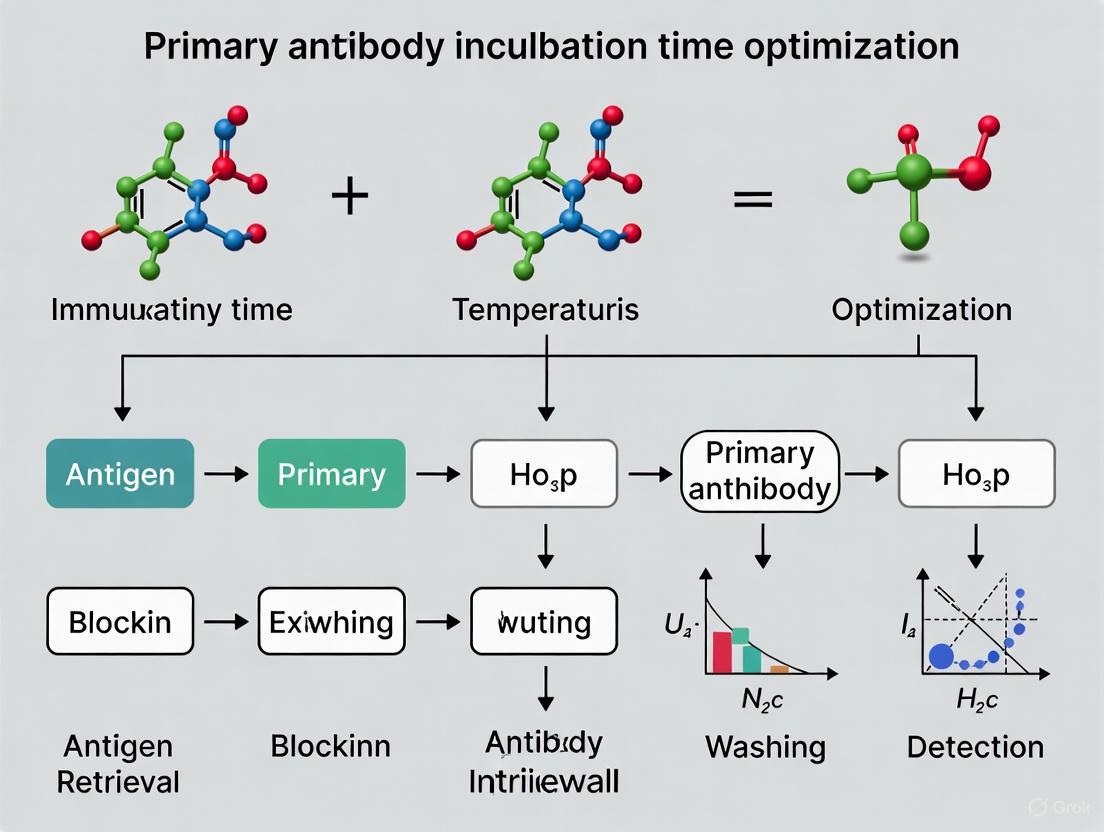
This article provides a comprehensive guide for researchers and drug development professionals on optimizing primary antibody incubation time and temperature, two critical parameters that directly impact the specificity, signal intensity,...
Primary Antibody Incubation Time and Temperature: A Complete Optimization Guide for Researchers
Abstract
This article provides a comprehensive guide for researchers and drug development professionals on optimizing primary antibody incubation time and temperature, two critical parameters that directly impact the specificity, signal intensity, and reproducibility of immunoassays. We cover the foundational principles of antibody-antigen kinetics, present method-specific protocols for Western blot, immunofluorescence (IF), and IHC/ICC, and offer systematic troubleshooting strategies for common issues like high background and weak signal. The content also details validation techniques to ensure result reliability and compares the performance of novel, resource-saving methods against conventional approaches, empowering scientists to establish robust and efficient protocols in their laboratories.
The Science of Binding: How Time and Temperature Govern Antibody-Antigen Interactions
The interaction between a primary antibody and its target antigen is not a simple static lock-and-key mechanism, but a dynamic process governed by the principles of kinetics and thermodynamics. The energy landscape theory provides a unified physical framework for understanding these interactions. Imagine a topographic map where the "altitude" represents the free energy of the molecular system. Antibody-antigen binding is a process where the system explores this terrain, settling into low-energy regions called energy wells.
In this framework, high-affinity, specific binding corresponds to a deep, sharply defined energy well. This is characterized by a substantial negative change in Gibbs free energy (ΔG), typically ranging from -7 to -14 kcal/mol, which drives spontaneous association. This favorable energy change arises from precise geometric and chemical complementarity, allowing for extensive non-covalent interactions. In contrast, lower-affinity or "non-specific" binding appears as broad, shallow energy basins on the landscape. These interactions are more generic, have fewer stabilizing bonds, and are characterized by rapid dissociation rates.
The duration (time) and thermal energy (temperature) of an incubation directly influence the system's ability to find the deepest, most specific energy well. Optimizing these parameters is therefore essential for maximizing signal-to-noise ratio in experiments. [1]
Troubleshooting Guides
Guide 1: Diagnosing and Resolving High Background Staining
Problem: High background signal, also known as high background staining, compresses the dynamic range of detection and makes it difficult to distinguish true positive signals. [2]
| Possible Cause | Prevention & Solution Strategies |
|---|---|
| Insufficient Washing | - Follow a consistent washing protocol: fill wells completely, include a soak step (30 sec - 2 min), then flick and firmly tap the plate dry on absorbent paper. [2]- Repeat the wash cycle 3-5 times. [2] |
| Incomplete Blocking | - Use a sufficient concentration of blocking agent (e.g., BSA, non-fat dry milk). [2]- Ensure adequate blocking time (at least 1-2 hours; consider overnight at 4°C for stubborn cases). [2] |
| Excessive Antibody Concentration | - Perform an antibody titration experiment to find the optimal concentration that provides the best signal-to-noise ratio. [3] [2]- Using too high a concentration of a high-affinity antibody can increase background. [4] |
| Non-specific Antibody Cross-Reactivity | - Verify that your antibodies do not cross-react with other proteins in your sample system. [2] |
| Sub-optimal Incubation Temperature | - For some antibodies, overnight incubation at elevated temperatures (e.g., 37°C) can increase background. Lower temperatures (4°C) are often preferred for long incubations. [3] |
Guide 2: Addressing Weak or No Signal
Problem: The target analyte is present, but little to no detection signal is observed.
| Possible Cause | Prevention & Solution Strategies |
|---|---|
| Reagent Degradation or Inactivity | - Check expiration dates and avoid repeated freeze-thaw cycles of antibodies and substrates. [2] |
| Insufficient Incubation Time/Temperature | - Ensure antibody-antigen binding reaches equilibrium by adhering to recommended incubation times and temperatures. [2]- For high-affinity antibodies, a longer incubation time at a lower concentration can be effective. [4] |
| Antibody Concentration Too Low | - Re-titrate the antibody. An excessively low concentration will produce a signal too dim to distinguish from background. [3] |
| Sample-Related Issues | - Confirm the analyte concentration is within the kit's detection range. [2]- Remove interfering substances (e.g., cell debris, lipids, proteases) via centrifugation or filtration. [2] |
| Epitope Inaccessibility | - Fixation or other sample processing steps may mask the epitope. Consider using polyclonal antibodies, which recognize multiple epitopes and may be less susceptible to this issue. [4] |
Frequently Asked Questions (FAQs)
FAQ 1: What are the recommended starting conditions for primary antibody incubation?
A common and reliable starting point is to incubate tissue samples overnight at 4°C. For cell-based assays, a 1-hour incubation at room temperature is often used. The typical working concentration for a monoclonal antibody ranges from 5-25 µg/mL, while for an antigen-affinity purified polyclonal antibody, it is generally lower, around 1.7-15 µg/mL. [4]
FAQ 2: Can I shorten the incubation time, and if so, how?
Yes, incubation times can be shortened, but this often requires compensatory adjustments. To maintain signal intensity within a shorter timeframe (e.g., 1-2 hours), you often need to increase the concentration of the primary antibody. It is crucial to re-optimize and titrate the antibody under the new conditions, as this can increase experimental costs and the risk of background. [3]
FAQ 3: How does temperature specifically affect my antibody binding?
Temperature influences the kinetic energy of the molecules. Higher temperatures (e.g., room temperature or 37°C) can accelerate the binding kinetics, potentially leading to faster equilibrium. However, this can also increase the rate of non-specific binding and, for some antibodies or epitopes, lead to degradation or instability, which reduces the signal over longer periods. Lower temperatures (4°C) favor specific, high-affinity interactions and are more stable for prolonged incubations. [3]
FAQ 4: Is agitation necessary during incubation?
Not always. Recent research on minimal-volume incubation strategies, such as the sheet protector method, has shown that effective and specific binding can be achieved without agitation. This suggests that for conventional methods, agitation aids in replenishing local antibody depletion, but it may not be strictly necessary for efficient binding to occur. [5]
Experimental Data & Protocols
Quantitative Effects of Time and Temperature
The table below summarizes experimental data from immunofluorescence analysis, demonstrating how varying time and temperature impacts signal intensity. MFI(+) is the mean fluorescence intensity in antigen-expressing cells, and S/N is the signal-to-noise ratio. [3]
Table 1: Signal Intensity of Vimentin Antibody Under Different Incubation Conditions
| Incubation Temperature | Incubation Duration | MFI(+) (a.u.) | S/N Ratio |
|---|---|---|---|
| 4°C | 1 hour | 1,200,000 | 40 |
| 21°C | 1 hour | 1,400,000 | 47 |
| 37°C | 1 hour | 2,200,000 | 73 |
| 4°C | 2 hours | 1,500,000 | 50 |
| 21°C | 2 hours | 2,000,000 | 67 |
| 37°C | 2 hours | 2,800,000 | 93 |
| 4°C | Overnight (O/N) | 6,500,000 | 217 |
| 21°C | Overnight (O/N) | 4,500,000 | 150 |
| 37°C | Overnight (O/N) | 3,500,000 | 117 |
This data shows that for this particular vimentin antibody, the maximum specific signal is achieved with an overnight incubation at 4°C. While higher temperatures accelerated binding within the first 1-2 hours, they did not match the final signal achieved by the longer, colder incubation.
Protocol: Antibody Titration for Optimal Signal-to-Noise
Purpose: To empirically determine the ideal primary antibody concentration for a specific application.
Materials:
- Primary antibody
- Validated positive and negative control samples (e.g., cell lines known to express or lack the target)
- All standard reagents for your detection method (e.g., buffers, secondaries, substrates)
Method:
- Prepare Sample Series: Process your positive and negative control samples identically.
- Dilution Series: Prepare a series of doubling dilutions of your primary antibody (e.g., 1:50, 1:100, 1:200, 1:500, 1:1000) in an appropriate diluent.
- Incubate: Apply the antibody dilutions to your positive and negative control samples. Incubate under your standard conditions (e.g., overnight at 4°C).
- Complete Assay: Complete the rest of your experimental protocol (washing, secondary antibody, detection).
- Quantify and Calculate: Measure the signal in the positive samples (MFI(+)) and negative samples (MFI(-)) for each dilution. Calculate the Signal-to-Noise (S/N) ratio for each point:
S/N = MFI(+) / MFI(-). - Identify Optimal Dilution: The optimal dilution is the one that yields a strong MFI(+) in the positive control while maintaining a low MFI(-) in the negative control, resulting in the highest S/N ratio. [3]
The Scientist's Toolkit: Key Research Reagent Solutions
Table 2: Essential Materials for Incubation Optimization
| Item | Function & Importance in Optimization |
|---|---|
| High-Affinity, Validated Antibodies | The foundation of a specific signal. Antibodies with high affinity and validated for the specific application (e.g., IHC, IF) reduce optimization time and ensure reliability. [4] |
| Blocking Agents (BSA, Milk, Casein) | Reduces non-specific background by occupying reactive sites on the membrane or tissue not occupied by the target. The choice of blocker can impact the signal. [2] |
| Precision Pipettes & Tips | Essential for accurate serial dilution during titration. Calibrated pipettes prevent volume errors that lead to poor reproducibility. [2] |
| Thermostatic Incubators | Provides consistent and uniform temperature control during incubation, preventing "edge effects" in plates and ensuring reproducible kinetics across the experiment. [2] |
| Sheet Protectors | A novel, minimal-volume incubation tool that enables significant antibody savings (as low as 20-150 µL for a mini membrane) and can work without agitation. [5] |
| (E)-4-Ethoxy-nona-1,5-diene | (E)-4-Ethoxy-nona-1,5-diene, MF:C11H20O, MW:168.28 g/mol |
| Terbiumacetate | Terbiumacetate, MF:C6H12O6Tb, MW:339.08 g/mol |
Appendix: Diagrams & Workflows
Energy Landscape of Antibody Binding
Diagram 1: Binding as an Energy Landscape. This conceptual diagram shows how an antibody (starting in the unbound state) can fall into a shallow, non-specific energy basin or overcome a kinetic barrier to achieve stable, specific binding in a deep energy well. Adequate time and appropriate temperature provide the energy needed for this transition. [1]
Incubation Optimization Workflow
Diagram 2: Incubation Optimization Workflow. This flowchart provides a step-by-step guide for systematically optimizing primary antibody incubation conditions, integrating the titration protocol and troubleshooting guides.
The Role of Antibody Affinity and Avidity in Protocol Design
Troubleshooting Guides & FAQs
Frequently Asked Questions
FAQ 1: How do affinity and avidity fundamentally differ, and why is this critical for assay design? Affinity measures the strength of a single antibody-binding site (paratope) to its specific epitope. Avidity describes the total accumulated binding strength of multiple simultaneous interactions between a multivalent antibody and a multivalent antigen [6]. Understanding this distinction is critical because high-avidity interactions can compensate for low individual affinity, leading to more stable binding in techniques like immunofluorescence or Western blot, even with short incubation times [6] [7].
FAQ 2: My immunofluorescence signal is weak. Could incubating the primary antibody overnight at 4°C help? Yes, this is a standard and highly effective optimization strategy. Incubating at 4°C overnight is a recommended starting point because the lower temperature slows reaction kinetics, promoting specific binding while minimizing non-specific background and protecting the antibody from degradation [3]. For example, a Vimentin antibody showed significantly higher mean fluorescence intensity (MFI) with an overnight incubation at 4°C compared to shorter incubations at higher temperatures [3].
FAQ 3: I am using a rare or expensive antibody. How can I conserve it without sacrificing signal? The Sheet Protector (SP) strategy for Western blotting can drastically reduce antibody consumption. This method uses a stationery sheet protector to create a thin, evenly distributed layer of antibody solution over the nitrocellulose membrane, requiring only 20–150 µL of solution compared to the conventional 10 mL [5]. This approach can maintain sensitivity and specificity while enabling room temperature incubation and faster detection [5].
FAQ 4: Can I use machine learning to engineer antibodies with better affinity and specificity? Yes, machine learning is an emerging and powerful tool for co-optimizing antibody properties. Models can be trained on deep sequencing data from antibody libraries to predict mutations that improve both affinity for the target antigen and specificity (i.e., reduce off-target binding). These models can identify rare, co-optimized variants that might be missed by conventional analysis [8].
Common Problems & Solutions
Problem: High background staining in immunofluorescence.
- Potential Cause 1: Primary antibody concentration is too high.
- Solution: Perform a titration experiment. Test a range of antibody dilutions to find the optimal concentration that maximizes the signal-to-noise ratio [3]. The datasheet recommendation is an excellent starting point.
- Potential Cause 2: Non-specific antibody binding.
- Solution: Consider the antibody's biophysical properties. Antibodies prone to non-specific binding can be engineered for higher specificity using machine learning approaches [8]. For standard assays, ensure adequate blocking and washing steps.
Problem: Inconsistent Western blot results with a limited antibody stock.
- Potential Cause: Inefficient antibody usage and distribution in large incubation volumes.
- Solution: Adopt the Sheet Protector (SP) strategy. This method ensures even distribution of a minimal antibody volume (as little as 20 µL) over the membrane, which can yield comparable sensitivity and specificity to conventional methods while conserving precious reagent [5].
Problem: Poor tissue penetration of an Antibody-Drug Conjugate (ADC) in solid tumors.
- Potential Cause: The "binding site barrier" effect, where the ADC binds rapidly to targets at the periphery and does not penetrate deeper into the tissue [7].
- Solution: Coadminister a carrier dose of unconjugated antibody. A novel strategy involves using a specially designed High Avidity, Low Affinity (HALA) antibody as a carrier. In high-expression tumors, the HALA antibody competes effectively with the ADC, pushing it deeper. In low-expression tumors, the ADC outcompetes the HALA antibody, ensuring sufficient target binding [7].
Quantitative Guide to Primary Antibody Incubation
The table below summarizes key optimization variables based on experimental data.
Table 1: Optimization of Primary Antibody Incubation for Immunofluorescence
| Parameter | Typical Starting Condition (Tissue) | Typical Starting Condition (Cells) | Impact on Signal & Background | Experimental Example from Literature |
|---|---|---|---|---|
| Incubation Time | Overnight (O/N, ~18 hours) [4] [3] | 1 hour at room temperature [4] | Longer incubations generally increase specific signal intensity [3]. | Vimentin antibody MFI was highest with O/N vs. 1-2 hour incubations [3]. |
| Incubation Temperature | 4°C [4] [3] | Room Temperature (RT) [4] | Lower temperatures (4°C) favor specific binding and reduce background [3]. | E-Cadherin antibody showed optimal S/N at 4°C O/N; 37°C O/N degraded signal [3]. |
| Antibody Concentration | Monoclonal: 5-25 µg/mL; Polyclonal: 1.7-15 µg/mL [4] | Monoclonal: 5-25 µg/mL; Polyclonal: 1.7-15 µg/mL [4] | Too high → high background; Too low → weak signal. Must titrate [3]. | MUC-1 antibody titration identified an optimal dilution with high S/N [3]. |
Detailed Experimental Protocols
Protocol 1: Microfluidic Antibody Affinity Profiling in Solution This protocol measures affinity and active concentration directly in complex samples like plasma, avoiding artifacts from surface immobilization [9].
- Conjugate antigen with fluorophore: Purify the target antigen and label it with a fluorescent dye (e.g., Alexa Fluor 647 NHS ester) using standard conjugation chemistry. Remove excess dye via desalting chromatography [9].
- Prepare the sample: Mix the fluorescently labeled antigen with the biological sample containing antibodies (e.g., patient plasma).
- Perform Microfluidic Diffusional Sizing (MDS): Inject the mixture into a Fluidity One-M instrument. Two fluid streams run side-by-side without mixing. The diffusion of the antigen-antibody complex across the stream interface is slower than the unbound antigen due to its larger hydrodynamic radius (Rh) [9].
- Data analysis: The instrument software analyzes the diffusion data to determine the Rh distribution, from which the affinity and concentration of antibodies in the sample are calculated [9].
Protocol 2: Yeast Surface Display for Antibody Affinity Maturation This protocol is used to engineer and select antibody variants with improved affinity [10].
- Library transformation: Create a library of antibody mutants and express them on the surface of yeast cells fused to the Aga2p protein. The antibody is flanked by tags (e.g., HA and c-myc) for detection [10].
- Magnetic bead selection: Incubate the yeast library with magnetic beads coated with the target antigen. This step enriches for yeast cells displaying antibodies that bind the antigen, even with low affinity, through avidity effects [10].
- Fluorescence-Activated Cell Sorting (FACS): Label the yeast library with a fluorescently tagged antigen and antibodies against the detection tags. Use FACS to isolate yeast cells that display high levels of the antibody (high tag signal) and exhibit strong antigen binding (high antigen fluorescence) [10].
- Regrowth and analysis: Sort and culture the selected cells. The process can be repeated for multiple rounds to further enrich high-affinity binders. Individual clones can then be sequenced and characterized [10].
The Scientist's Toolkit
Table 2: Key Reagent Solutions for Affinity and Avidity Studies
| Reagent / Tool | Function in Experiment |
|---|---|
| Fluidity One-M Instrument | An automated system that uses Microfluidic Diffusional Sizing (MDS) to measure antibody affinity and concentration directly in solution, avoiding immobilization artifacts [9]. |
| Sheet Protector (SP) | A common stationery item used in the SP Western blot strategy to distribute minimal volumes of antibody solution evenly over a membrane, drastically reducing reagent consumption [5]. |
| HALA (High Avidity, Low Affinity) Antibody | An engineered carrier antibody used in ADC therapy. Its low monovalent affinity allows it to compete with the ADC only in high-expression tumor regions, improving ADC penetration automatically [7]. |
| Yeast Surface Display Library | A platform for protein engineering where a diverse library of antibody variants is expressed on the yeast surface, enabling selection of clones with desired properties like higher affinity [10]. |
| Polyspecificity Reagents (e.g., Ovalbumin, CHO cell membrane prep) | Used in FACS sorting to identify and remove antibodies with high non-specific binding, thereby improving the specificity of therapeutic antibody candidates [8]. |
| oxalic acid | Oxalic Acid Reagent|High-Purity|For Research Use |
| Z-Pro-Leu-Gly-NHOH | Z-Pro-Leu-Gly-NHOH, MF:C21H30N4O6, MW:434.5 g/mol |
Conceptual Diagrams
Affinity vs. Avidity
Troubleshooting High Background
In immunohistochemistry (IHC) and immunofluorescence (IF), the successful detection of target antigens hinges on the preservation of epitope stability. Epitope instability can significantly limit applications of antibody-based technology in both laboratory and clinical research [11] [12]. Each epitope possesses a unique instability profile when exposed to various physiochemical conditions during sample preparation and staining procedures [11]. This technical guide addresses how fixation and temperature directly impact epitope integrity and provides optimized protocols to ensure reliable experimental outcomes.
Frequently Asked Questions on Epitope Stability
How does fixation affect epitope stability?
Fixation plays a critical role in preserving cell morphology and tissue architecture, but it can mask or destroy antigenic sites if not properly optimized [13].
- Chemical Crosslinking Fixatives (e.g., formaldehyde, paraformaldehyde, glutaraldehyde) create methylene bridges between proteins, which can physically block antibody access to epitopes. The extent of crosslinking is concentration and time-dependent [13].
- Precipitating Fixatives (e.g., acetone, methanol, ethanol) coagulate and denature proteins, which can destroy conformation-dependent epitopes while potentially preserving linear epitopes [13].
- Fixative Selection must be empirically determined for each antigen. While formaldehyde shows broad specificity for most cellular targets, glutaraldehyde is a stronger crosslinker but penetrates tissue more slowly and can significantly modify tissue architecture [13].
Why does temperature impact antibody-antigen binding?
Temperature affects both the structural integrity of antibodies and their target epitopes, as well as the binding kinetics between them.
- Antibody Thermosensitivity: Antibodies are multi-domain proteins that undergo irreversible denaturation at high temperatures. Research shows IgG denaturation becomes significantly irreversible at temperatures above 65°C, with almost complete loss of antigen-binding activity after several minutes at 90°C [14].
- Domain-Specific Stability: Different antibody domains exhibit varying heat resistance. The CH2 domain is typically the least stable, while CH3 is the most stable structural unit. This differential stability means antibodies can have a mixture of folded and unfolded structures at certain temperatures, increasing aggregation tendency [14].
- Epitope Thermolability: Studies have identified that thermosensitive epitopes undergo a sudden loss in immunoreactivity when a critical temperature between 42°C and 65°C is achieved. This critical temperature is pH-dependent [11].
What are the signs of epitope instability in my experiments?
- Complete absence of expected signal despite positive controls
- Weak or patchy staining inconsistent with target expression
- High background staining with nonspecific signal
- Inconsistent staining patterns between similar samples
- Failure to detect abundant targets confirmed by other methods
Troubleshooting Guides
Problem: Loss of Signal After Fixation
Potential Causes and Solutions:
Over-fixation with crosslinking agents
- Solution: Reduce formaldehyde fixation time from 24 hours to 4-24 hours depending on tissue size
- Protocol: For delicate epitopes, test fixation times from 1-24 hours with antigen retrieval optimization
Epitope masking by aldehyde crosslinks
- Solution: Implement antigen retrieval techniques
- Heat-Induced Epitope Retrieval (HIER) Protocol:
- Use 10mM sodium citrate buffer (pH 6.0)
- Heat to 95°C for 20 minutes
- Cool to room temperature for 30 minutes before proceeding with staining [13]
Inappropriate fixative for target antigen
- Solution: Screen alternative fixatives using the guide below:
Table: Fixative Selection Guide for Different Antigen Types
| Antigen Type | Recommended Fixative | Alternative Fixatives | Fixation Duration |
|---|---|---|---|
| Most proteins, peptides | 4% Paraformaldehyde | 10% Neutral Buffered Formalin | 4-24 hours at 4°C |
| Large protein antigens | Ice-cold 100% acetone | 100% methanol | 10-15 minutes at -20°C |
| Nucleic acids | Carnoy's solution | Methanol:acetic acid (3:1) | 1-4 hours at 4°C |
| Delicate tissues | Bouin's fixative | Modified zinc formalin | 2-8 hours at room temperature |
| Electron microscopy | 4% PFA + 1% glutaraldehyde | 1% osmium tetroxide | 2-4 hours at 4°C |
Problem: Inconsistent Staining with Temperature Variation
Potential Causes and Solutions:
Antibody denaturation during storage or incubation
Epitope instability at elevated temperatures
- Solution: Determine optimal incubation temperature for each antibody-epitope pair
- Experimental Approach: Test incubation conditions using a checkerboard assay with varying temperatures and times
Table: Temperature Optimization Guide for Antibody Incubation
| Incubation Condition | Temperature Range | Recommended Duration | Best For | Limitations |
|---|---|---|---|---|
| Standard incubation | 4°C | Overnight (18 hours) | Most applications; high affinity antibodies | Time-consuming |
| Accelerated incubation | 21-25°C (room temp) | 1-2 hours | High-throughput screens; stable epitopes | May reduce signal for low abundance targets |
| Thermally accelerated | 37°C | 30-60 minutes | Rapid results; cleared tissue applications | Risk of epitope/antibody denaturation |
| Cold-sensitive epitopes | 4°C | 4-24 hours | Thermolabile epitopes | Extended protocol time |
Experimental Protocols for Epitope Stability Assessment
Protocol 1: Fixation Optimization Screen
Objective: Determine the optimal fixation method that preserves both morphology and epitope integrity.
Materials:
- Tissue or cell samples containing target antigen
- Various fixatives (4% PFA, 10% NBF, acetone, methanol, etc.)
- Antigen retrieval solutions (citrate buffer, EDTA buffer, etc.)
- Validated primary antibodies
- Appropriate detection system
Methodology:
- Divide samples into multiple aliquots for different fixative treatments
- Apply fixatives for varying durations (1, 4, 8, 24 hours)
- Process all samples through identical embedding and sectioning procedures
- Perform antigen retrieval with multiple methods (HIER, enzymatic, none)
- Stain with standardized antibody protocol
- Evaluate both morphological preservation and signal intensity
Evaluation Criteria:
- Signal intensity compared to positive controls
- Background staining levels
- Cellular and tissue morphology preservation
- Consistency across sample replicates
Protocol 2: Temperature Tolerance Profiling
Objective: Establish the thermal stability profile for antibody-epitope interaction.
Materials:
- Purified target antigen or known positive control samples
- Primary antibody of interest
- Temperature-controlled heating blocks or water baths
- Standard detection reagents
Methodology:
- Prepare identical sample aliquots
- Expose to increasing temperatures (4°C, 25°C, 37°C, 45°C, 55°C, 65°C) for fixed duration
- Cool samples to standard incubation temperature
- Perform antibody staining under identical conditions
- Quantify signal intensity using appropriate method (fluorescence, chromogenic)
Data Analysis:
- Plot signal intensity versus temperature
- Identify critical temperature threshold where signal loss begins
- Establish safe operating temperature range for the antibody-epitope pair
Advanced Techniques: Antibody Stabilization for Thermally Accelerated Staining
Recent advances in antibody engineering have developed methods to stabilize antibodies against thermal denaturation:
SPEARs Technology (Synergistically Protected Polyepoxide-crosslinked Fab-complexed Antibody Reagents):
- Chemically stabilized antibodies withstand up to 4 weeks of continuous heating at 55°C [15]
- Enable thermally facilitated 3D immunolabeling (ThICK staining)
- Achieve nearly fourfold deeper penetration in human brain tissue with threefold less antibody [15]
Application Protocol:
- Complex primary antibodies with anti-IgG Fab fragments
- Crosslink with polyglycerol 3-polyglycidyl ether (P3PE)
- Use stabilized antibodies for high-temperature incubation
- Implement thermal cycling to enhance penetration and reduce nonspecific binding
Research Reagent Solutions
Table: Essential Reagents for Epitope Stability Research
| Reagent Category | Specific Examples | Function | Application Notes |
|---|---|---|---|
| Crosslinking Fixatives | 4% Paraformaldehyde, 10% NBF, Glutaraldehyde | Preserve morphology via protein crosslinking | May mask epitopes; requires antigen retrieval |
| Precipitating Fixatives | Cold acetone, methanol, ethanol | Precipitate proteins while maintaining structure | Better for linear epitopes; may destroy conformational epitopes |
| Antigen Retrieval Buffers | Citrate buffer (pH 6.0), EDTA buffer (pH 8.0-9.0), Tris-EDTA | Reverse formaldehyde crosslinks; expose hidden epitopes | pH selection critical for different epitopes |
| Blocking Agents | BSA, normal serum, non-fat dry milk | Reduce nonspecific background | Compatibility with antibodies varies |
| Stabilization Reagents | P3PE, trehalose, glycerol | Enhance antibody thermal stability | SPEARs technology enables high-temperature applications |
| Thermostable Antibodies | VHH nanobodies, single-chain Fv | Engineered formats with enhanced heat resistance | VHH retains ~50% activity after 200min at 90°C [14] |
Visual Guide: Epitope Stability Optimization Workflow
Epitope Stability Optimization Workflow
Successful epitope preservation requires careful optimization of both fixation and temperature parameters. Key principles include:
- Empirical Optimization: Each antibody-epitope pair has unique stability characteristics that must be determined experimentally [11] [4].
- Balanced Fixation: Choose fixatives that preserve morphology without destroying epitopes, using the minimal effective fixation time [13].
- Temperature Management: Standard overnight incubation at 4°C provides robust results for most applications, but accelerated protocols require validation [4] [3].
- Stabilization Technologies: Emerging methods like SPEARs enable novel approaches through enhanced thermal tolerance [15].
By systematically addressing fixation and temperature variables using the protocols and troubleshooting guides provided, researchers can overcome epitope stability challenges and achieve consistent, reliable results in their immunohistochemistry and immunofluorescence experiments.
Antibody incubation is a critical step in immunohistochemistry (IHC) and immunofluorescence (IF) experiments, directly influencing signal strength, specificity, and overall staining quality. The optimal conditions vary significantly between monoclonal and polyclonal antibodies due to their fundamental biochemical differences. Monoclonal antibodies represent a homogeneous population derived from a single B-cell clone, offering high specificity to a single epitope but potentially greater vulnerability to epitope masking. Polyclonal antibodies, in contrast, constitute a heterogeneous mixture targeting multiple epitopes, generally providing enhanced stability across varying pH and salt concentrations but requiring more stringent optimization to minimize background staining from non-specific interactions. This guide provides evidence-based standard protocols and troubleshooting strategies to help researchers establish robust staining procedures for both antibody types.
Standard Incubation Conditions
The table below summarizes the recommended starting conditions for primary antibody incubation. These parameters should be optimized for each specific antibody and application.
Table 1: Standard Primary Antibody Incubation Conditions for IHC/ICC [4]
| Parameter | Monoclonal Antibodies | Polyclonal Antibodies |
|---|---|---|
| Concentration for Tissue | 5-25 µg/mL, overnight at 4°C | 1.7-15 µg/mL, overnight at 4°C |
| Concentration for Cells | 5-25 µg/mL, 1 hour at room temperature | 1.7-15 µg/mL, 1 hour at room temperature |
| Key Advantage | Single epitope specificity | Lower concentration required; multiple epitope recognition |
| Primary Limitation | Vulnerable to epitope masking or changes in protein conformation | Heterogeneous population may contain non-specific antibodies |
Experimental Protocols for Optimization
Antibody Titration Protocol
Titrating the primary antibody is the most critical step for achieving a high signal-to-noise ratio. The following protocol outlines a standard procedure for determining the optimal antibody dilution [3].
- Sample Preparation: Prepare multiple slides or wells with identical positive control samples (tissue or cells known to express the target antigen) and negative control samples (lacking the antigen).
- Antibody Dilution: Prepare a series of antibody dilutions. For a monoclonal antibody, test concentrations within the 5-25 µg/mL range. For a polyclonal antibody, test the 1.7-15 µg/mL range [4].
- Incubation and Detection: Apply the different antibody dilutions to the sample set and incubate overnight at 4°C. Complete the rest of the staining protocol (washing, secondary antibody incubation, detection) uniformly across all samples.
- Analysis: Examine the stained samples. The optimal dilution is the one that provides the strongest specific signal on the positive control with the lowest background on the negative control.
The workflow for this optimization process is summarized in the following diagram:
Optimizing Incubation Time and Temperature
While overnight incubation at 4°C is the standard recommended condition for maximum signal and minimal background, some experimental setups may require adjustments [4] [3].
- Time and Temperature Interplay: Longer incubation times at lower temperatures (e.g., 4°C) generally promote specific binding and reduce non-specific background. Shorter incubations (1-2 hours) are possible but often require increased antibody concentration to compensate for reduced binding time, which can increase costs and background [3].
- Stability Considerations: The ideal conditions can depend on the stability of both the antibody and the target epitope. For instance, some epitopes may degrade or become masked during extended incubations at higher temperatures (e.g., 37°C), leading to a loss of signal [3].
FAQs and Troubleshooting
What are the first steps if I observe weak or no staining?
- Verify Antibody Applicability: Confirm the antibody has been validated for your specific application (e.g., IHC-paraffin) and species [16].
- Check Antibody Activity: Run a positive control to ensure the antibody has not lost potency due to improper storage, contamination, or excessive freeze-thaw cycles [17] [16].
- Review Antigen Retrieval: For formalin-fixed paraffin-embedded (FFPE) tissues, epitope masking is common. Optimize your antigen retrieval method (HIER or PIER) [18] [16].
- Increase Antibody Concentration or Time: If the signal is weak, systematically increase the primary antibody concentration or extend the incubation time [16] [19].
How can I resolve high background staining?
- Titrate Primary Antibody: The most common cause of high background is an excessively high antibody concentration. Re-titrate to find a dilution that maintains signal while reducing background [17] [16].
- Improve Blocking: Ensure you are using an appropriate blocking serum (e.g., 10% normal serum from the host species of the secondary antibody) for a sufficient duration [17] [16].
- Check Secondary Antibody: Include a control without the primary antibody. If staining persists, the secondary antibody may be causing non-specific binding. Switch to a pre-adsorbed secondary antibody or re-optimize its dilution [17].
- Quench Endogenous Enzymes: When using HRP-based detection, quench endogenous peroxidase activity with Hâ‚‚Oâ‚‚ [17] [16].
Why incubate overnight at 4°C? Overnight incubation at 4°C is the gold standard because the lower temperature slows down the kinetics of non-specific antibody binding, thereby reducing background. The extended time allows for maximum specific binding of the primary antibody to the target antigen, resulting in a superior signal-to-noise ratio compared to shorter incubations at room temperature or 37°C [3] [19].
The Scientist's Toolkit: Research Reagent Solutions
Table 2: Essential Reagents for Antibody-Based Staining [17] [4] [16]
| Reagent | Function | Key Consideration |
|---|---|---|
| Antigen Retrieval Buffers | Reverses formaldehyde-induced crosslinks to unmask epitopes in FFPE tissues. | Use heat-induced (HIER) or protease-induced (PIER) methods based on antibody and target. |
| SignalStain Antibody Diluent | A specialized buffer for diluting primary antibodies. | Can enhance signal and stability compared to generic buffers like BSA/TBST [18]. |
| Normal Serum | Used as a blocking agent to reduce non-specific binding of secondary antibodies. | Should match the host species of the secondary antibody (e.g., use goat serum for anti-goat secondary) [17] [19]. |
| Polymer-Based Detection Reagents | Highly sensitive detection systems for visualizing antibody binding. | Offer greater sensitivity and lower background than traditional avidin-biotin (ABC) systems [18]. |
| DAB Substrate Kit | A chromogenic substrate that produces a brown precipitate upon reaction with HRP. | Common for bright-field microscopy; development time must be controlled to prevent over-staining. |
| HRP-Conjugated Secondary Antibodies | Binds to the primary antibody and carries the enzyme for detection. | Ensure the secondary is raised against the species of the primary antibody (e.g., anti-rabbit for a rabbit primary) [16]. |
| (S)-Pirlindole Hydrobromide | (S)-Pirlindole Hydrobromide | |
| 2-(3-Ethynylphenoxy)aniline | 2-(3-Ethynylphenoxy)aniline, MF:C14H11NO, MW:209.24 g/mol | Chemical Reagent |
How does antibody concentration directly affect the Signal-to-Noise Ratio?
The concentration of the primary antibody is a primary determinant of the signal-to-noise ratio (SNR). An optimal concentration maximizes the specific signal from your target while minimizing non-specific background binding.
- High Antibody Concentration: Excess antibody leads to non-specific binding to off-target sites, significantly increasing background noise and obscuring the specific signal [20] [21].
- Low Antibody Concentration: Insufficient antibody results in a weak, underwhelming specific signal, making it difficult to distinguish from the inherent background [22].
The table below summarizes the effects and recommended actions for different concentration scenarios:
| Antibody Concentration | Effect on Specific Signal | Effect on Background Noise | Recommended Action |
|---|---|---|---|
| Too High | Saturated or unchanged | Significantly increased | Further dilute the antibody; perform a titration experiment [20] [21]. |
| Too Low | Significantly decreased | Low | Increase the antibody concentration; extend incubation time [21] [22]. |
| Optimal | Strong and clear | Minimal | Maintain these conditions for future experiments. |
Optimization Protocol: Antibody Titration To empirically determine the optimal dilution for a new antibody, a titration experiment is essential [21].
- Prepare Dilutions: Based on the manufacturer's datasheet, prepare a series of antibody dilutions (e.g., 1:50, 1:100, 1:250, 1:500, 1:1000).
- Incubate Samples: Apply each dilution to identical, control sample sections. Keep the incubation time and temperature constant across all samples.
- Evaluate Staining: Analyze the stained samples. The optimal dilution is the one that produces the strongest specific signal with the lowest background.
What are the most effective strategies to reduce high background noise?
High background can render an experiment uninterpretable. The table below outlines common causes and their proven solutions.
| Problem | Cause | Solution |
|---|---|---|
| Non-specific Antibody Binding | Inadequate blocking; secondary antibody cross-reactivity. | Extend blocking time; use serum from the secondary antibody host species for blocking; use cross-adsorbed secondary antibodies [21] [22]. |
| Endogenous Fc Receptor Binding | Fc regions of antibodies bind to Fc receptors on immune cells. | Use F(ab')2 fragment secondary antibodies, which lack the Fc region [21] [22]. |
| Tissue Autofluorescence | Natural fluorescence from collagen, red blood cells, lipofuscin, or aldehyde fixatives [23] [22]. | Use autofluorescence quenching kits (e.g., TrueVIEW, ReadyProbes) [23] [22]. |
| Insufficient Washing | Unbound antibodies remain in the well or on the tissue. | Increase wash times and volume; ensure thorough agitation during washes [20]. |
| Species Cross-Reactivity | Secondary antibody binds to endogenous immunoglobulins in the sample. | Select a primary antibody from a species different than your sample; use highly cross-adsorbed secondary antibodies [24] [25]. |
How can I amplify a weak specific signal without increasing background?
For low-abundance targets, enhancing the specific signal is often necessary. The following methods amplify the signal at the site of antigen-antibody binding.
- Indirect Detection: Switch from a directly conjugated primary antibody to an unlabeled primary antibody followed by a labeled secondary antibody. As most secondary antibodies are polyclonal, multiple secondaries can bind to a single primary, amplifying the signal [22].
- Tyramide Signal Amplification (TSA): This method utilizes an HRP-conjugated secondary antibody to catalyze the deposition of multiple fluorescently-labeled tyramide molecules directly onto the tissue near the target antigen. This can enhance sensitivity by as much as 200-fold compared to standard methods [22].
- Iterative Immunostaining (IT-IF): For challenging techniques like Expansion Microscopy (ExM), where fluorophores are physically diluted, performing multiple rounds of immunostaining on the same sample can significantly increase the fluorescent signal intensity without compromising the signal-to-background ratio [26].
Experimental Protocol: Iterative Immunostaining for Signal Enhancement This protocol is adapted from methods used in expansion microscopy to counteract signal dilution [26].
- First Staining Cycle: Perform a standard immunostaining procedure (primary antibody incubation, followed by fluorophore-conjugated secondary antibody) on your fixed and permeabilized sample.
- Image Acquisition: Image the sample after the first cycle.
- Iteration: Subject the same sample to a second, third, or even fourth round of staining using the same primary and secondary antibodies.
- Final Imaging: After the final staining cycle, acquire the final image. The total fluorescence intensity is cumulatively increased with each cycle.
How do incubation time and temperature interact to influence SNR?
Incubation time and temperature are interdependent factors that control the kinetics of antibody-antigen binding. Optimizing them together is crucial for a high-quality result.
- General Rule: Higher-affinity antibodies require less time to bind effectively.
- Standard Practice: Overnight incubation at 4°C is a common starting point for many protocols, as the slow reaction favors specific over non-specific binding [4] [21].
- Innovative Approach: The "Sheet Protector (SP) Strategy" demonstrates that efficient incubation can be achieved at room temperature in as little as 15 minutes to a few hours by using a minimal antibody volume distributed as a thin layer, though this requires further optimization of antibody concentration [5].
The diagram below illustrates the logical workflow for optimizing these parameters.
The Scientist's Toolkit: Key Reagents for SNR Optimization
| Reagent / Tool | Function in SNR Optimization |
|---|---|
| Cross-Adsorbed Secondary Antibodies | Secondary antibodies that have been purified to remove components that bind to off-target species, drastically reducing background in multiplexing or species-on-species experiments [21] [22]. |
| F(ab')2 Fragment Secondary Antibodies | These fragments lack the Fc region, preventing non-specific binding to Fc receptors present in tissues like spleen, lymph nodes, and macrophages [21] [22]. |
| Autofluorescence Quenching Kits | Chemical reagents (e.g., TrueVIEW, ReadyProbes) that bind to or react with common sources of autofluorescence (aldehydes, collagen, lipofuscin), quenching their signal and improving the signal-to-noise ratio [23] [22]. |
| Tyramide Signal Amplification (TSA) Kits | Kits that provide the necessary reagents for powerful signal amplification, enabling the detection of low-abundance targets that would otherwise be invisible [22]. |
| Polymer-Based HRP Detection Systems | For chromogenic IHC, these systems (e.g., Multi-rAb Polymer HRP) offer a biotin-free detection method that is highly sensitive and results in lower background compared to traditional avidin-biotin complex (ABC) methods [21]. |
| Sheet Protector (SP) Strategy | A novel, accessible method that uses a common stationery sheet protector to incubate a membrane with a minimal volume of antibody (20-150 µL), enabling rapid room-temperature incubation and drastic antibody conservation [5]. |
| 4-Octyl acetate | 4-Octyl Acetate|CAS 5921-87-9|Research Chemicals |
| Hexadecyl 3-methylbutanoate | Hexadecyl 3-methylbutanoate|High Purity |
Practical Protocols: Optimizing Conditions for Western Blot, IF, and IHC/ICC
Troubleshooting Guides
Weak or No Signal
Q: I followed my protocol but am getting very weak or no signal on my blot. What could be causing this?
Weak or absent signal is one of the most common issues in Western blotting and can stem from problems at nearly every stage of the process [27].
- Failed Transfer: Proteins may not have transferred efficiently from the gel to the membrane. High molecular weight proteins might not transfer completely, while low molecular weight proteins may pass through the membrane if the pore size is too large [27] [28].
- Antibody Issues: The primary or secondary antibody may be inactive due to overuse, improper storage, too many freeze-thaw cycles, or may be used at a sub-optimal concentration [29] [27] [30].
- Insufficient Antigen: The amount of target protein loaded might be below the detection limit of your assay [29] [28].
- HRP System Failure: Sodium azide in buffers quenches HRP activity, and old or insufficient ECL substrate will yield little to no signal [27] [28].
- Sub-optimal Blocking or Buffers: Over-blocking can mask epitopes, and using an incompatible blocking buffer (e.g., milk with some phospho-specific antibodies) can reduce antibody binding [27] [30].
Solutions:
- Confirm Transfer Efficiency: After transfer, stain the gel with Coomassie blue to see if protein remains, or stain the membrane with Ponceau S to confirm successful protein transfer [29] [27].
- Troubleshoot Antibodies: Ensure the secondary antibody matches the host species of the primary antibody. Test antibody functionality with a dot blot or a known positive control sample. Titrate antibody concentrations, as the manufacturer's suggested dilution may not be optimal for your specific setup [27] [28].
- Eliminate HRP Inhibition: Ensure no buffers contain sodium azide. Use fresh, high-purity glycerol and prepare fresh ECL substrate [29] [27].
- Optimize Blocking and Buffers: If using milk, try switching to BSA, especially for phosphoprotein detection. Consult the antibody datasheet for recommended dilution buffers [27] [30].
- Increase Signal Generation: Load more protein (20–50 µg per lane is a common starting point), increase exposure time, or use a more sensitive ECL substrate [27] [30]. For low-abundance targets, consider sample enrichment via immunoprecipitation [29].
High Background
Q: My blot has a dark, uniform haze that obscures my bands. How can I reduce this high background?
High background occurs when antibodies bind non-specifically across the membrane instead of only to the target protein [28] [31].
- Insufficient Blocking: If non-specific sites on the membrane are not adequately blocked, antibodies will bind indiscriminately [27] [31].
- Excessive Antibody Concentration: Using too much primary or secondary antibody is a primary cause of high background [28] [31].
- Incompatible Blocking Agent: Milk contains casein and biotin, which can cross-react with certain antibodies (e.g., phospho-specific ones) or avidin-biotin detection systems [27] [28].
- Inadequate Washing: Failure to thoroughly wash away unbound antibody leaves material that contributes to background noise [29] [31].
- Membrane Handling: If the membrane dries out during the procedure, it can lead to high, blotchy background [27] [32].
Solutions:
- Optimize Blocking: Ensure you block for at least 1 hour at room temperature or overnight at 4°C with adequate volume. If using milk with a phospho-specific antibody, switch to BSA [27] [31] [30].
- Titrate Antibodies: Reduce the concentration of your primary and/or secondary antibodies. A secondary-only control can help determine if your secondary is the source of background [27] [31].
- Wash Thoroughly: Increase the number, duration, and volume of washes. A typical regimen is 3-5 washes for 5-10 minutes each with TBST (with 0.1% Tween-20) with gentle agitation [29] [28] [31].
- Handle Membrane Carefully: Keep the membrane fully wet at all times. Use clean gloves and forceps to prevent contamination and avoid drying [28] [33].
- Use Fresh Buffers: Prepare fresh blocking and wash buffers to avoid microbial contamination, and filter them if necessary [27] [32].
Non-Specific or Unexpected Bands
Q: I see bands at unexpected molecular weights. How can I confirm the target band and eliminate non-specific ones?
Unexpected bands can arise from antibody cross-reactivity, protein modifications, or degradation [27] [30].
- Antibody Cross-Reactivity: Polyclonal antibodies, in particular, may recognize epitopes on proteins other than your target [27] [30].
- Protein Degradation: Proteolysis during sample preparation can create protein fragments that the antibody still recognizes, appearing as lower molecular weight bands [29] [30].
- Post-Translational Modifications (PTMs): Modifications like glycosylation, phosphorylation, or ubiquitination can alter the apparent molecular weight of a protein, resulting in multiple bands or smears [32] [30].
- Protein Isoforms or Splice Variants: Your target protein may naturally exist in multiple forms of different sizes [30].
- Incomplete Reduction: Disulfide bonds that are not fully broken can lead to higher-order multimers running at much higher molecular weights [29] [32].
Solutions:
- Run Appropriate Controls: Include a positive control (lysate known to express the target), a negative control (lysate known not to express it), and a secondary antibody-only control. This helps identify which bands are specific [27] [30].
- Prevent Degradation: Always prepare samples on ice using fresh lysis buffers containing protease (and phosphatase, if relevant) inhibitors [30].
- Ensure Complete Reduction and Denaturation: Use fresh reducing agents (DTT, β-mercaptoethanol) in your sample buffer and ensure proper heating for denaturation [29] [32].
- Research Your Target: Check databases like UniProt or PhosphoSitePlus for known isoforms, splice variants, and PTMs that could explain multiple bands [30].
- Optimize Antibody Specificity: If non-specific bands persist, try a different antibody validated for Western blotting in your species of interest [28] [30].
Quantitative Data and Protocol Comparison
The following table summarizes key quantitative differences between the conventional method and the innovative Sheet Protector (SP) strategy, primarily based on research that demonstrated a minimal-volume approach could drastically reduce antibody consumption without compromising signal quality [5].
Table 1: Quantitative Comparison of Conventional vs. Sheet Protector (SP) Western Blot Protocols
| Parameter | Conventional (CV) Protocol | Sheet Protector (SP) Strategy |
|---|---|---|
| Primary Antibody Volume | ~10 mL (for a mini-gel) [5] | 20–150 µL (adjustable based on membrane size) [5] |
| Primary Incubation Time | Overnight (~18 hours) [5] | 30 minutes to 2 hours (or longer if sealed to prevent evaporation) [5] |
| Primary Incubation Temperature | 4°C (with agitation) [5] | Room Temperature (agitation not required) [5] |
| Key Equipment | Plastic container, rocker/shaker, cold room [5] | Sheet protector (stationery item), zipper bag (for long incubations) [5] |
| Reported Sensitivity & Specificity | Standard for the technique [5] | Comparable to conventional method when antibody concentration is adjusted [5] |
Experimental Protocol: Antibody Incubation Using the Sheet Protector Strategy
This protocol details the method for using a sheet protector to create a minimal-volume antibody layer, adapted from the research article [5]. This method is presented as a potential optimization within the broader context of primary antibody incubation time and temperature research.
Materials:
- Primary antibody at working concentration in 5% skim milk/TBST (or recommended buffer)
- Sheet protector (common stationery item)
- Tweezers
- Paper towels
- Zipper bag (for incubations >2 hours)
- Wet paper towel
Method:
- Membrane Preparation: After blocking with 5% skim milk and washing, transiently immerse the membrane in TBST to remove excess milk. Thoroughly blot the membrane on a paper towel to absorb residual moisture. The membrane should be semi-dry [5].
- Apply Membrane to Sheet Protector: Place the prepared membrane on a leaflet of a cropped sheet protector [5].
- Apply Antibody: Pipette a small volume of the primary antibody working solution directly onto the membrane. The required volume (in µL) can be estimated for a 4.5 cm-long nitrocellulose membrane (0.2 µm pore) as 3.5 × (Number of Lanes + 2). This typically ranges from 20–150 µL [5].
- Create the SP Unit: Gently lower the upper leaflet of the sheet protector onto the membrane. The weight of the plastic and the surface tension of the solution will allow the antibody to disperse as a thin, even layer over the entire membrane. This assembly is the "SP unit" [5].
- Incubate:
- For incubations up to 2 hours, the SP unit can be left on the bench at room temperature.
- For longer incubations (e.g., overnight), place the SP unit on a wet paper towel, seal it inside a zipper bag to prevent evaporation, and incubate at the desired temperature [5].
- Post-Incubation: After incubation, open the SP unit, retrieve the membrane, and proceed with standard TBST wash steps and secondary antibody incubation [5].
Protocol Workflow and Logical Relationships
The following diagram illustrates the key decision points and steps involved in the Sheet Protector strategy compared to the Conventional method.
Research Reagent Solutions
The following table lists key materials used in the featured Sheet Protector experiment and their functions in the context of antibody-saving protocols [5].
Table 2: Essential Materials for Antibody-Saving Western Blot Protocols
| Item | Function/Application in the Protocol |
|---|---|
| Sheet Protector | Creates a sealed, space-confined unit that allows a minimal volume of antibody solution to spread evenly across the membrane via surface tension [5]. |
| Nitrocellulose (NC) Membrane | The solid support matrix to which proteins are transferred and on which the immunodetection reaction occurs. The SP strategy was validated on 0.2 µm NC membranes [5]. |
| Skim Milk (5% in TBST) | Used as a blocking agent to occupy non-specific binding sites on the membrane and as the diluent for the primary antibody solution [5]. |
| Primary Antibody | The key reagent that provides specificity for the target protein. The SP strategy aims to minimize consumption of this often costly and rare reagent [5]. |
| HRP-Conjugated Secondary Antibody | Binds to the primary antibody and, through an enzymatic reaction with a chemiluminescent substrate, enables signal detection [5]. |
| Chemiluminescent Substrate | A reagent that produces light in the presence of HRP, allowing visualization of the target protein bands on an imaging system [5]. |
| Zipper Bag | Used for long incubations with the SP unit to prevent evaporation of the small antibody volume [5]. |
Frequently Asked Questions (FAQs)
Q: Does the Sheet Protector strategy work with all membrane types? A: The primary research validating this method was conducted on nitrocellulose (NC) membranes with a 0.2 µm pore size [5]. Its performance on PVDF membranes has not been extensively documented and may require optimization due to PVDF's different hydrophobicity and protein binding characteristics.
Q: Can I reuse antibodies with the SP strategy? A: While the SP strategy itself uses a small volume of fresh antibody, reusing diluted antibodies is generally not recommended. Antibodies are less stable after dilution, and the dilution buffer is prone to microbial contamination, which can degrade the antibody and lead to inconsistent results [30]. For optimal and reproducible results, use freshly prepared antibody dilutions.
Q: How do I determine the correct antibody concentration for the SP method if I only know the dilution for the conventional method? A: The research indicates that to achieve a signal intensity comparable to the conventional method, you may need to double the concentration of the primary antibody in the SP strategy [5]. For example, if you use a 1:1000 dilution in 10 mL for the conventional method, you might start with a 1:500 dilution in 50 µL for the SP method. However, you should empirically titrate the antibody for your specific target and conditions.
Q: My high background persists even after following the standard tips. What are some less common causes? A: Consider these advanced troubleshooting steps:
- Contaminated Equipment: Old transfer pads, sponges, or incubation trays can harbor residues. Soak them in 100% methanol for 10 minutes to clean [33].
- Water Quality: Impurities in the water used to make buffers can cause speckling. Use high-purity water [32].
- Secondary Antibody Age: For fluorescent Westerns, secondary antibodies can degrade over time, increasing background. Use IRDye-labeled antibodies within 3 months when stored at 4°C [33].
- Blocking Buffer Aggregates: Undissolved particles in your blocking solution (especially milk powder) can create a speckled background. Filter the blocking solution before use [32].
This technical support center is framed within the broader research thesis investigating the optimization of primary antibody incubation time and temperature. The fundamental differences between cell culture (ICC/IF) and tissue section (IHC) samples necessitate distinct optimization strategies to maximize signal-to-noise ratio and specificity.
Frequently Asked Questions (FAQs) & Troubleshooting
Q1: How do optimal incubation times for primary antibodies typically differ between cell cultures and tissue sections? A: Permeability is the key differentiator. Cultured cells are a monolayer, allowing for rapid antibody penetration. Tissue sections, especially paraffin-embedded ones, are a dense three-dimensional matrix. Therefore, tissue samples generally require significantly longer incubation times to ensure the antibody penetrates deep into the section.
- Cell Cultures (ICC/IF): Often 1-2 hours at room temperature or overnight at 4°C.
- Tissue Sections (IHC): Often 1 hour at room temperature for some antigens, but routinely overnight at 4°C for best results, especially for nuclear or less abundant targets.
Q2: What are the trade-offs between incubating at 4°C versus room temperature (20-25°C)? A: This is a core consideration of our optimization research.
- 4°C (Overnight): Pros: Reduced non-specific binding (lower background), better antibody stability, optimal for delicate antigens. Cons: Much longer protocol time, slower kinetics of binding.
- Room Temperature (1-2 hours): Pros: Faster assay completion, faster antibody-antigen binding kinetics. Cons: Potential for increased non-specific binding and higher background, risk of degradation for labile epitopes.
Q3: My tissue sample staining has high background. What incubation-related factors should I check? A: High background in tissues is frequently due to incomplete blocking or non-optimal primary antibody concentration/time.
- Antibody Concentration: The antibody may be too concentrated. Titrate down.
- Incubation Time: Incubation time may be too long, especially at RT. Try shorter RT incubations or switch to 4°C overnight.
- Blocking: Ensure your blocking serum is from the same species as the secondary antibody and is applied for a sufficient time (≥1 hour).
- Washing: Increase the duration and agitation of washes post-primary incubation.
Q4: My cell culture samples show weak or no signal. What should I optimize first? A: For cells, the issue is often insufficient signal rather than high background.
- Permeabilization: Confirm that your permeabilization step (e.g., with Triton X-100 or Tween-20) was effective, especially for intracellular targets.
- Antibody Concentration/Penetration: The antibody concentration may be too low, or the incubation time too short. Increase concentration or time.
- Antigen Retrieval (for fixed cells): While more common in IHC, some fixation methods (especially cross-linking with paraformaldehyde) may mask epitopes in cells, requiring a mild antigen retrieval step.
Table 1: Recommended Primary Antibody Incubation Parameters by Sample Type
| Parameter | Cell Cultures (ICC/IF) | Tissue Sections (IHC) | Rationale |
|---|---|---|---|
| Typical Duration | 1 - 2 hours (RT) / Overnight (4°C) | Overnight (4°C) / 1-2 hours (RT, robust targets) | Tissue density impedes antibody penetration, requiring more time. |
| Typical Temperature | Room Temperature (20-25°C) or 4°C | 4°C (preferred for specificity) or Room Temperature | 4°C incubation minimizes background in complex tissue samples. |
| Antibody Dilution | Often higher (e.g., 1:500 - 1:2000) | Often lower (e.g., 1:50 - 1:500) | Tissues have higher non-specific protein content, requiring more antibody for specific binding. |
| Critical Step Before Incubation | Permeabilization | Antigen Retrieval (for FFPE) & Permeabilization | Epitopes in FFPE tissues are cross-linked and masked, requiring heat-induced or enzymatic unmasking. |
Table 2: Troubleshooting Guide: Incubation-Related Problems
| Problem | Possible Cause (Cell Sample) | Possible Cause (Tissue Sample) | Suggested Remedy |
|---|---|---|---|
| High Background | Incubation time too long (RT), insufficient blocking | Primary antibody concentration too high, incubation temperature too high | Titrate antibody; switch to 4°C overnight incubation; optimize blocking |
| Weak/No Signal | Insufficient permeabilization, low antibody titer, short incubation | Ineffective antigen retrieval, poor antibody penetration, short incubation | Optimize permeabilization/retrieval; increase antibody concentration or incubation time |
| Non-Specific Staining | Antibody cross-reactivity, over-fixation | Endogenous enzyme activity not quenched, non-specific antibody binding | Use isotype control; optimize fixation time; use appropriate blocking sera |
Experimental Protocols
Protocol 1: Optimizing Primary Antibody Incubation for Cultured Cells (ICC/IF)
Objective: To determine the optimal primary antibody incubation time and temperature for a specific target in fixed and permeabilized HeLa cells.
Materials:
- HeLa cells grown on coverslips
- 4% Paraformaldehyde (PFA) in PBS
- 0.1% Triton X-100 in PBS
- Blocking solution (e.g., 5% BSA or serum in PBS)
- Primary antibody of interest
- Fluorescently-labeled secondary antibody
- Mounting medium with DAPI
Methodology:
- Culture & Fixation: Grow HeLa cells on sterile glass coverslips in a 24-well plate to 60-80% confluency. Fix with 4% PFA for 15 minutes at room temperature.
- Permeabilization: Permeabilize cells with 0.1% Triton X-100 for 10 minutes.
- Blocking: Incubate with blocking solution for 1 hour at room temperature.
- Primary Antibody Incubation (Test Conditions):
- Prepare the primary antibody at the manufacturer's recommended dilution in blocking solution.
- Apply to cells and incubate under different conditions:
- Condition A: 1 hour at room temperature
- Condition B: 2 hours at room temperature
- Condition C: Overnight (~16 hours) at 4°C
- Washing: Wash 3 x 5 minutes with PBS-Tween 20 (0.1%).
- Secondary Antibody: Incubate with fluorescent secondary antibody (in blocking solution) for 1 hour at room temperature in the dark.
- Washing & Mounting: Wash 3 x 5 minutes with PBS. Rinse with dHâ‚‚O. Mount coverslips onto slides using an anti-fade mounting medium containing DAPI.
- Imaging & Analysis: Image using a fluorescence microscope. Compare signal intensity and background across conditions.
Protocol 2: Optimizing Primary Antibody Incubation for Paraffin-Embedded Tissue Sections (IHC)
Objective: To determine the optimal primary antibody incubation conditions for a nuclear antigen in formalin-fixed paraffin-embedded (FFPE) mouse liver tissue.
Materials:
- FFPE mouse liver tissue sections (5 µm thickness) on charged slides
- Xylene and ethanol series (100%, 95%, 70%)
- Antigen retrieval solution (e.g., citrate buffer, pH 6.0)
- Blocking solution (e.g., 2.5% Normal Horse Serum)
- Primary antibody of interest
- ImmPRESS HRP Polymer Detection Kit (or equivalent)
- DAB Substrate Kit
- Hematoxylin counterstain
Methodology:
- Dewax & Rehydrate: Bake slides at 60°C for 30 min. Deparaffinize in xylene (2 x 5 min) and rehydrate through a graded ethanol series to distilled water.
- Antigen Retrieval: Perform heat-induced epitope retrieval in citrate buffer (pH 6.0) using a pressure cooker or microwave as per standard protocol. Cool slides to room temperature.
- Blocking: Rinse with PBS. Apply peroxidase block (from kit) for 10-15 min. Wash. Apply protein block (or serum block) for 20-30 min.
- Primary Antibody Incubation (Test Conditions):
- Apply primary antibody diluted in antibody diluent to the tissue sections.
- Incubate under different conditions:
- Condition A: 1 hour at room temperature
- Condition B: Overnight (~16 hours) at 4°C
- (Optional) Condition C: 2 hours at 37°C in a humidified chamber
- Washing: Wash 3 x 5 minutes with PBS-Tween 20 (0.1%).
- Detection: Apply the polymer-based HRP-conjugated secondary reagent for 30 minutes. Wash.
- Visualization: Apply DAB chromogen for 1-10 minutes, monitor development, and stop reaction in water.
- Counterstaining & Mounting: Counterstain with Hematoxylin. Dehydrate, clear in xylene, and mount with a permanent mounting medium.
- Analysis: Evaluate staining under a brightfield microscope for specific nuclear signal intensity and non-specific background.
Experimental Workflow & Pathway Diagrams
IF/IHC Sample Prep Workflow
Antibody Binding Kinetics
The Scientist's Toolkit: Research Reagent Solutions
| Reagent / Solution | Function | Application Note |
|---|---|---|
| Paraformaldehyde (PFA) | Cross-linking fixative. Preserves cellular architecture by creating covalent bonds between proteins. | Standard for IF/ICC. Over-fixation can mask epitopes. |
| Triton X-100 / Tween-20 | Non-ionic detergent for permeabilization. Dissolves lipid membranes to allow antibody entry. | Use for cell membranes (ICC). Concentration and time are critical. |
| Citrate Buffer (pH 6.0) | Common solution for heat-induced epitope retrieval (HIER). Breaks protein cross-links formed by formalin fixation. | Essential for most FFPE IHC to unmask epitopes. |
| Normal Serum (e.g., Horse, Goat) | Used for blocking. Saturates non-specific protein-binding sites to reduce background. | Should match the species of the secondary antibody. |
| Bovine Serum Albumin (BSA) | Common blocking agent and antibody diluent. Reduces non-specific hydrophobic and ionic interactions. | A versatile, non-specific protein blocker. |
| Antibody Diluent | Specialized buffer for stabilizing primary antibodies during incubation. Often contains protein stabilizers and preservatives. | Can enhance signal and reduce background compared to PBS/BSA alone. |
| Pyrido[1,2-e]purin-4-amine | Pyrido[1,2-e]purin-4-amine|High-Quality Research Chemical | |
| 2,5-Dimethyltridecane | 2,5-Dimethyltridecane, CAS:56292-66-1, MF:C15H32, MW:212.41 g/mol | Chemical Reagent |
Primary antibody incubation is a critical step in immunohistochemistry (IHC) that significantly impacts the sensitivity and specificity of target detection. While room temperature incubations offer speed, the practice of overnight incubation at 4°C has become a standard protocol in many research and clinical diagnostic laboratories seeking enhanced sensitivity. This guide explores the scientific rationale, practical advantages, and limitations of this approach within the broader context of antibody incubation optimization, providing evidence-based troubleshooting and procedural guidance for scientific professionals.
↑ Core Concepts and Mechanisms
The decision to incubate primary antibodies at 4°C overnight is rooted in fundamental biochemical principles. Lowering the incubation temperature reduces the kinetic energy of molecules, which in turn slows down the rate of antibody-antigen binding. While this might seem counterproductive, it creates conditions favorable for highly specific molecular interactions.
- Enhanced Specificity: At reduced temperatures, the formation of low-affinity, non-specific bonds is disfavored. This allows primarily the high-affinity, specific interactions between the antibody and its intended epitope to occur, resulting in a cleaner signal with reduced background staining [34].
- Preservation of Antibody Integrity: Extended incubations at higher temperatures can potentially lead to antibody degradation or denaturation over time. Incubating at 4°C helps maintain the structural integrity and binding capability of the antibody throughout the prolonged incubation period, which is especially crucial for sensitive or labile antibodies [35].
- Optimized Kinetics for Rare Targets: For antigens that are expressed at very low levels or for antibodies with lower affinity, the extended time allows for a greater number of successful binding events to accumulate, thereby amplifying the final detectable signal to a level that might be unachievable with shorter incubations [36].
The choice to use an overnight incubation at 4°C involves weighing several factors. The following table summarizes the key pros and cons to guide experimental design.
Table 1: Pros and Cons of Overnight Primary Antibody Incubation at 4°C
| Aspect | Pros | Cons |
|---|---|---|
| Sensitivity | High: Maximizes signal for low-abundance targets and low-affinity antibodies. [36] | Potential for excessive signal if not optimized, leading to over-staining. |
| Specificity | High: Reduced kinetic energy minimizes non-specific binding, lowering background. [34] | Risk of non-specific binding remains if antibody concentration is too high. |
| Signal-to-Noise Ratio | Superior: The combination of high signal and low background often yields excellent results. [34] | Time-consuming process requires planning and can delay results. |
| Experimental Flexibility | Convenient: Incubation can be set up to run conveniently outside of peak working hours. | Protocol Duration: Extends total experiment time by 12-24 hours. |
| Antibody Consumption | Often Lower: Allows for higher dilutions of primary antibody, conserving valuable reagents. [37] | Resource Intensity: Ties up equipment (e.g., refrigerated chambers) for extended periods. |
| Antibody Stability | Enhanced: Cold temperature helps preserve antibody activity during long incubations. [35] | Not universally superior: Some antibody-epitope pairs perform best at room temperature. [34] |
↑ Troubleshooting Guide: Resolving Common Issues
Despite its advantages, the overnight incubation method can present specific challenges. This troubleshooting guide addresses common problems and offers solutions.
Table 2: Troubleshooting Overnight Incubation at 4°C
| Problem | Potential Causes | Recommended Solutions |
|---|---|---|
| Weak or No Staining | - Antibody concentration too low.- Incomplete tissue penetration.- Epitope damaged or masked by over-fixation.- Antibody degraded from improper storage. | - Titrate antibody to find optimal dilution. [37]- Ensure adequate permeabilization step. [38]- Optimize antigen retrieval method (e.g., microwave vs. pressure cooker). [34]- Aliquot antibodies to minimize freeze-thaw cycles; confirm storage at recommended temperature. [35] [37] |
| High Background Staining | - Primary antibody concentration too high.- Inadequate blocking of non-specific sites.- Insufficient washing after incubation.- Secondary antibody cross-reactivity. | - Titrate down the primary antibody concentration. [17] [38]- Extend blocking incubation; consider different blocking agents (e.g., serum, BSA). [17] [34]- Increase wash duration and volume after antibody incubation. [34]- Include a secondary antibody-only control; use cross-adsorbed secondary antibodies. [17] |
| Non-Specific Staining | - Antibody aggregation.- Incubation time is too long for the antibody concentration. | - Centrifuge antibody solution briefly before use to pellet aggregates.- Test shorter incubation times (e.g., 2-4 hours at room temperature) with adjusted concentration. [37] |
| Uneven Staining | - Inadequate coverage of tissue section by antibody solution.- Slides drying out during incubation. | - Ensure sufficient volume of antibody diluent is used to cover the entire section.- Use a humidity chamber to prevent evaporation during the long incubation. [36] |
↑ Detailed Experimental Protocol
The following workflow outlines a standardized method for overnight primary antibody incubation at 4°C, incorporating best practices for optimal results.
Protocol Steps:
- Sample Preparation: After deparaffinization and rehydration of formalin-fixed, paraffin-embedded (FFPE) tissue sections, perform antigen retrieval using a microwave oven in citrate (pH 6.0) or Tris-EDTA (pH 9.0) buffer, as appropriate for your primary antibody [39] [34].
- Blocking: Block endogenous peroxidase activity by incubating sections with 3% Hâ‚‚Oâ‚‚ in methanol for 10 minutes at room temperature [39] [17]. Subsequently, block non-specific protein binding by applying a blocking buffer (e.g., 5% normal serum from the species of the secondary antibody or a commercial protein block) for 30 minutes at room temperature [34].
- Primary Antibody Incubation:
- Dilute the primary antibody in the recommended diluent (e.g., antibody diluent or PBS/BSA) [34].
- Apply the diluted antibody to the tissue sections, ensuring complete coverage.
- Place the slides in a humidity chamber to prevent evaporation and incubate overnight (typically 12-16 hours) at 4°C [34] [36].
- Washing and Detection: The following day, wash the slides thoroughly with TBST (3 times for 5 minutes each) to remove any unbound primary antibody [34]. Proceed with incubation of the enzyme-conjugated secondary antibody (e.g., HRP-polymer) for 30 minutes at room temperature [39].
- Visualization: After another series of washes, develop the signal using a chromogenic substrate like DAB. Counterstain with hematoxylin, dehydrate, and mount the sections for imaging [39] [34].
↑ The Scientist's Toolkit: Essential Research Reagents
Successful implementation of the overnight incubation protocol relies on key reagents. The following table details essential materials and their functions.
Table 3: Key Research Reagent Solutions
| Reagent | Function | Key Considerations |
|---|---|---|
| Primary Antibodies | Binds specifically to the target protein antigen. | Must be validated for IHC applications. Monoclonal antibodies offer high specificity; polyclonal can offer higher sensitivity. [37] |
| Antigen Retrieval Buffers (e.g., Citrate, Tris-EDTA) | Reverses formaldehyde-induced cross-links to expose hidden epitopes. | The optimal buffer (pH and composition) is antibody-dependent and critical for signal strength. [34] |
| Blocking Serums/Reagents (e.g., Normal Goat Serum, BSA) | Occupies non-specific binding sites on tissue to reduce background. | Should be matched to the host species of the secondary antibody for effective blocking. [17] [34] |
| Polymer-based Detection Kits (HRP-conjugated) | Amplifies the primary antibody signal for visualization. | More sensitive than avidin-biotin (ABC) systems and avoids issues with endogenous biotin. [17] [34] |
| Chromogenic Substrates (e.g., DAB) | Produces an insoluble colored precipitate at the antigen site upon reaction with the detection enzyme. | Provides a permanent stain; DAB is the most common. Allows visualization with a brightfield microscope. [17] |
| Antibody Diluent | Buffer used to dilute antibodies to their working concentration. | A specialized, optimized diluent can significantly improve the signal-to-noise ratio compared to simple buffers like PBS. [34] |
| 4,6-Dineopentyl-1,3-dioxane | 4,6-Dineopentyl-1,3-dioxane|High-Purity Research Chemical | |
| Triacontane, 11,20-didecyl- | Triacontane, 11,20-didecyl-, CAS:55256-09-2, MF:C50H102, MW:703.3 g/mol | Chemical Reagent |
↑ Frequently Asked Questions (FAQs)
Q1: Can I shorten the incubation time instead of going overnight? A1: Yes, incubation at room temperature for 1-2 hours is a common alternative. However, this often requires a higher concentration of the primary antibody to achieve similar signal intensity, which can increase costs and potentially raise background staining. Overnight incubation at 4°C allows for higher antibody dilutions, conserving reagents while promoting specific binding [37].
Q2: How does incubation temperature affect antibody stability? A2: Temperature is a critical factor for antibody stability. While room temperature exposure for a few hours is generally acceptable, prolonged exposure can lead to aggregation and loss of activity. Incubating at 4°C helps preserve the antibody's structure and binding affinity over the extended duration of the assay. For long-term storage, antibodies should be aliquoted and kept at -20°C or lower to prevent degradation from repeated freeze-thaw cycles [35].
Q3: My positive control is staining, but my experimental tissue is not. What should I check? A3: This indicates your protocol and antibodies are working, but the target may not be present or accessible in your experimental tissue. Verify the antigen expression in your tissue sample. Also, consider that over-fixation can mask epitopes; optimizing the antigen retrieval method (e.g., trying a pressure cooker instead of a microwave) may be necessary [34] [38].
Q4: Why is proper antibody storage and handling so important for this protocol? A4: The success of a sensitive technique like overnight incubation depends heavily on antibody integrity. Improper storage, contamination, or repeated freeze-thaw cycles can degrade the antibody, leading to a loss of potency and resulting in weak or absent staining. Always follow the manufacturer's storage instructions and aliquot antibodies upon receipt [17] [37].
Frequently Asked Questions (FAQs)
Q1: What is the primary scientific basis for reducing incubation times and using room temperature? A1: The principle is based on the kinetics of antibody-antigen binding. While traditional protocols use extended times at 4°C to maximize specificity and minimize degradation, recent studies show that the majority of high-affinity binding occurs within the first 60-90 minutes. Elevated temperature (e.g., room temperature) increases the molecular motion, accelerating this binding equilibrium. The key is ensuring the assay conditions (e.g., buffer ionic strength, pH) are optimized to favor specific binding even at accelerated rates.
Q2: Can any primary antibody be used with these accelerated protocols? A2: No. Antibody performance is highly variable. Monoclonal antibodies with high affinity and specificity are generally more suitable for shorter incubations. Polyclonals, or antibodies with known low affinity, may suffer from reduced signal or increased background. It is critical to empirically validate each antibody under the new conditions before full implementation in a screening campaign.
Q3: What are the most significant risks when switching from cold to room temperature incubation? A3: The main risks are:
- Increased Non-Specific Binding: Warmer temperatures can exacerbate low-affinity, non-specific interactions.
- Increased Proteolytic Degradation: Cellular or tissue samples may experience higher protease activity.
- Evaporation: Especially critical in high-throughput microplate formats, leading to altered reagent concentrations.
Q4: How do I validate an accelerated protocol for my specific HTS assay? A4: Validation requires a direct comparison against your standard protocol using a well-characterized positive and negative control. Key performance metrics to compare include:
- Signal-to-Noise (S/N) ratio
- Signal-to-Background (S/B) ratio
- Z'-factor (a statistical measure of assay robustness for HTS)
- Intra-assay and inter-assay coefficient of variation (CV)
Troubleshooting Guides
Problem: High Background Signal
- Cause: Increased non-specific binding at room temperature.
- Solution:
- Optimize Blocking: Increase the concentration of your blocking agent (e.g., BSA, serum) or extend the blocking time.
- Adjust Wash Stringency: Increase the number of wash cycles or add a mild detergent (e.g., 0.05% Tween-20) to the wash buffer.
- Titrate Antibody: The optimal antibody concentration may be lower in accelerated protocols. Perform a new titration curve at room temperature.
Problem: Loss of Specific Signal (Weak Staining)
- Cause: Insufficient antibody-antigen binding due to drastically reduced incubation time.
- Solution:
- Increase Antibody Concentration: As a starting point, double the antibody concentration used in your standard protocol and re-titrate.
- Moderate Incubation Time: Instead of 1 hour, try a 2-hour incubation. The goal is to find the shortest time that preserves robust signal.
- Verify Antibody Suitability: The antibody may simply not be suitable for short incubations. Test a different, validated antibody for the same target.
Problem: Inconsistent Results Between Plates
- Cause: Evaporation or temperature gradients across the microplate during room temperature incubation.
- Solution:
- Use a Sealing Lid or Plate Sealer: Prevent evaporation during the incubation step.
- Employ a Thermally Equilibrated Incubator: Do not leave plates on an open bench. Use a dedicated room temperature incubator or a heated microplate shaker with a lid to ensure even temperature.
- Standardize Setup Time: Ensure the time from plate preparation to placement in the incubator is consistent across all runs.
Data Presentation
Table 1: Comparison of Traditional vs. Accelerated Incubation Protocols for IHC
| Parameter | Traditional Protocol (Overnight, 4°C) | Accelerated Protocol (1 hour, RT) | Impact on HTS |
|---|---|---|---|
| Total Incubation Time | ~16-18 hours | ~1 hour | ~94% reduction in process time |
| Signal Intensity | 100% (Reference) | 85-95% | Minimally impacted; sufficient for robust detection |
| Background Staining | Low | Low to Moderate | Can be managed with optimized blocking/washing |
| Assay Robustness (Z'-factor) | >0.7 | >0.6 | Maintains excellent suitability for screening |
| Throughput | Low | High | Enables screening of 10x more compounds per day |
Table 2: Effect of Incubation Time on Antibody Binding Saturation at Room Temperature
| Incubation Time (Minutes) | % of Maximum Binding Achieved | Recommended Use Case |
|---|---|---|
| 30 | ~70% | Very high throughput; lower sensitivity acceptable |
| 60 | ~90% | Ideal for most HTS applications |
| 90 | ~95% | Balance between speed and maximum signal |
| 120 | ~98% | Near-maximal binding; when signal is critical |
| Overnight | 100% | Gold standard for maximum sensitivity (non-HTS) |
Experimental Protocols
Protocol: Validating a Primary Antibody for Accelerated Workflows
Objective: To determine the optimal concentration and incubation time at room temperature for a primary antibody without sacrificing assay robustness.
Materials:
- See "The Scientist's Toolkit" below.
- Test primary antibody.
- Positive and negative control samples (e.g., cells with and without target expression).
Methodology:
- Plate Preparation: Seed or plate your positive and negative control samples in a 96-well microplate. Include replicate wells for each condition.
- Fixation/Permeabilization: Perform standard cell fixation and permeabilization steps appropriate for your assay.
- Blocking: Block the plates with an optimized blocking buffer for 30 minutes at room temperature.
- Antibody Titration: Prepare a 2-fold serial dilution of your primary antibody in antibody diluent. Include a no-primary-antibody control (diluent only).
- Incubation Time Matrix:
- Apply the different antibody concentrations to the plate.
- Incubate separate plates for 30, 60, 90, and 120 minutes at room temperature in a humidified, sealed container or incubator.
- Washing: Wash all plates 3-5 times with a stringent wash buffer (e.g., PBS with 0.1% Tween-20).
- Detection: Apply an appropriate fluorescent or chemiluminescent detection system according to manufacturer protocols.
- Data Analysis:
- Measure the signal from positive and negative controls.
- Calculate the S/N and Z'-factor for each antibody concentration and time point.
- The optimal condition is the shortest time and lowest antibody concentration that yields a Z'-factor > 0.5 (acceptable for HTS) or > 0.7 (excellent for HTS).
Mandatory Visualizations
Diagram Title: Accelerated IHC Workflow
Diagram Title: Antibody Binding Cascade
The Scientist's Toolkit
Table 3: Essential Research Reagent Solutions for Accelerated Workflows
| Item | Function in Accelerated Workflows |
|---|---|
| High-Affinity Monoclonal Antibodies | Provides specific and rapid binding to the target antigen, crucial for short incubation times. |
| Optimized Antibody Diluent | A buffered solution containing stabilizers and blockers to reduce non-specific binding and protect antibody integrity at room temperature. |
| Stringent Wash Buffer (e.g., PBS + 0.1% Tween-20) | Critical for removing unbound and loosely-bound antibodies to minimize background signal, especially important at elevated temperatures. |
| Robust Blocking Agent (e.g., 5% BSA, Protein Block) | Saturates non-specific binding sites on the sample to prevent non-specific attachment of the primary antibody. |
| Humidified Microplate Sealer | Prevents evaporation of small reagent volumes in microplates during room temperature incubations, ensuring consistent concentration. |
| Thermostatic Microplate Shaker/Incubator | Maintains a consistent and uniform room temperature across all wells with optional shaking to enhance mixing and binding kinetics. |
| Rapid-Detection Substrate (e.g., HRP/Chemiluminescent) | Allows for fast signal generation with high sensitivity, complementing the speed of the accelerated incubation steps. |
| Acetohydrazide; pyridine | Acetohydrazide; pyridine, CAS:7467-32-5, MF:C7H11N3O, MW:153.18 g/mol |
| HOOCCH2O-PEG5-CH2COOtBu | HOOCCH2O-PEG5-CH2COOtBu|Bifunctional PEG Linker |
The Western blot technique, an indispensable tool for protein analysis for over four decades, traditionally relies on incubating membranes in large volumes of antibody solution with overnight protocols. Primary antibody incubation is a critical, yet time-consuming step in this process, often requiring 18 hours or more [5]. This case study explores a groundbreaking methodology—the Sheet Protector (SP) Strategy—that fundamentally challenges this convention. By enabling efficient immunodetection in minutes rather than hours, this approach offers a paradigm shift in western blotting efficiency, particularly valuable for rapid diagnostics and high-throughput drug development pipelines [5].
Experimental Protocol: Implementing the Sheet Protector Strategy
Key Research Reagent Solutions
The following table details the essential materials and reagents used in the foundational study for the Sheet Protector strategy [5].
Table 1: Key Research Reagents and Materials for the SP Strategy
| Item | Function/Description | Specific Examples/Notes |
|---|---|---|
| Sheet Protector | Creates a thin, uniform layer for minimal-volume antibody distribution. | Common stationery material; creates an "SP unit" with the membrane and antibody. |
| Nitrocellulose (NC) Membrane | Solid support for immobilized proteins. | Amersham Protran 0.2 μm NC membrane was used [5]. |
| Primary Antibody | Specifically binds the target protein. | Validated antibodies for GAPDH, α-tubulin, and β-actin were tested [5]. |
| Blocking Buffer | Prevents non-specific antibody binding. | 5% skim milk in TBST [5]. |
| Wash Buffer | Removes unbound antibodies and reagents. | Tris-buffered saline with 0.1% Tween 20 (TBST) [5]. |
| Detection Substrate | Generates chemiluminescent signal for visualization. | WesternBright Quantum chemiluminescent substrate [5]. |
Step-by-Step Workflow
The diagram below illustrates the streamlined workflow of the Sheet Protector strategy, highlighting the key differences from the conventional method.
Detailed Methodology [5]:
- Membrane Preparation: After transferring proteins and blocking with 5% skim milk, briefly immerse the membrane in TBST to wash away excess milk.
- Moisture Removal: Thoroughly blot the membrane on a paper towel to absorb residual moisture. A semi-dried state is crucial for optimal antibody distribution.
- Assembly: Place the membrane on a cropped leaflet of a sheet protector.
- Antibody Application: Apply a small volume of the primary antibody working solution directly onto the membrane. The required volume (µL) can be estimated empirically, but typically ranges from 20–150 µL for a mini-gel membrane.
- Creating the SP Unit: Gently place the upper leaflet of the sheet protector over the membrane. The downward pressure and the solution's surface tension will create a thin, even liquid layer over the entire membrane surface.
- Incubation: Incubate the assembled SP unit at room temperature for the desired time (see optimization tables in Section 3). For incubations longer than 2 hours, place the SP unit on a wet paper towel and seal it inside a zipper bag to prevent evaporation.
- Post-Incubation: After incubation, remove the membrane from the SP unit and proceed with standard TBST washing steps, secondary antibody incubation, and signal detection.
Data & Results: Performance and Optimization
Quantitative Comparison: SP Strategy vs. Conventional Method
The SP strategy was rigorously tested against the conventional (CV) method. The data below summarizes the key performance differences.
Table 2: Direct Comparison of Conventional and Sheet Protector Strategies
| Parameter | Conventional (CV) Method | Sheet Protector (SP) Strategy |
|---|---|---|
| Antibody Volume | ~10 mL [5] | 20 - 150 µL (adjustable) [5] |
| Typical Incubation Time | Overnight (18 hours) at 4°C [5] | Minutes to 2 hours at Room Temperature [5] |
| Agitation Required? | Yes (on an orbital shaker) [5] | No [5] |
| Reported Sensitivity | Baseline | Comparable to conventional method [5] |
| Key Equipment | Centrifuge tubes, rocker/shaker, cold room | Sheet protector, zipper bag (for long incubations) |
Antibody Concentration Optimization
Since the SP strategy uses a minimal, non-replenishing antibody pool, determining the optimal concentration is vital for achieving strong signal intensity. The study found that slightly higher antibody concentrations may be needed in the SP method to match the signal intensity of the CV method [5].
Table 3: Antibody Concentration Guidance for SP Strategy
| Target Protein (Example) | Conventional Method | SP Strategy (Equivalent Signal) | Notes |
|---|---|---|---|
| Housekeeping Proteins (e.g., GAPDH) | 0.1 µg/mL in 10 mL [5] | 0.2 µg/mL in 20 µL [5] | For abundant proteins, a 2x concentration in SP may be sufficient. |
| Low-Abundance Targets | Manufacturer's recommendation | Requires empirical titration (e.g., 2-5x CV concentration) | Follow antibody validation guidelines to ensure specificity [37]. |
Troubleshooting Guide & FAQs
This section addresses common challenges and questions researchers may face when implementing the Sheet Protector strategy.
Frequently Asked Questions
Q1: Does the SP strategy compromise the sensitivity or specificity of my Western blot? A: No. The foundational study confirmed that the sensitivity and specificity of the SP strategy are comparable to the conventional method when optimized. The near-irreversible binding kinetics of antibody-antigen interactions make a large, replenishing antibody pool non-essential for effective detection [5].
Q2: My blot has high background after using the SP method. What could be the cause? A: High background is often related to antibody concentration or blocking conditions, not the SP method itself [28] [40].
- Solution: Ensure the membrane is adequately blotted before assembly to prevent dilution of the antibody. Titrate down the concentration of your primary antibody. Verify that your blocking solution (5% skim milk or BSA) is fresh and effective [40].
Q3: The antibody solution is not spreading evenly under the sheet protector. How can I fix this? A: Uneven distribution is typically due to residual moisture on the membrane.
- Solution: After the transient TBST wash, blot the membrane more thoroughly with a paper towel to achieve a consistent "semi-dried" state before applying the antibody [5].
Q4: Can I use this method for fluorescent Western blotting? A: While the primary study used chemiluminescent detection [5], the principle of minimal-volume incubation is applicable to fluorescently conjugated antibodies. Direct detection methods using conjugated primary antibodies are particularly well-suited for streamlined workflows [41]. Ensure incubation is performed in the dark to prevent fluorophore bleaching.
Troubleshooting Common Problems
The following logic diagram helps diagnose and resolve the most common issues encountered with the SP strategy.
Additional Troubleshooting Tips:
- Weak or No Signal:
- Cause: Antibody concentration is too low for the minimal-volume system, or the membrane dried out.
- Solution: Increase the primary antibody concentration and titrate to find the optimal working concentration for the SP method [5] [37]. For incubations >2 hours, ensure the SP unit is sealed in a bag with a damp towel to prevent evaporation [5].
- Non-specific or Diffuse Bands:
Integration with Broader Research Context
Relationship to Other Antibody Incubation Innovations
The SP strategy is part of a broader field of research focused on optimizing antibody-based assays. Other approaches include:
- Rapid Incubation Systems: Commercial systems like SNAPi.d. use vacuum to reduce antibody incubation to under 30 minutes, confirming that drastically shorter times are feasible with the right setup [42].
- Directly Conjugated Primaries: Using primary antibodies conjugated to HRP or fluorophores eliminates the need for secondary antibody incubation, further speeding up the workflow, and is highly compatible with the SP approach [41] [43].
Importance of Antibody Validation
The success of any optimized protocol, including the SP strategy, hinges on the use of well-validated antibodies. Researchers must ensure that their primary antibodies are specific for the denatured epitopes present in Western blots [37]. Always include appropriate positive and negative controls, especially when adapting a protocol for detecting low-abundance targets [44] [37].
Frequently Asked Questions (FAQs)
Q1: How does the choice of blocking buffer affect my antibody diluent, and what are common incompatible combinations? The blocking buffer forms the base of your antibody diluent and is critical for minimizing background. Incompatibilities can cause high background or weak signal [28].
- Milk with biotin systems: Do not use milk (which contains biotin) with avidin-biotin detection systems, as this will cause high background [28].
- Phosphoprotein detection: Avoid phosphate-based buffers like PBS and phosphoprotein-containing blockers like milk or casein when detecting phosphoproteins. Instead, use BSA in Tris-buffered saline [28].
- Alkaline Phosphatase (AP) conjugates: When using an AP-conjugated antibody, select a blocking buffer in Tris-buffered saline (TBS) because phosphate-buffered saline (PBS) interferes with AP activity [28].
Q2: My western blot has a high background. Could this be related to my antibody diluent or agitation? Yes, high background is frequently linked to these factors [28] [45].
- Antibody concentration: The most common cause is an excessively high concentration of primary or secondary antibody. Decrease the antibody concentration in your diluent [28] [46].
- Incompatible diluent: See Q1 for incompatible blocking buffers. Try a different blocking agent (e.g., BSA instead of milk) or use a commercial blocking buffer designed for compatibility [28].
- Insufficient agitation: Without gentle agitation, antibodies can bind non-specifically to the membrane in localized areas. Use agitation during all incubation and wash steps to ensure even exposure [28].
- Insufficient washing: Increase the number and volume of washes. Adding Tween 20 to your wash buffer to a final concentration of 0.05% can help reduce background [28].
Q3: What is the "Sheet Protector" (SP) strategy for antibody incubation, and what are its advantages? The SP strategy is a minimal-volume incubation method that uses a common sheet protector to distribute a small volume of antibody solution (20–150 µL for a mini-blot) over the membrane as a thin layer [5]. Key advantages include:
- Dramatic antibody conservation: Uses microliters instead of milliliters of antibody solution [5].
- No agitation required: The reaction proceeds efficiently without a rocker or shaker [5].
- Faster incubation: Incubation can be successfully performed at room temperature on the order of minutes to hours, rather than overnight [5].
Q4: How do I troubleshoot a weak or absent signal in my experiment? A weak or absent signal can be due to issues at multiple stages [28] [46] [45].
- Check antibody concentration and activity: Your primary antibody concentration may be too low, or the antibody may have lost activity. Increase the antibody concentration and ensure it has been stored properly and is not expired [28] [46].
- Verify antigen presence and transfer: Ensure you have loaded enough protein and that the transfer to the membrane was efficient. Stain your gel and membrane post-transfer to confirm [28] [47].
- Inspect buffer composition: Do not use sodium azide in your diluent or buffers if you are using HRP-conjugated antibodies, as it inhibits HRP activity [28].
- Antigen masking: The protein in your blocking buffer might be masking the antigen. Try decreasing the blocking agent concentration or switching to a different blocking buffer [28].
Quantitative Optimization Data
Table 1: General Starting Points for Primary Antibody Concentration in Immunoblotting [4]
| Antibody Type | Typical Starting Concentration | Common Incubation Condition |
|---|---|---|
| Monoclonal | 5 - 25 µg/mL | Overnight at 4°C |
| Polyclonal (Affinity Purified) | 1.7 - 15 µg/mL | Overnight at 4°C |
Table 2: Optimizing Antibody Incubation Time and Temperature for Immunofluorescence [3] This data demonstrates how signal intensity and signal-to-noise ratio (S/N) can vary significantly with conditions.
| Target | Incubation Time | Temperature | Resulting Signal & S/N |
|---|---|---|---|
| Vimentin | 1-2 hours | 21°C / 37°C | Moderate MFI(+) and S/N |
| Vimentin | Overnight | 4°C | Maximum MFI(+) and S/N |
| E-Cadherin | 1-2 hours | 37°C | Highest S/N, but lower MFI(+) |
| E-Cadherin | Overnight | 4°C / 21°C | High MFI(+) and reasonable S/N |
| E-Cadherin | Overnight | 37°C | Lowered MFI(+) and S/N |
Experimental Protocols
Protocol 1: Running a Reagent Gradient for Western Blot Optimization [47] This protocol is essential for empirically determining the optimal dilution for a new antibody.
- Prepare the Membrane: Load your protein sample evenly across multiple lanes of a gel. After electrophoresis and transfer, lightly mark the lane positions on the membrane with a pencil.
- Segment the Membrane: Carefully cut the membrane into strips, each containing one complete lane.
- Incubate with Gradients: Place each membrane strip in a separate container. Incubate each strip with a different concentration of your primary antibody (e.g., 1:500, 1:1000, 1:2000, 1:5000). All other variables (time, temperature, agitation) must be kept constant.
- Reassemble and Detect: After incubation and washing, reassemble the membrane strips and incubate with secondary antibody and substrate simultaneously.
- Analyze: Image the membrane. The antibody dilution that provides the strongest specific signal with the lowest background is optimal.
Protocol 2: Sheet Protector (SP) Strategy for Minimal-Antibody Incubation [5]
- Prepare the Membrane: After blocking, briefly immerse the membrane in wash buffer (e.g., TBST) and then thoroughly blot it on a paper towel to absorb residual moisture.
- Apply Antibody: Place the semi-dried membrane on a leaflet of a cropped sheet protector. Apply the calculated minimal volume of primary antibody working solution (e.g., 20-150 µL) to the membrane.
- Create the SP Unit: Gently lower the upper leaflet of the sheet protector onto the membrane. The antibody solution will disperse as a thin layer by surface tension, creating a sealed "SP unit."
- Incubate: Incubate the SP unit flat for the desired time (e.g., 15 minutes to several hours) at room temperature. For longer incubations, place the SP unit on a wet paper towel inside a sealed bag to prevent evaporation.
- Proceed: Open the SP unit and proceed with standard washing and secondary antibody incubation steps.
Workflow Diagram
The Scientist's Toolkit: Key Research Reagent Solutions
Table 3: Essential Reagents for Antibody-Based Assays
| Reagent Category | Example Products | Function & Application |
|---|---|---|
| Blocking Buffers | StartingBlock T20 Buffer, SuperBlock T20 Buffer, BSA, Non-fat Dry Milk [28] | Reduces non-specific binding to minimize background. Choice depends on target (e.g., avoid milk for phosphoproteins). |
| Protein Stabilizers | StabilCoat, StabilGuard, MatrixGuard Diluent [48] | Improves immunoassay sensitivity and shelf-life by stabilizing proteins and reducing matrix interferences. |
| Dialyzers & Concentrators | Slide-A-Lyzer MINI Dialysis Device, Pierce Protein Concentrators [28] | Adjusts sample buffer composition (e.g., reduces salt) to prevent electrophoresis artifacts. |
| SDS-PAGE Sample Prep Kits | Pierce SDS-PAGE Sample Prep Kit [28] | Removes excess detergent, salts, and other interfering substances from samples before gel loading. |
| High-Sensitivity Substrates | SuperSignal West Femto Maximum Sensitivity Substrate [28] | Chemiluminescent substrates for detecting low-abundance proteins. |
| Epi-N-Acetyl-lactosamine | Epi-N-Acetyl-lactosamine, MF:C14H25NO11, MW:383.35 g/mol | Chemical Reagent |
| Cerium;niobium | Cerium;Niobium Compound | Research-grade Cerium;Niobium compound for catalytic and environmental applications. For Research Use Only (RUO). Not for personal use. |
Solving Common Problems: A Strategic Guide to Perfecting Your Protocol
High background staining is a frequent challenge in immunohistochemistry (IHC) and immunofluorescence (IF), compromising data interpretation. This guide, framed within broader research on primary antibody incubation, systematically addresses how time, temperature, and antibody concentration influence background. We provide targeted troubleshooting and validated protocols to help researchers achieve optimal signal-to-noise ratios.
FAQ: Addressing Common High Background Concerns
1. What are the primary culprits of high background staining? High background typically results from non-specific antibody binding, endogenous enzyme activity, insufficient blocking, or suboptimal primary antibody incubation conditions (concentration, time, temperature) [17] [49].
2. How does antibody concentration specifically affect background? Excessively high antibody concentration increases non-specific interactions between the antibody and non-target epitopes, elevating background staining. Conversely, an extremely high secondary antibody concentration can paradoxically reduce signal detection [17].
3. Can adjusting incubation time and temperature reduce background? Yes. Longer incubations at lower temperatures (e.g., overnight at 4°C) often promote specific binding and lower background compared to shorter, high-temperature incubations. Higher temperatures can sometimes lead to epitope damage or increased non-specific binding [3] [4].
4. If my positive control shows a weak signal and high background, what should I check first? This combination often points to an over-concentrated primary antibody. The first step is to perform an antibody titration to find the concentration that maximizes signal-to-noise ratio [17] [3].
Troubleshooting Guide: A Systematic Approach
Follow this logical pathway to diagnose and resolve the causes of high background in your experiments.
Step 1: Isolate the Source with Key Controls
Before adjusting your primary antibody, run these essential controls to identify the background source:
- Secondary Antibody Control: Process your sample but omit the primary antibody. Persistent high background implicates the secondary antibody or detection system [37].
- Tissue Autofluorescence Control (for IF): Include an unstained sample to determine the inherent autofluorescence level of your tissue [49].
Step 2: Optimize Primary Antibody Parameters
If controls point to the primary antibody, systematically optimize its use. The table below summarizes how time, temperature, and concentration interact.
Table 1: Optimizing Primary Antibody to Reduce Background
| Parameter | Typical Starting Condition | Effect on Background if Too High | Troubleshooting Action |
|---|---|---|---|
| Antibody Concentration | Follow manufacturer's datasheet [3] | Markedly increases non-specific binding and background [17] | Perform a titration experiment using 2-fold dilutions around the recommended concentration [3] [37] |
| Incubation Time | 1 hour at room temp (cells) or overnight at 4°C (tissues) [4] | Can increase non-specific binding; effect is less pronounced than concentration [3] | Test shorter incubations (1-2 hrs) at room temp vs. overnight at 4°C [3] |
| Incubation Temperature | 4°C (overnight) or room temperature (shorter) [4] | High temperatures (e.g., 37°C) can damage epitopes or antibodies, potentially increasing noise [3] | For high background, prefer longer, cooler incubations (4°C) to promote specific binding [3] [4] |
Step 3: Address Other Common Causes
If background persists after optimizing the primary antibody, investigate these other frequent causes:
- Insufficient Blocking: Ensure you are using an appropriate blocking agent (e.g., 1-5% BSA, serum, or milk) for 1 hour at room temperature. The blocking serum should be from a different species than the primary antibody [50].
- Endogenous Enzymes/Biotin: For enzymatic detection, quench endogenous peroxidases with 3% Hâ‚‚Oâ‚‚. Block endogenous biotin using a commercial avidin/biotin blocking kit [17].
- Ionic Interactions: Add NaCl to your antibody diluent to a final concentration of 0.15 M to 0.6 M to reduce non-specific ionic interactions [17] [51].
- Insufficient Washing: Perform extensive washing after each antibody incubation step, using buffers containing detergents like 0.05% - 0.5% Tween-20 [49] [51].
Experimental Protocol: Antibody Titration for Optimal S/N
This protocol outlines how to empirically determine the ideal primary antibody concentration for your specific experimental setup.
Methodology:
- Sample Preparation: Use a well-characterized positive control cell line or tissue section known to express your target antigen. Including a negative control (where the target is absent) is crucial for calculating background [3].
- Antibody Dilution Series: Prepare a two-fold serial dilution of your primary antibody in an appropriate diluent (e.g., PBS with 1% BSA). A typical range might span from 4 times higher to 4 times lower than the manufacturer's recommendation [37].
- Incubation and Processing: Apply the different antibody dilutions to your replicate samples. Keep all other variables—incubation time, temperature, washing, detection, and imaging—absolutely consistent across all samples [3].
- Quantification and Analysis:
- Selection: The optimal antibody concentration is the one that provides the highest S/N ratio, not necessarily the strongest absolute signal.
Table 2: Research Reagent Solutions for Background Troubleshooting
| Reagent Category | Specific Examples | Function in Reducing Background |
|---|---|---|
| Blocking Reagents | Normal serum, BSA (1-5%), non-fat dry milk [50] [51] | Coats non-specific binding sites on the tissue and membrane to prevent antibody attachment. |
| Detection Blockers | Peroxidase suppressor (e.g., 3% Hâ‚‚Oâ‚‚), ReadyProbes Avidin/Biotin Blocking Solution, levamisole (for AP) [17] | Inhibits endogenous enzymes (peroxidases, phosphatases) and biotin that cause high background. |
| Wash Buffer Additives | Tween-20 (0.05%-0.5%), NaCl (0.15-0.6 M) [17] [51] | Detergents remove loosely bound antibodies; salt disrupts non-specific ionic interactions. |
| Antibody Diluents | PBS or TBS with 1% BSA and low-concentration detergent [37] | Provides a stable environment for antibodies; proteins like BSA help maintain stability during incubation. |
| Validated Antibodies | Monoclonal (e.g., R&D Systems "MAB", CST Verified), Antigen Affinity-Purified Polyclonal (e.g., R&D Systems "AF") [51] [4] | Ensures high specificity for the target, minimizing non-specific cross-reactivity from the start. |
Diagnosing high background requires a systematic approach, beginning with proper controls to isolate the cause. The interplay between primary antibody concentration, incubation time, and temperature is critical. Empirical optimization via antibody titration is the most reliable method to achieve a superior signal-to-noise ratio, ensuring the accuracy and reliability of your experimental data.
Within the broader scope of primary antibody incubation time and temperature optimization research, a fundamental challenge consistently emerges: the reliable detection of low-abundance or unstable protein targets. The interaction between the primary antibody and its target antigen is the cornerstone of techniques like Western blot, immunohistochemistry (IHC), and immunofluorescence (IF). When the target is scarce or labile, this interaction becomes the critical bottleneck. Weak or absent signals are often not a failure of the antibody itself, but a consequence of suboptimal binding conditions that fail to maximize sensitivity while preserving antigen integrity. This guide synthesizes key troubleshooting strategies and optimized protocols, with a specific focus on experimental variables that can be adjusted to rescue signal for the most challenging targets.
Systematic Troubleshooting Guide
Q: I am consistently getting a weak or no signal from my low-abundance target, even though my positive controls work. What are the primary factors I should investigate?
A systematic approach is essential. The following table outlines the most common causes and their solutions, with particular emphasis on challenges specific to low-abundance or unstable targets.
| Potential Cause | Recommended Solution | Key Considerations for Low-Abundance Targets |
|---|---|---|
| Suboptimal Antibody Concentration [3] [4] | Perform a serial antibody titration to find the optimal signal-to-noise ratio. | For low-abundance targets, a higher antibody concentration or a longer incubation time may be required to drive the binding reaction [3]. |
| Ineffective Antigen Retrieval (IHC/IF) [52] [53] | Optimize the antigen retrieval method (e.g., microwave or pressure cooker over water bath) and buffer (e.g., Citrate pH 6.0, Tris-EDTA pH 9.0) [52]. | Over-fixed tissues can mask epitopes severely; a more robust retrieval protocol may be necessary [53]. |
| Insufficient Antigen Load or Degradation | Confirm protein concentration. Add fresh protease and phosphatase inhibitors to lysis buffers to prevent degradation of unstable targets [54]. | For Western blot, consider enriching your sample via immunoprecipitation prior to blotting [29]. |
| Suboptimal Incubation Time/Temperature [3] [4] | For maximum signal, incubate primary antibodies overnight at 4°C. | Shorter incubations, even at higher temperatures, often yield significantly lower signals for rare targets [3]. |
| Inefficient Detection System | Use a highly sensitive, polymer-based detection system instead of avidin/biotin-based or directly conjugated systems [52]. | Signal amplification is often crucial for detecting low-abundance targets. |
| Loss of Antigenicity | For unstable epitopes (e.g., phosphorylation sites), ensure rapid and adequate fixation, and include phosphatase inhibitors in buffers for IHC/IF [54]. | Avoid long-term storage of stained slides, as signal can fade [55]. |
Q: My signal is now present but accompanied by high background. How can I suppress background without losing my specific signal?
Achieving a high signal-to-noise ratio is paramount. The strategies below often work in concert with the sensitivity enhancements listed above.
- Titrate the Primary Antibody: The most common cause of high background is an excessively high antibody concentration [53]. Re-perform your titration to find a dilution that maintains specific signal while minimizing non-specific binding.
- Enhance Blocking and Washing: Ensure you are using an effective blocking agent (e.g., 5% normal serum from the secondary antibody host species or BSA) for at least 30-60 minutes [52] [56]. Perform stringent washes (e.g., 3 x 5 minutes with TBST) after primary and secondary antibody incubations [52].
- Use Appropriate Diluents and Buffers: Dilute antibodies in buffers containing a mild detergent like Tween-20 (0.05%-0.1%) to reduce hydrophobic interactions [53]. Avoid using milk or BSA as a diluent for anti-goat or anti-sheep secondary antibodies, as bovine IgG can cross-react [29].
- Prevent Tissue Drying: Never let your tissue sections or membranes dry out during the procedure, as this causes irreversible non-specific antibody binding [52] [53].
- Include Proper Controls: Always run a secondary-only control (no primary antibody) to identify the source of background, which is often cross-reactivity or non-specific binding of the secondary antibody [52] [56].
Advanced Optimization Strategies
Quantitative Incubation Data
Optimizing time and temperature is a balancing act. The following table summarizes experimental data that can guide protocol development for challenging targets.
| Incubation Condition | Impact on Signal Intensity | Impact on Background | Recommendation |
|---|---|---|---|
| 4°C, Overnight (16-18 hrs) [3] [4] | Maximum signal; allows slow, specific binding to rare epitopes. | Typically low background. | Gold standard for sensitivity, especially for low-abundance targets [3]. |
| Room Temperature, 1-2 hours [3] [4] | Moderate to low signal; may be insufficient for rare targets. | Low to moderate. | Can be used for abundant targets; not recommended for low-abundance targets without increasing antibody concentration [3]. |
| 37°C, 1-2 hours [3] | Variable; can increase signal for some targets but may degrade unstable epitopes. | Can increase due to non-specific binding. | Use with caution; may require extensive optimization and is not universally beneficial [3]. |
| Antibody Dilution in 5% BSA/TBST | Good for preserving antibody activity. | Effective at reducing background. | A versatile and reliable diluent for most applications. |
| Antibody Dilution in Milk/TBST | Good for common targets. | Can cause background with certain secondary antibodies (e.g., anti-goat) [29]. | Check compatibility with your secondary antibody. |
The Researcher's Toolkit: Essential Reagent Solutions
The following reagents are fundamental for optimizing signal detection in antibody-based assays.
| Reagent / Material | Function | Application Notes |
|---|---|---|
| Sheet Protector (SP) [5] | Enables minimal-volume (20-150 µL) antibody incubation, drastically reducing reagent consumption and enabling faster detection. | A novel, low-cost stationery material proven effective for Western blot; allows incubation without agitation [5]. |
| SignalStain Boost IHC Detection Reagents [52] | Polymer-based detection system offering enhanced sensitivity over traditional avidin/biotin-based systems. | Critical for detecting low-abundance targets in IHC by providing superior signal amplification [52]. |
| Protease & Phosphatase Inhibitors [54] | Protects protein targets, especially unstable ones like phospho-proteins, from degradation during sample preparation. | Essential for preserving labile epitopes and post-translational modifications. |
| Antigen Retrieval Buffers (e.g., Citrate, Tris-EDTA) [52] | Reverses formaldehyde-induced cross-links to "unmask" epitopes in fixed tissues, making them accessible to antibodies. | The choice of buffer pH and retrieval method (microwave/pressure cooker) is antibody-dependent and critical for IHC/IF success [52]. |
| Normal Serum | Used as a blocking agent to reduce non-specific binding of secondary antibodies to the tissue or membrane. | Should be from the same species as the secondary antibody for maximum effectiveness [52] [56]. |
| Acromelic acid D | Acromelic acid D|For Research Use Only | Acromelic acid D is a neurotoxic kainoid for neuroscience research. This product is For Research Use Only and not for human or veterinary diagnostic or therapeutic use. |
Experimental Protocols & Workflows
Protocol: Antibody Titration for Optimal Signal-to-Noise
This protocol is essential for establishing the ideal working concentration for any new antibody, particularly for critical low-abundance targets.
- Sample Preparation: Prepare multiple identical samples (membranes or slides). For Western blot, use a positive control cell lysate; for IHC/IF, use a positive control tissue section.
- Serial Dilution: Prepare a series of primary antibody dilutions. A good starting range is a 2-fold serial dilution that brackets the manufacturer's recommended dilution (e.g., 1:50, 1:100, 1:200, 1:500, 1:1000).
- Incubation: Apply each dilution to a separate sample and incubate overnight at 4°C for maximum sensitivity.
- Detection: Process all samples simultaneously using the same detection method and exposure time.
- Analysis: Identify the dilution that produces the strongest specific signal with the cleanest background. This is your optimal working concentration.
Protocol: Minimal-Volume Incubation Using Sheet Protector (for Western Blot)
This innovative protocol, derived from recent research, can achieve high-sensitivity detection while using 100-fold less antibody than conventional methods [5].
Diagram: Sheet Protector Workflow for Western Blot.
Detailed Methodology [5]:
- Blocking: After transferring protein, block the nitrocellulose (NC) membrane with 5% skim milk solution for 1 hour.
- Prepare Membrane: Transiently immerse the blocked membrane in TBST to wash off excess milk, then thoroughly blot it with a paper towel to achieve a semi-dried state.
- Apply Antibody: Place the membrane on a leaflet of a cropped sheet protector. Apply a small volume of primary antibody working solution (calculated as 20-150 µL for a mini-gel membrane) directly onto the membrane.
- Create SP Unit: Gently place the upper leaflet of the sheet protector over the membrane. The antibody solution will disperse as a thin layer by surface tension, forming the "SP unit."
- Incubate: Incubate the SP unit flat on a bench. For incubations over 2 hours, place the unit on a wet paper towel and seal it inside a zipper bag to prevent evaporation. Incubation can be done at room temperature in minutes or at 4°C for several hours.
- Wash and Detect: After incubation, open the SP unit, retrieve the membrane, and proceed with standard TBST washing and secondary antibody incubation.
Frequently Asked Questions (FAQs)
Q: Can I shorten the primary antibody incubation time to get results faster, especially for low-abundance targets? While it is possible, it is generally not advisable for low-abundance targets. Research shows that overnight incubation at 4°C consistently yields the highest signal intensity [3]. Shorter incubations (1-2 hours), even at elevated temperatures like 37°C, often result in a significantly weaker signal because the binding reaction does not reach equilibrium. If you must shorten the time, be prepared to significantly increase the concentration of your primary antibody, which can be costly and may increase background [3].
Q: For a phosphorylated (unstable) target, what specific steps should I take during sample preparation? Phospho-specific targets require rapid stabilization to preserve the modification. Immediately after treatment, fix cells with at least 4% formaldehyde to inhibit endogenous phosphatases [55]. During lysis and staining, include a cocktail of protease and phosphatase inhibitors in all buffers to prevent degradation and dephosphorylation [54]. Ensure quick and thorough washing steps post-treatment to stop ongoing enzymatic activity.
Q: The sheet protector method seems unconventional. Does it truly provide comparable results to conventional Western blotting? Yes, peer-reviewed research has confirmed that the sheet protector (SP) strategy provides sensitivity and specificity comparable to the conventional (CV) method while offering additional advantages [5]. These advantages include a massive reduction in antibody consumption (down to 20-150 µL versus 10 mL), the ability to incubate without agitation, faster detection times, and room-temperature incubation capability [5]. It is a validated, accessible approach for enhancing antibody efficiency.
What is Antibody Titration and Why is it Crucial?
Antibody titration is a systematic process of determining the optimal concentration of a primary antibody to use in an immunoassay to achieve the highest specific signal with the lowest background noise. This optimization is fundamental to experimental reproducibility and data reliability in techniques such as immunohistochemistry (IHC) and immunofluorescence (IF). Using an antibody at too low a concentration yields a weak, undetectable signal, while excessive concentration increases non-specific binding and background staining, compromising result interpretation [4] [57] [3]. Performing a proper titration with integrated controls is therefore not merely a recommendation but a critical step in robust assay development, ensuring that the antibody's performance is both specific and reproducible within the context of your specific experimental system [58] [59].
The Core Principle: Signal-to-Noise Ratio
The primary goal of antibody titration is to maximize the signal-to-noise ratio (S/N). The "signal" is the specific fluorescence or colorimetric detection at the target antigen's location, while the "noise" is the non-specific background staining [3]. A high S/N ratio means the specific staining is bright and clear against a dark, clean background. As illustrated in the graph below, when an antibody is applied at too low a concentration, the signal is dim. As concentration increases, the signal intensifies until it plateaus. However, beyond the optimal point, further increases in antibody concentration lead to a rise in background noise without improving the specific signal, thereby decreasing the overall S/N [57] [3].
Materials and Reagents
Research Reagent Solutions
The following table details the essential materials required to perform a comprehensive antibody titration experiment.
| Item | Function & Importance |
|---|---|
| Primary Antibody | The key reagent whose optimal working concentration is being determined. Ensure it is validated for your specific application (e.g., IHC, IF) [4] [58]. |
| Positive Control Sample | A cell line or tissue known to express the target antigen. Essential for confirming the antibody can generate a signal [60] [3]. |
| Negative Control Sample | A cell line or tissue known not to express the target antigen (e.g., knockout cells). Critical for assessing non-specific background noise [61] [3] [59]. |
| Isotype Control | An antibody of the same class (e.g., IgG) but without specificity for the target. Helps identify background from non-specific antibody binding [60]. |
| Secondary Antibody | A labeled antibody that binds to the primary antibody. Must be raised against the host species of the primary antibody and be pre-adsorbed if needed to minimize cross-reactivity [61] [60]. |
| Blocking Buffer | (e.g., 1-5% BSA, serum, or milk powder). Reduces non-specific binding of antibodies to the sample. The blocking serum must be from a different species than the primary antibody [61]. |
| Wash Buffer | (e.g., PBS or TBST). Used to remove unbound antibodies and reagents. Inadequate washing is a common cause of high background [60]. |
| Mounting Medium | Preserves the sample and, for fluorescence, often includes anti-fade agents to slow photobleaching [61]. |
Experimental Protocol: A Step-by-Step Guide
Step 1: Preparation of Dilution Series
Begin by preparing a series of dilutions for your primary antibody. It is critical to use the same buffer and diluent for all dilutions that you plan to use in your final experiment, as the diluent can significantly impact antibody performance [60]. A typical starting point is to create a 1:2 serial dilution covering a broad range. For instance, if the manufacturer suggests a 1:500 dilution, you might test a series from 1:100 to 1:16000 [57]. For a monoclonal antibody, a common starting concentration range is 5-25 µg/mL, while for an antigen-affinity purified polyclonal antibody, a range of 1.7-15 µg/mL is often suitable [4].
Table: Example Primary Antibody Dilution Series
| Tube | Dilution Factor | Final Concentration (if stock is 1 mg/mL) |
|---|---|---|
| A | 1:100 | 10 µg/mL |
| B | 1:200 | 5 µg/mL |
| C | 1:400 | 2.5 µg/mL |
| D | 1:800 | 1.25 µg/mL |
| E | 1:1600 | 0.625 µg/mL |
| F | 1:3200 | 0.3125 µg/mL |
Step 2: Sample Preparation and Sectioning
Prepare your test samples, which should include both positive and negative control tissues or cells [3]. For tissues, ensure proper fixation and embedding. Cut sections of consistent thickness and mount them on slides. To control for pre-analytical variables, it is highly recommended to use a tissue microarray (TMA) or multiple slides with consecutive sections from the same block, allowing you to test all antibody dilutions on nearly identical samples [59].
Step 3: Staining Procedure with Integrated Controls
The following workflow outlines the key steps for processing your slides, highlighting where controls are integrated. All incubation steps should be performed in a humidified chamber to prevent the samples from drying out [54].
Step 4: Data Acquisition
Image all slides using consistent microscope or scanner settings. For quantitative immunofluorescence, use a high-throughput imaging system to collect the Mean Fluorescence Intensity (MFI) for a minimum of 1,000 positive events for each concentration [57] [3]. Ensure that the acquisition settings (e.g., exposure time, laser power, gain) are not saturating the signal and are kept identical across all samples to allow for direct comparison.
Data Analysis and Interpretation
Calculating the Staining Index and Optimal Dilution
To objectively determine the optimal antibody dilution, calculate a Staining Index (SI) or Separation Index for each dilution using data from your positive and negative control samples [57].
Formulas:
- Median Fluorescence Intensity (MFI): Measure the median signal intensity in your positive (MFI+) and negative (MFI-) control samples for each dilution.
- Staining Index (SI):
SI = (MFI+ - MFI-) / (2 * Standard Deviation of Negative)[57]. - Separation Index:
(MFI+ - MFI-) / (84th percentile of negative - 16th percentile of negative)[57]. This method uses percentiles, making it more robust to outliers.
The dilution that yields the highest SI is the optimal concentration. This point provides the most robust assay, where small pipetting errors or variations in cell number will have a minimal impact on the staining results [57].
Table: Example Data from a Titration Experiment
| Antibody Dilution | MFI (Positive) | MFI (Negative) | Std Dev (Negative) | Staining Index |
|---|---|---|---|---|
| 1:100 | 18,500 | 2,100 | 450 | 18.2 |
| 1:200 | 15,000 | 950 | 200 | 35.1 |
| 1:400 | 9,800 | 550 | 120 | 38.6 |
| 1:800 | 5,100 | 350 | 90 | 26.4 |
| 1:1600 | 2,200 | 250 | 70 | 13.9 |
| 1:3200 | 900 | 200 | 60 | 5.8 |
In this example, the 1:400 dilution provides the highest Staining Index and should be selected for future experiments.
Visual Assessment of Staining Quality
While quantitative analysis is ideal, visual assessment remains important. Compare your test slides to the controls.
- Optimal Dilution (e.g., 1:400): Specific staining is strong and localized to the expected cellular compartment (nuclear, cytoplasmic, membranous). The background is clean, with little to no non-specific signal in the negative control.
- Too Concentrated (e.g., 1:100): Signal may be very strong, but background is high in both test and negative control samples, indicating non-specific binding.
- Too Dilute (e.g., 1:3200): Specific signal is weak or absent, making it difficult to distinguish from background.
Troubleshooting Common Issues
Even with a careful titration, issues can arise. The table below outlines common problems and their solutions.
| Problem | Possible Cause | Solution |
|---|---|---|
| Little to No Staining | Epitope not expressed in sample [54]. | Verify protein expression in your sample type using a positive control. |
| Antibody concentration too low or incubation time too short [54]. | Increase concentration or incubation time. Overnight incubation at 4°C is often optimal [4] [3]. | |
| Ineffective antigen retrieval [60] [54]. | Optimize antigen retrieval method (e.g., use microwave vs. water bath) and buffer [60]. | |
| High Background | Primary antibody concentration too high [57] [54]. | Decrease antibody concentration (the most common fix). |
| Inadequate blocking [60] [54]. | Ensure blocking serum is from the same species as the secondary antibody host, not the primary [61]. | |
| Secondary antibody cross-reactivity [60] [54]. | Include a secondary-only control. Use secondary antibodies that are cross-adsorbed against the species of your sample. | |
| Inadequate washing [60]. | Increase wash duration and frequency (e.g., 3x 5 minutes with agitation) [60]. | |
| Non-Reproducible Staining | Variation between antibody lots [59]. | Titrate each new lot of antibody. |
| Inconsistent sample preparation (fixation, retrieval) [59]. | Standardize all pre-analytical steps. | |
| Improper antibody storage and handling [54]. | Aliquot antibodies to avoid repeated freeze-thaw cycles. |
A systematically performed antibody titration with appropriate controls is a non-negotiable foundation for any high-quality immunohistochemistry or immunofluorescence experiment. By investing the time to determine the concentration that maximizes the signal-to-noise ratio, researchers ensure that their data is specific, reproducible, and interpretable. This rigorous approach, framed within the broader context of antibody validation, is essential for generating reliable scientific results and accelerating progress in research and drug development.
Frequently Asked Questions
What is Signal-to-Noise Ratio (SNR) in the context of Western blotting? In Western blotting, the Signal-to-Noise Ratio (SNR) is a quantitative measure that compares the intensity of your specific protein band (the signal) to the background variation or haze on the membrane (the noise). A higher SNR means your target band is clearer and easier to distinguish from the background, which is crucial for accurate analysis [62]. It is often calculated on a logarithmic scale (decibels, or dB) [63].
Why is a high SNR important for my antibody optimization experiments? A high SNR is a key indicator of a robust and specific antibody-antigen reaction. During optimization, your goal is to find incubation conditions that maximize the specific signal while minimizing non-specific background. This leads to more reliable, reproducible, and publishable data. For diagnostic or clinical applications, a much higher SNR (in the range of 20–30 dB) may be necessary to ensure confidence in the results [63].
My Western blot has a low SNR. What are the first things I should check? Start with these fundamental steps:
- Repeat the experiment: Simple human error, like an incorrect antibody dilution or extra wash step, can often be the cause [64].
- Check your controls: Ensure you have appropriate positive and negative controls. If a known positive control fails, there is likely a problem with your protocol [64].
- Inspect reagents: Check that all antibodies and buffers have been stored correctly and are not past their expiration date [64].
- Antibody Concentration: This is a primary variable to optimize. Test a range of concentrations to find the one that gives the strongest specific signal with the least background [4].
How can I use SNR to quantitatively compare different antibody incubation conditions? You can use densitometry software (like FIJI/ImageJ) to measure the mean pixel intensity of your protein band (signal) and an adjacent empty area of the membrane (noise). The SNR can be calculated as the signal intensity divided by the noise intensity [62]. By calculating the SNR for blots performed under different incubation times or temperatures, you can objectively identify the condition that provides the most favorable balance, moving from subjective assessment to a data-driven decision.
Troubleshooting Guide: Low Signal-to-Noise Ratio
| Problem Area | Specific Issue | Potential Solution |
|---|---|---|
| Primary Antibody | Concentration too high | Titrate the antibody; high concentrations can increase non-specific binding and background noise [4]. |
| Concentration too low | Increase the antibody concentration to enhance the specific signal [4]. | |
| Incubation time too short | Extend the incubation time to allow for more specific binding. Overnight incubation at 4°C is a common starting point for tissues [4]. | |
| Blocking | Inefficient blocking | Ensure blocking serum is compatible with your detection system. Increase blocking time or try a different blocking agent (e.g., BSA vs. milk). |
| Washing | Insufficient washing | Increase the number or duration of washes after antibody incubations to remove unbound antibody [64]. |
| Detection | Excessive substrate | Optimize the incubation time with chemiluminescent substrate; overexposure can lead to high background. |
Experimental Protocol: SNR-Optimized Antibody Incubation
This protocol provides a detailed methodology for using the Sheet Protector (SP) strategy, a recent innovation that minimizes antibody consumption while enabling rapid optimization of incubation parameters [5].
1. Key Research Reagent Solutions
| Item | Function in the Experiment |
|---|---|
| Sheet Protector (SP) | A common stationery item used to create a thin, evenly distributed layer of antibody solution over the membrane, drastically reducing required volume [5]. |
| Nitrocellulose (NC) Membrane | The porous membrane to which separated proteins are transferred and immobilized for probing [5]. |
| Primary Antibody | The specific antibody that binds to your protein of interest. Must be diluted in an appropriate buffer like 5% skim milk in TBST [5]. |
| HRP-Conjugated Secondary Antibody | An antibody that binds the primary antibody and is conjugated to an enzyme (Horseradish Peroxidase) for chemiluminescent detection [5]. |
| Chemiluminescent Substrate | A reagent that produces light in the presence of the HRP enzyme, allowing visualization of the protein bands [5]. |
2. Method: Sheet Protector (SP) Strategy
A. Gel Electrophoresis and Transfer
- Perform SDS-PAGE and transfer proteins to a nitrocellulose membrane using your standard protocol [5].
- Confirm successful transfer using a reversible stain like Ponceau S.
B. Blocking
- Block the membrane in 5% skim milk solution in TBST for 1 hour at room temperature with gentle agitation [5].
C. Primary Antibody Probing (SP Method)
- Briefly immerse the blocked membrane in TBST to remove excess milk and blot residual moisture with a paper towel. The membrane should be semi-dry [5].
- Place the membrane on a leaflet of a cropped sheet protector.
- Apply a small volume of primary antibody working solution directly onto the membrane. The required volume (µL) can be estimated as
Volume = 5 × (Lane Number) + 20, tailored to your membrane [5]. - Gently overlay the upper leaflet of the sheet protector. The antibody solution will disperse over the membrane as a thin layer via surface tension, forming an "SP unit" [5].
- Incubate the SP unit for your desired time (e.g., 15 minutes to 2 hours) at room temperature. For longer incubations, place the SP unit on a wet paper towel inside a sealed bag to prevent evaporation [5].
D. Washing and Secondary Antibody Incubation
- Remove the membrane from the SP and wash three times in TBST for 5 minutes per wash with agitation.
- Incubate with HRP-conjugated secondary antibody in a container with gentle agitation for 1 hour at room temperature [5].
E. Detection and SNR Analysis
- Wash the membrane again as before.
- Treat with chemiluminescent substrate and capture the image [5].
- Use densitometry software to measure the mean intensity of a target band (Signal) and an adjacent background area (Noise). Calculate SNR = Signal Intensity / Noise Intensity [62].
3. Data Presentation: Conventional vs. SP Strategy
The table below summarizes quantitative data comparing the conventional method with the SP strategy, highlighting key efficiency gains.
| Parameter | Conventional (CV) Method | Sheet Protector (SP) Strategy |
|---|---|---|
| Primary Antibody Volume | ~10,000 µL [5] | 20 - 150 µL [5] |
| Typical Incubation Time | Overnight (18 hours) [5] | 15 minutes - 2 hours [5] |
| Incubation Temperature | 4°C [5] | Room Temperature [5] |
| Agitation Required? | Yes [5] | No [5] |
| Reported Sensitivity | Baseline | Comparable to CV method [5] |
Workflow Visualization
The following diagram illustrates the logical decision-making process for troubleshooting and optimizing your primary antibody incubation using SNR as a key metric.
Decision Flowchart for SNR Optimization
The diagram below outlines the experimental workflow for the Sheet Protector (SP) strategy, a key method for efficient antibody optimization.
Sheet Protector Strategy Workflow
Frequently Asked Questions
1. What is non-specific binding and why is it a problem? Non-specific binding (NSB) occurs when antibodies or other assay components attach to surfaces or molecules other than the intended target antigen. This leads to high background signal, reduced assay sensitivity, and false-positive or false-negative results, ultimately compromising the reliability and accuracy of your data [65] [66].
2. My western blot has high background everywhere. What should I check first? Your first steps should focus on blocking and washing [67].
- Blocking: Ensure you are using a fresh, appropriate blocking agent at the correct concentration (usually 1-5%) and that you have blocked for a sufficient amount of time (e.g., 1 hour at room temperature or overnight at 4°C) [31] [67].
- Washing: Increase the frequency and/or vigor of your washes. Try multiple short washes (e.g., 5 rounds of 6 minutes) with a wash buffer containing a detergent like 0.1% Tween-20 to remove weakly bound reagents [67].
3. Can the primary antibody itself cause non-specific bands? Yes. Using too high a concentration of the primary antibody is a common cause of non-specific bands and high background [31]. The antibody may bind to proteins that share similar, but not identical, epitopes. To correct this, perform a titration experiment to identify the optimal dilution that provides a strong specific signal with minimal background [67].
4. How does the choice of membrane affect non-specific binding? The type of membrane you select influences the background. PVDF membranes have a higher protein binding capacity, which can offer greater sensitivity but also a higher propensity for background. Nitrocellulose membranes typically produce lower background but are more brittle. If you are detecting an abundant protein and do not need to re-probe your membrane, switching to nitrocellulose may help reduce non-specific signal [31].
5. What is the role of the secondary antibody in non-specific binding? Using an excess of secondary antibody can result in high background [31]. Furthermore, if the secondary antibody is not cross-adsorbed, it may cross-react with other proteins in the sample or the capture antibody in sandwich assays. Always use secondary antibodies that have been cross-adsorbed against immunoglobulins of other species to minimize cross-reactivity, and titrate the secondary antibody to find the optimal dilution (often as high as 1:5000 or 1:10000) [68] [67] [65].
6. How do incubation time and temperature affect binding specificity? Incubation conditions significantly impact the affinity and kinetics of antibody binding. While overnight incubation at 4°C is common and can enhance specificity for some antibodies, it is not always necessary. For certain high-affinity antibodies, a shorter incubation (e.g., 1-2 hours) at room temperature can be sufficient and can help reduce background [4] [31]. The optimal conditions must be determined empirically for each antibody.
Troubleshooting Guides
Guide 1: Troubleshooting High Background in Western Blots
Follow this sequential guide to systematically identify and resolve the source of high background. Change only one variable at a time to isolate the cause [67].
| Step | Problem Area | Corrective Actions |
|---|---|---|
| 1 | Blocking | • Ensure blocking solution is fresh.• Increase blocking time or try a different blocking agent (e.g., switch between BSA and non-fat dry milk).• Add 0.1% Tween-20 to the blocking buffer [31] [67]. |
| 2 | Washing | • Increase wash frequency (e.g., 5x 6-min washes instead of 3x 10-min).• Increase the volume and vigor of washing.• Ensure wash buffer contains 0.1% Tween-20 [67]. |
| 3 | Primary Antibody | • Titrate the primary antibody to find the optimal concentration; too much antibody causes background.• If problems persist, the antibody may be of low quality; consider an alternative supplier or an antibody against a different epitope [31] [67]. |
| 4 | Secondary Antibody | • Titrate the secondary antibody; often a higher dilution (e.g., 1:5000) is needed.• Ensure the secondary antibody is cross-adsorbed to minimize cross-reactivity.• Do not exceed recommended incubation times [31] [67]. |
| 5 | Detection | • Remove excess detection substrate before imaging.• Ensure the membrane does not dry out during imaging.• Optimize imaging exposure time and contrast settings [31] [67]. |
Guide 2: Addressing Non-Specific Binding in ELISA
This guide focuses on common pitfalls in ELISA development and how to overcome them.
| Issue | Potential Cause | Solution |
|---|---|---|
| High background across all wells | Inefficient blocking of the microplate. | • Optimize the type and concentration of blocking agent (e.g., BSA, casein, normal serum).• Extend the blocking incubation time.• Use a blocker that is certified to be IgG- and protease-free to avoid contaminants [65] [66]. |
| Inconsistent or irreproducible results | Cross-reaction of detection reagents. | • In sandwich ELISA, use a capture antibody and detection antibody from different host species.• Use cross-adsorbed secondary antibodies to prevent binding to the capture antibody [68] [65]. |
| False positives | Non-specific binding of sample components or antibodies to the plate. | • Test different microplate binding types (e.g., high-binding vs. medium-binding).• Include robust controls (e.g., no-primary-antibody control, no-sample control) to identify the source of interference [65]. |
Experimental Protocols & Data
Protocol: The Sheet Protector (SP) Strategy for Minimal Antibody Volume Western Blot
This innovative protocol demonstrates how to drastically reduce primary antibody consumption while maintaining sensitivity, a key consideration in optimization research [5].
1. Membrane Preparation: After transferring protein to a nitrocellulose (NC) membrane and blocking with 5% skim milk, briefly immerse the membrane in TBST to wash away excess milk. Thoroughly blot the membrane with a paper towel to absorb residual moisture until it is semi-dry [5].
2. Applying the Antibody:
- Place the semi-dried membrane on a leaflet of a cropped sheet protector.
- Apply a small volume of primary antibody working solution directly to the membrane. The volume can be calculated based on membrane size, typically ranging from 20–150 µL for a mini-gel [5].
- Gently place the upper leaflet of the sheet protector over the membrane. The antibody solution will disperse by surface tension to form a thin layer over the entire membrane, creating an "SP unit" [5].
3. Incubation:
- For incubations under 2 hours, the SP unit can be left at room temperature.
- For longer incubations (e.g., overnight), place the SP unit on a wet paper towel and seal it inside a zipper bag to prevent evaporation [5].
4. Post-Incubation: After incubation, remove the membrane from the sheet protector and proceed with standard washing steps, followed by incubation with secondary antibody and detection [5].
Key Advantages of the SP Strategy:
- Antibody Conservation: Uses 20-150 µL per membrane instead of the conventional 10 mL.
- Rapid Detection: Enables effective detection on the order of minutes.
- Flexible Incubation: Can be performed without agitation and at room temperature [5].
Quantitative Data: Antibody Incubation Conditions
The table below summarizes quantitative data on antibody concentration and incubation parameters from the search results, providing a reference for optimization.
| Assay Type | Antibody Type | Typical Concentration | Incubation Time & Temperature | Key Findings / Rationale |
|---|---|---|---|---|
| Western Blot (SP Strategy) [5] | Primary (e.g., anti-GAPDH) | 0.1 - 0.2 µg/mL (in 20-150 µL) | 15 min - O/N; RT or 4°C | Comparable sensitivity to conventional method; Room temperature incubation without agitation is sufficient. |
| IHC/ICC (General) [4] | Monoclonal Primary | 5-25 µg/mL | O/N at 4°C (tissue); 1 hr at RT (cells) | Longer, colder incubations can increase specificity and penetration. |
| IHC/ICC (General) [4] | Affinity-Purified Polyclonal | 1.7-15 µg/mL | O/N at 4°C (tissue); 1 hr at RT (cells) | Lower concentration required than monoclonal; more stable over pH/salt changes. |
| Cell-Based Binding Assay [69] | Monoclonal (e.g., Cetuximab) | 4-12 nM | Real-time measurement at 8°C, 15°C, 21°C, 37°C | Time to reach equilibrium is greatly extended at lower temperatures; kinetic changes were less than a factor of 10 across the temperature range. |
The Scientist's Toolkit: Essential Reagents for Minimizing NSB
| Reagent / Material | Function in Reducing Non-Specific Binding |
|---|---|
| Blocking Agents (BSA, Non-Fat Dry Milk, Casein, Normal Serum) [31] [68] [66] | Saturates unoccupied hydrophobic sites on the membrane or microplate to prevent non-specific adsorption of assay reagents. |
| Detergents (Tween-20, Triton X-100, NP-40) [31] [70] [67] | Added to wash and blocking buffers to disrupt hydrophobic and ionic interactions, helping to wash away weakly bound molecules. |
| Cross-Adsorbed Secondary Antibodies [68] [65] | Antibodies that have been purified to remove reactivity against immunoglobulins of other species, critically reducing cross-reactivity in multiplex or sandwich assays. |
| Nitrocellulose & PVDF Membranes [31] | The solid phase for western blotting. Nitrocellulose generally provides lower background, while PVDF offers higher binding capacity and durability. |
| Sheet Protector (Stationery Item) [5] | Enables the minimal-volume antibody incubation strategy for western blot, drastically reducing antibody consumption without specialized equipment. |
| High-Binding / Medium-Binding Microplates [65] | For ELISA, the plate's binding capacity must be matched to the assay. Using a plate with unnecessarily high binding capacity can increase NSB. |
Mechanisms of Non-Specific Binding and Correction
The following diagram illustrates the primary causes of non-specific binding in immunoassays and how effective blocking and washing mitigate them.
Frequently Asked Questions
Why do optimal incubation conditions vary between different antibodies? The optimal conditions for an antibody depend on its affinity (binding strength) and specificity for its target epitope. Higher-affinity antibodies often reach equilibrium faster and may be used with shorter incubations. Furthermore, the target protein itself and the properties of its epitope (a specific region the antibody recognizes) can be affected differently by temperature and time. Some epitopes are stable, while others may degrade or become masked at higher temperatures, harming the antibody's ability to bind [3].
Can I always use room temperature incubation to save time? Not always. While increasing the temperature can accelerate binding, it is not universally beneficial. For some antibodies, overnight incubation at 4°C yields a superior signal-to-noise ratio (S/N). In certain cases, prolonged incubation at 37°C can even lead to a decrease in signal, potentially due to epitope or antibody degradation [3]. The suitability of room temperature incubation must be determined empirically for each antibody.
My high-affinity antibody isn't working with a short protocol. What could be wrong? Even high-affinity antibodies require sufficient time to diffuse and bind to their target, especially in densely packed samples like tissue sections. If you are using a shorter incubation time, you may need to increase the antibody concentration to compensate. However, this can increase background noise and experimental costs, so a balance must be found through optimization [3].
How can I drastically reduce the volume of antibody needed? Recent research demonstrates a "Sheet Protector (SP) Strategy" for Western blotting. This method uses a stationery sheet protector to create a thin, evenly distributed layer of antibody solution over the membrane. This approach can reduce antibody consumption to just 20–150 µL for a mini-blot, achieving sensitivity comparable to conventional methods while allowing for faster incubation at room temperature and without agitation [5].
What is a common starting point for antibody concentration? For immunohistochemistry (IHC) and immunocytochemistry (ICC), typical starting concentrations are:
Troubleshooting Guides
Problem: Weak or No Signal
| Possible Cause | Solution |
|---|---|
| Antibody concentration too low | Perform a titration experiment. Test a range of concentrations to find the optimal S/N. |
| Incubation time too short | Extend the incubation time. For many antibodies, especially in IHC, overnight incubation at 4°C is standard for optimal signal [4]. |
| Low target abundance | For low-abundance targets, longer incubations (overnight at 4°C) are often necessary to maximize signal, as shorter incubations may be insufficient [3]. |
| Antibody degradation | Aliquot antibodies to avoid repeated freeze-thaw cycles. Prepare fresh working dilutions for each use, as diluted antibodies are less stable [71]. |
Problem: High Background Staining
| Possible Cause | Solution |
|---|---|
| Antibody concentration too high | Titrate to find a lower concentration that provides specific signal without noise. Excessive antibody leads to non-specific binding [3]. |
| Insufficient blocking | Ensure adequate blocking with serum, BSA, or milk before antibody application. |
| Over-incubation at high temperature | For some antibodies, incubation at 37°C can increase background. Switch to a longer, colder incubation (e.g., 4°C overnight) to improve S/N [3]. |
Experimental Data & Optimal Conditions
The data below, derived from real-world optimization experiments, clearly shows that the ideal incubation conditions are not one-size-fits-all but are specific to the antibody and its target.
Table 1: Antibody-Specific Optimization Examples in Immunofluorescence
| Target Protein | Antibody Clone | Recommended Optimal Condition | Alternative Condition & Result | Key Finding |
|---|---|---|---|---|
| Mucin-1 (MUC-1) [3] | (D9O8K) Rabbit mAb #14161 | Titration to find optimal dilution for S/N | N/A | Highlighted the importance of titration; both under- and over-concentration reduce S/N. |
| Vimentin [3] | (D21H3) XP Rabbit mAb #5741 | 4°C, Overnight | 1-2 hours at 21°C or 37°C: Significantly lower signal | For this antibody, time was the critical factor for maximum signal intensity. |
| E-Cadherin [3] | (24E10) Rabbit mAb #3195 | 4°C, Overnight or 21°C, Overnight | 37°C, Overnight: Lower MFI and S/N | This antibody's target was sensitive to high temperature, degrading over long periods. |
Table 2: Conventional vs. Innovative Incubation Methods in Western Blot
| Method | Typical Volume (mini-blot) | Incubation Conditions | Key Advantages |
|---|---|---|---|
| Conventional (CV) [5] | 10 mL | Overnight, 4°C, with agitation | Standardized protocol, well-understood. |
| Sheet Protector (SP) Strategy [5] | 20-150 µL | 15 mins - 2 hours, Room Temperature, no agitation | Drastically reduces antibody consumption, faster, no specialized equipment. |
Detailed Experimental Protocols
Protocol 1: Primary Antibody Titration for Immunofluorescence
This protocol is used to determine the optimal working concentration of a primary antibody for IF, balancing signal intensity with background noise [3].
- Sample Preparation: Prepare multiple samples of both positive control (expressing the target) and negative control (not expressing the target) cells, grown on coverslips or in a multi-well plate.
- Fixation and Permeabilization: Fix and permeabilize all samples using your standard, optimized protocol.
- Blocking: Block all samples with an appropriate blocking buffer (e.g., serum or BSA) to reduce non-specific binding.
- Prepare Antibody Dilutions: Prepare a series of dilutions of your primary antibody in blocking buffer. A typical starting range might be 1:50, 1:200, 1:500, and 1:1000, or follow the manufacturer's suggestion as a midpoint.
- Incubate: Apply the different antibody dilutions to the respective samples. Incubate under the same conditions (e.g., overnight at 4°C).
- Wash and Secondary Incubation: Wash all samples thoroughly. Apply the same dilution of fluorescently-labeled secondary antibody to all samples and incubate.
- Image and Analyze: Acquire images using constant microscope settings across all samples. Quantify the Mean Fluorescence Intensity (MFI) in both the positive (MFI+) and negative (MFI-) cells. Calculate the Signal-to-Noise Ratio (S/N = MFI+ / MFI-).
- Determine Optimal Dilution: The optimal dilution is the one that yields the highest S/N, indicating strong specific signal with minimal background.
Protocol 2: Sheet Protector (SP) Strategy for Western Blot
This protocol describes an innovative method to minimize antibody consumption in Western blotting [5].
- Membrane Preparation: After protein transfer, block the nitrocellulose (NC) membrane using standard procedures (e.g., with 5% skim milk).
- Wash and Dry: Briefly immerse the blocked membrane in TBST (or your standard wash buffer) and then thoroughly blot it with a paper towel to absorb residual moisture. The membrane should be semi-dry.
- Create SP Unit: Place the prepared membrane on a leaflet of a cropped sheet protector.
- Apply Antibody: Pipette a small volume of primary antibody working solution (calculated based on membrane size, typically 20-150 µL) directly onto the membrane.
- Overlay and Incubate: Gently place the upper leaflet of the sheet protector over the membrane. The antibody solution will disperse by surface tension to form a thin layer. This creates the "SP unit."
- Seal and Incubate: For incubations longer than 2 hours, place the SP unit on a wet paper towel and seal it inside a zipper bag to prevent evaporation. Incubate at room temperature for the desired time (from minutes to hours).
- Proceed to Detection: After incubation, open the SP unit, retrieve the membrane, and proceed with standard washing, secondary antibody incubation, and detection steps.
The Scientist's Toolkit: Research Reagent Solutions
Table 3: Essential Materials for Antibody Optimization Experiments
| Item | Function in Optimization | Example from Research |
|---|---|---|
| Positive & Negative Control Cell Lines [3] | Essential for calculating the Signal-to-Noise Ratio (S/N) during titration. | ZR-75-1 (MUC-1 positive) and HCT 116 (MUC-1 negative) cells were used to optimize anti-MUC1 antibody [3]. |
| Sheet Protector [5] | A common stationery item used to create a minimal-volume incubation chamber for Western blot, drastically reducing antibody consumption. | Used in the SP strategy to distribute 20-150 µL of antibody over a mini-blot membrane [5]. |
| Antigen-Affinity Purified Polyclonal Antibody [4] | Polyclonal antibodies that have been purified against the specific antigen, enriching for high-specificity antibodies and reducing background. | Recommended for IHC/ICC starting at 1.7-15 µg/mL, as they often recognize multiple epitopes and are less susceptible to epitope masking [4]. |
| High-Affinity Monoclonal Antibody [4] [72] | A homogeneous antibody population that binds a single epitope with high specificity, reducing cross-reactivity. | Recommended for distinguishing between highly similar protein family members [4]. |
Workflow and Decision Diagrams
Diagram 1: Antibody Optimization Workflow (97 characters)
Diagram 2: Weak Signal Decision Tree (91 characters)
Ensuring Reliability: How to Validate Your Protocol and Compare Method Efficacy
FAQ: Troubleshooting Antibody Specificity
Q: My western blot shows multiple bands. How can I determine which one is specific? A: Multiple bands often indicate non-specific antibody binding. The most rigorous way to identify the correct band is to use a knockout (KO) cell lysate as a control. In the KO lysate, the band corresponding to your target protein should disappear, confirming the specific signal [73] [59]. Additionally, ensure you are using the correct antibody concentration and optimized incubation conditions, as overly high concentrations can increase non-specific binding [74].
Q: My immunofluorescence staining shows unexpected subcellular localization. What could be wrong? A: Unexpected localization, such as cytoplasmic staining for a known nuclear transcription factor, is a classic sign of a non-specific antibody [59]. First, validate your antibody's specificity using a KO/Knockdown (KD) control. In a KO/KD sample, the specific signal should be lost. If the unexpected pattern remains, it is likely non-specific. Furthermore, review your fixation and permeabilization methods, as these can affect epitope accessibility and antibody binding [74] [75].
Q: I validated my antibody in a knockout cell line, but I still get high background in my IHC experiment. Why? A: While KO validation confirms specificity for the target protein, high background in IHC can stem from other issues. Consider the following:
- Endogenous immunoglobulins: If your primary antibody host species matches the tissue sample species, the secondary antibody will detect endogenous Igs, causing high background. Use a primary antibody from a different species [75].
- Insufficient blocking: Ensure you are using an effective blocking agent (e.g., BSA or serum) for an adequate time.
- Antibody concentration: The antibody may be too concentrated. Titrate to find the optimal dilution that maximizes signal-to-noise [4] [74].
Q: Can I use the same primary antibody incubation conditions (time/temperature) for all my experiments? A: No. The optimal incubation conditions can vary depending on the antibody and the application. For instance, while overnight incubation at 4°C is a common and reliable starting point for many antibodies [4] [74], some may perform well with shorter incubations at room temperature. As shown in the table below, the signal intensity and signal-to-noise ratio are dependent on both time and temperature, and this dependence is not identical for all antibodies [74]. You must optimize these conditions for each antibody.
Experimental Optimization: Incubation Time and Temperature
The following table summarizes quantitative data on how incubation time and temperature affect antibody performance in immunofluorescence. The data show that optimal conditions are antibody-dependent and must be determined empirically [74].
| Antibody Target | Incubation Conditions | Mean Fluorescence Intensity (MFI) | Signal-to-Noise Ratio | Key Finding |
|---|---|---|---|---|
| Vimentin (D21H3) XP Rabbit mAb #5741 | 4°C, Overnight | High | High | Recommended condition yielded maximum signal with little background [74]. |
| 21°C, 2 hours | Significantly Lower | Lower | Shorter incubation at a higher temperature yielded inferior signal [74]. | |
| E-Cadherin (24E10) Rabbit mAb #3195 | 4°C, Overnight | Near Optimal | Reasonable | A robust and reliable condition for this antibody [74]. |
| 37°C, Overnight | Lowered | Lowered | Elevated temperature during long incubation can reduce signal, potentially due to epitope loss [74]. |
Detailed Protocol: Knockout/Knockdown Validation for Western Blot
This protocol validates antibody specificity using CRISPR-Cas9 generated knockout cell lysates [73].
Sample Preparation:
- Culture both wild-type (WT) and knockout (KO) cell lines for your target protein. The KO line serves as the critical negative control [73].
- Harvest and lyse the cells using an appropriate lysis buffer (e.g., RIPA buffer) supplemented with fresh protease and phosphatase inhibitors to prevent protein degradation [76].
- Centrifuge the lysates to remove debris and determine the protein concentration using a standardized assay like BCA [5] [76].
Gel Electrophoresis and Transfer:
- Load equal amounts (e.g., 30 µg) of WT and KO whole cell extracts onto an SDS-PAGE gel alongside a protein molecular weight marker [73].
- Perform electrophoresis and transfer the proteins to a nitrocellulose or PVDF membrane.
Antibody Probing:
- Block the membrane with 5% skim milk or BSA for 1 hour.
- Incubate with the primary antibody against your target, diluted to the recommended concentration. Optimization Note: Incubation is typically done at 4°C overnight with gentle agitation, but conditions may vary [4] [74].
- Wash the membrane thoroughly.
- Incubate with an HRP-conjugated secondary antibody specific to the host species of the primary antibody.
- Wash the membrane again.
Detection and Analysis:
The Scientist's Toolkit: Research Reagent Solutions
The following table lists essential materials and their functions for performing effective antibody validation controls [73] [76] [75].
| Reagent / Material | Function in Validation |
|---|---|
| KO/Knockdown Cell Lines | Provides a definitive negative control by genetically ablating the target protein, allowing you to distinguish specific from non-specific signals [73] [75]. |
| Validated Primary Antibody | Binds specifically to the protein of interest. Recombinant monoclonal antibodies are recommended for superior specificity and lot-to-lot consistency [75]. |
| Species-Matched Secondary Antibody | Conjugated to a detection moiety (e.g., HRP, fluorophore); binds to the primary antibody for signal generation. Essential for indirect detection [75]. |
| Isotype Control Antibody | A negative control antibody that matches the host species and immunoglobulin class of the primary antibody but has no specific target. It helps identify background from non-specific Fc receptor binding [59]. |
| Protease Inhibitor Cocktail | Added to lysis and storage buffers to prevent proteolytic degradation of proteins in your samples, preserving the integrity of your target and other proteins [76]. |
Experimental Workflow Visualization
The following diagrams illustrate the logical workflows for implementing knockout and knockdown controls in antibody validation.
Diagram 1: Knockout Validation Workflow for Western Blot.
Diagram 2: Knockdown Validation Workflow for Immunofluorescence/Immunocytochemistry.
Troubleshooting Guide: Minimal-Volume Antibody Incubation
Q1: My Western blot signal is weak or non-existent after using the minimal-volume method. What should I check? A: A weak signal can often be traced to a few common setup errors. First, confirm that the nitrocellulose (NC) membrane was blotted to a semi-dry state before applying the antibody solution. Excessive moisture will dilute the antibody, drastically reducing its concentration and effectiveness. Second, ensure the sheet protector (SP) unit is properly sealed within a zipper bag with a damp paper towel to prevent evaporation during longer incubations; dried antibody will not bind. Finally, re-verify that the volume of antibody solution used is sufficient to form a thin, continuous layer over the entire membrane surface [5].
Q2: I notice uneven staining or high background on my membrane with the SP strategy. How can I resolve this? A: Uneven staining typically indicates improper distribution of the antibody solution. When placing the SP leaflet over the solution, lower it gently to allow the liquid to spread evenly across the membrane by surface tension. High background is often due to insufficient blocking or washing. Ensure the membrane is thoroughly blocked with 5% skim milk and that, after incubation, it is washed with TBST on an orbital shaker to remove unbound antibody effectively [5].
Q3: Can I reuse the primary antibody solution from the SP method? A: It is not recommended. Unlike the conventional method where a large volume of antibody might be reused, the minimal volume used in the SP strategy is largely depleted during the incubation process. Attempting to reuse it will likely result in a significantly weakened or absent signal [5].
Experimental Protocol: Sensitivity and Specificity Comparison
The following methodology details the direct comparison between conventional and minimal-volume (Sheet Protector) Western blot techniques [5].
1. Preparation of Cell Lysate and Membrane
- Cell Line: HeLa cells were cultured and lysed using RIPA buffer.
- Protein Quantification: Protein concentration of the lysate was determined using a BCA assay kit.
- Gel Electrophoresis and Transfer: Proteins (10 µg per well) were separated via SDS-PAGE on 8-12% acrylamide gels and subsequently transferred to a 0.2 µm nitrocellulose (NC) membrane. Protein transfer was confirmed by Ponceau S staining [5].
2. Blocking and Antibody Probing
- Blocking: The membrane was blocked with 5% skim milk in TBST for 1 hour with gentle agitation.
- Conventional (CV) Method: The blocked membrane was incubated in a container with 10 mL of primary antibody working solution (e.g., 0.1 µg/mL) at 4°C on an orbital shaker (60 RPM) overnight (~18 hours) [5].
- Minimal-Volume SP Strategy:
- The blocked membrane was briefly immersed in TBST and then blotted with a paper towel to absorb residual moisture.
- The semi-dried membrane was placed on a leaflet of a cropped sheet protector.
- A small volume of primary antibody working solution (20-150 µL, adjusted to membrane size) was applied directly onto the membrane.
- A second SP leaflet was gently overlaid, allowing the antibody to form a thin, continuous layer. This "SP unit" was incubated at room temperature for durations ranging from 15 minutes to 2 hours. For incubations over 2 hours, the SP unit was placed on a wet paper towel and sealed in a zipper bag to prevent evaporation [5].
3. Detection and Analysis
- Washing and Secondary Antibody: After primary incubation, membranes from both methods were washed three times with TBST and incubated with an HRP-conjugated secondary antibody for 1 hour with agitation.
- Signal Detection: Membranes were treated with a chemiluminescent substrate, and signals were captured using an imaging system like the ImageQuant LAS-4000 mini.
- Data Quantification: Signal intensity and molecular size were analyzed using FIJI software. Pearson’s correlation analysis was performed to compare the performance between methods [5].
Data Presentation: Quantitative Comparison
The table below summarizes the key performance metrics and characteristics of the two antibody incubation methods as established in the study [5].
Table 1: Comparison of Conventional and Minimal-Volume Antibody Incubation Methods
| Feature | Conventional Method | Minimal-Volume (SP) Strategy |
|---|---|---|
| Primary Antibody Volume | 10 mL | 20 - 150 µL |
| Incubation Time | ~18 hours (Overnight) | 15 minutes - 2 hours |
| Incubation Temperature | 4°C | Room Temperature |
| Agitation Required | Yes (Orbital Shaker) | No |
| Reported Sensitivity | Benchmark | Comparable to Conventional Method |
| Reported Specificity | Benchmark | Comparable to Conventional Method |
| Key Advantages | Standardized protocol | Drastic antibody savings, faster results, no agitation needed |
Workflow Visualization
The following diagram illustrates the logical workflow and decision points for the minimal-volume antibody incubation method.
The Scientist's Toolkit: Research Reagent Solutions
Table 2: Essential Materials for Minimal-Volume Western Blotting
| Item | Function in the Experiment |
|---|---|
| Nitrocellulose (NC) Membrane (0.2 µm) | The solid support onto which proteins are transferred and immobilized for antibody probing [5]. |
| Sheet Protector (Stationery Item) | Creates a sealed, thin chamber that allows an ultra-low volume of antibody solution to be evenly distributed across the membrane surface [5]. |
| Primary Antibody (e.g., anti-GAPDH) | The key detection reagent that specifically binds to the target protein of interest. The SP strategy drastically reduces consumption of this often costly and rare reagent [5]. |
| HRP-Conjugated Secondary Antibody | Binds to the primary antibody and, through a reaction with a chemiluminescent substrate, produces a detectable light signal for imaging [5]. |
| Chemiluminescent Substrate | A reagent that produces light in the presence of the HRP enzyme, allowing for the visualization and quantification of the target protein band [5]. |
Troubleshooting Guides & FAQs
High Background Signal
Q: My flow cytometry experiment has a high background signal, leading to a poor Signal-to-Noise Ratio (SNR). What are the primary causes related to antibody incubation?
A: High background is frequently tied to non-specific antibody binding or suboptimal incubation conditions.
- Cause 1: Antibody Concentration Too High. An excessive amount of antibody saturates specific epitopes and binds non-specifically.
- Cause 2: Insufficient Washing. Residual, unbound antibody remains in the sample.
- Cause 3: Inadequate Blocking. Fc receptors or other sites are available for non-specific antibody binding.
- Cause 4: Incubation Temperature Too High. Elevated temperatures can increase non-specific binding kinetics.
Troubleshooting Steps:
- Titrate Your Antibody: Perform a dilution series to find the optimal concentration that maximizes SNR.
- Review Wash Steps: Ensure adequate volume and number of wash buffers are used post-incubation. Consider adding a mild detergent (e.g., 0.1% Tween-20) to the wash buffer.
- Optimize Blocking: Extend blocking time, use a different blocking agent (e.g., serum from the host species of the secondary antibody), or include Fc receptor blocking reagents.
- Lower Incubation Temperature: Shift from room temperature (e.g., 25°C) to 4°C incubation to reduce non-specific interactions.
Weak or Low Signal Intensity
Q: I am observing a weak specific signal (low MFI) for my target antigen. How can I optimize my primary antibody incubation to improve this?
A: A low MFI indicates insufficient specific antibody binding.
- Cause 1: Antibody Concentration Too Low. Insufficient antibody is present to bind all available epitopes.
- Cause 2: Incubation Time Too Short. The antibody has not reached binding equilibrium.
- Cause 3: Incubation Temperature Too Low. Binding kinetics are slowed significantly.
- Cause 4: Antibody Degradation. The antibody has lost activity due to improper storage or repeated freeze-thaw cycles.
Troubleshooting Steps:
- Titrate Your Antibody: Increase the antibody concentration in a systematic test.
- Extend Incubation Time: Increase the primary antibody incubation time (e.g., from 1 hour to 2 hours at room temperature or overnight at 4°C).
- Increase Incubation Temperature: Perform incubation at room temperature instead of 4°C, balancing against potential increases in background.
- Verify Antibody Integrity: Use a new aliquot of antibody and confirm its recommended storage conditions.
Inconsistent Results Between Experiments
Q: My MFI and SNR values are inconsistent when I repeat the same experiment. What factors related to the protocol should I standardize?
A: Inconsistency often stems from uncontrolled variables in the incubation and washing process.
- Cause 1: Variable Incubation Times. Manual timing can lead to run-to-run differences.
- Cause 2: Fluctuating Incubation Temperatures. Room temperature not being controlled is a common culprit.
- Cause 3: Non-uniform Washing. Inconsistent vortexing, centrifugation speed, or supernatant aspiration between samples.
- Cause 4: Cell Preparation Variability. Differences in cell counting, viability, or fixation between assays.
Troubleshooting Steps:
- Strict Timer Use: Use a lab timer for every incubation and wash step.
- Control Temperature: Use a temperature-controlled incubator or cold room instead of a lab bench.
- Automate Washing: If possible, use a plate washer for high-throughput workflows, or create a detailed manual wash protocol (e.g., vortex for 10 seconds, centrifuge at 500xg for 5 minutes, aspirate to 50µL residual volume).
- Standardize Cell Handling: Use the same cell counter, fixation protocol, and buffer batches across experiments.
Experimental Protocols for Incubation Optimization
Protocol 1: Primary Antibody Titration at Fixed Time and Temperature
Objective: To determine the optimal concentration of a primary antibody for flow cytometry.
Methodology:
- Prepare a single-cell suspension of your target cells (1x10^6 cells/tube).
- Aliquot cells into 5 microcentrifuge tubes.
- Prepare a series of two-fold dilutions of the primary antibody in staining buffer (e.g., 1:50, 1:100, 1:200, 1:400, 1:800). Include a no-antibody control (staining buffer only).
- Add 100µL of each antibody dilution to the cell pellets. Resuspend gently.
- Incubate for 30 minutes at 4°C in the dark.
- Wash cells twice with 2 mL of cold flow cytometry staining buffer.
- Resuspend cells in a fixed volume (e.g., 300µL) of buffer for acquisition on the flow cytometer.
- Record the MFI for the positive population and calculate the SNR for each condition.
Protocol 2: Incubation Time and Temperature Matrix
Objective: To systematically evaluate the interaction between incubation time and temperature on MFI and SNR.
Methodology:
- Prepare a single-cell suspension and aliquot cells for a 3 (times) x 2 (temperatures) matrix, plus controls.
- Use the optimal antibody concentration determined in Protocol 1.
- Incubate cells with the primary antibody under the following conditions:
- Time: 30 min, 60 min, 120 min (O/N)
- Temperature: 4°C, 25°C (Room Temperature)
- Perform all wash steps as in Protocol 1.
- Acquire all samples on the flow cytometer and record MFI and background MFI (from an isotype control or FMO) for each condition.
- Calculate SNR (MFIsample / MFIbackground) for each data point.
Data Presentation
Table 1: Primary Antibody Titration Data (Fixed: 30 min, 4°C)
| Antibody Dilution | MFI (Target) | MFI (Isotype Control) | Signal-to-Noise Ratio (SNR) |
|---|---|---|---|
| 1:50 | 15500 | 950 | 16.3 |
| 1:100 | 12500 | 450 | 27.8 |
| 1:200 | 8500 | 220 | 38.6 |
| 1:400 | 4800 | 180 | 26.7 |
| 1:800 | 2500 | 150 | 16.7 |
Table 2: Incubation Time vs. Temperature Optimization Matrix
| Incubation Time | Temperature | MFI (Target) | MFI (Background) | Signal-to-Noise Ratio (SNR) |
|---|---|---|---|---|
| 30 minutes | 4°C | 8500 | 220 | 38.6 |
| 60 minutes | 4°C | 8900 | 250 | 35.6 |
| 120 minutes | 4°C | 9100 | 300 | 30.3 |
| 30 minutes | 25°C | 9200 | 550 | 16.7 |
| 60 minutes | 25°C | 9500 | 750 | 12.7 |
| 120 minutes | 25°C | 9600 | 1100 | 8.7 |
Visualizations
Workflow: Antibody Staining
SNR Troubleshooting Logic
The Scientist's Toolkit: Research Reagent Solutions
| Item | Function & Explanation |
|---|---|
| Flow Cytometry Staining Buffer | A PBS-based buffer containing BSA or FBS to reduce non-specific antibody binding during incubation and washing steps. |
| Fc Receptor Blocking Reagent | Antibodies or fragments that bind to Fc receptors on immune cells, preventing non-specific binding of the primary antibody and reducing background. |
| Validated Primary Antibody | An antibody with confirmed specificity and reactivity for the target epitope in the application (e.g., flow cytometry). Critical for reliable MFI data. |
| Isotype Control | An antibody of the same isotype but irrelevant specificity, used to measure and account for non-specific background signal. |
| Fluorescence-Minus-One (FMO) Control | A sample containing all fluorochromes except one, used to set positive gates accurately and determine background for SNR calculation. |
| Viability Dye | A dye (e.g., propidium iodide, DAPI) to exclude dead cells from analysis, as they often exhibit high non-specific antibody binding. |
| Precision Pipettes & Timers | Essential for ensuring consistent reagent volumes and incubation times, which are critical for reproducible MFI and SNR values. |
| Temperature-Controlled Incubator | Provides a stable environment for room temperature incubations, removing a key variable that affects antibody binding kinetics. |
Frequently Asked Questions
What are the most critical factors to control for minimizing inter-operator variability in antibody incubation? The most critical factors are strict adherence to standardized protocols for incubation time, temperature, and antibody concentration [4]. Inter-operator variability often arises from deviations in these steps, such as one researcher incubating at room temperature while another incubates at 4°C, or using different methods for determining antibody dilution.
How can I be sure that a new batch of a primary antibody will perform the same as my previous batch? Always run a parallel experiment using a positive control tissue with both the old and new antibody batches under your optimized conditions [37]. This direct comparison is the most reliable method. Furthermore, purchase antibodies from suppliers that provide detailed validation data and have robust quality control to ensure batch-to-batch consistency [4] [37].
Why do I get different staining results when I use the same protocol but on different days? Day-to-day differences can be caused by subtle changes in reagent preparation (e.g., pH of buffers), inaccurate temperature control during incubation or washing, and variations in antigen retrieval efficiency [17] [77]. Using a positive control slide in every experiment can help diagnose whether the issue is with the protocol or the experimental samples.
My positive control is staining weakly, what does this indicate? Weak staining in a known positive control strongly suggests a problem with your assay reagents or protocol. The primary antibody may have lost potency due to degradation from improper storage or excessive freeze-thaw cycles [17] [77]. Other causes include inactive detection reagents (e.g., HRP enzyme) [17] or issues with the antigen retrieval step [77].
Troubleshooting Guides
Troubleshooting Batch-to-Batch Antibody Variability
| Problem | Possible Cause | Verification Method | Corrective Action |
|---|---|---|---|
| Different Staining Intensity | Variation in antibody affinity or concentration between batches. | Perform a side-by-side titration assay with both batches on the same positive control tissue [37]. | Re-titrate the new antibody batch to find the optimal working concentration. Contact the supplier if performance is subpar [4]. |
| New Non-Specific Bands or Staining | Presence of different cross-reactive antibodies in the new batch. | Use a negative control tissue (knockout if possible) to identify non-specific binding [37]. | Increase blocking conditions or switch to a more specific antibody from a different supplier [4]. |
| Complete Lack of Staining | The new batch is directed against a different epitope that is masked in your specific protocol. | Confirm the antibody is validated for your application (IHC/ICC) and sample type (FFPE/frozen) [77] [37]. | Check the manufacturer's datasheet for any updated protocols. Consider using a different antigen retrieval method [77]. |
Troubleshooting Inter-Operator Variability
| Problem | Possible Cause | Standardization Protocol | Corrective Action |
|---|---|---|---|
| Inconsistent Staining Intensity Between Users | Variations in manually counting incubation times or inaccurate antibody dilution calculations. | Use a calibrated timer and a standardized dilution worksheet. Pre-aliquot antibody solutions to minimize pipetting errors. | Implement a detailed, step-by-step SOP with explicit timing and instructions for reagent preparation [4]. |
| High Background with One User | One operator is using an incorrect antibody concentration or insufficient washing. | Standardize the number of washes, wash duration, and agitation (e.g., use a rocking platform) [78]. | Ensure all users are trained on the importance of precise antibody titration and thorough washing steps [77] [79]. |
| Variable Tissue Morphology | Differences in fixation time, antigen retrieval intensity, or tissue handling. | Establish and validate a fixed protocol for fixation duration, antigen retrieval method (e.g., precise time/temperature for HIER), and define acceptable tissue quality [79]. | Use automated stainers for critical steps like antigen retrieval to minimize user-induced variation. |
Experimental Data & Protocols
Quantitative Data: Impact of Incubation Conditions on Staining Quality
The following table summarizes how key incubation parameters directly influence staining outcomes and reproducibility, based on optimized protocols [4].
| Incubation Parameter | Typical Range (Monoclonal) | Typical Range (Polyclonal) | Impact on Staining & Reproducibility |
|---|---|---|---|
| Temperature | 4°C (overnight) / RT (1-2 hours) [4] | 4°C (overnight) / RT (1-2 hours) [4] | 4°C overnight is preferred for specificity and low background, enhancing reproducibility [4]. |
| Time | 1 hour (RT) to Overnight (4°C) [4] | 1 hour (RT) to Overnight (4°C) [4] | Longer incubations (e.g., overnight) ensure equilibrium binding, reducing variability from minor timing differences. |
| Concentration | 5-25 µg/mL [4] | 1.7-15 µg/mL [4] | Critical. Must be empirically determined for each antibody batch. High concentration causes background; low concentration causes weak signal [4] [37]. |
Core Protocol: Antibody Titration for Batch Qualification
Purpose: To determine the optimal working concentration for a new antibody batch and assess its performance against the current batch.
Materials:
- Primary antibody (old and new batches)
- Positive control tissue sections (known to express the target)
- Standardized detection kit (secondary antibody, HRP/DAB)
- Blocking buffer (e.g., 1% BSA with 10% normal serum [79])
- Washing buffer (PBS or TBS with 0.05% Tween-20 [17])
Method:
- Prepare serial dilutions of both the old and new antibody batches in your standardized antibody diluent. A typical starting range is two-fold dilutions above and below the manufacturer's recommended concentration [37].
- Apply the dilution series to consecutive positive control tissue sections.
- Incubate overnight at 4°C in a humidified chamber to ensure consistent temperature [4].
- Perform detection and visualization using your standardized protocol for all slides.
- Analyze results: The optimal dilution is the one that provides the strongest specific signal with the lowest background. Compare the new batch's profile to the old one.
The Scientist's Toolkit: Research Reagent Solutions
| Item | Function in Assay Reproducibility |
|---|---|
| Antigen Affinity-Purified Antibodies | Polyclonal antibodies purified against the specific antigen reduce non-specific background and yield more consistent results, minimizing batch-to-batch variability [4]. |
| Phosphate-Buffered Saline (PBS) / Tris-Buffered Saline (TBS) | Standardized washing and dilution buffers are fundamental. Avoid bacterial contamination in PBS that can damage proteins [77]. For phosphorylated proteins, TBS is preferred over PBS [37]. |
| Normal Serum from Secondary Host | Used in blocking buffers to prevent non-specific binding of the secondary antibody, a common source of high background [17] [79]. |
| HRP-Conjugated Secondary Antibodies | Pre-adsorbed/secondary antibodies that have been cross-absorbed against immunoglobulins from other species reduce cross-reactivity and background in multiplex studies [79]. |
| Antigen Retrieval Buffer (e.g., Citrate, Tris-EDTA) | Standardizing the pH and composition of antigen retrieval buffer is critical for consistent epitope unmasking, especially in FFPE tissues [17] [39]. |
| Hydrogen Peroxide (Hâ‚‚Oâ‚‚) | Used to quench endogenous peroxidase activity, preventing false-positive signals in HRP-based detection systems [17] [77]. |
Experimental Workflow Diagrams
FAQ: Understanding Cross-Method Validation
What is cross-method validation and why is it critical? Cross-method validation confirms that an antibody recognizes the same specific target across different experimental techniques, such as Immunofluorescence (IF), Western Blot (WB), and Immunohistochemistry (IHC) [80]. This process is crucial because an antibody's performance is application-specific; it may work perfectly in one technique but fail in another due to differences in how the antigen is presented (e.g., denatured in WB vs. native in IF) [80] [81]. It ensures experimental findings are solid, repeatable, and trustworthy [80].
What are the fundamental "Five Pillars" of antibody validation? The International Working Group for Antibody Validation (IWGAV) proposes five foundational strategies to ensure antibody specificity without prior knowledge of the target protein [80] [81]. These are:
- Genetic Strategies: Using knockout or knockdown cells to confirm the loss of signal.
- Orthogonal Strategies: Comparing antibody-based data with results from non-antibody methods.
- Independent Antibody Validation: Correlating results from multiple antibodies against different epitopes on the same target.
- Immunoprecipitation followed by Mass Spectrometry (IP/MS): Verifying the identity of the pulled-down protein.
- Recombinant Expression: Using cells expressing the recombinant protein as a positive control.
My IF and Western Blot results show inconsistent molecular weights for the same target. Is this a validation failure? Not necessarily. A discrepancy in apparent molecular weight alone is not a definitive sign of failure. Many proteins undergo post-translational modifications (like glycosylation) or exist in different proteolytic forms, which can shift their migration on a gel [81]. The key is to confirm the identity of the bands or signals using the validation pillars, such as IP/MS or orthogonal methods, rather than relying solely on theoretical molecular weight [81].
What is the role of orthogonal validation in correlating IF and IHC? Orthogonal validation is a powerful pillar that cross-references antibody-based results with data from antibody-independent methods [82]. For IF and IHC, this involves comparing the protein localization and expression levels observed with your antibody to data from techniques like in situ hybridization (RNAscope) or RNA sequencing that detect the target's mRNA [82]. Consistency between the protein signal and the mRNA expression pattern across different tissues or cell lines strongly validates your antibody's specificity [82] [81].
Troubleshooting Guide: Resolving Common Discrepancies
| Problem Observed | Potential Cause | Solution & Validation Approach |
|---|---|---|
| Signal in IF/IHC, but no band in WB | - The antibody recognizes a conformational epitope destroyed by SDS-denaturation in WB.- The target protein is insoluble and lost during WB sample preparation. | - Use a different antibody known to target a linear epitope for WB.- Validate using an orthogonal method (e.g., transcriptomics) to confirm target presence [82] [81]. |
| Correct band in WB, but no signal in IF/IHC | - The epitope is masked by fixation, cross-linking, or protein interactions.- Inadequate permeabilization prevents antibody access to the intracellular target. | - Optimize fixation and permeabilization protocols [83].- Use antigen retrieval methods for IHC.- Perform a knockout validation in IF/IHC to confirm the negative result is due to true target absence [84]. |
| Different localization in IF vs. IHC | - Legitimate biological variation between the cell line model and the tissue context.- Artifacts from differences in sample processing. | - Consult public databases (e.g., Human Protein Atlas) for expected localization.- Validate using an independent antibody to see if the pattern is reproducible [80]. |
| Extra or non-specific bands in WB | - Antibody cross-reactivity with unrelated proteins of similar molecular weight. | - Reduce antibody concentration to improve specificity [51].- Validate by genetic knockout/knockdown; the extra bands should disappear if they are specific [80] [84].- Use IP/MS to identify the off-target proteins [80]. |
| High background in IF/IHC | - Non-specific antibody binding or insufficient blocking.- Over-concentration of the primary or secondary antibody. | - Titrate the primary antibody to find the optimal dilution that maximizes signal-to-noise [4] [3].- Ensure blocking serum is from a different species than the primary antibody host [83]. |
Experimental Protocols for Robust Cross-Validation
Protocol 1: Orthogonal Validation Using Transcriptomics Data
This protocol uses publicly available RNA-seq data to validate protein expression patterns observed in IF or WB [82] [81].
- Select a Cell Line Panel: Choose 3-5 cell lines with known, variable expression levels of your target gene based on transcriptomic databases (e.g., DepMap Portal, BioGPS) [82] [81].
- Perform Western Blot: Prepare protein lysates from your chosen cell lines and run a standard WB [81].
- Quantify and Correlate: Measure the band intensity for your target in each cell line. Normalize to a loading control (e.g., β-Actin).
- Acquire Transcriptomic Data: Obtain the normalized mRNA expression data (e.g., TPM values) for your target gene in the same cell lines from a public database.
- Statistical Analysis: Plot the WB band intensity against the mRNA expression value for each cell line and calculate the Pearson correlation coefficient. A high correlation (e.g., >0.5) validates that your antibody is detecting the true target [81].
The logical workflow for this protocol is outlined below.
Protocol 2: Genetic Knockout/Knockdown for Specificity Confirmation
This is considered a gold-standard method for confirming antibody specificity by showing signal loss when the target gene is inactivated [80] [84].
- Generate KO/Knockdown Model: Use CRISPR-Cas9 to create a stable knockout cell line or siRNA/shRNA for transient knockdown of your target gene. A wild-type (WT) cell line is the control.
- Parallel Analysis with Multiple Techniques:
- Western Blot: Run lysates from both KO and WT cells. A specific antibody will show a band in the WT lane and a clear absence of that band in the KO lane [84].
- Immunofluorescence: Culture KO and WT cells on coverslips, perform IF, and compare the fluorescence signals. The signal should be absent in the KO cells.
- Interpretation: Consistent loss of signal across both WB and IF in the KO sample provides powerful, application-specific validation for your antibody [80] [84].
The Scientist's Toolkit: Essential Research Reagent Solutions
| Item | Function in Cross-Validation | Key Considerations |
|---|---|---|
| CRISPR-Cas9 KO Cell Lines | Provides a definitive negative control to test antibody specificity by completely removing the target protein [80] [84]. | Ensure the knockout is complete and validate at the DNA, RNA, and protein level. |
| siRNA/shRNA for Knockdown | Offers a faster, transient alternative to KO for reducing target protein levels and validating antibody signal [80]. | Optimize transfection efficiency and use a non-targeting siRNA as a control. |
| Cell Line Panels | A set of lines with varying expression of the target enables orthogonal validation against transcriptomic/proteomic data [82] [81]. | Select lines with high fold-change in expression for a clear correlation. |
| Antibodies Targeting Different Epitopes | Independent antibodies against the same protein confirm specificity if they yield congruent results [80]. | Choose antibodies raised against different, non-overlapping regions of the protein. |
| Positive Control Lysates/ Slides | Samples known to express the target protein (e.g., recombinant expression, specific tissue sections) are essential for confirming experimental workflow functionality [80]. | Verify the control's expression status with a previously validated method. |
| Validated Secondary Antibodies | Conjugated antibodies for detection must be highly specific to the primary antibody's host species to prevent background and false positives [51] [83]. | Always include a secondary-only control to check for non-specific binding. |
The relationship between different validation strategies and the evidence they provide can be visualized as a cycle of confirmation, as shown in the following diagram.
Frequently Asked Questions (FAQs)
1. What is the core trade-off in primary antibody incubation? The core trade-off involves balancing resource consumption (antibody volume, time, labor) against the sensitivity and specificity of the final signal. Conventional methods use large antibody volumes (e.g., 10 mL) with long incubations (e.g., overnight at 4°C) for high-quality results. Innovative strategies, like the Sheet Protector (SP) method, dramatically reduce antibody volume (20–150 µL) and can shorten incubation to minutes at room temperature, but may require concentration adjustments to match conventional method sensitivity [5].
2. How does antibody concentration relate to incubation time? Antibody concentration and incubation time have an inverse relationship. A high-affinity antibody can be used at a relatively high concentration for a shorter incubation time or, alternatively, at a lower concentration with a longer incubation period [4]. Optimization is required to find the right balance for your specific antibody and application.
3. Why might my new antibody not work even at the suggested concentration? The suggested concentrations from manufacturers are starting points derived from validation experiments in specific conditions. Your experimental setup, sample type, and fixation methods can differ. If the suggested dilution doesn't work, you should systematically test a range of antibody concentrations to find the optimal conditions for your experiment [71].
4. Can I reuse my diluted primary antibody? It is not recommended. Antibodies in diluted solutions are less stable and can lose reactivity quickly due to factors like adsorption to container walls and aggregation. For consistent results, prepare a fresh working dilution each time you use the antibody and discard it after use [71].
5. Beyond cost, what are the key benefits of reducing antibody consumption? Reducing antibody consumption extends valuable or rare antibody stocks, minimizes batch-to-batch variability risks by allowing you to use a single lot for more experiments, and increases the sustainability of your lab practices by reducing waste [5].
Troubleshooting Guides
Problem: High Background Signal
| Possible Cause | Solution |
|---|---|
| Primary antibody concentration is too high. | Titrate the antibody to find the optimal dilution. Perform a checkerboard titration if possible [85]. |
| Incomplete blocking. | Ensure your blocking buffer is fresh and effective. Consider testing different blocking agents (e.g., BSA vs. serum) and extend the blocking time if necessary [85]. |
| Insufficient washing. | Increase the number or duration of wash steps after antibody incubations. Ensure the entire membrane or plate surface is exposed to the wash buffer [4]. |
Problem: Weak or No Signal
| Possible Cause | Solution |
|---|---|
| Primary antibody concentration is too low. | Increase the antibody concentration. For a new antibody, test a broad range of concentrations in a preliminary experiment [4]. |
| Insufficient incubation time or temperature. | Increase incubation time (e.g., from 1 hour at room temperature to overnight at 4°C) to allow for more antibody-antigen binding [4]. |
| Antibody has lost reactivity. | Avoid repeated freeze-thaw cycles. For diluted antibodies, do not store and reuse them, as they degrade quickly [71]. |
| Epitope is not accessible. | The antibody may be raised against a short peptide, and the epitope could be shielded in the full-length, folded protein. Check the antibody's manual for validation details [71]. |
Problem: Inconsistent Results Between Experiments
| Possible Cause | Solution |
|---|---|
| Variation in incubation times or temperatures. | Standardize protocols strictly. Use a timer and calibrated equipment for temperatures [4]. |
| Different personnel performing steps slightly differently. | Create a detailed, step-by-step Standard Operating Procedure (SOP) for the assay to ensure consistency [86]. |
| Using a new batch of antibody without validation. | Always perform a side-by-side comparison of the new and old antibody batches on a known sample to ensure performance is consistent. |
Quantitative Data for Experimental Planning
The table below summarizes key parameters from different strategies to help you model the cost-benefit trade-offs for your experiments.
Table 1: Comparison of Antibody Incubation Strategies
| Parameter | Conventional (CV) Method [5] | Sheet Protector (SP) Strategy [5] | Standard IHC/ICC Protocol [4] |
|---|---|---|---|
| Typical Antibody Volume | ~10,000 µL (10 mL) | 20 - 150 µL | N/A (Concentration-based) |
| Typical Incubation Time | Overnight (18 hours) | Minutes to 2 hours | 1 hour (cells) to Overnight (tissue) |
| Typical Incubation Temperature | 4°C | Room Temperature | Room Temperature (cells) to 4°C (tissue) |
| Agitation Required? | Yes (on an orbital shaker) | No | Implied for consistent binding |
| Key Advantage | Established, reliable sensitivity. | Extreme antibody savings, faster, no special equipment. | Optimized for specific sample types. |
| Key Disadvantage | High antibody consumption, longer duration. | Requires empirical volume/conc. determination. | May still use more antibody than SP method. |
Table 2: Recommended Antibody Concentration Ranges for Optimization
| Antibody Type | Typical Starting Concentration Range (for IHC/ICC) [4] | Typical Coating Concentration (for ELISA) [85] |
|---|---|---|
| Monoclonal Antibody | 5 - 25 µg/mL | 1 - 12 µg/mL |
| Affinity-Purified Polyclonal Antibody | 1.7 - 15 µg/mL | 1 - 12 µg/mL |
Experimental Protocol: Sheet Protector (SP) Method for Western Blot
This protocol allows for a drastic reduction in antibody volume used during the probing step of a western blot [5].
Materials Needed:
- Nitrocellulose (NC) membrane with transferred protein.
- Primary antibody solution at working concentration.
- Sheet protector (standard office stationery).
- Scissors.
- Paper towels.
- A sealed container or zipper bag with a wet paper towel (for longer incubations).
Methodology:
- Block and Wash: After transferring your proteins, block the NC membrane with 5% skim milk solution for 1 hour with gentle rocking. Wash the membrane three times with TBST.
- Prepare Membrane: Transiently immerse the blocked membrane in TBST to wash away excess skim milk. Thoroughly blot the membrane on a paper towel to absorb any residual moisture. The membrane should be semi-dry.
- Create SP Unit: Crop a leaflet from the sheet protector to a manageable size. Place the semi-dried membrane onto the cropped sheet protector.
- Apply Antibody: Pipette a small volume of the primary antibody working solution directly onto the membrane. The required volume (V) can be estimated as
V (µL) = 5.5 × N, whereNis the total number of lanes [5]. - Cover and Incubate: Gently place the upper leaflet of the sheet protector over the membrane. The antibody solution will disperse over the membrane as a thin layer held by surface tension. This forms the "SP unit."
- Incubate:
- For short incubations (up to 2 hours), the SP unit can be left on the bench.
- For longer incubations (e.g., over 2 hours), place the SP unit on a wet paper towel and seal it inside a zipper bag to prevent evaporation.
- Proceed with Detection: After incubation, carefully remove the membrane from the sheet protector and proceed with standard washing, secondary antibody incubation, and detection steps.
Visualizing the Optimization Trade-offs
The following diagram illustrates the core relationship between key variables in antibody incubation and the resulting experimental outcomes.
The Scientist's Toolkit: Research Reagent Solutions
Table 3: Essential Materials for Optimized Antibody Experiments
| Item | Function in Optimization | Brief Explanation |
|---|---|---|
| Sheet Protector | Enables minimal-volume antibody incubation [5]. | A common stationery item used to create a sealed, thin layer for distributing a small antibody volume over a membrane. |
| Affinity-Purified Antibodies | Reduces background noise and improves specificity [4]. | Antibodies purified against the specific antigen, removing non-specific immunoglobulins that cause high background. |
| Checkerboard Titration Plate | Systematic optimization of multiple variables [85] [86]. | A multi-well plate used to test different concentrations of two components (e.g., capture and detection antibodies) simultaneously. |
| Standard Diluent | Ensures accurate quantification in assays like ELISA [86]. | A matrix that closely matches the sample to prevent matrix effects, ensuring the standard curve is valid for the sample. |
| Chemiluminescent Substrate | Provides high sensitivity for detection [5]. | A reagent that produces light when acted upon by HRP or AP enzymes, allowing for highly sensitive detection of protein bands. |
Conclusion
Optimizing primary antibody incubation time and temperature is not a one-size-fits-all endeavor but a strategic process that balances sensitivity, specificity, speed, and resource consumption. The foundational principles of antibody-antigen kinetics guide the establishment of robust protocols, which can be fine-tuned using systematic troubleshooting and validation approaches. The emergence of innovative methods, such as the sheet protector strategy for Western blot, demonstrates a clear trend towards developing more efficient and accessible techniques. As the field advances, future directions will likely involve further protocol miniaturization, integration with automated platforms, and the development of more stable antibody formulations, ultimately enhancing reproducibility and accelerating discovery in biomedical and clinical research.
References
- 1. Reconciling specificity and non-specificity in antibody binding [https://pmc.ncbi.nlm.nih.gov/articles/PMC12443689/]
- 2. ELISA Troubleshooting Guide is Here!_AntibodySystem [https://www.antibodysystem.com/archive/469.html]
- 3. Immunofluorescence: Antibody Dilution and Incubation ... [https://blog.cellsignal.com/successful-immunofluorescence-antibody-dilution-and-incubation]
- 4. Primary Antibody Selection & Optimization [https://www.rndsystems.com/resources/protocols/primary-antibody-selection-optimization]
- 5. Sheet Protector Strategy for Western Blot to Reduce ... [https://pmc.ncbi.nlm.nih.gov/articles/PMC12462392/]
- 6. Avidity in antibody effector functions and biotherapeutic ... [https://pubmed.ncbi.nlm.nih.gov/35790857/]
- 7. Design of high avidity and low affinity antibodies for in situ ... [https://www.nature.com/articles/s41598-022-11648-0]
- 8. Co-optimization of therapeutic antibody affinity and ... [https://www.nature.com/articles/s41467-022-31457-3]
- 9. Protocol to determine antibody affinity and concentration in ... [https://pmc.ncbi.nlm.nih.gov/articles/PMC9925161/]
- 10. 通过Yeast Surface Display 进行蛋白质工程 [https://www.jove.com/cn/t/66994/protein-engineering-by-yeast-surface-display]
- 11. of monoclonal antibody-defined Stability epitopes [https://pubmed.ncbi.nlm.nih.gov/1710252/]
- 12. (PDF) Stability of monoclonal antibody-defined epitopes [https://www.academia.edu/59064194/Stability_of_monoclonal_antibody_defined_epitopes]
- 13. Strategies and Formulations | Thermo Fisher Scientific - US Fixation [https://www.thermofisher.com/us/en/home/life-science/protein-biology/protein-biology-learning-center/protein-biology-resource-library/pierce-protein-methods/fixation-strategies-formulations.html]
- 14. Heat denaturation of the antibody, a multi-domain protein [https://pmc.ncbi.nlm.nih.gov/articles/PMC5899721/]
- 15. Antibody stabilization for thermally accelerated deep ... [https://www.nature.com/articles/s41592-022-01569-1]
- 16. IHC Troubleshooting Guide | Common Issues & Fixes [https://www.bosterbio.com/protocol-and-troubleshooting/ihc-troubleshooting?srsltid=AfmBOor_C7c9nSu1wx7b4XtXfQSDuLLZVkHzpEi9Ju7y6YXoAxNEdpzB]
- 17. IHC Troubleshooting Guide [https://www.thermofisher.com/us/en/home/life-science/protein-biology/protein-biology-learning-center/protein-biology-resource-library/pierce-protein-methods/ihc-troubleshooting-guide.html]
- 18. Immunohistochemistry (IHC) Troubleshooting Guide & the ... [https://www.cellsignal.com/learn-and-support/troubleshooting/ihc-troubleshooting-guide?srsltid=AfmBOoqLN-qyrCQzmj1QIhsVIdkthco6faQEcVEY3NKvZJxNsGMVD5A8]
- 19. Immunohistochemistry Frozen Troubleshooting: IHC-Fr Help [https://www.novusbio.com/support/support-by-application/immunohistochemistry-frozen/troubleshooting.html?srsltid=AfmBOoqwnGtIt0joU8Aoz-Ds4dZdYlmKGIyvWiArA8gyJTOvPjFH3Bek]
- 20. How to deal with high background in ELISA [https://www.abcam.com/en-us/technical-resources/troubleshooting/high-background-elisa]
- 21. Selecting Antibodies For IHC [https://www.ptglab.com/support/immunohistochemistry-protocol/selecting-antibodies-for-ihc/?srsltid=AfmBOoqe-tBxOpAeNy1il2WZ8fICBFlLMxLYKYYl1eQTbONvTvVHvIpD]
- 22. Amplification and Background Reduction Techniques [https://fluorofinder.com/amplification-and-background-reduction-techniques/]
- 23. Reduce Tissue Autofluorescence And Dramatically ... [https://vectorlabs.com/blog/reduce-tissue-autofluorescence-and-dramatically-enhance-signal-to-noise-ratio/?srsltid=AfmBOoozJIxXhbRcY44YugxI-2dwH_sAFM38RhjPsUJ9KC1krCfXdg1n]
- 24. Considerations When Selecting A Primary Antibody [https://vectorlabs.com/blog/considerations-when-selecting-a-primary-antibody/?srsltid=AfmBOopPJ7yML11QQ31TYOqptMz0LIws7l57dSArXQPVu1e9bYyfAJfC]
- 25. Important Considerations for Antibody Selection - CST Blog [https://blog.cellsignal.com/antibody-essentials-part-5-important-considerations-for-antibody-selection]
- 26. Iterative Immunostaining and NEDD Denoising for ... [https://pmc.ncbi.nlm.nih.gov/articles/PMC11427331/]
- 27. The 8 Western Blot Failures and How to Prevent Them (2025 ... [https://wildtypeone.substack.com/p/the-8-western-blot-failures-and-how?utm_campaign=post&triedRedirect=true]
- 28. Western Blot Troubleshooting [https://www.thermofisher.com/us/en/home/life-science/protein-biology/protein-biology-learning-center/protein-gel-electrophoresis-information/western-blot-troubleshooting.html]
- 29. Western blot troubleshooting guide! [https://www.jacksonimmuno.com/secondary-antibody-resource/technical-tips/western-blot-trouble-shooting/]
- 30. Western Blotting Troubleshooting Guide [https://www.cellsignal.com/learn-and-support/troubleshooting/western-blot-troubleshooting-guide?srsltid=AfmBOopI0Say2VwG3ba42SnJj1AQ71JEpAI5G2WF8gAsX8bHFv2a89uO]
- 31. 5 Tips for Reducing Non-specific Signal on Western Blots [https://nordicbiosite.com/news/5-tips-for-reducing-non-specific-signal-on-western-blots]
- 32. Western Blot Troubleshooting [https://www.antibodies.com/applications/western-blotting/western-blot-troubleshooting]
- 33. Troubleshooting Quantitative Western Blots Hints and Tips [https://www.licorbio.com/applications/quantitative-western-blots/troubleshooting]
- 34. Immunohistochemistry (IHC) Troubleshooting Guide & the ... [https://www.cellsignal.com/learn-and-support/troubleshooting/ihc-troubleshooting-guide?srsltid=AfmBOopMiiG_bcsUPtws_0Iu7q4ZrWxuWwtUVIhnbovFo1Rbveckmn7-]
- 35. How Temperature Affects Primary Antibody Stability in ... [https://www.celnovte.com/solution/how-temperature-affects-primary-antibody-stability-in-western-blotting/]
- 36. Immunohistochemistry (IHC): The Complete Guide [https://www.antibodies.com/applications/immunohistochemistry]
- 37. Western blotting guide: Part 5, Primary Antibodies [https://www.jacksonimmuno.com/secondary-antibody-resource/immuno-techniques/western-blotting-guide-part-5/]
- 38. Immunohistochemistry Troubleshooting | Tips & Tricks [https://www.stressmarq.com/support/technical-support/troubleshooting/immunohistochemistry-troubleshooting/?srsltid=AfmBOop9jTbliNnil-HZ7K27SQaHPfi7_dkNu405St5cS8XJaic2kcMB]
- 39. Optimization of a thermochemical antibody stripping method ... [https://bmcresnotes.biomedcentral.com/articles/10.1186/s13104-025-07301-4]
- 40. Western Blotting Troubleshooting Guide [https://www.cellsignal.com/learn-and-support/troubleshooting/western-blot-troubleshooting-guide?srsltid=AfmBOornJQybnNBZcFrjqFAs5wq8ZCJR81YaTUr-ZWIZLgQ_5cfxaOUh]
- 41. Conjugated Primary Antibodies [https://www.thermofisher.com/us/en/home/life-science/antibodies/primary-antibodies/conjugated-primary-antibodies.html]
- 42. Effects of changes to Western Blot Protocols [https://www.cellsignal.com/learn-and-support/protocols/protocol-western-variation?srsltid=AfmBOoqnt1j5KyXB164LgQqB9MtxTmOD2E0dxe4IFeZcDe93fMrHF_dc]
- 43. Detection & Visualization of Antibody Binding [https://www.rndsystems.com/resources/protocols/detection-visualization-antibody-binding]
- 44. Optimization of a Western blot protocol for the detection ... [https://www.sciencedirect.com/science/article/pii/S2475037925003401]
- 45. The Top 10 Western Blotting Mistakes (and Solutions!) [https://bitesizebio.com/19799/the-top-10-western-blotting-mistakes-and-solutions/]
- 46. How to Troubleshoot Western Blot Monoclonal Antibodies ... [https://www.neobiotechnologies.com/resources/western-blotting-monoclonal-antibodies-troubleshooting/?srsltid=AfmBOoosXIsJ3LSHVcneX6iEyusMKTu9PYHnby65v-ukyAldZOqUDRaf]
- 47. Troubleshooting and Optimizing a Western Blot [https://blog.addgene.org/troubleshooting-and-optimizing-a-western-blot]
- 48. What are Some Potential Errors that can Occur in an ELISA? [https://shop.surmodics.com/elisa-test-results-troubleshooting]
- 49. Immunofluorescence (IF) Troubleshooting Guide [https://www.cellsignal.com/learn-and-support/troubleshooting/if-troubleshooting-guide?srsltid=AfmBOoppIC6JJbXfYLcCFZ6oza8hzx8DXizEJSSQyL_jJ451h7KzgEKt]
- 50. 9 Tips to optimize your IF experiments [https://www.ptglab.com/news/blog/9-tips-to-optimize-your-if-experiments/?srsltid=AfmBOorEZUL47MCgK9p8O3Hwd9_a9rBevNFzp3wYPkjEtzPQwe7k1lh5]
- 51. Western Blot Troubleshooting Guide [https://www.rndsystems.com/resources/technical/troubleshooting-guide-western-blot]
- 52. Immunohistochemistry (IHC) Troubleshooting Guide & the ... [https://www.cellsignal.com/learn-and-support/troubleshooting/ihc-troubleshooting-guide?srsltid=AfmBOoph7ga4AvXzqzY1RGh_10ytokkPSy0p1XsWWsu08E33u_JcqE0A]
- 53. Ultimate IHC Troubleshooting Guide: Fix Weak Staining & ... [https://www.atlasantibodies.com/knowledge-hub/blog/the-ultimate-ihc-troubleshooting-guide-from-weak-staining-to-high-background/]
- 54. Immunohistochemistry Troubleshooting [https://www.antibodies.com/applications/immunohistochemistry/ihc-troubleshooting]
- 55. Immunofluorescence (IF) Troubleshooting Guide [https://www.cellsignal.com/learn-and-support/troubleshooting/if-troubleshooting-guide?srsltid=AfmBOoqqTZ8X6zWvKhaE-9DOxEHT8r-aF7llgnrabUriQJUZ-KoltPMo]
- 56. 9 Tips to optimize your IF experiments [https://www.ptglab.com/news/blog/9-tips-to-optimize-your-if-experiments/?srsltid=AfmBOopFqYNYF-m9Tu60VOZ6p8aT0adVzVd0LZ-l-NSV7M_pVjrNVF6h]
- 57. Antibody Titration | McGovern Medical School [https://med.uth.edu/imm/flow-cytometry-services/protocols-and-guidelines/antibody-titration/]
- 58. Guide to Antibody Validation Techniques [https://www.neobiotechnologies.com/resources/antibody-validation-methods/?srsltid=AfmBOopn17nXRGXLSKWp0UKQXDv8BIKdKGck4ZmkUXmEsEt5Fz5XxnjI]
- 59. Antibody validation - PMC [https://pmc.ncbi.nlm.nih.gov/articles/PMC3891910/]
- 60. Immunohistochemistry (IHC) Troubleshooting Guide & the ... [https://www.cellsignal.com/learn-and-support/troubleshooting/ihc-troubleshooting-guide?srsltid=AfmBOoq2DY87DLCZlYE8LDDqvQMQskMt0hzsr1t3LTWSFAbGk-BdPLdA]
- 61. 9 Tips to optimize your IF experiments [https://www.ptglab.com/news/blog/9-tips-to-optimize-your-if-experiments/?srsltid=AfmBOoqhes6Ig0NL3X0-VZ4IKdgynt-24QLUtwCJTx2HDjsN1FLdbNqA]
- 62. Signal Noise Ratio - an overview | ScienceDirect Topics [https://www.sciencedirect.com/topics/biochemistry-genetics-and-molecular-biology/signal-noise-ratio]
- 63. Signal-to-Noise Ratio Measures Efficacy of Biological ... [https://pmc.ncbi.nlm.nih.gov/articles/PMC4485182/]
- 64. Troubleshooting Protocols - Biological Sciences: Summer ... [https://guides.library.cmu.edu/biologicalsciencesSRI/troubleshooting]
- 65. Non-Specific Binding and Cross-Reaction of ELISA [https://pmc.ncbi.nlm.nih.gov/articles/PMC8394222/]
- 66. Blockers Practical Guide - Life Science [https://collateral.meridianlifescience.com/view/190168198/7/]
- 67. Remove Non-specific Binding For Great Western Blot images [https://bitesizebio.com/26042/non-specific-binding-tips-to-sharpen-up-your-western-blot/]
- 68. ELISA Guide; Part 2: The ELISA Protocol [https://www.jacksonimmuno.com/secondary-antibody-resource/immuno-techniques/elisa-guide-part-2/]
- 69. Impact of assay temperature on antibody binding ... [https://pmc.ncbi.nlm.nih.gov/articles/PMC5700398/]
- 70. 9 Tips to optimize your IF experiments [https://www.ptglab.com/news/blog/9-tips-to-optimize-your-if-experiments/?srsltid=AfmBOor1DZPV3eCLmux7cwRisBtAmdi-SQo1eZbVT5QHVEhVHeZXkCp7]
- 71. Antibodies Support—Troubleshooting [https://www.thermofisher.com/us/en/home/technical-resources/technical-reference-library/antibodies-immunoassays-support-center/antibodies-support/antibodies-support-troubleshooting.html]
- 72. Monoclonal antibodies: the invisible allies that changed ... [https://theconversation.com/monoclonal-antibodies-the-invisible-allies-that-changed-the-face-of-medicine-45807]
- 73. Knockout and Knockdown Antibody Validation [https://www.thermofisher.com/us/en/home/life-science/antibodies/invitrogen-antibody-validation/knockout-knockdown-antibody-validation.html]
- 74. æˆåŠŸçš„å…ç–«è§å…‰æ³•ï¼šæŠ—体稀释度和åµè‚²æ¡ä»¶ - CST åšå®¢ [https://blog.cellsignal.cn/successful-immunofluorescence-antibody-dilution-and-incubation]
- 75. How to choose and use antibodies [https://www.abcam.com/en-us/technical-resources/guides/antibody-basics/how-to-choose-and-use-antibodies]
- 76. Co-IP实验æ¥éª¤+注æ„事项 [https://www.antiby.com/Knowledge1-1276.html]
- 77. IHC Troubleshooting Guide | Common Issues & Fixes [https://www.bosterbio.com/protocol-and-troubleshooting/ihc-troubleshooting?srsltid=AfmBOoqmFiWYEfj9hP5lKxluhbFSVuu-3PwH3zIsdNje3Qh7Xl-MJGX-]
- 78. ICC/IF Troubleshooting [https://www.antibodies.com/applications/immunofluorescence/immunofluorescence-troubleshooting]
- 79. Troubleshooting Guide: Immunohistochemistry [https://www.rndsystems.com/resources/technical/troubleshooting-guide-immunohistochemistry]
- 80. Guide to Antibody Validation Techniques [https://www.neobiotechnologies.com/resources/antibody-validation-methods/?srsltid=AfmBOopNQsF-yqLSh-wNOscHRyF31yZwnraivr-1muypmPqetbcfpJIo]
- 81. Enhanced validation of antibodies for research applications [https://www.nature.com/articles/s41467-018-06642-y]
- 82. Hallmarks of Antibody Validation: Orthogonal Strategy [https://www.cellsignal.com/about-us/approach-validation-principles/orthogonal-data?srsltid=AfmBOoop0cG9ZzdI3w65-DM6SUNoRj9bHgE371OYx-5ZzPk4TcH6jp19]
- 83. 9 Tips to optimize your IF experiments [https://www.ptglab.com/news/blog/9-tips-to-optimize-your-if-experiments/?srsltid=AfmBOoo0N_1I8YW0EfUAEOPawRWBKKKjcH5XJsDGIZC6klFWfPfo49_3]
- 84. Antibody Applications and Validation [https://www.antibodies.com/antibody-basics/applications-validation]
- 85. ELISA Development and Optimization [https://www.thermofisher.com/us/en/home/life-science/protein-biology/protein-biology-learning-center/protein-biology-resource-library/pierce-protein-methods/overview-elisa/elisa-development-optimization.html]
- 86. ELISA Guide; Part 3: ELISA Optimization [https://www.jacksonimmuno.com/secondary-antibody-resource/immuno-techniques/elisa-guide-part-3-elisa-optimization/]