IHC Assay Development for Precision Medicine: A Complete Guide for Biomarker Validation and Clinical Translation
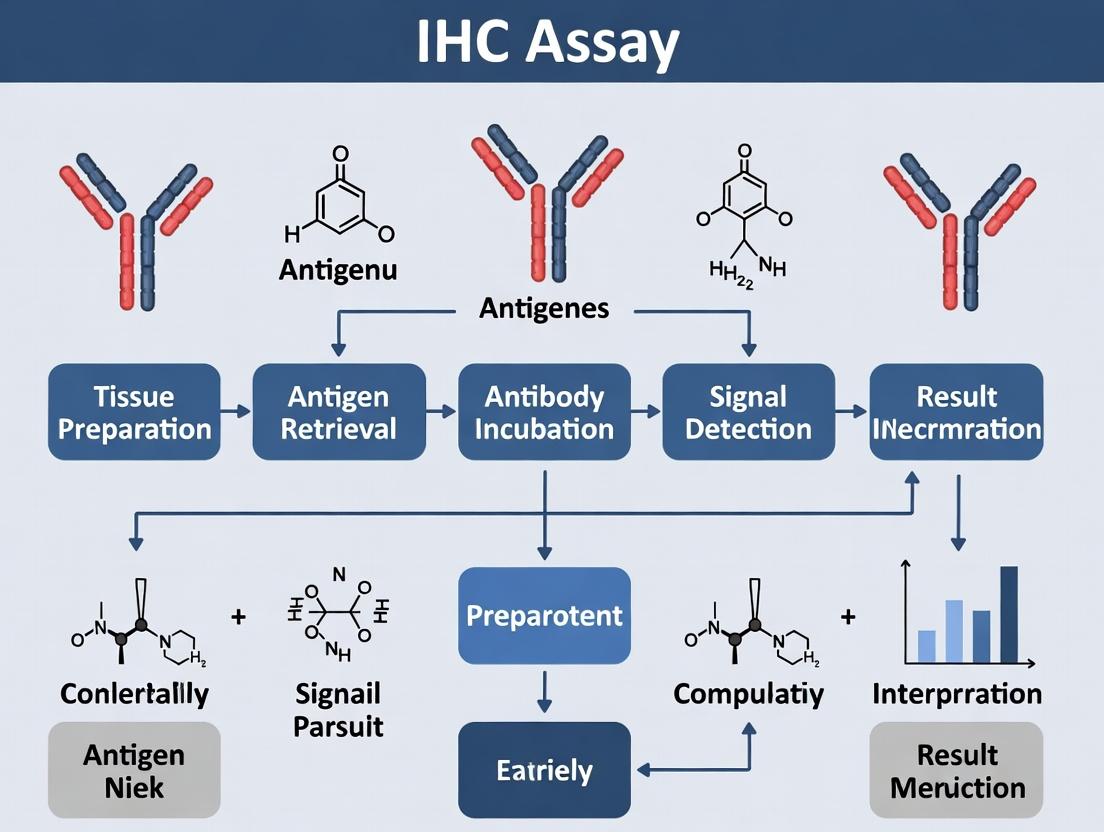
This article provides a comprehensive roadmap for researchers, scientists, and drug development professionals engaged in developing robust immunohistochemistry (IHC) assays for precision medicine applications.
IHC Assay Development for Precision Medicine: A Complete Guide for Biomarker Validation and Clinical Translation
Abstract
This article provides a comprehensive roadmap for researchers, scientists, and drug development professionals engaged in developing robust immunohistochemistry (IHC) assays for precision medicine applications. We cover the foundational role of IHC in biomarker discovery, detailing methodological best practices from antigen retrieval to multiplex staining. The guide delves into advanced troubleshooting and optimization strategies to ensure assay reproducibility and specificity. Finally, we explore critical validation frameworks and comparative analyses with other platforms (e.g., NGS, immunoassays) to establish IHC as a reliable tool for clinical decision-making. This resource synthesizes current standards and innovations to bridge the gap between research-grade assays and clinically actionable diagnostics.
The Pillars of Precision: Understanding IHC's Foundational Role in Biomarker Discovery and Target Identification
Within the paradigm of precision medicine research, the development of robust immunohistochemistry (IHC) assays is a critical translational bridge. While next-generation sequencing (NGS) provides a comprehensive genomic blueprint, it cannot confirm the translation, post-translational modification, cellular localization, or spatial distribution of protein targets. This application note details the integral role of IHC in validating genomic findings and providing essential spatial context, thereby enabling accurate patient stratification and therapeutic targeting.
The Spatial Resolution Gap in Genomics
Genomic profiling, including whole-exome and transcriptome sequencing, identifies mutations, amplifications, and expression signatures associated with disease. However, these data are typically dissociated from tissue architecture. Key quantitative insights from recent studies underscore this limitation.
Table 1: Discrepancies Between mRNA and Protein Expression in Solid Tumors
| Cancer Type | Cohort Size | Correlation Coefficient (mRNA vs. Protein) | Key Discrepant Pathway | Clinical Implication |
|---|---|---|---|---|
| Colorectal Adenocarcinoma | 95 patients | r=0.38 for immune checkpoint proteins | PD-L1/PD-1 signaling | mRNA levels poorly predict IHC protein positivity for therapy selection. |
| Non-Small Cell Lung Cancer | 167 samples | r=0.41 for HER2 | ERBB2 signaling | Genomic amplification not always concordant with membranous protein overexpression. |
| Glioblastoma Multiforme | 50 tumor cores | r=0.29 for phospho-STAT3 | JAK-STAT signaling | Activated (phosphorylated) protein state invisible to genomics. |
Detailed Protocol: Multiplex IHC for Spatial Phenotyping
This protocol validates a genomic-defined immune-hot signature by characterizing the spatial relationship between cytotoxic T-cells and tumor cells.
Title: Validation of Genomic Immune Signature by Multiplex IHC
Objective: To spatially validate a transcriptome-derived T-cell inflamed signature using multiplex IHC for CD8 (cytotoxic T-cells), PD-L1 (immune checkpoint), and Pan-CK (tumor cells).
Materials & Reagent Solutions: Table 2: Essential Research Reagent Solutions for Multiplex IHC
| Reagent | Function | Example Product/Catalog |
|---|---|---|
| Formalin-Fixed, Paraffin-Embedded (FFPE) Tissue Sections | Preserves tissue morphology and antigenicity for retrospective analysis. | Prepared per institutional SOP. |
| Antigen Retrieval Buffer (pH 9.0 Tris-EDTA) | Unmasks epitopes cross-linked by formalin fixation. | Vector Laboratories, H-3301. |
| Primary Antibody Panel (Rabbit anti-CD8, Mouse anti-PD-L1, Rabbit anti-Pan-CK) | Highly validated, species-specific antibodies for target detection. | CD8 (Cell Marque, 108M-96), PD-L1 (DAKO 22C3), Pan-CK (DAKO, AE1/AE3). |
| Tyramide Signal Amplification (TSA) Opal Fluorophores | Enables sequential antibody application and signal amplification for multiplexing. | Akoya Biosciences, Opal 520, 570, 690. |
| Autofluorescence Quencher | Reduces tissue autofluorescence to improve signal-to-noise ratio. | Vector Laboratories, SP-8500. |
| Digital Slide Scanner & Analysis Software | Enables high-resolution image capture and quantitative spatial analysis. | Akoya Vectra/ Phenochart, Indica Labs HALO. |
Experimental Workflow:
- Sectioning & Baking: Cut FFPE sections at 4µm onto charged slides. Bake at 60°C for 1 hour.
- Deparaffinization & Rehydration: Immerse slides in xylene (3 changes, 5 min each), followed by graded ethanol (100%, 95%, 70%, 5 min each) and distilled water.
- Antigen Retrieval: Heat slides in pH 9.0 Tris-EDTA buffer in a pressurized decloaking chamber at 95°C for 20 minutes. Cool for 30 minutes at room temperature (RT).
- Peroxidase Blocking: Apply endogenous peroxidase block (3% H₂O₂) for 10 minutes at RT.
- Protein Block: Apply protein block (e.g., 10% normal goat serum) for 10 minutes at RT.
- Sequential Staining (for 1st antigen, CD8):
- Apply primary anti-CD8 antibody (1:200 dilution) for 1 hour at RT.
- Apply HRP-conjugated secondary antibody for 10 minutes at RT.
- Apply Opal 520 fluorophore (1:100 dilution) for 10 minutes at RT.
- Perform microwave heat stripping (in pH 9.0 buffer) to remove antibodies, preserving the deposited fluorophore.
- Repeat Step 6 for PD-L1 (Opal 570) and Pan-Cytokeratin (Opal 690).
- Counterstain & Mount: Apply spectral DAPI for nuclei staining. Apply anti-fade mounting medium.
- Image Acquisition & Analysis: Scan slides using a multispectral microscope. Use spectral unmixing software. Quantify cell densities and calculate spatial metrics (e.g., CD8+ cell distance to nearest PD-L1+ tumor cell).
Logical Framework: Integrating IHC with Genomic Data
The following diagram illustrates the decision-making workflow in precision medicine research where IHC validates and contextualizes genomic data.
Title: IHC Validation of Genomic Data in Precision Medicine
Key Signaling Pathway Validated by IHC
The PI3K-AKT-mTOR pathway is frequently altered at the genomic level. IHC for phosphorylated proteins (e.g., pAKT, pS6) is required to confirm pathway activation in the tumor microenvironment.
Title: PI3K Pathway Activation Validated by IHC
For precision medicine assay development, IHC is not superseded by genomics but is an essential complementary technology. It provides the requisite protein-level and spatial context to transform genomic predictions into actionable biological insights, directly informing patient stratification, drug development, and therapeutic response monitoring. Robust, standardized IHC protocols are therefore foundational to translational research pipelines.
Within the broader thesis on IHC assay development for precision medicine research, the rigorous classification and validation of biomarkers is paramount. Biomarkers, measurable indicators of biological processes or responses, are the cornerstone of diagnostic, prognostic, and therapeutic decision-making. This application note details the core biomarker classes—predictive, prognostic, and pharmacodynamic—that guide targeted therapy and clinical trial design. Immunohistochemistry (IHC) serves as a critical enabling technology for visualizing and quantifying these biomarkers in the context of intact tissue architecture, providing spatially resolved data essential for translational research and drug development.
Biomarker Classes: Definitions and Clinical Utility
Predictive Biomarkers identify individuals who are more likely to respond to a specific therapeutic intervention. They are used to select or stratify patients for treatment. Prognostic Biomarkers provide information on the likely course of the disease (e.g., aggressiveness, risk of recurrence) irrespective of therapy. They inform disease management and trial design. Pharmacodynamic (PD) Biomarkers demonstrate that a drug has engaged its intended target and induced a biological effect. They are used to confirm mechanism of action and guide dosing in early-phase trials.
Table 1: Core Characteristics of Key Biomarker Classes
| Biomarker Class | Primary Question Answered | Clinical/Research Utility | Example (Associated Therapy) |
|---|---|---|---|
| Predictive | Who will respond to Drug X? | Patient selection/stratification for therapy | HER2 overexpression (Trastuzumab) |
| Prognostic | What is the disease outcome? | Risk stratification, trial enrichment | Ki-67 index in breast cancer |
| Pharmacodynamic | Is Drug Y hitting its target? | Proof of mechanism, dose optimization | pMAPK suppression by a MEK inhibitor |
Application Notes & Protocols for IHC-Based Biomarker Assessment
Protocol: Predictive Biomarker Assay (e.g., PD-L1 IHC 22C3 pharmDx)
Purpose: To identify non-small cell lung cancer (NSCLC) patients eligible for pembrolizumab therapy by detecting PD-L1 expression. Principle: Monoclonal antibody 22C3 binds to PD-L1 on formalin-fixed, paraffin-embedded (FFPE) tumor cells. Visualization via EnVision FLEX visualization system.
Detailed Methodology:
- Tissue Sectioning: Cut FFPE tissue sections at 4 μm. Mount on positively charged slides. Dry at 60°C for 1 hour.
- Deparaffinization & Rehydration: Perform in xylene and graded ethanol series (100%, 95%, 70%).
- Antigen Retrieval: Use EnVision FLEX Target Retrieval Solution (High pH, Code K8004). Heat in a pre-heated water bath (95-99°C) for 20 minutes. Cool for 20 minutes at room temperature (RT).
- Peroxidase Blocking: Incubate with EnVision FLEX Peroxidase-Blocking Reagent for 5 minutes at RT.
- Primary Antibody Staining: Apply PD-L1 IHC 22C3 mouse monoclonal primary antibody. Incubate for 30 minutes at RT.
- Visualization: Apply EnVision FLEX/HRP polymer for 20 minutes at RT, followed by DAB+ chromogen for 10 minutes.
- Counterstaining & Mounting: Counterstain with hematoxylin, dehydrate, clear, and mount.
- Scoring: Calculate Tumor Proportion Score (TPS) = (Number of viable PD-L1 staining tumor cells / Total number of viable tumor cells) x 100%. A TPS ≥ 1% is considered positive for patient selection.
Protocol: Prognostic Biomarker Assay (Ki-67 Proliferation Index)
Purpose: To assess tumor cell proliferation rate as a prognostic indicator in breast cancer. Principle: MIB-1 monoclonal antibody binds to the Ki-67 nuclear antigen present in all active phases of the cell cycle (G1, S, G2, M).
Detailed Methodology:
- Sample Preparation: As per steps 1-3 above, using a citrate-based (low pH) retrieval solution.
- Primary Antibody Staining: Apply anti-Ki-67 (clone MIB-1) antibody. Incubate for 60 minutes at RT.
- Detection: Use a polymer-based detection system (e.g., Dako REAL). Apply linker antibody (15 min), enzyme conjugate (15 min), and DAB chromogen (10 min).
- Quantification: Using digital image analysis (DIA) software: a. Annotate the invasive tumor region. b. Software algorithm identifies stained (positive) and unstained (negative) tumor cell nuclei. c. Ki-67 Index = (DIA-positive nuclei / Total DIA-counted tumor nuclei) x 100%. Manual counting in hot spots is an alternative but less reproducible method.
Protocol: Pharmacodynamic Biomarker Assay (pERK IHC)
Purpose: To demonstrate target modulation in a tumor biopsy following treatment with a MEK or RAF inhibitor. Principle: Phospho-specific antibody detects activated/phosphorylated ERK1/2, a downstream effector of the MAPK pathway.
Detailed Methodology:
- Critical Pre-Analytical Note: PD biomarker assessment often requires paired biopsies (pre- and post-treatment). Consistent fixation (e.g., 24 hours in neutral buffered formalin) is critical.
- Antigen Retrieval: Use EDTA-based retrieval buffer (pH 8.0) at 95-99°C for 30 minutes.
- Primary Antibody Staining: Apply anti-phospho-p44/42 MAPK (Erk1/2) (Thr202/Tyr204) antibody overnight at 4°C.
- Detection: Use a sensitive tyramide signal amplification (TSA) system to detect low-abundance phospho-epitopes. Block endogenous peroxidase, apply primary antibody, followed by HRP-conjugated secondary, then incubate with fluorophore- or enzyme-conjugated tyramide.
- Quantification & Analysis: a. Use H-score or digital image analysis to quantify staining intensity (0-3+) and percentage of positive tumor cells. b. H-score = Σ (1 x % cells 1+) + (2 x % cells 2+) + (3 x % cells 3+). Range 0-300. c. A significant decrease in H-score or staining intensity in the post-treatment biopsy indicates target inhibition.
Visualizing Biomarker Context and Workflows
Diagram 1: Relationship between biomarker classes in precision medicine.
Diagram 2: Standard IHC assay development workflow.
Diagram 3: MAPK pathway and PD biomarker modulation.
The Scientist's Toolkit: Essential Research Reagents & Materials
Table 2: Key Reagent Solutions for IHC Biomarker Development
| Reagent/Material | Function in IHC Protocol | Critical Notes for Precision Medicine Assays |
|---|---|---|
| FFPE Tissue Sections | The analyte substrate; preserves morphology and antigenicity. | Consistent fixation time (e.g., 6-72 hrs in NBF) is critical for PD biomarker comparability. |
| Validated Primary Antibodies | Binds specifically to the target biomarker (e.g., PD-L1, Ki-67, pERK). | Use clinically validated clones (e.g., 22C3 for PD-L1) or analytically validated research-grade antibodies with clear specificity data. |
| Antigen Retrieval Buffers | Reverses formaldehyde-induced cross-linking to expose epitopes. | pH choice (citrate pH6.0, EDTA/TRIS pH8.0-9.0) is antigen-specific and must be optimized. |
| Polymer-Based Detection Systems | Amplifies signal via enzyme-labeled polymers linked to secondary antibodies. | Reduces non-specific staining vs. traditional avidin-biotin. Essential for high sensitivity. |
| Chromogens (DAB, AEC) | Enzyme substrate producing a visible precipitate at the antigen site. | DAB is permanent and common; requires careful titration to avoid over-staining. |
| Automated IHC Stainers | Standardizes all incubation, wash, and drying steps. | Mandatory for reproducible, high-throughput clinical trial testing. |
| Digital Image Analysis (DIA) Software | Quantifies staining intensity and percentage in a reproducible manner. | Key for objective scoring of continuous biomarkers (H-score, TPS) and reducing inter-observer variability. |
| Multiplex IHC/IF Kits | Allows simultaneous detection of 2+ biomarkers on one slide. | Enables study of co-expression and spatial relationships (e.g., PD-L1+ cells near CD8+ T cells). |
Immunohistochemistry (IHC) is a cornerstone technique in precision medicine research, enabling the spatial localization of specific biomarkers in tissue sections. Its application spans from target discovery and validation in drug development to patient stratification in clinical trials and companion diagnostic (CDx) development. The assay's success hinges on rigorously defining the clinical and biological question at the outset, ensuring the resulting data is fit-for-purpose.
Key Quantitative Metrics in IHC Assay Performance
The analytical validation of an IHC assay requires quantification of several key parameters. Recent guidelines (e.g., FDA, CLSI, and LDT frameworks) emphasize the need for robust, reproducible assays.
Table 1: Key Analytical Validation Parameters for IHC Assays
| Parameter | Definition | Typical Target/Threshold | Measurement Method |
|---|---|---|---|
| Analytical Sensitivity (LOD) | Lowest amount of target detectable above background. | Positive signal at ≤1+ staining intensity. | Titration of antigen-expressing cell lines or recombinant protein. |
| Analytical Specificity | Assay’s ability to detect only the intended target. | No staining in confirmed negative tissues; expected staining pattern. | CRISPR knockout/isogenic controls, siRNA, orthogonal methods (IF, WB). |
| Precision (Repeatability) | Agreement under identical conditions (same run, operator, instrument). | CV of scoring results <10-15% for quantitative IHC. | Consecutive staining and scoring of same samples (≥3 replicates). |
| Precision (Reproducibility) | Agreement across varying conditions (different days, sites, lots). | Concordance rate ≥90% for positive/negative calls. | Multi-site, multi-operator studies using a standard sample set. |
| Robustness | Capacity to remain unaffected by small, deliberate variations. | Method performs within specification. | Testing variations in antigen retrieval time, primary Ab incubation, etc. |
Table 2: Common IHC Scoring Systems and Their Applications
| Scoring System | Description | Data Type | Best Used For |
|---|---|---|---|
| H-Score | Calculated as: Σ (Pi * i), where Pi = % of cells stained at intensity i (0-3). Range: 0-300. | Continuous | Research, continuous biomarker expression (e.g., HER2, PD-L1). |
| Allred Score | Combines proportion score (0-5) and intensity score (0-3). Total: 0-8. | Semi-quantitative | Hormone receptor status in breast cancer. |
| Tumor Proportion Score (TPS) | Percentage of viable tumor cells with partial/complete membrane staining. | Percentage | PD-L1 assessment in NSCLC (e.g., 22C3 pharmDx). |
| Composite Positive Score (CPS) | Number of positive cells (tumor, lymphocyte, macrophage) / total tumor cells x 100. | Continuous | PD-L1 in gastric or cervical cancer. |
| Binary (Positive/Negative) | Defined by a specific, validated cut-off (e.g., ≥1+ in ≥10% of cells). | Categorical | Companion diagnostics with a clear clinical threshold. |
Experimental Protocols
Protocol 3.1: Initial Antibody Validation for IHC
Objective: To confirm the specificity and optimal dilution of a primary antibody for IHC on formalin-fixed, paraffin-embedded (FFPE) tissue. Materials: FFPE cell pellet controls (positive and negative), target FFPE tissues, validated primary antibody, isotype control, detection system, automated or manual IHC platform. Procedure:
- Deparaffinization & Antigen Retrieval: Bake slides at 60°C for 1 hr. Deparaffinize in xylene and rehydrate through graded ethanol to water. Perform heat-induced epitope retrieval (HIER) using pH 6.0 or 9.0 buffer in a decloaking chamber (20-30 min at 95-100°C). Cool for 30 min.
- Peroxidase Blocking: Incubate with 3% H₂O₂ for 10 min to block endogenous peroxidase. Rinse with wash buffer.
- Protein Block: Apply serum-free protein block for 10 min to reduce non-specific binding.
- Primary Antibody Incubation: Apply titrated concentrations of primary antibody (e.g., 1:50, 1:100, 1:200, 1:500) and isotype control to serial sections. Incubate for 60 min at room temperature or overnight at 4°C.
- Detection: Apply labeled polymer-HRP secondary antibody for 30 min. Visualize with DAB chromogen for 5-10 min, monitor under microscope.
- Counterstaining & Mounting: Counterstain with hematoxylin, dehydrate, clear, and mount with permanent medium.
- Analysis: Evaluate staining intensity, subcellular localization, and non-specific background. Optimal dilution provides strong specific signal with minimal background in positive control and no signal in negative/isotype controls.
Protocol 3.2: Multi-Site Reproducibility Assessment
Objective: To evaluate the inter-laboratory reproducibility of a fully optimized IHC protocol. Materials: A tissue microarray (TMA) containing a spectrum of expression levels (negative, low, medium, high), pre-aliquoted reagent kits, detailed SOP, digital slide scanner. Procedure:
- Sample Distribution: Distribute identical TMA sections and standardized reagent kits (same lot numbers) to ≥3 independent testing sites.
- Staining: Each site follows the identical SOP to stain the TMA on their validated IHC platforms.
- Digitalization: All stained slides are scanned at 20x magnification using calibrated scanners.
- Blinded Analysis: Slides are de-identified and scored independently by at least two qualified pathologists at a central location using digital pathology software.
- Statistical Analysis: Calculate inter-site concordance rates (positive/negative agreement), intraclass correlation coefficient (ICC) for continuous scores (H-score), and Cohen’s kappa for categorical scores.
Visualizations
IHC Assay Development Workflow for Precision Medicine
Targeted Therapy Inhibits a Key Signaling Pathway
The Scientist's Toolkit: Research Reagent Solutions
Table 3: Essential Reagents for IHC Assay Development
| Reagent Category | Specific Example | Function & Importance in Development |
|---|---|---|
| Validated Primary Antibodies | Rabbit monoclonal anti-PD-L1 (Clone 28-8), Phospho-specific anti-AKT (Ser473). | High specificity is critical for accurate biomarker detection. Validated for IHC on FFPE. |
| Isotype Controls | Rabbit IgG, Mouse IgG1. | Distinguish specific signal from background/non-specific binding in optimization. |
| Positive Control Tissues | FFPE cell lines with known expression, multi-tissue blocks (MTBs). | Essential for run-to-run monitoring of assay performance and sensitivity. |
| Negative Control Tissues | CRISPR knockout cell line pellets, target-negative tissues. | Critical for establishing assay specificity during validation. |
| Antigen Retrieval Buffers | Citrate-based (pH 6.0), Tris-EDTA (pH 9.0). | Unmask epitopes cross-linked by formalin fixation. pH optimization is target-dependent. |
| Detection Systems | Polymer-based HRP/AP systems (e.g., EnVision, ImmPRESS). | Amplify signal while minimizing background. Choice affects sensitivity and multiplexing. |
| Chromogens | DAB (brown), Fast Red (red), Metal-enhanced DAB. | Produce insoluble precipitate at antigen site. DAB is most common and permanent. |
| Automated IHC Stainers | Ventana Benchmark, Leica BOND, Agilent/Dako Omnis. | Ensure protocol consistency, reproducibility, and high-throughput capacity. |
| Digital Pathology Platforms | Aperio/Leica, Philips, 3DHistech scanners; HALO, QuPath analysis software. | Enable quantitative, reproducible scoring and remote peer review for multi-site studies. |
1. Introduction
In the development of robust immunohistochemistry (IHC) assays for precision medicine research, the selection and validation of primary antibodies constitute the most critical variable. The accuracy of biomarker detection, which directly informs therapeutic decisions, hinges on antibodies with assured clonality, specificity, and reproducibility. This application note details fundamental protocols and considerations for characterizing these core attributes, ensuring assay reliability in translational research and drug development.
2. Fundamental Concepts and Characterization Protocols
2.1 Clonality: Monoclonal vs. Polyclonal
Clonality refers to the origin of an antibody population. Monoclonal antibodies (mAbs) are derived from a single B-cell clone, recognizing a single epitope with high uniformity. Polyclonal antibodies (pAbs) are a mixture from multiple B-cell clones, recognizing multiple epitopes on the same target.
- Characterization Protocol: Isotyping
- Purpose: To confirm the immunoglobulin class/subclass (e.g., IgG1, IgG2a, IgM) of a monoclonal antibody, a key indicator of clonal purity and relevant for downstream applications.
- Methodology (ELISA-based):
- Coat a 96-well plate with 100 µL/well of capture antibody (e.g., anti-mouse kappa light chain) in carbonate-bicarbonate buffer (pH 9.6). Incubate overnight at 4°C.
- Block with 200 µL/well of 3% BSA in PBS for 2 hours at room temperature (RT).
- Add 100 µL/well of the test antibody (hybridoma supernatant, purified mAb) and appropriate isotype controls. Incubate 1-2 hours at RT.
- Add 100 µL/well of HRP-conjugated isotype-specific detection antibodies (e.g., anti-mouse IgG1-HRP, IgG2a-HRP). Incubate 1 hour at RT.
- Develop with TMB substrate for 15 minutes. Stop with 1M H2SO4.
- Read absorbance at 450 nm. A positive, singular isotype signal confirms monoclonal purity.
2.2 Specificity: Target Engagement Verification
Specificity is the antibody's ability to bind exclusively to its intended target antigen. It must be empirically verified for each application (e.g., IHC).
Characterization Protocol: Western Blot (Lysate Analysis)
- Purpose: To confirm target protein recognition at the expected molecular weight and assess cross-reactivity.
- Methodology:
- Prepare cell or tissue lysates (positive and negative controls for target expression).
- Separate proteins by SDS-PAGE (4-20% gradient gel recommended) and transfer to PVDF membrane.
- Block membrane with 5% non-fat milk in TBST for 1 hour at RT.
- Incubate with primary antibody at optimized dilution in blocking buffer overnight at 4°C.
- Wash 3x with TBST, 5 minutes each.
- Incubate with appropriate HRP-conjugated secondary antibody for 1 hour at RT.
- Wash 3x with TBST. Detect using enhanced chemiluminescence (ECL) substrate.
- Critical: The antibody should produce a single predominant band at the expected molecular weight (± post-translational modification shifts).
Characterization Protocol: Immunohistochemistry (Tissue Context)
- Purpose: To validate antibody performance in its primary application, assessing cellular and subcellular localization.
- Methodology (Basic IHC on FFPE Tissue):
- Deparaffinize and rehydrate FFPE tissue sections.
- Perform heat-induced epitope retrieval (HIER) using citrate (pH 6.0) or EDTA (pH 9.0) buffer.
- Quench endogenous peroxidase with 3% H2O2 for 10 minutes.
- Block with 5% normal serum (from secondary host species) for 1 hour at RT.
- Incubate with primary antibody at optimized concentration in antibody diluent for 1 hour at RT or overnight at 4°C.
- Wash and apply labeled polymer-secondary antibody system (e.g., HRP polymer) for 30 minutes at RT.
- Visualize with DAB chromogen, counterstain with hematoxylin, and mount.
2.3 Reproducibility: Lot-to-Lot Consistency
Reproducibility ensures consistent performance across different antibody batches and laboratories.
- Characterization Protocol: Parallel Staining Assay
- Purpose: To quantitatively compare new and established lots of an antibody.
- Methodology:
- Select a well-characterized tissue microarray (TMA) containing positive, negative, and variable expression cores.
- Stain serial sections from the same TMA simultaneously with the old (reference) and new (test) antibody lots using an identical, validated IHC protocol.
- Employ digital pathology to quantify staining (e.g., H-score, percent positivity).
- Analyze correlation using linear regression. An R² value >0.95 indicates acceptable lot-to-lot consistency.
3. Data Summary Tables
Table 1: Comparative Analysis of Antibody Clonality
| Feature | Monoclonal Antibody | Polyclonal Antibody |
|---|---|---|
| Origin | Single B-cell clone | Multiple B-cell clones |
| Epitope Specificity | Single, defined epitope | Multiple epitopes |
| Batch Consistency | High (with proper validation) | Variable (requires extensive lot testing) |
| Cost & Production | High cost, hybridoma/ recombinant | Lower cost, animal immunization |
| Best for IHC Use Case | Quantification, phospho-specific targets, standardized assays | Detecting proteins with low abundance or denatured epitopes |
Table 2: Key Metrics for Antibody Specificity Validation
| Validation Method | Key Readout | Acceptability Criterion for IHC Assay Development |
|---|---|---|
| Western Blot | Banding pattern | Single predominant band at expected molecular weight. |
| IHC with KO/KD Controls | Staining signal | Absence of signal in genetically modified negative control tissue. |
| Orthogonal Validation | Correlation with alternative method (e.g., RNAscope, IF) | Spatial correlation coefficient > 0.80. |
| Peptide Blocking | Staining intensity | >80% reduction in signal with pre-incubation with target peptide. |
4. Visual Summaries
Title: Antibody Characterization Workflow for IHC Development
Title: Core IHC Staining Protocol Workflow
5. The Scientist's Toolkit: Key Research Reagent Solutions
| Item | Function in Characterization |
|---|---|
| Recombinant Target Protein | Positive control for specificity assays (ELISA, BLI). Essential for determining affinity. |
| Isogenic Knockout Cell Line | Gold-standard negative control for Western Blot and IHC specificity verification. |
| Tissue Microarray (TMA) | Enables high-throughput, simultaneous staining of multiple tissues for reproducibility testing and titration. |
| Validated Reference Antibody | A well-characterized antibody (e.g., from independent clone) for orthogonal confirmation of staining pattern. |
| Antigen Retrieval Buffers (Citrate pH6.0, EDTA/Tris pH9.0) | Unmask epitopes cross-linked during formalin fixation; optimization is critical for IHC. |
| Polymer-based Detection System | Amplifies signal and reduces non-specific background compared to traditional avidin-biotin systems. |
| Chromogen (DAB) | Enzyme substrate producing a stable, insoluble brown precipitate for light microscopy. |
| Digital Pathology Software | Enables quantitative, objective analysis of staining intensity and distribution for reproducibility metrics. |
Application Notes: Tissue Selection for IHC in Precision Medicine
The choice of tissue preservation method is a foundational variable in immunohistochemistry (IHC) assay development for precision medicine. The integrity of the tissue directly impacts biomarker detection reliability, assay validation, and, ultimately, clinical decision-making.
Quantitative Comparison of FFPE vs. Frozen Tissue for IHC
Table 1: Core Characteristics of FFPE vs. Frozen Tissue Specimens
| Parameter | Formalin-Fixed Paraffin-Embedded (FFPE) | Frozen (Cryopreserved) |
|---|---|---|
| Morphology Preservation | Excellent architectural detail. | Good to moderate; potential for ice crystal artifacts. |
| Antigen Preservation | Variable; cross-linking may mask epitopes, often requiring antigen retrieval. | Generally superior for labile epitopes; minimal cross-linking. |
| RNA/DNA Integrity | Moderate to poor for long fragments; highly cross-linked. | High integrity for nucleic acids, suitable for multi-omics. |
| Storage & Logistics | Room temperature, stable for decades; easy to transport. | Requires -80°C or liquid N₂; costly long-term storage. |
| Clinical Relevance | Gold standard for histopathology; vast archives available. | Primarily used in research settings; limited historical archives. |
| TMA Compatibility | Excellent; standard material for TMAs. | Challenging; possible but not routine. |
| Primary Use Case | Retrospective studies, diagnostic archives, high-throughput TMAs. | Prospective studies, biomarkers sensitive to cross-linking (e.g., phospho-proteins). |
Biobank Specimen Considerations
Modern biobanks are critical for precision medicine research. Key quality metrics for specimens intended for IHC include:
- Pre-analytical Variables: Cold ischemia time (target: <30 minutes), fixation type and duration (10% NBF, 18-24 hours for FFPE), and storage conditions.
- Annotated Data: Associated clinical outcome, treatment history, and molecular profiling data exponentially increase specimen value.
- Ethical & Regulatory Compliance: Informed consent, IRB approval, and data privacy (GDPR, HIPAA) are mandatory for translational research.
Tissue Microarrays (TMAs): Design and Application
TMAs enable high-throughput, simultaneous analysis of dozens to hundreds of tissue cores on a single slide, ensuring uniform assay conditions.
- Design Types: Multi-tumor, progression, survival, or drug trial cohorts.
- Control Cores: Essential to include positive, negative, and normal tissue cores for assay validation and normalization.
- Limitations: Intra-tumor heterogeneity may be under-sampled; core diameter (0.6-2.0mm) must be justified by biomarker distribution.
Protocols
Protocol 1: Antigen Retrieval Optimization for FFPE-TMAs
Objective: To recover epitopes masked by formalin cross-linking for IHC on FFPE-TMA sections.
Materials:
- FFPE-TMA sections (4-5 µm thick)
- Heat-induced epitope retrieval (HIER) buffer (e.g., citrate pH 6.0, Tris-EDTA pH 9.0)
- Decloaking chamber or pressure cooker
- PBS (pH 7.4)
- Humidity chamber
Methodology:
- Deparaffinization & Hydration: Bake slides at 60°C for 20 min. Process through xylene (3 x 5 min) and graded ethanol (100%, 100%, 95%, 70% - 2 min each). Rinse in deionized water.
- HIER Buffer Selection: Test both citrate (pH 6.0) and Tris-EDTA (pH 9.0) buffers in parallel for novel antibodies.
- Retrieval: Fill a container with retrieval buffer, bring to a boil using a decloaking chamber (125°C for 30 sec, then 90°C for 10 min) or a pressure cooker. Cool slides in buffer for 20 min at room temperature.
- Washing: Rinse slides in running cool tap water for 5 min. Transfer to PBS for 5 min before proceeding to IHC staining.
Protocol 2: Validation of IHC on Matched FFPE vs. Frozen Sections
Objective: To compare biomarker detection efficiency between matched FFPE and frozen tissues.
Materials:
- Paired tissue samples from same surgical specimen (one fixed in formalin, one snap-frozen)
- Cryostat and microtome
- Poly-L-lysine or charged slides
- Acetone (for frozen fixation)
- Identical primary antibody, detection system, and visualization substrate.
Methodology:
- Sectioning: Cut serial sections from FFPE block (4 µm) and frozen block (5-7 µm). Mount frozen sections immediately and fix in cold acetone for 10 min.
- Parallel Staining: Perform IHC using the identical protocol with optimized retrieval for FFPE and no retrieval for frozen sections. Use the same antibody dilution, incubation time, and detection kit.
- Quantitative Analysis: Use digital pathology/image analysis software to quantify staining intensity (H-score, Allred score) and percentage of positive cells in matched morphological regions.
- Statistical Comparison: Perform correlation analysis (e.g., Pearson coefficient) between quantitative scores from FFPE and frozen sections to validate the FFPE assay.
Diagrams
Title: Tissue Selection Workflow for IHC Assay Development
Title: High-Throughput TMA IHC Analysis Pipeline
The Scientist's Toolkit: Essential Reagents & Materials
Table 2: Key Research Reagent Solutions for Tissue-Based IHC Studies
| Item | Function & Importance |
|---|---|
| 10% Neutral Buffered Formalin (NBF) | Standard fixative for FFPE; consistent pH and buffering prevent artifacts. Critical for pre-analytical control. |
| Cryomatrix/OCT Compound | Optimal cutting temperature (OCT) medium for embedding tissue prior to snap-freezing. Preserves morphology for frozen sections. |
| TMA Construction System | Instrument (manual or automated) for precise extraction of tissue cores from donor blocks and insertion into recipient paraffin blocks. |
| Antigen Retrieval Buffers | Citrate (pH 6.0) and Tris/EDTA (pH 9.0). Essential for unmasking FFPE epitopes. Optimization is key for novel targets. |
| Validated Primary Antibodies | Antibodies specifically verified for IHC on FFPE and/or frozen tissue. Clone and lot validation is non-negotiable. |
| Polymer-based Detection Kits | HRP or AP polymer systems offer high sensitivity and low background compared to traditional avidin-biotin. |
| Chromogens (DAB, AEC) | DAB (brown, alcohol-stable) and AEC (red, aqueous). Choice impacts contrast and compatibility with counterstains & automation. |
| Automated Slide Stainers | Ensure reproducibility and high-throughput for large-scale studies (e.g., clinical trials, TMA screening). |
| Digital Pathology Scanner | Enables whole-slide imaging for archiving, remote analysis, and quantitative image analysis. |
| Image Analysis Software | Tools for quantifying staining intensity, cellular localization, and H-score calculation across TMA cores. |
From Protocol to Practice: A Step-by-Step Guide to Developing Robust IHC Assays
Within the development of robust immunohistochemistry (IHC) assays for precision medicine research, a rigorous and standardized workflow is paramount. The reliability of IHC data, which often directly informs patient stratification and therapeutic decisions, hinges on meticulous control across three interdependent phases: Pre-Analytical, Analytical, and Post-Analytical. This document provides detailed application notes and protocols framed within a thesis on IHC assay development for novel biomarker validation.
Phase 1: Pre-Analytical Phase
This phase encompasses all steps from tissue acquisition to the initiation of staining, and is the most significant source of variability.
Key Variables & Protocols
1. Tissue Collection & Ischemia Time
- Protocol: Surgical Resection to Fixation: Immediately upon resection, tissue should be placed in a sterile container and transported on ice to pathology. The target ischemia time (time from devascularization to fixation) should be ≤60 minutes for most phospho-epitopes and ≤30 minutes for highly labile targets.
- Data: Impact of ischemia time on antigen integrity.
Table 1: Effect of Cold Ischemia Time on Antigen Immunoreactivity Score (IRS)*
| Target Antigen | 30 min Ischemia (Mean IRS) | 60 min Ischemia (Mean IRS) | 120 min Ischemia (Mean IRS) |
|---|---|---|---|
| Phospho-ERK1/2 (pT202/pY204) | 9.2 | 7.1 | 3.5 |
| Ki-67 | 10.5 | 10.3 | 9.8 |
| CD31 | 11.0 | 10.9 | 10.7 |
IRS scale 0-12, combining intensity (0-3) and percentage (0-4).
2. Fixation
- Protocol: Neutral Buffered Formalin (NBF) Fixation: Immerse tissue in 10% NBF (volume at least 10x tissue volume). Fixation time is critical: 24-48 hours for most tissues (e.g., 1 cm thick block). Prolonged fixation (>72h) can mask epitopes.
- Data: Fixation time optimization for a novel target.
Table 2: IHC Signal Intensity vs. Formalin Fixation Duration
| Fixation Duration | H-Score (Mean) for Target X | Coefficient of Variation (CV%) |
|---|---|---|
| 8 hours | 145 | 25% |
| 24 hours | 210 | 12% |
| 48 hours | 205 | 10% |
| 72 hours | 165 | 18% |
3. Tissue Processing, Embedding, and Sectioning
- Protocol: Paraffin Embedding: Process fixed tissue through graded ethanol (70%, 80%, 95%, 100%), xylene, and molten paraffin using an automated tissue processor (total cycle ~12 hours). Embed in orientation. Section at 4-5 µm using a microtome, float in a 40°C water bath, and mount on charged slides. Dry slides at 60°C for 1 hour.
The Scientist's Toolkit: Pre-Analytical Essentials
| Item | Function |
|---|---|
| 10% Neutral Buffered Formalin | Cross-linking fixative preserving tissue morphology and antigens. |
| Cold Transport Medium | Preservative medium for maintaining RNA/DNA and labile protein integrity during transport. |
| Automated Tissue Processor | Standardizes dehydration, clearing, and paraffin infiltration. |
| Charged/Plus Slides | Positively charged surface for superior tissue section adhesion. |
| Microtome | Precision instrument for cutting consistent, thin tissue sections. |
Diagram 1: Pre-analytical workflow for FFPE tissues.
Phase 2: Analytical Phase
This phase covers slide preparation, staining, and detection.
Detailed Staining Protocol (Automated Platform)
Protocol: Automated IHC for FFPE Sections
- Deparaffinization & Rehydration: Bake slides at 60°C for 20 min. Run through xylene (2 changes, 5 min each), then 100%, 95%, 80%, 70% ethanol (2 min each), finishing in distilled water.
- Antigen Retrieval: Place slides in pre-heated retrieval buffer (e.g., Tris-EDTA, pH 9.0 or Citrate, pH 6.0) in a pressure cooker or decloaking chamber. Heat at 95-100°C for 20 minutes. Cool at room temp for 30 min. Rinse in distilled water, then place in wash buffer (Tris-buffered saline with Tween, TBST).
- Peroxidase Blocking: Apply endogenous peroxidase block (3% H₂O₂ in methanol) for 10 min at RT. Rinse with wash buffer.
- Protein Blocking: Apply normal serum (from species of secondary antibody) or casein-based block for 30 min at RT to reduce nonspecific binding.
- Primary Antibody Incubation: Apply optimized dilution of primary antibody in antibody diluent. Incubate in a humidified chamber for 60 min at RT or overnight at 4°C. Rinse with wash buffer (3 x 5 min).
- Detection System: Apply labeled polymer-based secondary antibody/HRP conjugate (e.g., polymer-HRP anti-rabbit) for 30 min at RT. Rinse with wash buffer (3 x 5 min).
- Chromogen Development: Apply DAB (3,3'-Diaminobenzidine) substrate for 5-10 min. Monitor development under a microscope. Rinse in distilled water to stop.
- Counterstaining & Mounting: Counterstain with Hematoxylin for 30-60 sec. Rinse in tap water, dip in bluing reagent. Dehydrate through graded alcohols (70%, 95%, 100%) and xylene. Coverslip with permanent mounting medium.
The Scientist's Toolkit: Analytical Essentials
| Item | Function |
|---|---|
| Antigen Retrieval Buffer (pH6/pH9) | Reverses formaldehyde cross-links to expose masked epitopes. |
| Primary Antibody (Validated for IHC) | Specific binder for the target antigen of interest. |
| Polymer-based Detection System | Amplifies signal with multiple enzyme molecules per secondary antibody. |
| DAB Chromogen | Enzyme substrate producing an insoluble brown precipitate at antigen site. |
| Automated IHC Stainer | Ensures precise, reproducible, and high-throughput staining with minimal variability. |
Diagram 2: Core analytical IHC staining protocol.
Phase 3: Post-Analytical Phase
This phase involves interpretation, analysis, and reporting of results.
Quantitative Image Analysis Protocol
Protocol: Digital Pathology & Quantitative Scoring
- Scanning: Scan stained slides using a whole slide scanner at 20x or 40x magnification.
- Annotation: Using image analysis software (e.g., QuPath, HALO, Visiopharm), annotate regions of interest (ROI) – e.g., tumor epithelium, excluding stroma and necrosis.
- Algorithm Training: For automated analysis, train a classifier to identify tumor cells based on morphological features. Set parameters for DAB detection (color threshold, optical density).
- Quantification: Execute analysis. Common outputs include:
- H-Score: (0-300) = Σ (1 x % weak staining) + (2 x % moderate staining) + (3 x % strong staining).
- Allred Score: For breast cancer biomarkers (proportion + intensity, 0-8).
- Tumor Proportion Score (TPS): Percentage of viable tumor cells with membrane staining (e.g., for PD-L1).
- Data Export & Integration: Export numerical data for statistical analysis correlating with clinical outcomes.
Table 3: Comparison of IHC Scoring Methods for Precision Medicine
| Scoring Method | Output Range | Best For | Inter-Observer Concordance (Kappa) | Suitability for Automation |
|---|---|---|---|---|
| H-Score | 0-300 | Cytoplasmic/Nuclear targets, gradient expression | 0.75 | High |
| Tumor Proportion Score (TPS) | 0-100% | Membrane staining (e.g., PD-L1) | 0.82 | High |
| Allred Score | 0-8 | Hormone receptors (ER/PR) | 0.88 | Medium |
| Binary (+/-) | 0 or 1 | Mutant protein presence/absence | 0.95 | High |
The Scientist's Toolkit: Post-Analytical Essentials
| Item | Function |
|---|---|
| Whole Slide Image (WSI) Scanner | Digitizes entire glass slide for high-resolution digital analysis. |
| Digital Pathology Software | Platform for viewing, annotating, and quantitatively analyzing WSI. |
| Image Analysis Algorithm | Automated script for consistent, objective cell segmentation and scoring. |
| Laboratory Information System (LIMS) | Tracks patient/sample metadata and integrates staining results with clinical data. |
| Statistical Analysis Software | For correlating quantitative IHC data with clinical endpoints (e.g., survival, response). |
Diagram 3: Post-analytical digital pathology workflow.
A comprehensive, standardized, and quality-controlled workflow spanning pre-analytical, analytical, and post-analytical phases is non-negotiable for developing fit-for-purpose IHC assays in precision medicine research. Each phase contributes critically to the assay's validity, reproducibility, and ultimately, its utility in guiding patient-specific therapeutic strategies. The integration of robust protocols, validated reagents, and quantitative digital pathology is essential for transforming subjective histological assessment into objective, reliable data.
In the pursuit of robust and reproducible immunohistochemistry (IHC) for precision medicine research, the retrieval of masked epitopes in formalin-fixed, paraffin-embedded (FFPE) tissues is a critical pre-analytical step. This document details advanced protocols and considerations for optimizing Heat-Induced Epitope Retrieval (HIER) to ensure accurate biomarker detection, directly impacting therapeutic decision-making and drug development.
The Impact of pH and Buffer Composition on Antigen Retrieval
The choice of retrieval buffer and its pH is antigen-specific and fundamentally alters the efficiency of epitope unmasking. The mechanism involves reversing methylene cross-links formed during formalin fixation. Recent studies and empirical data highlight the following trends:
- Citrate-based buffers (pH 6.0): Effective for a majority of nuclear and cytoplasmic antigens (e.g., ER, PR, p53). The mildly acidic environment is gentler on tissue morphology.
- Tris-EDTA/EGTA buffers (pH 8.0-9.0): Essential for many phosphorylated epitopes, membrane proteins, and challenging nuclear targets (e.g., FoxP3, HER2 extracellular domain). The alkaline environment disrupts different cross-link bonds.
- High-pH (>9.0) buffers: Required for a subset of particularly resistant antigens but can compromise tissue integrity if not carefully monitored.
Table 1: Retrieval Buffer Efficacy for Common Biomarkers in Precision Medicine
| Biomarker | Primary Buffer (pH 6.0) | Alternative Buffer (pH 9.0) | Optimal HIER Method | Reported Retrieval Index Score* (%) |
|---|---|---|---|---|
| ERα (Nuclear) | Citrate (High) | Tris-EDTA (Moderate) | Pressure Cooker | 95-98% |
| HER2 (Membrane) | Tris-EDTA (High) | Citrate (Low) | Water Bath / Decloaker | 92-96% |
| PD-L1 (Membrane) | Tris-EDTA (High) | High-pH (9.0) | Decloaker | 90-94% |
| Ki-67 (Nuclear) | Citrate (High) | Tris-EDTA (High) | Pressure Cooker | 98-99% |
| MSH2 (Nuclear) | Tris-EDTA (High) | Citrate (Moderate) | Water Bath | 94-97% |
| Phospho-STAT3 | Tris-EDTA (High) | Citrate (Low) | Decloaker | 88-92% |
*Retrieval Index Score: A composite metric based on staining intensity, signal-to-noise ratio, and inter-laboratory reproducibility from recent proficiency testing data.
Detailed HIER Protocols for Assay Development
Protocol 1: Standardized Water Bath Method for High-Throughput Screening
This protocol offers uniformity and is suitable for screening multiple biomarkers during assay development.
- Dewaxing & Hydration: Deparaffinize slides in xylene (3 x 5 min). Rehydrate through graded ethanol series (100%, 100%, 95%, 70% - 2 min each) to distilled water.
- Buffer Preparation: Prepare 1x retrieval solution (e.g., Citrate pH 6.0 or Tris-EDTA pH 9.0). Pre-heat a Coplin jar containing buffer in a water bath to 95-99°C.
- Retrieval: Place slides in the pre-heated buffer. Incubate for 20-40 minutes (optimize per antigen) at 95-99°C, ensuring the slides remain submerged.
- Cooling: Remove the jar from the bath and cool at room temperature for 20 minutes.
- Rinsing: Rinse slides in distilled water, then transfer to PBS or TBS wash buffer for 5 min.
- Proceed to Staining: Continue with standard IHC protocol (peroxidase blocking, primary antibody incubation, etc.).
Protocol 2: Pressure Cooker Method for Robust, High-Temperature Retrieval
Ideal for resistant antigens, providing rapid, uniform heating. Essential for consistent results in clinical trial biomarker analysis.
- Dewaxing & Hydration: As per Protocol 1.
- System Setup: Fill a decloaking chamber or electric pressure cooker with 2-3 L of distilled water. Add the recommended volume of 10x retrieval buffer stock to a slide rack chamber and fill to cover slides with 1x working solution.
- Retrieval: Place the slide rack in the cooker. Seal and heat. For electric cookers, use the designated "HIER" program (~110-125°C, 1.5-2.5 min at full pressure). For stove-top models, bring to full pressure (whistling) and time for 2-10 minutes.
- Pressure Release & Cooling: Use a rapid pressure release method. Immediately open the lid, carefully remove the slide rack, and cool in the buffer at room temperature for 20-30 minutes.
- Rinsing: Rinse thoroughly in distilled water, then wash buffer for 5 min.
- Proceed to Staining.
The Scientist's Toolkit: Essential Research Reagent Solutions
Table 2: Key Reagents for HIER Optimization in IHC Assay Development
| Reagent / Solution | Function & Rationale |
|---|---|
| Citrate Buffer (10x, pH 6.0) | Standard retrieval buffer for many nuclear antigens. Provides consistent mild-acid environment for cross-link reversal. |
| Tris-EDTA Buffer (10x, pH 9.0) | Alkaline retrieval buffer critical for phospho-epitopes and membrane targets. EDTA chelates calcium ions, aiding protein dissociation. |
| High-pH (>9.0) Buffer | Specialized solution for the most refractory antigens (e.g., some viral proteins). Use with morphological vigilance. |
| Phosphate-Buffered Saline (PBS) | Standard wash and dilution buffer. Maintains physiological pH and osmolarity post-retrieval. |
| Tris-Buffered Saline (TBS) | Alternative wash buffer, sometimes preferred with phosphorylated targets or alkaline phosphatase detection systems. |
| Protease Enzyme (e.g., Proteinase K) | Enzyme-Induced Epitope Retrieval (EIER) agent for select antigens where HIER fails (e.g., collagen-bound epitopes). Use is antigen-specific. |
| HIER Equipment (Water Bath/Decloaker) | Provides controlled, uniform heating. Decloakers (pressure cookers) offer faster cycle times and higher effective temperatures. |
Visualizing Workflows and Relationships
HIER Optimization Decision Pathway
Molecular Mechanism of HIER
Application Notes
Within the development of immunohistochemistry (IHC) assays for precision medicine research, the selection of an appropriate detection system is critical. It directly impacts assay sensitivity, specificity, multiplexing capability, and compatibility with automated platforms. This document details the core principles, comparative performance, and application contexts for four pivotal detection methodologies.
Direct Detection
In direct detection, the primary antibody is conjugated directly to a reporter enzyme (e.g., horseradish peroxidase - HRP) or a fluorophore. This one-step method offers rapid staining, minimal non-specific background, and is ideal for high-throughput screening. However, sensitivity is limited by the stoichiometry of the label.
Primary Application in Precision Medicine: Rapid screening of highly expressed, validated biomarkers (e.g., HER2 IHC in breast cancer) where signal amplification is not required and simplicity is paramount.
Indirect Detection (Avidin-Biotin-Complex - ABC & LSAB)
This two-step method uses a labeled secondary antibody that binds to the primary antibody. The ABC method further amplifies signal by forming a complex of enzyme-linked avidin and biotinylated secondary antibodies. It provides superior sensitivity over direct methods due to multiple reporter molecules binding per primary antibody.
Primary Application in Precision Medicine: Detecting targets with moderate expression levels. It remains a robust, well-characterized workhorse for many diagnostic and research IHC assays.
Polymer-Based Detection
Polymer-based systems (e.g., EnVision, ImmPRESS) replace the biotin-avidin complex with a dextran or synthetic polymer backbone. Numerous enzyme molecules (HRP or alkaline phosphatase - AP) and secondary antibodies are attached to this polymer. This offers significant advantages:
- Higher Sensitivity: Greater enzyme-to-antibody ratio than ABC.
- Reduced Background: Eliminates endogenous biotin interference.
- Compact Size: Better penetration into tissue sections.
Primary Application in Precision Medicine: Highly sensitive detection of low-abundance targets, such as phosphorylated signaling proteins or immune checkpoint markers (PD-L1), crucial for patient stratification.
Tyramide Signal Amplification (TSA)
TSA, also known as Catalyzed Reporter Deposition (CARD), is an enzyme-mediated signal amplification method. HRP, linked to the primary or secondary antibody, catalyzes the deposition of numerous labeled tyramide molecules onto tyrosine residues adjacent to the enzyme. This results in an exponential increase in signal, offering the highest sensitivity among conventional methods.
Primary Application in Precision Medicine: Detection of extremely low-copy-number targets, enabling highly multiplexed assays (multiplex IHC) through sequential rounds of staining with different fluorophores. Essential for tumor microenvironment profiling (e.g., characterizing T-cell subsets, macrophage polarization).
Quantitative Comparison of Detection Systems
Table 1: Performance Characteristics of IHC Detection Systems
| Characteristic | Direct | Indirect (ABC) | Polymer-Based | TSA |
|---|---|---|---|---|
| Typical Signal Amplification | 1x (No amplification) | ~10-20x | ~50-100x | >1000x |
| Assay Time | ~1 hour | ~2 hours | ~2 hours | ~3-4 hours per cycle |
| Endogenous Biotin Interference | None | High | None | Low (if polymer-HRP used) |
| Multiplexing Potential | Low (direct conjugates only) | Moderate | Moderate | Very High (sequential) |
| Best Suited For | High-abundance antigens | Routine, moderate expression | Low-abundance antigens | Ultra-sensitive detection, multiplex IHC |
| Key Limitation | Low sensitivity | Background, biotin interference | Potential over-amplification | Complexity, signal diffusion risk |
Protocols
Protocol 1: Standard Polymer-Based IHC Detection (HRP/DAB)
Objective: To detect a target protein of moderate to low abundance in formalin-fixed, paraffin-embedded (FFPE) tissue sections.
Materials: See "The Scientist's Toolkit" below.
Procedure:
- Deparaffinization & Antigen Retrieval: Bake slides at 60°C for 20 min. Deparaffinize in xylene and rehydrate through graded ethanol series to water. Perform heat-induced epitope retrieval in appropriate buffer (e.g., citrate pH 6.0 or EDTA/TRIS pH 9.0) using a pressure cooker or steamer for 15-20 min. Cool for 30 min.
- Peroxidase Blocking: Incubate slides with 3% hydrogen peroxide in PBS for 10 min at room temperature (RT) to quench endogenous peroxidase activity. Rinse with wash buffer.
- Protein Block: Apply a protein block (e.g., normal serum or casein) for 10 min at RT to reduce non-specific binding.
- Primary Antibody Incubation: Apply optimized dilution of primary antibody in antibody diluent. Incubate in a humidified chamber for 60 min at RT or overnight at 4°C. Wash 3 x 2 min.
- Polymer Reagent Incubation: Apply polymer-HRP conjugated secondary antibody (e.g., anti-mouse/rabbit IgG). Incubate for 30 min at RT. Wash 3 x 2 min.
- Chromogen Detection: Prepare DAB solution according to manufacturer's instructions. Apply to tissue and develop for 2-10 min, monitoring signal intensity under a microscope. Stop reaction by immersing slides in distilled water.
- Counterstaining & Mounting: Counterstain with hematoxylin for 30-60 seconds. Dehydrate through graded alcohols, clear in xylene, and mount with a permanent mounting medium.
Protocol 2: Multiplex Fluorescent IHC using Tyramide Signal Amplification
Objective: To sequentially detect three low-abundance targets on a single FFPE tissue section.
Materials: See "The Scientist's Toolkit." Requires fluorophore-conjugated tyramides (e.g., Opal dyes).
Procedure:
- Initial Steps: Complete Protocol 1, Steps 1-3.
- First Target - Primary Antibody: Apply first primary antibody (e.g., Rabbit anti-CD8). Incubate and wash as in Protocol 1.
- First Target - Polymer & TSA: Apply anti-rabbit HRP polymer for 30 min at RT. Wash. Apply corresponding fluorophore-tyramide (e.g., Opal 520) diluted 1:100 in amplification diluent for 10 min. Wash.
- Antibody Stripping: To denature and remove the primary-secondary antibody complex, heat slides in antigen retrieval buffer at 95-100°C for 20 min. Cool and wash. This step is critical for multiplexing.
- Repeat Cycle: Repeat Steps 2-4 for the second (e.g., Mouse anti-CD68, Opal 690) and third (e.g., Rabbit anti-PD-L1, Opal 570) targets, using appropriate polymer reagents and tyramide fluorophores.
- Counterstaining & Mounting: Apply DAPI for nuclear counterstain (5 min). Wash and mount with antifade fluorescent mounting medium.
- Imaging: Acquire images using a multispectral or confocal fluorescence microscope with appropriate filter sets for each fluorophore to prevent bleed-through.
Diagrams
Direct Detection Method
Indirect ABC Detection Method
Polymer-Based Detection Method
Tyramide Signal Amplification (TSA) Method
The Scientist's Toolkit
Table 2: Essential Reagents for IHC Detection System Development
| Reagent / Solution | Function in Protocol | Key Consideration for Precision Medicine |
|---|---|---|
| Validated Primary Antibodies | Specific binding to target antigen. | Clone, species, and dilution must be optimized and locked down for clinical-grade assays. |
| Polymer-HRP/AP Detection System | Provides secondary antibody and enzyme conjugate on a polymer backbone for signal amplification. | Choose based on host species of primary antibody. Off-the-slick kits ensure lot-to-lot consistency. |
| Fluorophore-Conjugated Tyramides (Opal dyes) | TSA substrate for ultra-sensitive, multiplex fluorescent detection. | Spectral compatibility and order of use are crucial for multiplex panel design. |
| Antigen Retrieval Buffers (Citrate, EDTA, TRIS) | Unmask epitopes cross-linked by formalin fixation. | pH and buffer type must be rigorously optimized for each target to ensure reproducibility. |
| Chromogens (DAB, AEC, Vector Blue) | Enzyme substrates that produce a visible, permanent precipitate. | DAB is gold standard; consider alternatives for multiplexing or specific microscope filters. |
| Automated IHC Stainer | Platform for performing staining protocols. | Essential for standardizing incubations, washes, and timing in high-throughput research. |
| Multispectral Imaging System | Captures and analyzes multiplex fluorescent or chromogenic signals. | Required for spectral unmixing in multiplex TSA assays to quantitate co-expression patterns. |
Within the broader thesis on IHC assay development for precision medicine research, the transition from singleplex to multiplex assays represents a pivotal advancement. Multiplex IHC/IF (mIHC/IF) enables the simultaneous detection of multiple biomarkers on a single tissue section, preserving critical spatial context. This capability is fundamental for deconvoluting the complex cellular interactions and functional states within the tumor microenvironment (TME), directly informing therapeutic strategies, patient stratification, and biomarker discovery in oncology.
Key Applications in Precision Medicine Research
The application of mIHC/IF provides quantitative spatial data essential for hypothesis testing in drug development and translational research.
Table 1: Key mIHC/IF Applications and Measurable Outcomes
| Application Focus | Primary Objectives | Key Quantitative Readouts |
|---|---|---|
| Immuno-oncology Biomarker Discovery | Identify predictive signatures of response to immune checkpoint inhibitors (ICIs). | Density and proximity of CD8+ T cells to PD-L1+ tumor cells; Spatial clustering of immunosuppressive cells (Tregs, M2 macrophages). |
| Tertiary Lymphoid Structure (TLS) Analysis | Assess TLS maturity as a prognostic biomarker. | Count and zone distribution of B-cell (CD20+), T-cell (CD3+), and dendritic (CD21+) cells within TLS; Germinal center (Ki-67+) presence. |
| Cancer Cell Phenotyping & Heterogeneity | Characterize intra-tumoral heterogeneity and epithelial-mesenchymal transition (EMT). | Co-expression patterns of cytokeratin, vimentin, and E-cadherin; Distribution of stem-cell markers (ALDH1) relative to proliferation (Ki-67). |
| Stromal & Vascular Architecture | Evaluate tumor angiogenesis and fibroblast infiltration. | Density of α-SMA+ cancer-associated fibroblasts (CAFs) relative to CD31+ endothelial cells; Proximity of CAFs to collagen fibers (Sirius Red). |
Detailed Protocol: Sequential Immunofluorescence (seqIF) for 6-Plex Phenotyping
This protocol details a tyramide signal amplification (TSA)-based sequential staining method for formalin-fixed, paraffin-embedded (FFPE) tissue sections, optimized for a 6-plex panel.
Materials & Equipment:
- FFPE tissue sections (4-5 µm) on charged slides
- Automated staining platform (e.g., Ventana Discovery Ultra, Leica BOND RX) or manual humidity chambers
- Heat-induced epitope retrieval (HIER) buffer (pH 6 and pH 9)
- Primary antibodies validated for sequential application (see Toolkit)
- HRP-conjugated secondary antibodies
- TSA-conjugated fluorophores (e.g., Opal, Alexa Fluor TSA)
- Microwave or steamer for epitope retrieval and fluorophore inactivation
Procedure:
- Deparaffinization & HIER: Bake slides at 60°C for 1 hour. Deparaffinize in xylene and rehydrate through graded ethanol to water. Perform HIER using appropriate pH buffer in a pressure cooker (95°C, 20 min). Cool and wash in TBST.
- Primary Antibody Incubation: Apply first primary antibody (e.g., anti-CD3, rabbit monoclonal). Incubate for 1 hour at room temperature (RT). Wash.
- HRP Polymer & TSA Development: Apply appropriate anti-species HRP polymer for 30 min at RT. Wash. Apply selected TSA-fluorophore (e.g., Opal 520, 1:100 dilution) for 10 min. Wash thoroughly.
- Antibody Stripping / Inactivation: Place slide in citrate-based stripping buffer (pH 6.0) and heat in a microwave at 100°C for 10-20 minutes. This denatures and removes the primary-secondary-HRP complex while leaving the deposited fluorophore intact. Cool and wash.
- Repetition for Subsequent Markers: Repeat Steps 2-4 for each subsequent primary antibody (e.g., CD8, CD68, PD-1, PD-L1, PanCK), using a spectrally distinct TSA-fluorophore for each cycle (Opal 570, 620, 690, etc.).
- Counterstaining & Mounting: After the final cycle, stain nuclei with DAPI (1 µg/mL, 5 min). Wash and mount with anti-fade mounting medium.
- Image Acquisition & Analysis: Acquire multispectral images using a fluorescence slide scanner or confocal microscope. Use spectral unmixing software to separate fluorophore signals. Analyze using digital image analysis (DIA) platforms for cell segmentation, phenotyping, and spatial analysis.
Scientist's Toolkit: Essential Reagents & Solutions
Table 2: Key Research Reagent Solutions for mIHC/IF
| Item | Function / Role in mIHC/IF |
|---|---|
| TSA / Opal Reagents | Enzyme-activated fluorescent tyramides that provide high signal amplification, enabling sequential multiplexing on standard FFPE tissue. |
| Validated Primary Antibody Panels | Antibodies rigorously tested for compatibility in sequential staining, with confirmed target specificity after multiple rounds of heat-mediated stripping. |
| Multispectral Imaging System | Microscope or scanner capable of capturing the full emission spectrum per pixel; essential for spectral unmixing to eliminate autofluorescence and crosstalk. |
| Spectral Unmixing Software | Software to deconvolve overlapping emission spectra from multiple fluorophores, generating pure signal channels for each marker. |
| Digital Image Analysis (DIA) Platform | AI/machine learning-based software for cell segmentation, phenotype assignment, and quantitative spatial analysis (e.g., distances, neighborhoods). |
| Automated Staining Platform | Instrument that standardizes reagent dispensing, incubation times, and washing, critical for reproducibility in lengthy sequential protocols. |
Visualizations: Pathways and Workflows
TSA Signal Amplification Mechanism
Sequential mIHC/IF Staining Workflow
Key Cellular Interactions in the Tumor Microenvironment
This document presents application notes and protocols for integrating digital pathology and quantitative image analysis into a broader thesis on immunohistochemistry (IHC) assay development. The central thesis posits that robust, standardized, and quantitative IHC data, derived via computational pathology pipelines, is foundational for generating reproducible biomarkers essential for patient stratification, target engagement assessment, and treatment response prediction in precision medicine research and drug development.
Application Note: Quantitative Scoring of HER2 IHC in Breast Cancer
Objective: To replace subjective manual scoring with an objective, reproducible algorithm for HER2 IHC, a critical predictive biomarker for trastuzumab therapy. Rationale: Manual HER2 scoring (0 to 3+) suffers from inter-observer variability. Quantitative digital analysis provides continuous, precise measurements of membrane staining intensity and completeness, enabling more nuanced patient classification.
Table 1: Comparison of HER2 Scoring Methods
| Scoring Metric | Manual (Light Microscopy) | Digital Image Analysis (DIA) |
|---|---|---|
| Output Type | Ordinal (0, 1+, 2+, 3+) | Continuous (% positive cells, membrane intensity) |
| Inter-reader Concordance (Kappa) | 0.65 - 0.75 | >0.95 (algorithm-dependent) |
| Analysis Time per Case | 3-5 minutes | ~60 seconds (post-setup) |
| Key Measured Features | Subjective assessment of membrane staining | DAB Optical Density, Membrane Connectivity, H-score (calculated) |
| Integration with Other Data | Qualitative | Directly exportable to statistical software |
Protocol 2.1: HER2 Digital Quantification Workflow
- Slide Digitization: Scan IHC slides at 40x magnification (0.25 µm/pixel) using a whole slide scanner (e.g., Leica Aperio, Philips Ultrafast).
- Quality Control: Review digital slide for focus, staining artifacts, and tissue folding. Annotate viable tumor regions for analysis.
- Color Deconvolution: Apply algorithm (e.g., Ruifrok & Johnston method) to separate Hematoxylin (nuclei) and DAB (target protein) signals.
- Tissue Segmentation:
- Nuclear Detection: Use intensity thresholding on Hematoxylin channel to create a nuclear mask.
- Cell Membrane Detection: Apply a membrane-specific filter (e.g, gradient or line detection) to the DAB channel within a defined expansion region around each nucleus.
- Quantification:
- For each cell, calculate average DAB optical density within the membrane region.
- Calculate percentage of cells with membrane staining above a validated intensity threshold.
- Optionally, compute an H-score = (% weak cells * 1) + (% moderate cells * 2) + (% strong cells * 3).
- Algorithm Validation: Compare DIA results against consensus scores from at least two board-certified pathologists on a training set (minimum 50 cases).
Diagram: HER2 DIA Analysis Workflow
Title: HER2 Digital Image Analysis Pipeline
Application Note: Multiplex IHC (mIHC) Phenotyping for Tumor Microenvironment
Objective: To develop an algorithm for co-localization analysis of multiple biomarkers (e.g., CD8, PD-1, PD-L1, Pan-CK) on a single tissue section to characterize immune cell phenotypes and spatial relationships. Rationale: The tumor immune microenvironment is a key determinant of therapy response. mIHC with spectral imaging or iterative staining allows for simultaneous assessment of cell types and functional states, requiring advanced image analysis for cell segmentation, classification, and spatial analysis.
Table 2: Key Metrics from mIHC Phenotyping Analysis
| Metric Category | Specific Metric | Biological Relevance |
|---|---|---|
| Density Metrics | Cells/mm² for each phenotype (e.g., CD8+ T-cells) | Immune infiltration level |
| Co-expression Metrics | % of CD8+ cells that are PD-1+ | T-cell exhaustion status |
| Spatial Metrics | Distance of CD8+ cells to nearest PD-L1+ tumor cell | Potential for immune suppression |
| G-function (point pattern statistic) | Clustering or dispersion of immune cells |
Protocol 3.1: Multiplex IHC Analysis via Spectral Unmixing
- Staining & Imaging: Perform multiplex IHC using Opal or similar fluorescent tyramide system. Acquire images using a multispectral microscope (e.g., Vectra/Polaris).
- Spectral Unmixing: For each pixel, use a reference spectral library from single-stained slides to decompose the mixed signal into contributions from each fluorophore and autofluorescence.
- Single-Cell Segmentation:
- Use a nuclear marker (DAPI) to identify all cell nuclei via watershed or deep learning (U-Net) segmentation.
- Expand the nuclear boundary by a set radius (e.g., 3µm) to define the cytoplasmic region.
- Cell Phenotyping: For each segmented cell, measure the mean intensity of each biomarker in the cytoplasmic/perimembrane region. Apply positivity thresholds (determined from controls) to assign a phenotype (e.g., "CD8+ PD-1+").
- Spatial Analysis:
- Export X,Y coordinates and phenotype for each cell.
- Use spatial statistics packages (e.g.,
spatstatin R) to calculate cell-to-cell distances and clustering metrics. - Generate nearest-neighbor distance maps and cluster indices.
Diagram: mIHC Phenotyping and Spatial Analysis
Title: Multiplex IHC and Spatial Analysis Process
The Scientist's Toolkit: Research Reagent Solutions
Table 3: Essential Materials for Digital IHC Analysis
| Item Name | Function & Importance |
|---|---|
| Validated Primary Antibodies | High specificity and lot-to-lot consistency are non-negotiable for reproducible quantitative IHC. |
| Automated IHC Stainer | Ensures standardized staining protocol with minimal variability (e.g., Ventana Benchmark, Leica Bond). |
| Whole Slide Scanner | Converts glass slides into high-resolution digital images for analysis. Key specs: resolution (20x/40x), speed, focus method. |
| Digital Pathology Image Management System | Secure database for storing, retrieving, and managing whole slide images (e.g., Omnyx, Philips IntelliSite). |
| Image Analysis Software (Open Source) | QuPath, ImageJ/Fiji. Flexible platforms for developing and validating custom analysis scripts. |
| Image Analysis Software (Commercial) | Indica Labs HALO, Visiopharm, Aperio Image Analysis Toolbox. Provide optimized, validated modules for specific assays. |
| Multispectral Imaging System | For multiplex IHC, enables separation of multiple overlapping fluorophores (e.g., Akoya Biosciences Vectra). |
| Annotation Software | Allows pathologists to delineate regions of interest (tumor, stroma) to guide the analysis algorithm. |
| High-Performance Computing Storage | Whole slide images are large (1-5 GB each). Requires robust network storage and backup solutions. |
Algorithm Development Protocol: Trainable Segmentation
Protocol 5.1: Developing a U-Net for Tumor Region Segmentation Objective: Create a deep learning model to automatically identify invasive tumor regions in H&E-stained slides, a prerequisite for focused IHC analysis.
- Data Curation: Collect 100-200 digitized H&E slides from relevant tumor type. A pathologist should annotate the invasive tumor region on each slide using software (e.g., ASAP, QuPath).
- Patch Extraction: Extract many small image patches (e.g., 256x256 pixels) at 20x magnification from the whole slide images, along with their corresponding annotation masks.
- Model Architecture: Implement a U-Net convolutional neural network (CNN) using a framework like TensorFlow or PyTorch. The U-Net contracts to learn features and expands to generate a segmentation map.
- Training: Split data into training (70%), validation (15%), and test (15%) sets. Train the model to minimize Dice loss between its prediction and the pathologist's mask.
- Validation: Evaluate the model on the held-out test set using metrics like Dice Coefficient and Pixel Accuracy. Obtain pathologist review of model outputs on new cases.
Diagram: U-Net Model Development Workflow
Title: Deep Learning Model Training for Segmentation
Solving the Puzzle: Advanced Troubleshooting and Optimization Strategies for Reliable IHC Results
Within precision medicine research, immunohistochemistry (IHC) is indispensable for validating therapeutic targets and stratifying patient populations. However, assay reliability is frequently compromised by three pervasive pitfalls: high background, non-specific staining, and weak signal intensity. This document provides detailed application notes and protocols to diagnose and rectify these issues, thereby enhancing the robustness of IHC data critical for drug development decisions.
I. Background Staining: Diagnosis and Resolution
Excessive background noise obscures specific signal, leading to false-positive interpretations in biomarker analysis.
Table 1: Common Causes and Solutions for High Background Staining
| Cause | Diagnostic Check | Corrective Protocol | Typical Impact on Assay (% Reduction in Background) |
|---|---|---|---|
| Endogenous Enzyme Activity | Incubate tissue with chromogen alone (no primary antibody). | Treat with 0.3% H₂O₂ in methanol for 30 min. | 85-95% |
| Non-specific Antibody Binding (Fc receptors) | Use isotype control antibody. | Block with 2-5% normal serum from host species of secondary antibody for 1 hr. | 70-80% |
| Over-fixation (Masking) | Antigen Retrieval (AR) test with varying time/pH. | Optimize AR time (10-40 min) and pH (6.0 vs. 9.0). | Variable (40-70%) |
| Inadequate Washing | Review protocol steps post-primary/secondary. | Increase wash buffer volume (200ml/slide) & use 0.025% Tween-20. | 60-75% |
| Endogenous Biotin | Apply avidin/biotin block or use biotin-free detection. | Commercial avidin/biotin blocking kit, 15 min each step. | 90-98% |
Protocol 1: Systematic Background Diagnosis Workflow
Control Slide Preparation:
- Prepare a slide with serial sections of the target tissue.
- Assign slides to the following conditions: a) No primary antibody (secondary only), b) Isotype control, c) Primary antibody with standard protocol.
Endogenous Blocking Test:
- Deparaffinize and rehydrate sections.
- Apply 0.3% H₂O₂ in methanol for 30 minutes at RT.
- Rinse in PBS.
Protein Blocking Optimization:
- Prepare blocking solutions: 2%, 5%, and 10% normal serum (or 1-5% BSA) in PBS.
- Apply different blocks to designated sections for 1 hour at RT.
- Proceed with standard IHC protocol from primary antibody step.
Wash Stringency Test:
- Post-primary and post-secondary antibody steps, perform washes with:
- Condition A: PBS, 3x 5 min.
- Condition B: PBS with 0.025% Tween-20, 3x 5 min.
- Condition C: PBS with 0.1% Triton X-100, 3x 5 min.
- Compare background levels.
- Post-primary and post-secondary antibody steps, perform washes with:
II. Non-Specific Staining
Non-specific staining arises from antibody cross-reactivity or hydrophobic interactions.
Protocol 2: Antibody Cross-Reactivity and Titration
- Antibody Validation: Ensure primary antibody is validated for IHC on fixed tissue. Use Western blot or knockout tissue controls if available.
- Optimal Dilution (Checkerboard Titration):
- Prepare serial dilutions of primary antibody (e.g., 1:50, 1:100, 1:200, 1:500, 1:1000) in antibody diluent.
- Apply to serial tissue sections.
- Use standardized detection and development times.
- Select the dilution yielding the highest signal-to-noise ratio.
Table 2: Reagent-Based Solutions for Non-Specific Staining
| Reagent | Concentration / Type | Function | Incubation Protocol |
|---|---|---|---|
| Normal Serum | 2-5% in PBS | Blocks charged sites and Fc receptors. | 1 hour at RT. |
| Protein Block (BSA) | 1-5% in PBS | Blocks hydrophobic interactions. | 30 min at RT. |
| Casein-Based Blockers | Commercial ready-to-use | Provides comprehensive blocking with low background. | As per manufacturer (often 10-30 min). |
| Antibody Diluent with Carrier Protein | Commercial | Stabilizes antibody, reduces adhesion to glass/slide. | Use for all antibody dilutions. |
III. Weak or Absent Signal
Weak signal compromises sensitivity, a critical failure in low-abundance biomarker detection.
Table 3: Optimization Strategies for Signal Amplification
| Parameter | Optimization Options | Recommended Starting Point | Effect on Signal Strength |
|---|---|---|---|
| Antigen Retrieval (AR) Method | Heat-Induced Epitope Retrieval (HIER) - Citrate pH6.0, Tris-EDTA pH9.0 | Citrate buffer, pH 6.0, 95-100°C, 20 min. | Crucial; can increase signal by >300%. |
| Primary Antibody Incubation | Time/Temperature: 1 hr RT, Overnight 4°C, or 30 min at 37°C. | Overnight at 4°C. | 4°C incubation often improves binding by 50-100%. |
| Detection System | Polymer-based, Streptavidin-Biotin Complex (ABC), Tyramide Signal Amplification (TSA). | Standard polymer HRP/AP. | TSA can amplify signal 10-100x but increases background risk. |
| Chromogen Incubation Time | Monitor under microscope; typical DAB: 30 sec to 10 min. | Start with 5 min, monitor every 60 sec. | Linear increase to saturation. |
Protocol 3: Signal Recovery and Amplification
Antigen Retrieval Optimization:
- Test 1 (pH): Process serial sections with AR at pH 6.0 and pH 9.0 buffers.
- Test 2 (Method): Compare pressure cooker (2-5 min at full pressure) vs. water bath (20-40 min at 95-100°C) vs. protease-induced retrieval (10-20 min at 37°C).
- Cool slides for 30 min before proceeding.
Amplified Detection Protocol (Polymer-Based):
- After primary antibody, rinse slides in PBS.
- Apply HRP/AF-labeled polymer secondary antibody for 30 min at RT.
- Wash thoroughly.
- Prepare DAB solution: Mix 1 drop of DAB chromogen per 1 ml of substrate buffer. Apply to tissue and monitor development microscopically (typically 1-10 minutes).
- Stop reaction in distilled water.
- Counterstain, dehydrate, clear, and mount.
The Scientist's Toolkit: Research Reagent Solutions
| Item | Function / Purpose |
|---|---|
| Validated Primary Antibodies | Essential for specificity; target-specific binding. |
| Species-Matched Isotype Controls | Distinguish specific signal from non-specific background. |
| Normal Serum (from secondary host species) | Blocks Fc receptors to reduce non-specific antibody binding. |
| HRP/AF Polymer Detection Systems | High-sensitivity, biotin-free systems minimizing background. |
| Antigen Retrieval Buffers (pH 6.0 Citrate & pH 9.0 Tris-EDTA) | Unmask epitopes cross-linked by formalin fixation. |
| Endogenous Enzyme Block (H2O2) | Quenches endogenous peroxidase activity. |
| Commercial Protein Block (BSA/Casein) | Reduces hydrophobic and ionic non-specific interactions. |
| DAB+ Chromogen Kit | Stable, high-contrast chromogen for HRP-based detection. |
| Mounting Medium (Aqueous & Permanent) | Preserves stain and enables high-resolution imaging. |
Visualizations
Title: IHC Problem-Solving Decision Tree
Title: IHC Signal-to-Noise Determinants
Application Notes
In the development of immunohistochemistry (IHC) assays for precision medicine research, reproducibility and specificity are paramount. The optimization of key pre-analytical and analytical variables directly impacts the accurate detection of predictive biomarkers, such as PD-L1, HER2, and mutant IDH1. This document synthesizes current best practices to establish robust, standardized protocols suitable for clinical research and therapeutic decision-making.
Critical Optimization Targets:
- Antibody Titration: Prevents false-negative (under-concentration) or high background/false-positive (over-concentration) results. Optimal dilution maximizes the signal-to-noise ratio.
- Incubation Times: Affects antibody-antigen binding equilibrium. Under-incubation reduces sensitivity; over-incubation can increase non-specific binding.
- Blocking Conditions: Mitigates non-specific background staining by saturating reactive sites on the tissue section not occupied by the target antigen.
A harmonized approach to optimizing these variables is essential for generating reliable data that can inform patient stratification and response prediction.
Data Presentation
Table 1: Example Optimization Matrix for a Rabbit Monoclonal Primary Antibody (e.g., Anti-PD-L1, Clone 22C3)
| Variable | Tested Range | Optimal Value (FFPE Tissue) | Impact on Stain Quality |
|---|---|---|---|
| Primary Antibody Dilution | 1:50 – 1:800 | 1:200 | Specific membranous staining with minimal cytoplasmic background. |
| Primary Antibody Incubation | 15 min – 2 hrs (RT) / Overnight (4°C) | 32 min at 37°C (or O/N at 4°C) | Maximum target saturation. Shorter RT times yielded heterogeneous staining. |
| Protein Block (Serum) | 5-10% Goat/Donkey Serum, 5-30 min | 10% Normal Goat Serum, 20 min | Effective reduction of non-specific Fc receptor binding. |
| Protein Block (BSA) | 1-5% BSA, 5-30 min | 2.5% BSA, 20 min | Effective for reducing non-ionic background. Often used in combination with serum. |
| DETECTION: HRP Polymer Incubation | 10 – 40 min | 20 min at RT | Balanced chromogen development; longer times increased background. |
Table 2: Impact of Key Variables on Assay Performance Metrics
| Performance Metric | Most Influential Variable | Optimal Strategy | Consequence of Poor Optimization |
|---|---|---|---|
| Signal Intensity | Primary Antibody Titration | Perform checkerboard titration against a known positive control. | Low signal obscures true positives; excessive signal masks specificity. |
| Signal-to-Noise Ratio | Blocking Condition & Antibody Incubation Time | Combine protein block with optional detergent (e.g., 0.025% Triton X-100) and optimize incubation. | High background impedes accurate scoring and quantification. |
| Reproducibility | Incubation Time & Temperature | Standardize using a calibrated thermal plate, not ambient temperature. | Inter-assay variability compromises longitudinal study data and clinical correlation. |
Experimental Protocols
Protocol 1: Checkerboard Titration for Primary Antibody Optimization
Objective: To determine the optimal dilution and incubation time for a primary antibody.
Materials: See "The Scientist's Toolkit" below.
Method:
- Prepare serial dilutions of the primary antibody (e.g., 1:50, 1:100, 1:200, 1:400, 1:800) in antibody diluent.
- Using a multi-tissue block containing known positive and negative tissues, section at 4µm and mount on charged slides.
- Follow standard dewaxing and rehydration steps. Perform antigen retrieval appropriate for the target.
- Apply the protein block (e.g., 10% normal serum) for 20 minutes at RT.
- Apply antibody dilutions to sequential sections.
- Incubation Time Matrix: For each dilution, test two incubation conditions: a) 32 minutes at 37°C in a humidified chamber, and b) Overnight (~16 hours) at 4°C.
- Rinse slides and apply the designated detection system (e.g., HRP polymer) for a fixed time (e.g., 20 min).
- Apply chromogen (DAB) for a standardized duration (e.g., 5 min), counterstain, dehydrate, and mount.
- Analysis: Score slides blinded. The optimal condition is the highest dilution with the shortest incubation time that yields intense, specific staining in positive control tissue and zero background in negative tissue.
Protocol 2: Systematic Evaluation of Blocking Conditions
Objective: To identify the most effective blocking reagent for a specific antibody-tissue system.
Materials: See "The Scientist's Toolkit" below.
Method:
- Select a positive control tissue section known to have moderate levels of the target antigen.
- After antigen retrieval, divide slides into groups.
- Apply different blocking solutions to each group for 20 minutes at RT:
- Group A: 10% Normal Serum (from the species of the detection system's secondary antibody).
- Group B: 2.5% Bovine Serum Albumin (BSA) in PBS.
- Group C: Commercial protein-free blocking solution (per manufacturer's instructions).
- Group D: Combined block (e.g., 5% Serum + 1% BSA).
- Control: No block (PBS only).
- Without rinsing, tap off the block and immediately apply the primary antibody at the preliminarily optimized dilution and incubation time.
- Complete the IHC protocol with detection and visualization.
- Analysis: Compare staining specificity and background across groups. The optimal block delivers the highest target-specific signal with the cleanest negative-tissue background.
Mandatory Visualization
IHC Experimental Workflow for Precision Biomarkers
Logic of IHC Variable Optimization
The Scientist's Toolkit
Key Research Reagent Solutions for IHC Optimization:
| Reagent / Material | Function & Importance in Optimization |
|---|---|
| Validated Primary Antibodies | Clone-specific antibodies (e.g., anti-PD-L1 clones 22C3, SP142) are essential for detecting specific biomarkers. Validation for IHC on FFPE tissue is non-negotiable. |
| Antigen Retrieval Buffers (pH 6.0 Citrate, pH 9.0 EDTA/Tris) | Reverses formalin-induced cross-links. The pH and buffer type must be optimized for each antigen-antibody pair. |
| Normal Serum & BSA | Protein-based blocking agents. Serum blocks Fc receptors; BSA blocks non-specific hydrophobic interactions. |
| Polymer-based Detection Kits (HRP or AP conjugated) | Signal amplification systems. Offer high sensitivity and lower background compared to traditional avidin-biotin. |
| Chromogen Substrates (DAB, AEC) | Enzyme substrates that produce a colored precipitate at the antigen site. DAB is permanent and common. |
| Multitissue Microarray (TMA) | Contains multiple positive/negative controls on one slide, enabling high-throughput, simultaneous optimization of conditions. |
| Controlled Humidity Chambers | Prevents evaporation of reagents during incubations, which is critical for consistency, especially for long protocols. |
| Calibrated Thermal Plate | Ensures precise incubation temperatures (37°C, 60°C), removing a major variable of ambient temperature fluctuations. |
Within the development of immunohistochemistry (IHC) assays for precision medicine research, standardization is the cornerstone of reproducibility and clinical translation. Reliable IHC data, used for patient stratification, biomarker discovery, and therapeutic response monitoring, is critically dependent on the implementation of a comprehensive control strategy. This document details the application and protocols for three essential control types: Isotype, Tissue, and Process Controls, framing them within a rigorous assay development framework.
The Control Paradigm in IHC Assay Development
Quantitative Impact of Controls on Assay Performance
The implementation of a multi-tiered control system directly correlates with improved assay robustness. The following table summarizes key performance metrics linked to control use.
Table 1: Impact of Control Implementation on IHC Assay Metrics
| Control Type | Metric Influenced | Typical Improvement with Controls | Consequence of Omission |
|---|---|---|---|
| Process Controls | Inter-assay CV (Coefficient of Variation) | Reduction from ~25% to <15% | High batch-to-batch variability, unreliable longitudinal data. |
| Tissue Controls | Assay Specificity (Signal-to-Noise Ratio) | Increase of 30-50% SNR | Increased false-positive/negative rates, misclassification of patient samples. |
| Isotype Controls | Background Signal (Non-specific staining) | Reduction of 40-60% in background | Overestimation of target expression, leading to incorrect biomarker scoring. |
| Composite (All Controls) | Intra-laboratory Reproducibility (Concordance) | Increase to >90% Cohen's Kappa | Poor inter-site agreement, hindering multi-center trial validity. |
Logical Workflow for Control Integration
The sequential integration of controls within the IHC workflow ensures systematic error identification.
Diagram Title: IHC Control Integration Workflow
Detailed Protocols and Application Notes
Protocol: Isotype Control Staining for Background Quantification
Purpose: To determine the level of non-specific antibody binding attributable to Fc receptor interactions or hydrophobic/ionic forces.
Materials (The Scientist's Toolkit):
Table 2: Essential Reagents for Isotype Control Protocol
| Item | Function | Critical Parameter |
|---|---|---|
| Isotype Control Antibody | Matches the host species, immunoglobulin class (IgG1, IgG2a), and conjugate (e.g., HRP) of the primary antibody. | Must be non-reactive with human tissues. |
| Validated Primary Antibody | Target-specific antibody. Used in parallel for comparison. | Clonal, lot-controlled, optimized dilution. |
| Positive Control Tissue Slide | Tissue known to express the target antigen. | Fixed and processed identically to test samples. |
| Chromogenic DAB Kit | For visualization of antibody binding. | Consistent preparation and incubation time. |
| Automated Stainer or Humidified Chamber | To ensure consistent staining conditions. | Temperature and humidity control. |
Methodology:
- Sectioning: Cut consecutive 4-5 µm sections from the same FFPE positive control tissue block.
- Slide Labeling: Label one slide "Primary Ab" and the other "Isotype Control."
- Deparaffinization & Antigen Retrieval: Perform identical standard procedures on both slides.
- Antibody Application:
- Primary Ab Slide: Apply the optimized dilution of the specific primary antibody.
- Isotype Control Slide: Apply the isotype control antibody at the same protein concentration as the primary antibody.
- Detection: Apply the identical detection system (e.g., polymer-HRP, DAB) to both slides.
- Counterstaining & Mounting: Counterstain with hematoxylin, dehydrate, clear, and mount both slides.
- Analysis: Image slides under identical microscope settings. Use image analysis software to quantify the DAB signal intensity in the same anatomical region on both slides. The signal from the isotype control slide represents the non-specific background.
Protocol: Tissue Microarray (TMA) as a Multi-Tissue Control System
Purpose: To concurrently validate assay specificity, sensitivity, and dynamic range across multiple tissues and antigen expression levels.
Methodology:
- TMA Design & Construction:
- Select cores (0.6-2.0 mm diameter) representing a range of tissues: known positive, known negative, tissues with heterogeneous expression, and normal adjacent tissue.
- Include pathologist-validated cores with graded expression levels (e.g., Her2 0, 1+, 2+, 3+ for IHC).
- Assemble cores into a recipient paraffin block using a TMA constructor.
- Staining & Validation:
- Cut 4-5 µm sections from the TMA block and include one section in every IHC staining batch.
- Stain the TMA slide alongside patient samples using the standardized protocol.
- A validated assay must show the expected staining pattern: positive in appropriate cores, negative in negative cores, and a gradation matching the expected expression scores.
Protocol: Process Control for Daily Run Validation
Purpose: To monitor the consistency of the entire IHC procedure, from deparaffinization to detection.
Methodology:
- Preparation of FFPE Cell Line Pellet Control:
- Culture cells with known high expression (positive) and null expression (negative) of the target.
- Formalin-fix and pellet the cells in agarose or histogel.
- Process the pellets into paraffin blocks alongside routine patient samples.
- Daily Staining Run:
- Include one section each of the positive and negative cell pellet blocks on every staining run.
- After staining, evaluate the controls before reviewing patient samples.
- Acceptance Criteria: Positive control must show strong, specific staining. Negative control must show no specific staining. Any deviation indicates a failure in reagents or instrumentation, invalidating the entire run.
Signaling Pathway Context for Control Selection
The biological pathway under investigation dictates the choice of tissue controls. For example, validating an antibody for a phospho-epitope in a signaling pathway requires controls that capture pathway activation states.
Diagram Title: PD-L1 Signaling & Control Strategy
The systematic deployment of isotype, tissue, and process controls is non-negotiable in the development of IHC assays for precision medicine. Isotype controls define the background noise floor, tissue controls confirm biological specificity and range, and process controls ensure technical reproducibility. Together, they transform a qualitative stain into a quantitative, reliable biomarker measurement tool, forming the foundation upon which robust patient stratification and drug development decisions can be made.
Within the broader thesis on IHC assay development for precision medicine research, controlling pre-analytical variability is paramount. The journey from tissue procurement to a stained slide on the microscope is fraught with potential artifacts introduced during fixation, processing, and sectioning. These artifacts can profoundly impact antigenicity, tissue morphology, and subsequent interpretation, leading to unreliable data that undermines the goal of precise biomarker quantification. This document provides detailed application notes and protocols to identify, mitigate, and validate against these critical pre-analytical challenges.
Quantifying the Impact of Pre-Analytical Variability
Systematic studies have demonstrated the measurable effects of fixation delay, duration, and processing on key biomarkers.
Table 1: Impact of Cold Ischemia Time on HER2 IHC Score Stability (Breast Carcinoma)
| Cold Ischemia Time (Minutes) | % of Cases with HER2 Score Change (vs. Immediate Fixation) | Primary Artifact Observed |
|---|---|---|
| 30 | 5% | Minimal cytoplasmic retraction |
| 60 | 18% | Faint, diffuse staining; moderate retraction |
| 120 | 45% | Significant score reduction (3+ to 2+/1+) |
| 240 | 70% | Severe degradation; unreliable quantification |
Table 2: Effects of Formalin Fixation Duration on Nuclear Antigen Retrieval
| Fixation Time in 10% NBF | Ki-67 Labeling Index (Mean ± SD) | p53 Stain Intensity (0-3+ scale) |
|---|---|---|
| 6-8 hours (Optimal) | 32.5% ± 4.1 | 2.8+ |
| 24-48 hours (Extended) | 28.1% ± 5.7 | 2.5+ |
| >72 hours (Prolonged) | 19.4% ± 8.2* | 1.7+* |
*Indicates statistically significant reduction (p<0.01).
Protocols for Mitigation and Validation
Protocol 2.1: Standardized Tissue Fixation for Precision IHC
Objective: To ensure consistent, penetrating fixation that preserves antigenicity and morphology. Materials:
- Neutral Buffered Formalin (10%, pH 7.2-7.4)
- Specimen containers with 10:1 fixative-to-tissue volume ratio
- Timer and standardized fixation log sheet
- Cold ischemia monitoring system (optional)
Procedure:
- Procurement & Trimming: Immediately upon resection, place tissue in a pre-labeled container. Trim tissue to a thickness not exceeding 4mm (preferably 3mm).
- Initiate Fixation: Submerge tissue in ≥10 volumes of 10% NBF within 30 minutes of devascularization (Cold Ischemia Time <30 min).
- Fixation Duration: Fix at room temperature for 24-48 hours. For small biopsies (e.g., core needles), 6-12 hours may be sufficient.
- Documentation: Record exact cold ischemia time and fixation start/end times.
- Post-Fixation: Transfer tissue to 70% ethanol for storage if processing is delayed.
Protocol 2.2: Assessment of Fixation Adequacy (H&E-Based)
Objective: To objectively grade fixation quality prior to IHC staining. Procedure:
- Section the fixed, processed tissue at 4-5 µm and perform standard H&E staining.
- Evaluate using the following scoring system under a light microscope:
- Score 1 (Optimal): Uniform cytoplasmic staining, crisp nuclear detail, no retraction artifacts at the periphery.
- Score 2 (Adequate): Slight cytoplasmic basophilia at the center, good nuclear detail.
- Score 3 (Suboptimal): Significant pallor in the tissue center, nuclear pyknosis or smudging.
- Score 4 (Poor): Diffuse pallor, loss of nuclear detail, severe retraction.
- Tissues scoring 3 or 4 should be flagged, and IHC results interpreted with extreme caution.
Protocol 2.3: Protocol for Minimizing Sectioning Artifacts
Objective: To produce uniform, wrinkle-free, and adherent sections for IHC. Materials: High-quality microtome, charged or positively adhesive slides, floatation bath (40-45°C). Procedure:
- Block Facing: Carefully face the paraffin block until the full tissue surface is exposed.
- Sectioning: Cut 4-5 µm sections using a smooth, steady motion. Use a new blade for critical samples.
- Floatation: Gently float the ribbon on the warm water bath for <1 minute to just allow expansion.
- Mounting: Pick up sections onto charged slides, ensuring no wrinkles or trapped bubbles.
- Drying: Dry slides upright in a 37°C incubator overnight or at 60°C for 1 hour. Avoid higher temperatures to prevent heat-induced antigen masking.
Visualizing Workflows and Relationships
Pre-Analytical Variables and Associated Artifacts
QC Protocol for Reliable IHC Development
The Scientist's Toolkit: Research Reagent Solutions
Table 3: Essential Materials for Managing Pre-Analytical Variables
| Item | Function & Rationale |
|---|---|
| Pre-Charged/Positively Adhesive Slides | Prevents tissue detachment during rigorous antigen retrieval steps, critical for automated staining platforms. |
| pH-Stable Neutral Buffered Formalin (10%) | Maintains a consistent pH (7.2-7.4) to prevent acid-induced degradation of proteins and nucleic acids. |
| Validated Multi-Tissue Control Blocks | Contain cell lines or tissues with known antigen expression levels (negative, weak, strong) to monitor staining performance across runs. |
| Cold Ischemia Tracking Solution | Digital timers or chemical indicators that objectively record time from resection to fixation. |
| Automated Tissue Processor | Provides standardized, reproducible cycles of dehydration, clearing, and infiltration, minimizing operator variability. |
| High-Quality Microtome Blades (Disposable) | Ensures consistent, artifact-free (chatter, tear) sectioning for uniform analyte exposure. |
| Controlled Temperature Water Bath | Maintains precise temperature (typically 40-45°C) for section flattening without over-expansion or antigen leaching. |
| Programmable Slide Drying Oven | Allows standardized, gentle drying (e.g., 37°C overnight) to adhere tissue without heat-induced antigen masking. |
Assay Reproducibility and Intra-/Inter-Laboratory Harmonization Best Practices
Within the broader thesis on IHC assay development for precision medicine research, achieving robust reproducibility is the cornerstone of translating biomarker data into reliable clinical decisions. Variability in pre-analytical, analytical, and post-analytical phases can undermine the validity of companion diagnostics and therapeutic targets. This document outlines application notes and protocols designed to establish and maintain intra- and inter-laboratory harmonization for IHC assays, ensuring data integrity across research and drug development pipelines.
Major contributors to IHC inconsistency and target benchmarks for control.
Table 1: Key Variability Factors and Harmonization Targets
| Variable Phase | Specific Factor | Impact on Results | Harmonization Target |
|---|---|---|---|
| Pre-Analytical | Cold Ischemia Time (CIT) | Phospho-epitope degradation; antigen loss. | CIT ≤ 60 minutes for phospho-targets; ≤ 1 hour for FFPE routine. |
| Pre-Analytical | Fixation Type & Duration | Over/under-fixation alters epitope availability. | 10% NBF, 18-24 hours fixation at room temperature. |
| Analytical | Primary Antibody Incubation | Concentration, time, temperature critically affect signal. | Optimized via checkerboard titration; ≤10% CV in QC staining intensity. |
| Analytical | Antigen Retrieval (AR) | pH and method (heat-induced vs. enzymatic) are crucial. | Validated pH (6.0, 8.0, or 9.0) with controlled retrieval time (±5%). |
| Analytical | Detection System | Enzyme (HRP/AP) and chromogen (DAB, etc.) consistency. | Use validated, lot-controlled polymer detection kits. |
| Post-Analytical | Scoring Method (Manual) | Inter-reader subjectivity. | Intra-class correlation coefficient (ICC) ≥ 0.85 for continuous scores. |
| Post-Analytical | Digital Image Analysis | Algorithm variability across platforms. | >90% concordance on validated samples between software. |
AR: Antigen Retrieval; CV: Coefficient of Variation; QC: Quality Control.
Core Experimental Protocols
Protocol 2.1: Checkerboard Titration for Antibody Validation
Objective: To determine the optimal primary antibody concentration and antigen retrieval conditions that provide maximum specific signal with minimum background. Materials: See "The Scientist's Toolkit" (Section 5). Procedure:
- Prepare a multi-tissue microarray (TMA) containing known positive, weak positive, and negative tissues.
- Perform antigen retrieval at three different pH conditions (e.g., pH 6.0, pH 8.0, pH 9.0 citrate/EDTA buffers) on separate serial sections.
- For each AR condition, apply the primary antibody in a series of doubling dilutions (e.g., 1:50, 1:100, 1:200, 1:400, 1:800) to adjacent TMA sections.
- Process all slides with the same, standardized detection system and chromogen (e.g., polymer-HRP, DAB).
- Counterstain, dehydrate, clear, and mount.
- Analysis: Using digital image analysis (DIA), measure the stain intensity (e.g., H-score) and percentage of positive cells. The optimal condition is the lowest antibody concentration at the AR pH that yields the maximum specific signal in positive controls with minimal background in negative controls.
Protocol 2.2: Inter-Laboratory Ring Trial (Round Robin)
Objective: To assess and align staining protocols across multiple laboratories. Procedure:
- Central Coordination: A lead lab prepares a standardized TMA block with control cell lines and patient tissues. Identical serial sections are distributed to all participating labs.
- Protocol Execution: Labs receive the same protocol (see below) and specified reagent lots (antibody, detection kit, buffers). They also run their in-house "legacy" protocol on a parallel section.
- Standardized Staining Protocol (to be distributed):
- Deparaffinization: Xylene, 3 changes, 5 min each.
- Rehydration: Graded ethanol (100%, 95%, 70%), 3 min each.
- Antigen Retrieval: Decloaking chamber, pH 9.0 EDTA buffer, 110°C, 4.5 minutes.
- Peroxidase Block: 3% H₂O₂, 10 min, RT.
- Primary Antibody: Anti-[Target] (Clone [X]), 1:150 dilution, 32 min, RT.
- Detection: Prediluted polymer-HRP detection kit, 20 min, RT.
- Chromogen: DAB, incubate 5 min, monitor microscopically.
- Counterstain: Hematoxylin, 30 seconds.
- Mount: Aqueous mounting medium.
- Slide Return & Analysis: All slides are returned to the lead lab for centralized, blinded analysis using a pre-defined DIA algorithm.
- Data Harmonization: Calculate ICC for scores. If ICC < 0.85, analyze discordant cases to identify root causes (e.g., retrieval time, wash buffer ionic strength).
Visualizing the Harmonization Workflow
Diagram 1: IHC Assay Harmonization & Validation Workflow
Signaling Pathway for a Common IHC Target (PD-L1)
Diagram 2: PD-L1 Expression Regulation & IHC Detection
The Scientist's Toolkit: Key Research Reagent Solutions
Table 2: Essential Materials for IHC Harmonization
| Item | Function & Importance for Harmonization |
|---|---|
| Multi-Tissue Microarray (TMA) | Contains calibrated positive, weak positive, and negative tissues for simultaneous validation of staining intensity and specificity across multiple samples on one slide. |
| Validated Primary Antibody Clone | Monoclonal antibody with documented specificity, clone, and recommended dilution for a specific IHC platform. Critical for inter-lab consistency. |
| Automated IHC Stainer | Reduces operator-dependent variability in incubation times, temperatures, and reagent application. Enables precise protocol programming. |
| Standardized Detection System | Pre-diluted, polymer-based detection kits (e.g., HRP-polymer) minimize lot-to-lot variation and non-specific background compared to manually assembled systems. |
| Controlled Buffer Systems | Pre-mixed, pH-validated antigen retrieval and wash buffers ensure consistent epitope unmasking and washing stringency, a major source of inter-lab variance. |
| Digital Slide Scanner | Creates high-resolution whole-slide images for remote review, centralized analysis, and archiving, enabling blinded scoring and data audit trails. |
| Digital Image Analysis (DIA) Software | Provides objective, quantitative assessment of stain intensity (H-score, % positivity) and location, reducing scorer subjectivity. |
| Reference Control Slides | Commercially available or internally validated cell line pellets with known, stable expression levels of the target, used for daily run QC. |
Beyond the Bench: Validating IHC Assays for Clinical Use and Comparative Platform Analysis
Within the development of immunohistochemistry (IHC) assays for precision medicine research, selecting an appropriate validation framework is not an administrative step but a foundational scientific decision. The chosen framework dictates the stringency, documentation, and performance criteria required to establish that an assay is reliable for its intended use, whether for exploratory research, clinical trials, or companion diagnostics. This application note delineates the core validation frameworks—Fit-for-Purpose, CLIA, CAP, and ISO 15189—providing protocols and tools to guide researchers and drug development professionals in robust IHC assay development.
Framework Definitions and Applicability
The selection of a validation framework is driven by the assay's context of use within the precision medicine pipeline.
Table 1: Comparison of Validation Frameworks for IHC Assay Development
| Framework | Primary Scope & Goal | Regulatory/ Oversight Body | Typical Context in IHC for Precision Medicine | Key Emphasis |
|---|---|---|---|---|
| Fit-for-Purpose | To provide a level of assay validation sufficient for a defined research or development purpose. | Internal or sponsor-defined; no formal body. | Early biomarker discovery, preclinical studies, translational research phases. | Flexibility, scientific rationale, iterative alignment with stage of development. |
| CLIA (Clinical Laboratory Improvement Amendments) | To ensure accuracy, reliability, and timeliness of patient test results in clinical diagnostics. | Centers for Medicare & Medicaid Services (CMS). | Assays used to guide clinical decisions in trials or as a Laboratory Developed Test (LDT). | Quality control, proficiency testing, personnel qualifications, ongoing performance monitoring. |
| CAP (College of American Pathologists) | Laboratory accreditation that incorporates and exceeds CLIA standards through peer-designed checklists. | College of American Pathologists. | IHC assays run in an anatomic pathology lab supporting clinical trials or diagnostics. | Entire laboratory quality management system, document control, inspection readiness. |
| ISO 15189 | International standard specifying quality and competence requirements for medical laboratories. | International Organization for Standardization (accredited by national bodies). | Global clinical trials, international lab networks, in vitro diagnostic development. | Process orientation, risk management, metrological traceability, customer focus. |
Quantitative Validation Parameters & Acceptance Criteria
Core analytical validation experiments are required across frameworks, with stringency of acceptance criteria escalating from Fit-for-Purpose to clinical standards.
Table 2: Common Analytical Validation Experiments and Typical Criteria for IHC
| Parameter | Definition & Protocol Summary | Fit-for-Purpose Example Criteria | CLIA/CAP/ISO 15189 Example Criteria |
|---|---|---|---|
| Precision (Repeatability & Reproducibility) | Protocol: Score n samples (e.g., 20) with variable expression levels across multiple runs (≥3), operators (≥2), and days (≥3). Calculate intra- and inter-observer concordance (Cohen's kappa) or coefficient of variation (for quantitative IHC). | Kappa ≥ 0.6 (moderate agreement); CV < 25% | Kappa ≥ 0.8 (excellent agreement); CV < 20% |
| Accuracy | Protocol: Compare IHC results to an orthogonal method (e.g., FISH for HER2, NGS for mutation status) or well-characterized reference standards. Use n ≥ 30 positive and n ≥ 30 negative samples. Calculate percent agreement, sensitivity, specificity. | Overall agreement ≥ 85% | Overall agreement ≥ 90%; Sensitivity/Specificity each ≥ 95% |
| Analytical Specificity (Cross-Reactivity) | Protocol: Test cell lines or tissues with known homologous antigens or unrelated proteins. Perform peptide blocking experiments with target and off-target peptides. | Demonstrated lack of staining with key homologous proteins. | Systematic testing and documentation of all known homologs; effective block with target peptide only. |
| Limit of Detection (LOD) | Protocol: Serial dilution of primary antibody or cell line pellets with known, low antigen expression. Determine the lowest concentration yielding a positive stain in ≥ 95% of replicates. | LOD established with minimal replicates (n=3). | LOD established with robust statistics (e.g., probit analysis, n≥20 replicates). |
| Robustness/Ruggedness | Protocol: Deliberately vary pre-analytical (fixation time) and analytical (incubation time, temperature, reagent lot) conditions. Assess impact on scoring. | Assay performs acceptably under minor, defined variations. | Formal experimental design (e.g., DOE) to define optimal operating ranges and controls. |
Detailed Experimental Protocol: IHC Assay Precision Study
This protocol outlines a comprehensive precision study suitable for frameworks from Fit-for-Purpose to ISO 15189, with scale and rigor adjusted accordingly.
Title: Protocol for Determining Intra- and Inter-Assay Precision of a Novel IHC Assay.
Objective: To evaluate the repeatability (intra-assay) and reproducibility (inter-assay) of [Target Name] IHC staining and scoring.
Materials (The Scientist's Toolkit): Table 3: Key Research Reagent Solutions for IHC Validation
| Item | Function & Specification |
|---|---|
| FFPE Tissue Microarray (TMA) | Contains n cores with a range of target expression (negative, low, medium, high) and relevant tissue types. Serves as the test substrate. |
| Primary Antibody (Clone XXX) | The key analyte-specific reagent. Must be fully characterized for specificity. Multiple lots required for robustness testing. |
| Detection System (Polymer-based HRP) | Amplifies signal. Must be compatible with the primary antibody species and tissue type. |
| Automated IHC Stainer | Ensures consistent processing times, temperatures, and reagent application (e.g., Ventana Benchmark, Leica BOND). |
| Reference Control Slides | Characterized positive and negative tissues, run with every batch for process control. |
| Digital Pathology Scanner | Enables whole slide imaging for standardized, re-evaluable analysis (e.g., Aperio, Philips). |
| Image Analysis Software | Provides quantitative scoring (e.g., H-score, % positivity) to minimize observer bias (e.g., HALO, QuPath). |
Procedure:
- Experimental Design: A minimum of 3 independent staining runs will be performed on 3 separate days. Each run will include the full TMA. Two qualified pathologists/technologists will score all slides independently and blinded.
- Staining: Perform IHC according to the optimized standard operating procedure (SOP) on the automated stainer. Include pre-defined positive and negative control slides in each run.
- Scanning & Analysis: Digitize all slides at 20x magnification. Using the image analysis software, annotate representative regions from each core. Export quantitative data (e.g., H-score).
- Data Analysis:
- Intra-Assay Precision: For each scorer, calculate the coefficient of variation (CV) of the H-score for each TMA core across the 3 runs.
- Inter-Assay Precision: Compare the mean H-score for each core between the two scorers using a concordance correlation coefficient (CCC) or intraclass correlation coefficient (ICC).
- Categorical Agreement: Categorize cores as Negative, Low, Medium, High based on pre-defined H-score cutoffs. Calculate inter-observer agreement using Cohen's kappa statistic.
Acceptance Criteria (Example for CAP/ISO 15189):
- Intra-assay CV < 20% for ≥ 90% of cores.
- Inter-assay ICC > 0.90.
- Inter-observer kappa > 0.80.
Validation Pathway Diagram
Title: IHC Assay Validation Pathway from Research to Clinic
IHC Validation Experiment Workflow
Title: IHC Validation Experiment Workflow
A tiered, fit-for-purpose approach to validation is essential for efficient IHC assay development in precision medicine. Early-phase research can employ flexible, focused validation to advance biomarkers, while assays influencing patient care must adhere to the rigorous, documented processes of CLIA, CAP, or ISO 15189. Understanding these frameworks' requirements allows researchers to design validation studies that are both scientifically sound and compliant with the necessary standards for their assay's intended journey from bench to bedside.
Within the thesis framework of IHC assay development for precision medicine research, establishing robust analytical performance is non-negotiable. Immunohistochemistry (IHC) serves as a cornerstone for biomarker identification, patient stratification, and therapeutic decision-making. Consequently, the translation of research findings into clinically actionable insights depends entirely on the validated reliability of the IHC assay. This document details the core concepts—Sensitivity, Specificity, Precision, and Limit of Detection (LoD)—and provides application notes and protocols for their determination, ensuring assays meet the stringent requirements of precision medicine.
Core Definitions and Their Impact on Biomarker Interpretation
- Analytical Sensitivity: The lowest concentration of an analyte (e.g., a phosphorylated protein, mutant protein) that an assay can reliably distinguish from a blank. In IHC, it relates to the detection of low antigen expression levels. Poor sensitivity leads to false-negative results, potentially excluding patients from beneficial targeted therapies.
- Clinical/Diagnostic Sensitivity: The proportion of true positive samples (e.g., from patients with a specific genetic mutation) that are correctly identified as positive by the assay.
- Analytical Specificity: The ability of an assay to detect only the intended target analyte without cross-reactivity to similar epitopes or off-target binding. In IHC, this is governed primarily by antibody clone selection and antigen retrieval optimization.
- Clinical/Diagnostic Specificity: The proportion of true negative samples (e.g., from patients without the mutation) that are correctly identified as negative by the assay.
- Precision: The closeness of agreement between independent test results obtained under stipulated conditions. It encompasses repeatability (same operator, equipment, short time interval) and reproducibility (different operators, sites, days). Poor precision undermines the consistency of biomarker scoring across research studies and clinical trials.
- Limit of Detection (LoD): The lowest concentration of analyte that can be consistently detected (but not necessarily quantified) with a stated probability (typically ≥95%). For IHC, it is the minimal amount of target antigen that yields a positive staining signal distinguishable from background.
Table 1: Target Performance Metrics for a Tier 1 IHC Biomarker in Precision Medicine Research (e.g., PD-L1, HER2)
| Performance Metric | Target Benchmark | Typical Validation Range | Key Influencing Factors |
|---|---|---|---|
| Diagnostic Sensitivity | ≥ 95% | 90-99% | Antibody affinity, antigen retrieval efficiency, detection system amplification. |
| Diagnostic Specificity | ≥ 90% | 85-99% | Antibody clone specificity, blocking conditions, use of isotype controls. |
| Repeatability (CV) | ≤ 10% | 5-15% | Staining protocol automation, reagent stability, instrument calibration. |
| Reproducibility (CV) | ≤ 15% | 10-20% | Protocol standardization across sites, operator training, lot-to-lot reagent variance. |
| Limit of Detection (LoD) | Defined by Lowest Control | Serial dilution of cell line microarray | Antibody titer, amplification system, chromogen incubation time. |
Table 2: Example LoD Determination Data for a Phospho-Protein IHC Assay
| Cell Line Dilution (Positive Cells) | Mean Staining Score (0-3) | Standard Deviation | % of Replicates Positive (n=20) | Conclusion |
|---|---|---|---|---|
| 100% (High Expresser) | 3.0 | 0.0 | 100% | Positive Control |
| 50% | 2.8 | 0.4 | 100% | Positive |
| 25% | 2.1 | 0.6 | 100% | Positive |
| 10% | 1.2 | 0.8 | 95% | Estimated LoD |
| 5% | 0.5 | 0.5 | 20% | Below LoD |
| 0% (Negative Cell Line) | 0.0 | 0.0 | 0% | Negative Control |
Experimental Protocols
Protocol 4.1: Determining Diagnostic Sensitivity and Specificity Using Characterized Tissue Microarrays (TMAs)
Objective: To calculate the clinical sensitivity and specificity of a novel IHC assay for a mutant protein (e.g., BRAF V600E).
Materials: See "The Scientist's Toolkit" below.
Method:
- TMA Acquisition/Construction: Procure or construct a TMA containing cores from patient samples with known status via a gold-standard method (e.g., NGS for mutation status). The TMA must include:
- Known positive samples (n≥50 recommended).
- Known negative samples (n≥50 recommended).
- Potential cross-reactivity controls (tissues expressing homologous proteins).
- IHC Staining: Perform IHC on the entire TMA following the optimized protocol. Include appropriate positive and negative assay controls on each slide.
- Blinded Scoring: Have at least two trained pathologists/researchers score the slides blinded to the known status. Use a predefined, binary scoring system (Positive/Negative) based on specific staining patterns.
- Data Analysis:
- Construct a 2x2 contingency table comparing IHC results with known status.
- Sensitivity = [True Positives / (True Positives + False Negatives)] x 100.
- Specificity = [True Negatives / (True Negatives + False Positives)] x 100.
- Report Cohen's Kappa statistic for inter-scorer agreement.
Protocol 4.2: Establishing Precision (Repeatability & Reproducibility)
Objective: To assess the intra- and inter-laboratory precision of a CD8+ T-cell infiltrate scoring assay.
Materials: Multi-tissue TMA, automated IHC stainer, standardized scoring guidelines (e.g., digital image analysis algorithm or manual count per mm²).
Method:
- Repeatability (Intra-assay):
- A single operator stains the same TMA slide set three times on the same day using the same equipment and reagent lot.
- Score each stained slide set.
- Calculate the Coefficient of Variation (CV = [Standard Deviation / Mean] x 100) for the quantitative score (e.g., cell count) for each tissue core across the three runs.
- Intermediate Precision (Inter-assay):
- The same operator stains the same TMA on three different days, using the same protocol but different reagent lots if possible.
- Calculate the CV across the three different runs.
- Reproducibility (Inter-laboratory):
- Distribute identical TMA sections and the standard operating procedure (SOP) to two additional laboratory sites.
- Each site performs IHC staining independently.
- All slides are returned to a central site for scoring by a single individual (or digitally analyzed).
- Calculate the CV across the results from all three sites.
- Acceptance Criterion: CV should be ≤15% for reproducibility in a research context; tighter thresholds (≤10%) are required for clinical trial assays.
Protocol 4.3: Determining the Limit of Detection (LoD) Using a Cell Line Microarray
Objective: To empirically determine the LoD for a HER2 IHC assay.
Materials: Cell lines with known HER2 expression levels (0 to 3+ by FISH), agarose or histology matrix for cell pellet microarray construction.
Method:
- Preparation of LoD Material: Create a formalin-fixed, paraffin-embedded (FFPE) cell block microarray. Serially dilute a high-expressing HER2 3+ cell line with a HER2 0- cell line to create mixtures simulating 100%, 50%, 25%, 10%, 5%, and 0% positive cells.
- IHC Staining: Stain the microarray slide with the anti-HER2 antibody using the proposed protocol. Perform a minimum of 20 independent replicate stainings over several days.
- Evaluation: For each dilution on each replicate, assess as "Positive" (any perceptible, specific membrane staining above background) or "Negative."
- Analysis: The LoD is defined as the lowest concentration (e.g., 10% positive cells) where ≥95% of the replicates (19 out of 20) are called positive. Probit or logistic regression analysis can provide a more statistical estimate.
Visualizations
IHC Assay Validation Pathway for Precision Medicine
Sensitivity & Specificity: The 2x2 Contingency Table
The Scientist's Toolkit: Essential Reagents & Materials for IHC Validation
Table 3: Key Research Reagent Solutions for IHC Performance Establishment
| Item | Function / Role in Validation | Critical for Which Metric? |
|---|---|---|
| Validated Primary Antibody (Multiple Clones) | Specific detection of target epitope. Clone selection is paramount for specificity. | Specificity, Sensitivity |
| FFPE Cell Line Microarrays (CLMAs) | Provide consistent, quantifiable controls with known analyte expression for LoD and precision studies. | LoD, Precision |
| Characterized Tissue Microarrays (TMAs) | Contain known positive/negative tissues for determining diagnostic sensitivity/specificity. | Sensitivity, Specificity |
| Polymer-based Detection System | Amplifies signal while minimizing background. Different systems impact sensitivity. | Sensitivity, LoD |
| Automated IHC Stainer | Standardizes all incubation and wash steps, critical for achieving high precision. | Precision |
| Antigen Retrieval Buffers (pH 6, pH 9) | Unmask epitopes altered by fixation. Optimization is key for sensitivity and specificity. | Sensitivity, Specificity |
| Chromogen (DAB, AEC) | Visualizes localized antibody binding. Incubation time and stability affect signal intensity. | Sensitivity, LoD |
| Digital Image Analysis Software | Enables quantitative, objective scoring of staining intensity and percentage, essential for reproducible precision data. | Precision |
| Isotype & Negative Control Reagents | Distinguish specific from non-specific binding, establishing assay background. | Specificity |
Within the broader thesis on IHC assay development for precision medicine, this document establishes the critical importance of robust clinical validation and concordance studies. The analytical performance of an IHC assay is foundational, but its ultimate value is determined by its ability to accurately predict patient outcomes and therapeutic responses. These studies form the bridge between a technically sound laboratory test and a clinically actionable tool.
Key Quantitative Data from Recent Studies
Table 1: Summary of Recent IHC Clinical Validation Studies
| Biomarker (Assay) | Cancer Type | Study Type | Concordance Metric | Hazard Ratio (HR) / Odds Ratio (OR) for Outcome | Reference (Year) |
|---|---|---|---|---|---|
| PD-L1 (22C3 pharmDx) | Non-Small Cell Lung Cancer | Clinical Utility | Overall Response Rate (ORR) Correlation | ORR: 45.6% (TPS ≥50%) vs 16.5% (TPS <50%) | Reck et al. (2022) |
| HER2 (4B5/Ventana) | Gastric Cancer | Concordance (IHC vs. ISH) | Overall Agreement | 96.7% (95% CI: 93.2-98.4%) | Bang et al. (2023) |
| MMR Proteins (MLH1, PMS2, MSH2, MSH6) | Colorectal Cancer | Prognostic Validation | 5-Year Disease-Free Survival (DFS) | HR: 2.1 for MMR-proficient vs. MMR-deficient (95% CI: 1.4-3.2) | Luchini et al. (2023) |
| Ki-67 (MIB-1) | Breast Cancer | Prognostic Validation | 10-Year Recurrence Risk | HR: 1.8 for High (>20%) vs. Low (≤20%) Ki-67 (95% CI: 1.3-2.5) | Nielsen et al. (2023) |
Table 2: Essential Reagent Solutions for IHC Clinical Validation Studies
| Reagent Category | Specific Example/Product | Function in Validation Protocol |
|---|---|---|
| Primary Antibodies (Clinical Grade) | PD-L1 22C3 pharmDx (Agilent), HER2 4B5 (Ventana) | Target-specific, validated, and locked clones for consistent biomarker detection. |
| Detection Systems | OptiView DAB IHC Detection Kit (Ventana), EnVision FLEX (Agilent) | Signal amplification and visualization with standardized chromogens. |
| Controls | Multi-tissue control blocks (MTBs), Cell line microarrays (CLMA) | Provide consistent positive and negative controls for run-to-run validation. |
| Antigen Retrieval Buffers | EDTA-based (pH 8.0) or Citrate-based (pH 6.0) buffers | Unmask epitopes in formalin-fixed, paraffin-embedded (FFPE) tissue sections. |
| Automated Stainers | BenchMark ULTRA (Ventana), Autostainer Link 48 (Agilent) | Ensure standardized, reproducible staining conditions with minimal manual variability. |
| Image Analysis Software | QuPath, HALO, Visiopharm | Enable objective, quantitative scoring of staining intensity and percentage. |
Detailed Experimental Protocols
Protocol 1: Retrospective Clinical Outcome Correlation Study
Objective: To determine the association between a candidate biomarker's IHC expression level and patient survival outcomes.
Materials:
- FFPE tissue blocks from a retrospective cohort with linked, annotated clinical outcome data (e.g., Overall Survival, Disease-Free Survival).
- Validated IHC assay for the target biomarker.
- Automated stainer and validated detection kit.
- Whole slide scanner and image analysis software.
Methodology:
- Cohort Definition: Define inclusion/exclusion criteria. Ensure ethical approval (IRB) is obtained.
- Tissue Microarray (TMA) Construction: Triplicate 1.0 mm cores from representative tumor regions are assembled into a recipient block.
- IHC Staining: Perform staining per the locked-down protocol. Include appropriate positive and negative controls on each slide.
- Digital Pathology & Scoring:
- Scan slides at 20x magnification.
- Annotate tumor regions manually or via AI-assisted segmentation.
- Apply image analysis algorithm to quantify biomarker expression (e.g., H-score, Combined Positive Score (CPS), or percentage of positive cells).
- Statistical Analysis:
- Dichotomize or categorize the continuous IHC score using a pre-defined cutoff (e.g., median, established clinical cutoff, or optimal cutoff from ROC analysis).
- Perform Kaplan-Meier survival analysis, comparing survival curves using the Log-rank test.
- Calculate Hazard Ratios (HR) and 95% Confidence Intervals (CI) using a Cox proportional hazards model, adjusting for relevant clinical covariates (age, stage, etc.).
Protocol 2: Inter-Observer Concordance Study
Objective: To assess the reproducibility of IHC scoring among multiple pathologists, a critical step for clinical adoption.
Materials:
- A set of pre-stained IHC slides (n=30-50) covering the full range of biomarker expression (negative, weak, moderate, strong).
- Participating board-certified pathologists (n=3-5).
- Scoring guidelines (e.g., FDA-approved companion diagnostic manual).
- Statistical analysis software.
Methodology:
- Slide Selection & Pre-Scoring: Select slides to represent the spectrum of staining. A lead pathologist establishes a reference score for each slide.
- Blinded Review: Each participating pathologist scores all slides independently, blinded to others' scores and clinical data.
- Data Collection: Record both categorical scores (e.g., positive/negative) and semi-quantitative scores (e.g., 0, 1+, 2+, 3+ or CPS).
- Statistical Analysis:
- For categorical scores: Calculate Overall Percent Agreement (OPA), Positive Percent Agreement (PPA), Negative Percent Agreement (NPA), and Cohen's Kappa (κ) statistic.
- For ordinal scores: Calculate Intraclass Correlation Coefficient (ICC) or weighted Kappa.
- Generate a Fleiss' Kappa for multiple raters if more than two.
Visualizations
Title: IHC Clinical Validation Workflow
Title: PD-L1 IHC Predictive Principle
In precision medicine research, comprehensive biomarker profiling is essential for accurate patient stratification, treatment selection, and therapeutic monitoring. While immunohistochemistry (IHC) remains a cornerstone technique in pathology laboratories, it does not operate in isolation. Next-generation sequencing (NGS), fluorescence in situ hybridization (FISH), and polymerase chain reaction (PCR)-based methods each offer unique and complementary insights. This application note, framed within a broader thesis on IHC assay development, details the synergistic integration of these technologies to create a robust, multi-modal biomarker profiling strategy for drug development and clinical research.
Comparative Technology Analysis
Each technology interrogates biomarkers at different functional levels—protein, DNA, and RNA—with varying sensitivity, specificity, and spatial context.
Table 1: Key Characteristics of Core Biomarker Profiling Technologies
| Technology | Analytical Target | Key Output | Sensitivity | Throughput | Spatial Context | Primary Applications |
|---|---|---|---|---|---|---|
| IHC | Protein epitopes | Protein expression and localization | Moderate (≥500 molecules/cell) | Medium | Preserved (tissue architecture) | PD-L1, HER2, hormone receptor status, tumor microenvironment |
| NGS | DNA/RNA sequences | Mutations, copy number variations, fusions, expression profiles | High (1-5% variant allele frequency) | Very High | Lost (bulk) or Preserved (spatial NGS) | Tumor mutational burden, microsatellite instability, comprehensive genomic profiling |
| FISH | DNA sequences | Gene amplification, translocation, deletion | High (single copy detection) | Low | Preserved (nuclear) | HER2 amplification, ALK, ROS1, RET fusions |
| PCR | DNA/RNA sequences | Presence/absence and quantity of specific sequences | Very High (0.1-1% VAF) | High | Lost | EGFR T790M, KRAS mutations, BCR-ABL1 quantification |
Table 2: Quantitative Performance Metrics in Routine Clinical Research
| Parameter | IHC | NGS (Panel) | FISH | qPCR/dPCR |
|---|---|---|---|---|
| Typical Turnaround Time | 1-2 days | 5-10 days | 2-3 days | 1 day |
| DNA Input Required | N/A | 10-100 ng | 50-200 cells | 1-100 ng |
| Limit of Detection | ~10% tumor cells | 1-5% VAF | ~2-5% cells | 0.1-0.01% VAF |
| Multiplexing Capacity | 3-8 (multiplex IHC) | 100s-1000s of genes | 2-4 (multiplex FISH) | 3-10 (multiplex) |
| Cost per Sample (Relative) | Low | High | Medium-High | Low-Medium |
Complementary Roles in Integrated Workflows
A synergistic diagnostic and research approach often begins with IHC for broad protein screening and spatial analysis, followed by targeted molecular assays for definitive characterization.
Diagram 1: Decision Workflow for Complementary Biomarker Testing
Diagram 2: Information Integration from Complementary Assays
Detailed Experimental Protocols
Protocol 1: Sequential IHC and FISH on a Single FFPE Section for HER2
This protocol maximizes information from scarce samples by performing IHC followed by FISH on the same tissue section.
Objective: To correlate HER2 protein overexpression (IHC) with ERBB2 gene amplification (FISH) within identical tumor cells.
Materials: (See "The Scientist's Toolkit" section for details)
Method:
- Sectioning: Cut 4-5 μm thick sections from the FFPE block and mount on positively charged slides.
- IHC Staining (Day 1): a. Deparaffinize and rehydrate slides through xylene and graded ethanol series. b. Perform heat-induced epitope retrieval (HIER) in citrate buffer (pH 6.0) for 20 minutes. c. Block endogenous peroxidase with 3% H₂O₂ for 10 minutes. d. Apply protein block (serum-free) for 10 minutes. e. Incubate with primary anti-HER2/ERBB2 rabbit monoclonal antibody (clone 4B5) for 60 minutes at room temperature. f. Detect using a polymer-based HRP detection system and DAB chromogen (brown precipitate). Do NOT apply a counterstain. g. Dehydrate, clear, and mount with a non-fluorescent, non-permanent mounting medium (e.g., glycerol-based).
- Image Acquisition and Analysis: a. Digitally scan the IHC-stained slide at 20x magnification. b. Score HER2 according to ASCO/CAP guidelines (0, 1+, 2+, 3+). Mark areas of interest (e.g., IHC 2+ regions).
- FISH on the Same Slide (Day 2): a. Crucial: Immerse the mounted slide in xylene overnight (16-18 hrs) to gently remove the coverslip and mounting medium. b. Dehydrate in 100% ethanol and air dry. c. Apply 10-20 μL of ERBB2/CEP17 dual-color FISH probe mix to the target area and add a coverslip. d. Co-denature slide and probe at 82°C for 5 minutes, then hybridize at 45°C in a humidified chamber overnight (16-20 hrs). e. Post-hybridization, wash slides in 2x SSC/0.1% NP-40 at 72°C for 2 minutes. f. Counterstain with DAPI and mount with anti-fade fluorescent mounting medium.
- Analysis: Using the pre-marked coordinates, analyze the FISH signal (orange ERBB2, green CEP17) in the same cells previously evaluated by IHC. Calculate the ERBB2/CEP17 ratio and average ERBB2 copy number.
Protocol 2: DNA Extraction from IHC-Stained FFPE Sections for Downstream NGS
Allows for genetic validation from a slide previously used for morphological and protein-based assessment.
Objective: To extract high-quality DNA from an FFPE slide previously stained with IHC (DAB) for subsequent NGS library preparation.
Method:
- Slide Selection: Use an IHC-stained slide with known tumor content, preferably with a light hematoxylin counterstain only.
- Microdissection: a. Optional: Apply a brief ethanol wash to remove any coverslip/mountant. b. Using a manual needle or laser capture microdissection (LCM) system, precisely isolate the tumor region(s) of interest, avoiding necrotic areas.
- DNA Extraction: a. Place the microdissected tissue into a microcentrifuge tube. b. Add 180 μL of ATL buffer (Qiagen) and 20 μL of Proteinase K. c. Incubate at 56°C with agitation until the tissue is completely lysed (1-3 hours). d. Heat-inactivate at 90°C for 5-10 minutes to reverse formalin cross-links. e. Proceed with standard silica-membrane column-based purification (e.g., QIAamp DNA FFPE Kit), including RNase A treatment and optional deparaffinization steps if needed. f. Elute DNA in 30-50 μL of low-EDTA TE buffer or molecular grade water.
- DNA QC and NGS: Quantify using a fluorometric assay (e.g., Qubit dsDNA HS). Assess fragmentation on a Bioanalyzer/TapeStation. Note: DNA will be fragmented; aim for a median size of 200-500 bp. Proceed with an NGS library prep kit optimized for FFPE-derived DNA.
The Scientist's Toolkit: Essential Research Reagent Solutions
Table 3: Key Reagents for Integrated Biomarker Profiling Workflows
| Reagent/Material | Supplier Examples | Function in Workflow | Critical Notes |
|---|---|---|---|
| FFPE Tissue Sections | In-house or commercial biorepositories | The universal starting material for all four techniques; preserves morphology and biomolecules. | Optimal thickness: 4-5 μm. Avoid over-heating during baking. |
| Validated Primary Antibodies (IVD/RUO) | Roche Ventana, Agilent Dako, Cell Signaling Tech | Specific detection of protein targets (e.g., PD-L1, HER2, MSH6) in IHC. | Clone, dilution, and retrieval conditions must be rigorously optimized and validated. |
| Polymer-based IHC Detection Systems | Roche UltraView, Agilent EnVision | Amplifies primary antibody signal with high sensitivity and low background. | Reduces non-specific staining compared to avidin-biotin systems. |
| Dual-Color FISH Probes | Abbott Molecular, Agilent | Simultaneously visualizes target gene and control centromere on metaphase/interphase chromosomes. | Must be validated for FFPE tissue. Protect from light during use. |
| NGS Library Prep Kit for FFPE DNA | Illumina TruSight, Thermo Fisher Ion AmpliSeq | Prepares fragmented, cross-linked DNA from FFPE for sequencing; includes uracil-tolerant polymerases. | Incorporate unique dual indices (UDIs) to minimize index hopping in multiplexed runs. |
| Digital PCR Master Mix | Bio-Rad, Thermo Fisher | Enables absolute quantification of rare mutations (e.g., EGFR T790M) with very high sensitivity. | Ideal for validating low-VAF variants called by NGS from limited sample input. |
| Multiplex IHC Opal Polymer/TSA Detection | Akoya Biosciences | Allows sequential detection of 6+ protein markers on a single FFPE section for spatial phenotyping. | Requires spectral imaging and unmixing for analysis. |
| Nucleic Acid Cross-link Reversal Buffer | Various | Critical step in FFPE DNA/RNA extraction protocols; improves yield and quality for NGS/PCR. | Often contains high concentrations of SDS and Proteinase K; requires careful handling. |
Navigating Regulatory Pathways for Companion Diagnostics (CDx) and Lab-Developed Tests (LDTs)
Within a broader thesis on IHC assay development for precision medicine research, understanding the regulatory landscape for biomarker assays is critical. This document provides application notes and protocols for navigating the distinct pathways for FDA-approved Companion Diagnostics (CDx) and laboratory-developed tests (LDTs), with a focus on immunohistochemistry (IHC) assays used in drug development.
Table 1: Key Regulatory Characteristics of CDx vs. LDTs (as of 2024)
| Aspect | FDA-Approved/CDx Assay | Laboratory-Developed Test (LDT) |
|---|---|---|
| Primary Regulator | FDA (Center for Devices and Radiological Health - CDRH) | CMS (CLIA) & FDA (increasing oversight). |
| Premarket Review | Required (PMA or 510(k) with De Novo). | Traditionally exempt; new FDA rule phases in review (April 2024). |
| Intended Use | Essential for safe/effective use of a corresponding therapeutic product. | In-house use to inform clinical decisions; not for drug trial enrollment. |
| Validation Standard | FDA-recognized standards (e.g., ICH Q2(R1), ISO 13485). | CLIA regulations (42 CFR Part 493); laboratory-defined validation. |
| Labeling | FDA-approved labeling with instructions for use (IFU). | Laboratory report; no FDA-reviewed IFU. |
| Modifications | Require FDA submission (PMA supplement, 30-day notice). | Laboratory can internally validate and implement. |
| Typical Turnaround Time for Approval | 6-36 months, concurrent with drug approval. | N/A for LDT launch; 60-90 days for validation. |
Table 2: Quantitative Comparison of Development & Validation Timelines
| Phase | CDx Assay (Estimated Months) | LDT (Estimated Months) |
|---|---|---|
| Analytical Validation | 12-24 | 3-6 |
| Clinical Validation | 24-36 (tied to drug trials) | 6-12 (retrospective/prospective studies) |
| Regulatory Submission/Review | 6-18 (PMA) | N/A (CLIA accreditation: 3-6) |
| Total to Clinical Use | 36-60+ | 9-18 |
Experimental Protocols for Key Development Stages
Protocol 1: Comprehensive Analytical Validation for an IHC-Based LDT (CLIA-Compliant)
Objective: To establish performance characteristics of an IHC assay for an exploratory biomarker.
Materials: See "Scientist's Toolkit" below.
Methodology:
- Precision (Repeatability & Reproducibility):
- Perform assay on 20 positive and 10 negative cases across three separate runs (operator, day, reagent lot).
- Calculate percent agreement and Cohen's kappa for inter- and intra-observer reproducibility among three pathologists.
- Accuracy (Concordance):
- Compare IHC results from 30 samples to an orthogonal method (e.g., FISH, NGS) if available. Calculate positive/negative percent agreement.
- Limit of Detection (LOD):
- Perform assay on a cell line pellet series with known antigen expression diluted in negative tissue. Determine the lowest concentration yielding a positive result in ≥95% of replicates.
- Robustness:
- Deliberately vary key parameters (primary antibody incubation time ±10%, antigen retrieval time ±5%). Results must remain within pre-defined acceptance criteria.
- Stability:
- Establish cut-off for unstained slide shelf-life and stained slide fade by testing stored materials at defined intervals.
Protocol 2: Clinical Validation for a CDx-Candidate IHC Assay
Objective: To link assay results to clinical outcomes for concurrent submission with a therapeutic product.
Methodology:
- Retrospective Clinical Cut-Point Analysis:
- Using archived samples from previous clinical trials, test a cohort with known clinical outcomes.
- Use ROC analysis to determine the IHC scoring threshold (e.g., H-score, % positive cells) that best predicts response or survival.
- Prospective Clinical Trial Assay (CTA) Validation:
- The assay is locked down after analytical validation.
- All patient screening in the pivotal drug trial is performed using the validated CTA at designated central labs.
- Clinical performance (sensitivity, specificity, PPV, NPV) is derived from the comparison of assay result and primary clinical endpoint data.
Visualizing Development and Regulatory Pathways
Title: CDx vs LDT Development Pathway Map
Title: Core IHC Assay Workflow with QC
The Scientist's Toolkit: Key Research Reagent Solutions
Table 3: Essential Materials for IHC Assay Development & Validation
| Item | Function & Importance |
|---|---|
| Validated Primary Antibodies | Specificity is paramount. Use antibodies with peer-reviewed data or perform extensive in-house validation using CRISPR/Cas9 KO controls. |
| Isotype & Negative Control Reagents | Critical for distinguishing specific from non-specific staining. Must be matched to host species and Ig class of primary antibody. |
| Multitissue Microarray (TMA) Blocks | Contain dozens of tissue cores on one slide. Essential for efficient antibody titration, precision studies, and robustness testing. |
| Cell Line Pellet Xenografts | Provide a consistent source of defined antigen-positive and negative material for longitudinal reproducibility and LOD studies. |
| Automated Staining Platforms | Ensure run-to-run reproducibility and standardization, a key requirement for both LDTs and CDx assays. |
| Digital Pathology & Image Analysis Software | Enables quantitative, reproducible scoring (e.g., H-score calculation) and reduces observer variability for high-complexity biomarkers. |
| Reference Standard Materials | Commercially available or internally developed tissue samples with consensus biomarker status. Used for assay calibration and proficiency testing. |
| Documentation & LIMS | A robust Laboratory Information Management System (LIMS) is required for tracking reagents, protocols, and results to meet regulatory traceability requirements. |
Conclusion
The development of robust, validated IHC assays is a critical translational bridge in precision medicine, converting biomarker discovery into clinically actionable information. This guide has underscored that success hinges on a rigorous, phased approach: establishing a solid foundational understanding of the biomarker's biology, implementing and optimizing meticulous methodologies, proactively troubleshooting to ensure reliability, and finally, validating assays within recognized regulatory and clinical frameworks. The future of IHC lies in its integration with multiplex spatial biology, artificial intelligence-driven quantification, and its role within multi-omic diagnostic workflows. For researchers and drug developers, mastering this continuum—from exploratory assay to validated diagnostic—is essential for delivering on the promise of personalized therapeutics and improving patient stratification and outcomes in oncology, neurology, and beyond.