IHC Validation in Precision Medicine: A Comprehensive Guide for Stratifying Patients in Clinical Trials
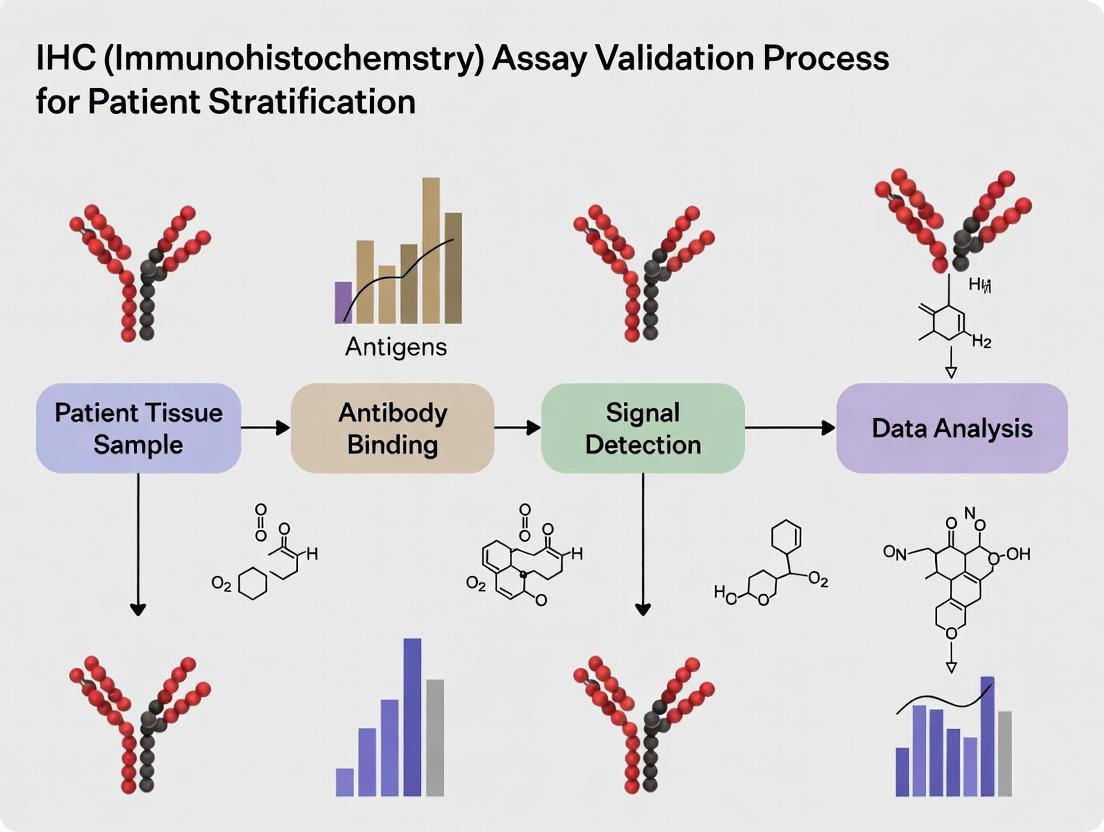
This article provides a detailed guide for researchers and drug development professionals on validating immunohistochemistry (IHC) assays for robust patient stratification in clinical trials.
IHC Validation in Precision Medicine: A Comprehensive Guide for Stratifying Patients in Clinical Trials
Abstract
This article provides a detailed guide for researchers and drug development professionals on validating immunohistochemistry (IHC) assays for robust patient stratification in clinical trials. It covers foundational principles, methodological best practices, troubleshooting strategies, and formal validation frameworks to ensure assays are analytically and clinically valid, reproducible, and compliant with regulatory expectations for precision medicine applications.
The Critical Role of IHC in Precision Medicine: Biomarker Discovery and Stratification Fundamentals
Within the thesis of IHC assay validation for patient stratification research, a rigorously validated immunohistochemistry (IHC) assay is the critical bridge between biomarker discovery and actionable clinical decisions. Unvalidated assays introduce variability that can misclassify patients, leading to failed clinical trials and, ultimately, denial of effective therapies or administration of ineffective ones with associated toxicity. This document outlines application notes and detailed protocols to anchor IHC biomarker data in analytical rigor.
Application Notes: The Pillars of IHC Validation
A fit-for-purpose validation strategy is essential. For patient stratification, assays typically require "Tier 2" validation as defined by the FDA-NIH Biomarker Working Group (BEST) guidelines, implying quantitative or semi-quantitative measurement used for treatment decisions.
Table 1: Core Validation Parameters and Acceptance Criteria
| Validation Parameter | Definition & Purpose | Typical Acceptance Criteria (Example for a HER2-like target) |
|---|---|---|
| Precision (Repeatability & Reproducibility) | Measures assay consistency across runs, days, operators, and instruments. | CV of scoring results < 20% for replicates; >90% concordance between operators and sites. |
| Accuracy | Agreement with a reference standard (e.g., FISH, PCR, orthogonal IHC method). | Overall Percent Agreement (OPA) > 90% with reference method. |
| Analytical Specificity (Selectivity) | Includes Cross-reactivity and Interference. | No staining in known negative cell lines/tissues; staining unaffected by common fixatives. |
| Sensitivity (Limit of Detection - LOD) | Lowest amount of analyte reliably detected. | Consistent, low-level staining in a weak expressor cell line/control; no staining in null control. |
| Robustness/ Ruggedness | Performance under deliberate, small variations (e.g., antigen retrieval time, antibody incubation). | Scoring results remain within precision limits despite minor protocol deviations. |
| Stability | Reagent and stained slide stability over time. | Consistent staining performance for reagent shelf-life and defined slide storage period. |
Table 2: Impact of Poor Validation on Patient Stratification Outcomes
| Validation Failure | Consequence for Research & Clinical Decision |
|---|---|
| Poor Precision | High patient misclassification rates, increased noise, inability to detect true biomarker subgroups. |
| Poor Accuracy | Discordance with other labs or standards, rendering data non-comparable and unreliable for stratification. |
| Insufficient Sensitivity | False-negative results, excluding patients who would benefit from therapy. |
| Lack of Specificity | False-positive results, exposing patients to ineffective therapies and side effects. |
Detailed Experimental Protocols
Protocol 1: Comprehensive Precision Testing
Objective: To determine intra-assay, inter-assay, inter-operator, and inter-instrument precision.
- Sample Set: Select a tissue microarray (TMA) with 10-12 cores spanning the dynamic range of expression (negative, weak, moderate, strong). Include triplicate cores of key levels.
- Experimental Runs: Perform the IHC assay on the same TMA slide across five independent runs (different days, same operator). Repeat on two different approved staining platforms.
- Scoring: Have three trained pathologists/analysts score all slides in a blinded manner. Use the validated scoring algorithm (e.g., H-score, % positive cells).
- Analysis: Calculate the Coefficient of Variation (CV%) for replicates within a run (repeatability) and between runs/days/instruments (reproducibility). Calculate inter-observer concordance (e.g., Intraclass Correlation Coefficient > 0.9 is desirable).
Protocol 2: Accuracy Assessment vs. Orthogonal Method
Objective: To establish correlation between IHC results and a quantitative molecular method.
- Sample Set: Use 30-50 archived tissue sections with known IHC biomarker status.
- Parallel Testing: Perform the validated IHC assay. From adjacent tissue sections, perform the orthogonal test (e.g., RNA-seq, RT-qPCR, or FISH for gene amplification).
- Quantification: For IHC, use a continuous score (H-score). For RT-qPCR, use log2(ΔΔCt) values.
- Analysis: Perform linear regression or Spearman correlation analysis. Establish the correlation coefficient (R² or Rho) and define the strength of agreement.
Protocol 3: Analytical Specificity (Cross-Reactivity) Check
Objective: To confirm antibody binding is specific to the target antigen.
- Cell Line Panel: Procure cell lysates or pellets from a panel of 3-5 cell lines: a) Target protein overexpressing, b) Target protein knockout/knockdown (CRISPR), c) Isoform or family member expressing lines.
- Western Blot: Run lysates on SDS-PAGE, transfer, and probe with the IHC antibody under validated conditions.
- IHC on Engineered Cells: Formalin-fix and paraffin-embed cell pellets from the above lines. Perform IHC.
- Analysis: Confirm a single band at the expected molecular weight on WB and appropriate staining only in target-expressing, not knockout, cells.
Pathway & Workflow Visualizations
Title: Consequences of IHC Validation Status on Patient Outcomes
Title: Core IHC Staining and Analysis Workflow
The Scientist's Toolkit: Essential Research Reagent Solutions
Table 3: Key Reagents for IHC Assay Validation
| Item | Function in Validation | Critical Consideration |
|---|---|---|
| Validated Primary Antibody | Specific binding to target epitope. | Clone specificity, vendor validation data, lot-to-lot consistency. |
| Isotype Control Antibody | Distinguishes specific from non-specific binding. | Matched species, immunoglobulin class, and concentration. |
| CRISPR/Cas9 Knockout Cell Line | Definitive negative control for specificity. | Used in Protocols 1 & 3 to confirm on-target activity. |
| Tissue Microarray (TMA) | Platform for precision and reproducibility studies. | Must contain biologically relevant controls across expression range. |
| Reference Standard Tissues | Benchmarks for accuracy and longitudinal performance. | Well-characterized tissues with consensus scores from a reference lab. |
| Chromogen (e.g., DAB) | Enzymatic signal generation. | Stable formulation, consistent particle size, low background. |
| Automated Staining Platform | Standardizes protocol execution. | Must be part of the validated method; protocol parameters locked. |
| Digital Pathology System | Enables quantitative, reproducible scoring. | Scanner calibration, image analysis algorithm validation. |
This document serves as a critical application note within a broader thesis on Immunohistochemistry (IHC) assay validation for patient stratification in clinical research and drug development. Proper classification and validation of biomarkers are foundational to developing robust IHC assays that can accurately identify patient subgroups, predict treatment benefit, and monitor therapeutic response. This note details the definitions, applications, and protocols for the three primary biomarker types assessed via IHC.
Biomarker Definitions and Comparative Data
Table 1: Core Characteristics of Key IHC Biomarker Types
| Biomarker Type | Primary Clinical Question | Typical IHC Target Examples | Use in Patient Stratification | Readout Timing |
|---|---|---|---|---|
| Predictive | Who will respond to a specific therapy? | PD-L1 (SP142/22C3 clones), HER2, ALK, NTRK | Directly determines treatment eligibility. | Pre-treatment |
| Prognostic | What is the likely disease outcome irrespective of therapy? | Ki-67, ER/PR in breast cancer, p53 mutational status | Informs clinical monitoring and trial enrichment, but not therapy choice alone. | Pre-treatment |
| Pharmacodynamic (PD) | Is the drug hitting its intended target? | pAKT, pERK, Cleaved Caspase-3, γH2AX | Confirms mechanism of action and guides dose selection in early-phase trials. | Pre- and Post-treatment |
Table 2: Validation Requirements Aligned with Thesis Framework
| Validation Parameter | Predictive Biomarker Assay (Primary Focus) | Prognostic Biomarker Assay | Pharmacodynamic Biomarker Assay |
|---|---|---|---|
| Analytical Sensitivity | Critical; linked to clinical cut-point. | Required for reproducible scoring. | High sensitivity to detect dynamic changes. |
| Clinical Cut-Point | Mandatory (e.g., PD-L1 ≥1%, ≥50%). | Often continuous or percentile-based. | May be relative (fold-change from baseline). |
| Assay Reproducibility | Essential for clinical decision-making. | Essential for longitudinal studies. | Critical for paired sample analysis. |
| Primary Tissue Context | Archived FFPE diagnostic samples. | Archived FFPE cohorts with outcome data. | Paired pre- and on-treatment FFPE biopsies. |
Detailed Experimental Protocols
Protocol 1: Predictive Biomarker IHC (e.g., PD-L1 22C3 on NSCLC) Objective: To validate an IHC assay for identifying NSCLC patients eligible for anti-PD-1 therapy. Materials: See "Scientist's Toolkit" below. Procedure:
- Tissue Microarray (TMA) Construction: Include cores from PD-L1 negative, low, and high-expressing NSCLC cell line pellets and known patient samples as controls.
- Sectioning: Cut TMA and test samples at 4µm onto charged slides. Dry at 60°C for 1 hour.
- Deparaffinization & Antigen Retrieval: Use automated platform with EDTA-based retrieval buffer (pH 9.0) for 20 min at 97°C.
- Primary Antibody Incubation: Apply anti-PD-L1 (Clone 22C3) at optimized dilution (e.g., 1:50) for 32 minutes at room temperature.
- Detection: Use EnVision FLEX+ visualization system with DAB as chromogen. Counterstain with hematoxylin.
- Scoring & Cut-Point Application: Score by trained pathologist using Tumor Proportion Score (TPS). Validate assay against the established clinical cut-points (≥1% and ≥50%).
Protocol 2: Pharmacodynamic Biomarker IHC (e.g., pERK in a MAPK Inhibitor Trial) Objective: To demonstrate target inhibition in paired tumor biopsies from a RAS/RAF pathway inhibitor trial. Materials: Phospho-specific anti-pERK1/2 (Thr202/Tyr204) antibody, phosphate-buffered saline (PBS). Critical Pre-Analytical Note: Phospho-epitopes are labile. Fix biopsy cores in neutral-buffered formalin within 15 minutes of acquisition. Fix for 6-24 hours. Procedure:
- Paired Sample Processing: Process pre-treatment and on-treatment (e.g., Day 15) biopsies identically.
- IHC Staining: Follow Protocol 1 steps with optimized retrieval for phospho-antigens (e.g., citrate pH 6.0).
- Quantitative Image Analysis (QIA):
- Scan slides using a high-resolution digital scanner.
- Use image analysis software to define tumor regions.
- Measure the H-score (0-300) = Σ (1 * % weak + 2 * % moderate + 3 * % strong intensity).
- Analysis: Calculate the mean H-score reduction (%) from pre- to on-treatment for each patient. A statistically significant group-level decrease confirms PD effect.
Signaling Pathway and Workflow Diagrams
Title: IHC Biomarker Decision Logic for Patient Stratification
Title: Paired Sample PD Biomarker IHC Workflow
The Scientist's Toolkit: Key Research Reagent Solutions
Table 3: Essential Materials for IHC Biomarker Validation
| Item | Function & Importance | Example |
|---|---|---|
| Validated Primary Antibodies | Clone specificity and validation for IHC on FFPE tissue are critical for reproducibility. | Anti-PD-L1 (Clone 22C3), Anti-HER2 (4B5), Anti-pERK (E10). |
| Automated IHC Stainer | Ensures standardized, high-throughput staining with minimal protocol variability. | Ventana Benchmark, Leica BOND, Agilent Dako Omnis. |
| Multitissue Control Blocks | Contains cell lines/tissues with known biomarker status for run-to-run quality control. | Commercial TMA blocks with PD-L1 high/ low/negative cores. |
| Antigen Retrieval Buffers | Unmasks epitopes cross-linked by formalin fixation; pH and buffer choice are target-dependent. | EDTA-based (pH 9.0) for PD-L1; Citrate-based (pH 6.0) for many phospho-targets. |
| Signal Detection Systems | Amplifies the primary antibody signal with high sensitivity and low background. | Polymer-based HRP systems (e.g., EnVision FLEX+, UltraView). |
| Whole Slide Scanner | Enables digital archiving, remote pathology review, and quantitative image analysis. | Aperio/Leica AT2, Hamamatsu NanoZoomer. |
| Image Analysis Software | Provides objective, quantitative scoring (H-score, % positivity) for prognostic and PD biomarkers. | HALO, Visiopharm, QuPath. |
| Isotype Controls | Distinguishes specific signal from non-specific antibody binding and background. | Mouse IgG1/kappa for monoclonal antibodies. |
Application Notes
Within the thesis framework of IHC assay validation for patient stratification, this pipeline is conceptualized as a multi-stage translational research process. It begins with biomarker discovery and culminates in a validated, clinically actionable diagnostic test. The transition from a research-grade IHC observation to a locked-down clinical assay is the critical inflection point. The following protocols and data are presented within this context, emphasizing the technical and analytical rigor required for robust patient stratification.
Table 1: Key Performance Indicators (KPIs) for IHC Assay Validation Phases
| Validation Phase | Primary Objective | Key Quantitative Metrics | Typical Acceptance Criteria (Example) |
|---|---|---|---|
| Analytical Validation | Assay Precision & Reproducibility | Intra-run CV, Inter-run CV, Inter-observer Concordance (Kappa) | CV < 15%; Kappa > 0.8 |
| Clinical Validation | Establishing Clinical Utility | Sensitivity, Specificity, Positive Predictive Value (PPV) | Sensitivity > 90%, Specificity > 95% |
| Clinical Utility | Demonstrating Patient Benefit | Hazard Ratio (HR), Relative Risk Reduction (RRR) | HR < 0.7, p-value < 0.05 |
Protocol 1: Analytical Validation of a Stratifying IHC Assay
Objective: To establish the precision, reproducibility, and dynamic range of an IHC assay intended for patient stratification.
Materials & Reagents: See "The Scientist's Toolkit" below.
Methodology:
- Sample Cohort Assembly: Select a retrospective tissue microarray (TMA) containing 50-100 cases representing the disease spectrum (e.g., tumor stages, histological subtypes). Include both known positive and negative controls.
- Staining Protocol Optimization: Using the primary antibody of interest, perform checkerboard titrations of antibody concentration and antigen retrieval conditions (pH, time). Select the optimal condition that maximizes the signal-to-noise ratio.
- Repeatability (Intra-run Precision): Stain the TMA three times in a single run. For each case, quantify the biomarker (e.g., H-Score, percentage of positive cells).
- Reproducibility (Inter-run & Inter-observer): Stain the same TMA in three independent runs on different days. Have three trained pathologists score all slides independently in a blinded manner.
- Data Analysis: Calculate the coefficient of variation (CV) for intra- and inter-run replicates. Calculate inter-observer agreement using Fleiss' Kappa statistic. Generate a linearity plot using cell line controls with known expression levels.
Protocol 2: Clinical Validation via Retrospective Cohort Analysis
Objective: To correlate IHC biomarker status with clinical outcome to define a stratifying cut-off.
Methodology:
- Cohort Selection: Identify a well-characterized retrospective patient cohort (n≥200) with annotated long-term follow-up data (e.g., overall survival, progression-free survival).
- Centralized IHC Testing: Perform IHC staining on all cohort samples in a single, centralized laboratory using the locked-down assay protocol from Protocol 1.
- Blinded Pathological Review: A panel of pathologists, blinded to clinical data, scores all slides using the predefined scoring algorithm.
- Statistical Analysis: Perform receiver operating characteristic (ROC) analysis against a clinical endpoint to determine the optimal biomarker scoring cut-off. Apply the cut-off to stratify patients into "Biomarker-High" and "Biomarker-Low" groups.
- Outcome Correlation: Use Kaplan-Meier survival analysis and log-rank test to compare outcomes between stratified groups. Calculate hazard ratios using Cox proportional hazards models.
Table 2: Example Clinical Validation Data Output
| Patient Stratum | N | Median Overall Survival (Months) | Hazard Ratio (vs. Low) | 95% Confidence Interval | p-value |
|---|---|---|---|---|---|
| Biomarker-High | 120 | 45.2 | 0.55 | 0.40 - 0.76 | 0.0003 |
| Biomarker-Low | 80 | 28.7 | Reference | -- | -- |
Visualizations
Title: The Patient Stratification Pipeline Workflow
Title: IHC-Detectable Signaling Pathway for Stratification
The Scientist's Toolkit: Key Reagent Solutions for IHC Validation
| Item | Function in Validation | Critical Specification |
|---|---|---|
| Validated Primary Antibody | Specific detection of the target biomarker. | Clone ID, host species, recommended dilution for IHC. |
| Antigen Retrieval Buffer | Unmask epitopes fixed in formalin-fixed tissue. | pH (6.0 citrate or 9.0 EDTA/Tris). |
| Detection System (HRP/DAB) | Amplify signal and generate visible chromogen precipitate. | Polymer-based systems for high sensitivity and low background. |
| Cell Line Microarray (CMA) | Controls for assay linearity and reproducibility. | Lines with known, graded expression of target. |
| Multitissue Control Block | Control for run-to-run staining consistency. | Includes known positive and negative tissues. |
| Digital Pathology Software | Quantitative image analysis for objective scoring. | Capable of H-Score, % positivity, and intensity algorithms. |
Within patient stratification research, the selection of a predictive or prognostic biomarker assay is a critical determinant of therapeutic success. Immunohistochemistry (IHC) remains a cornerstone technique for visualizing protein expression in the context of tissue architecture. However, the clinical translation of research findings hinges on rigorous assay validation. This application note defines and contextualizes the four essential pillars of IHC validation—Specificity, Sensitivity, Reproducibility, and Robustness—within a thesis framework aimed at ensuring that IHC data is analytically sound, reliable, and fit-for-purpose in guiding patient stratification and drug development decisions.
Core Definitions and Quantitative Benchmarks
Specificity: The ability of an assay to detect the target antigen without cross-reacting with other, non-target antigens. It defines the signal-to-noise ratio. Sensitivity: The lowest amount of the target antigen that an assay can reliably detect. It determines the detection threshold. Reproducibility: The precision of the assay, encompassing intra-assay (repeatability), inter-assay, inter-operator, and inter-instrument variability. Robustness: The resilience of the assay to deliberate, minor variations in protocol parameters (e.g., incubation times, temperature, reagent lot).
Table 1: Key Validation Metrics and Target Benchmarks for Patient Stratification Assays
| Validation Pillar | Metric | Typical Target Benchmark (Quantitative) | Relevance to Patient Stratification |
|---|---|---|---|
| Specificity | % Cross-reactivity (via peptide/lysate arrays) | <5% cross-reactivity with closely related isoforms | Prevents misclassification of biomarker-negative patients. |
| Sensitivity | Limit of Detection (LoD) | Detect target in cells with known low copy number (<1000 copies/cell) | Ensures detection of clinically relevant low-expressing patient subgroups. |
| Reproducibility | Coefficient of Variation (CV) for scoring (e.g., H-score) | Intra-lab CV <10%; Inter-lab CV <20% | Ensures consistent patient scoring across sites and time in clinical trials. |
| Robustness | % Deviation from reference score | <15% deviation when key parameters are altered | Ensures assay performance is maintained across routine lab conditions. |
Detailed Application Notes and Protocols
Protocol for Assessing Antibody Specificity
Objective: To confirm the primary antibody binds only to the intended target antigen.
Materials (Research Reagent Solutions):
- Target Antigen Peptide/Protein: Recombinant protein or blocking peptide for competitive inhibition.
- Cell Line Microarray: Contains isogenic cell lines with knockout (KO) of the target gene and wild-type (WT) controls.
- Multi-tissue Control Slide: Tissues with known positive and negative expression patterns.
- IHC-Validated Primary Antibody: Clone-specific antibody.
- Species-Matched Isotype Control: Non-immune IgG at the same concentration as the primary antibody.
Methodology:
- Competitive Inhibition: Pre-incubate the primary antibody with a 5-10 fold molar excess of the immunizing peptide for 1 hour at room temperature before application to the test tissue section. Process a parallel slide with non-blocked antibody.
- Genetic Validation (KO/KI): Perform IHC on formalin-fixed, paraffin-embedded (FFPE) pellets of target KO and WT isogenic cell lines.
- Isotype Control: Apply the species-matched isotype control to a serial tissue section at the same concentration as the primary antibody.
- IHC Staining: Perform full IHC protocol on all slides.
- Analysis: Specificity is confirmed by: a) Loss of signal in peptide-blocked sample, b) Absence of signal in KO cell lines with signal in WT, c) No staining with isotype control.
Protocol for Determining Analytical Sensitivity (LoD)
Objective: To establish the lowest level of target antigen the assay can consistently detect.
Methodology:
- Tissue Selection: Identify a cell line with a known, quantifiable amount of target antigen (molecules/cell) via mass spectrometry.
- Serial Dilution: Create a dilution series of the primary antibody (e.g., 1:50, 1:100, 1:200, 1:500, 1:1000).
- Staining: Stain serial sections of the FFPE cell line pellet with each antibody dilution using an otherwise identical protocol.
- Digital Image Analysis: Use quantitative digital pathology tools to measure the signal intensity (optical density) and percentage of positive cells.
- LoD Determination: The LoD is the lowest antibody concentration that yields a signal intensity statistically significantly higher (p<0.05) than the isotype control stain, while maintaining expected cellular localization.
Protocol for Assessing Inter-Laboratory Reproducibility
Objective: To evaluate the consistency of staining and scoring across multiple sites.
Methodology:
- Centralized Material Preparation: A central lab prepares and distributes identical sets of FFPE tissue microarrays (TMAs) containing a range of expression levels and negative controls.
- Standardized Protocol Distribution: All participating laboratories receive the same, detailed IHC protocol (including vendor catalog numbers for key reagents).
- Blinded Staining: Each site stains the TMAs according to the protocol on their own instrumentation.
- Digital Slide Scanning & Centralized Scoring: All stained slides are digitally scanned. Scoring (e.g., H-score, % positive cells) is performed by at least two pathologists/blinded analysts at a central location.
- Statistical Analysis: Calculate the inter-class correlation coefficient (ICC) or concordance correlation coefficient for continuous scores (H-score). For binary scoring (positive/negative), calculate Cohen's kappa. Target: ICC >0.8, Kappa >0.6.
The Scientist's Toolkit
Table 2: Essential Research Reagent Solutions for IHC Validation
| Item | Function in Validation |
|---|---|
| Isogenic Cell Line Pairs (WT/KO) | Gold standard for specificity testing, providing genetic negative controls. |
| Tissue Microarray (TMA) | Enables high-throughput analysis of multiple tissues/conditions on one slide, critical for reproducibility studies. |
| Recombinant Target Protein | Used for antibody pre-adsorption/blocking experiments to confirm specificity. |
| Automated IHC Stainer | Increases reproducibility by standardizing incubation times, temperatures, and wash steps. |
| Digital Slide Scanner & Analysis Software | Enables quantitative, objective scoring and facilitates remote, centralized review for multi-site studies. |
| Standardized Control Tissues | FFPE blocks of cell lines or tissues with known target expression levels, run with every assay to monitor sensitivity and robustness. |
Visualizations
Diagram 1: Four Pillars of IHC Validation
Diagram 2: IHC Workflow & Robustness Test Points
Companion diagnostics (CDx) are essential for the safe and effective use of corresponding therapeutic products. This application note details the regulatory frameworks of the U.S. Food and Drug Administration (FDA), the European Medicines Agency (EMA), and the Clinical Laboratory Improvement Amendments (CLIA) for CDx development and validation, contextualized within immunohistochemistry (IHC) assay validation for patient stratification in oncology research.
Key Definitions and Scope
- Companion Diagnostic Device: An in vitro diagnostic device that provides information essential for the safe and effective use of a corresponding therapeutic product.
- IHC-based CDx: Assays that detect protein expression or mutation via antigen-antibody binding in tissue sections, used for patient selection.
- Regulatory Premise: CDx are regulated as medical devices, but their review is often tied to the corresponding drug's approval (co-development).
The following table summarizes the core requirements and processes for FDA, EMA, and CLIA as they pertain to CDx.
Table 1: Comparison of FDA, EMA, and CLIA Guidelines for Companion Diagnostics
| Aspect | U.S. FDA (CDRH/CBER) | European Union (EMA & Notified Bodies) | CLIA (CMS) |
|---|---|---|---|
| Primary Guidance | In Vitro Companion Diagnostic Devices Guidance (2014, updated 2023) | IVD Regulation 2017/746 (IVDR); Guideline on good genomics biomarker practices | CLIA Regulations (42 CFR Part 493) |
| Regulatory Pathway | Premarket Approval (PMA) or 510(k) with De Novo classification. Linked review with drug (BLA/NDA). | Conformity Assessment (Annexes IX-XI of IVDR) by a Notified Body. Separate from drug MAA but coordination required. | Laboratory accreditation; not a device approval pathway. |
| Key Validation Principles | Analytical Validation, Clinical Validation, and Clinical Utility must be demonstrated. | Performance Evaluation (analytical & clinical), Scientific Validity, and Analytical Performance. | Verification of Performance Specifications (for FDA-cleared/approved tests) or Establishment of Performance Specifications (for LDTs). |
| Clinical Evidence | Requires clinical trial data demonstrating the CDx successfully identifies patients who will respond/not respond to the therapy. | Requires data establishing scientific validity and clinical performance for the intended purpose and target population. | Focuses on the lab's ability to generate accurate, reliable results; does not assess clinical utility. |
| Trial Design Considerations | Pre-specified hypotheses, statistical analysis plan, pre-defined cut-offs, and blinded evaluation. | Similar requirements. Emphasis on demonstrating clinical benefit and safety in the identified subgroup. | Not applicable to trial design. Applicable to the clinical trial testing performed by the lab. |
| Labeling Requirements | Detailed Instructions for Use (IFU) with intended use, interpretation, limitations, and clinical performance data. | Requirements per IVDR Annex I. Must include performance characteristics and scientific validity statement. | Test report must include specific elements as per CLIA regulations and the lab's established procedures. |
| Oversight of LDTs | Moving towards phased oversight under the Medical Device Regulation of LDTs (proposed rule, 2023). | Under IVDR, most CDx developed and used within a single institution (so-called "in-house" devices) face stricter rules (Article 5(5)). | Primary regulator for Laboratory Developed Tests (LDTs) via accreditation and proficiency testing. |
Application to IHC Assay Validation Protocols
Within a thesis on IHC assay validation, aligning experimental protocols with regulatory expectations is critical for translational research. The following protocols are designed to meet the analytical validation requirements common to all frameworks.
Protocol: Analytical Validation of an IHC-Based CDx Assay
Objective: To establish the analytical performance characteristics of an IHC assay detecting a therapeutic target (e.g., PD-L1, HER2) for patient stratification.
Experimental Workflow:
Diagram Title: IHC Assay Analytical Validation Workflow
Detailed Methodology:
Step 1: Intended Use & Sample Selection
- Clearly define the biomarker, disease indication, and clinical decision point (e.g., "Detection of PD-L1 expression on tumor cells in NSCLC to identify patients for Drug X").
- Procure a well-characterized, IRB-approved set of Formalin-Fixed, Paraffin-Embedded (FFPE) tissue specimens. Include positive, negative, and borderline expression levels, and relevant normal tissues. Create Tissue Microarrays (TMAs) for high-throughput staining.
Step 2: Limit of Detection (LOD) / Antibody Titration
- Perform a chessboard titration of the primary antibody (e.g., 1:50, 1:100, 1:200, 1:400, 1:800) on a TMA containing cells/tissues with known, low-level target expression.
- Use standardized antigen retrieval, detection system, and visualization.
- Determine the lowest antibody concentration that provides specific, reproducible staining above background (negative control). This concentration plus a safety margin becomes the working dilution.
Step 3: Analytical Specificity
- Cross-reactivity: Stain a panel of tissues known to express phylogenetically related proteins or common interfering antigens (e.g., endogenous immunoglobulins). Assess for off-target staining.
- Interference: Spike tissue sections with potential interferents (e.g., hemoglobin, bilirubin, mucin) or subject tissues to varying ischemic times pre-fixation. Compare staining to controls.
Step 4: Precision
- Repeatability (Intra-assay): Stain the same TMA slide 3 times in one run by one operator on one instrument. Calculate percent agreement (e.g., >95%).
- Reproducibility (Inter-assay, Inter-operator, Inter-site): Stain the same TMA set across 3 different days, by 3 trained operators, and potentially at 3 different labs. Use different reagent lots and instrument calibrations. Analyze using Cohen's Kappa statistic (κ > 0.6 indicates substantial agreement).
Step 5: Robustness
- Deliberately introduce minor variations in key parameters: antigen retrieval time (± 5 min), primary incubation time (± 10%), antibody dilution (± 1 step from working dilution). Assess impact on staining intensity and distribution.
Step 6: Scoring System Validation
- At least 3 board-certified pathologists, blinded to clinical data, score a representative set of 60-100 cases using the pre-defined scoring algorithm (e.g., Tumor Proportion Score for PD-L1).
- Assess inter-observer variability using Intraclass Correlation Coefficient (ICC) for continuous scores or Fleiss' Kappa for categorical scores. Target ICC > 0.9 or κ > 0.8.
Protocol: Clinical Validation via Retrospective Archival Study
Objective: To establish the clinical performance (sensitivity, specificity) of the IHC assay by correlating biomarker status with clinical outcome data from a historical cohort.
Experimental Workflow:
Diagram Title: Clinical Validation Using Retrospective Cohort
Detailed Methodology:
Step 1: Cohort & Endpoint Definition
- Identify a patient cohort treated uniformly with the drug of interest, with documented clinical outcomes (e.g., Objective Response Rate (ORR), Progression-Free Survival (PFS)).
- Define the primary clinical endpoint (e.g., ORR per RECIST 1.1). Pre-specify the statistical analysis plan, including hypotheses.
Step 2: Sample Acquisition & QC
- Retrieve archival FFPE blocks linked to the cohort. Ensure samples are treatment-naïve (pre-therapy).
- Perform H&E staining to confirm presence of sufficient tumor content (>XX%) and assess tissue quality.
Step 3-4: Blinded Staining and Scoring
- Perform IHC staining on all qualified samples in a single batch using the analytically validated protocol.
- A minimum of two pathologists, blinded to all clinical data, independently score the slides. Resolve discrepant cases through a consensus meeting.
Step 5: Statistical Analysis & Cut-off Optimization
- Unblind the biomarker scores to the clinical response data.
- Construct a 2x2 contingency table (Biomarker Positive/Negative vs. Responder/Non-responder).
- Calculate clinical sensitivity, specificity, Positive Predictive Value (PPV), and Negative Predictive Value (NPV).
- If the score is continuous (e.g., percentage of positive cells), perform Receiver Operating Characteristic (ROC) analysis to determine the optimal clinical cut-off that maximizes Youden's Index or balances sensitivity/specificity for the therapeutic context.
The Scientist's Toolkit: Key Reagent Solutions for IHC CDx Development
Table 2: Essential Materials for IHC Companion Diagnostic Development
| Research Reagent / Material | Function & Regulatory Consideration |
|---|---|
| Primary Antibody (Clone Specific) | The core detection reagent. Must be extensively characterized for specificity and lot-to-lot consistency. Documentation of sourcing and characterization is critical for regulatory submission. |
| Isotype & Negative Control Reagents | Essential for distinguishing specific from non-specific staining. Validated negative controls must be run with every assay batch. |
| Reference Standard Tissues | Well-characterized FFPE tissues with known biomarker status (positive, negative, borderline). Used for assay calibration, qualification of new reagent lots, and daily run validation. |
| Automated IHC Staining Platform | Ensures standardization and reproducibility. Platform-specific protocols must be locked down and validated. Reagent compatibility must be confirmed. |
| Validated Detection Kit (e.g., HRP Polymer) | Amplifies the primary antibody signal. Must be optimized and validated as a system with the primary antibody. Changes require re-validation. |
| Chromogen (e.g., DAB) | Produces the visible stain. Must provide consistent color development and be stable for archival purposes. |
| Digital Pathology & Image Analysis System | For quantitative or semi-quantitative scoring. Algorithms must be validated for accuracy and precision against manual pathologist scoring. |
| Documentation & LIMS System | Tracks all protocol deviations, reagent lots, instrument calibrations, and raw data. Essential for demonstrating control and traceability during audits. |
Building a Robust IHC Assay: Step-by-Step Protocol Development and Standardization
Within the context of IHC assay validation for patient stratification research, the integrity of pre-analytical variables is paramount. Variability introduced during tissue handling directly impacts antigenicity, morphology, and staining reproducibility, thereby threatening the validity of biomarker data used for therapeutic decision-making. This document outlines best practices and standardized protocols to minimize pre-analytical variation.
Tissue Collection & Grossing
Best Practice: Immediate and systematic handling post-resection is critical to prevent ischemic and autolytic changes. For stratification biomarkers like phospho-proteins, cold ischemia time must be controlled and documented.
Protocol: Standard Operating Procedure for Biopsy Grossing
- Receipt & Triaging: Record specimen receipt time. Place specimen in pre-champed saline-moistened gauze in a labeled container on wet ice if immediate processing is delayed.
- Orientation & Inking: For oriented specimens (e.g., skin excisions), use standardized ink colors (e.g., blue for deep margin) to maintain spatial context critical for staging.
- Sectioning: Using a clean, sharp blade, slice tissue into slices no thicker than 4-5 mm to ensure adequate fixative penetration. For large specimens, submit representative sections including tumor-normal interface and suspected areas of invasion.
- Documentation: Record cold ischemia time (CIT) from devascularization to fixation start, specimen dimensions, and block key.
Fixation
Best Practice: Neutral Buffered Formalin (NBF) remains the gold standard. Fixation time must be standardized, as under-fixation leads to poor morphology and antigen loss, while over-fixation causes excessive cross-linking and antigen masking.
Protocol: Optimal Formalin Fixation for IHC
- Fixative Volume: Use a 10:1 ratio of 10% NBF volume to tissue volume.
- Fixation Duration: Immerse tissue slices (4-5mm thick) in NBF for 24-48 hours at room temperature. For core needle biopsies, 6-12 hours may be sufficient.
- Validation Monitoring: For assay validation, include control tissues with known fixation times to establish the impact on your target antigens. Phospho-epitopes may require fixation initiation within minutes.
- Post-Fixation: After adequate fixation, transfer tissue to 70% ethanol for storage or proceed directly to processing.
Table 1: Impact of Formalin Fixation Time on Antigen Detection
| Antigen Class | Short Fixation (<6h) Risk | Optimal Fixation Window | Prolonged Fixation (>72h) Risk | Recommended Antigen Retrieval |
|---|---|---|---|---|
| Labile Epitopes (e.g., phospho-ERK1/2) | High false-negative rate | 18-24 hours | Severe masking, irreversible | High-pH, EDTA-based retrieval |
| Nuclear Antigens (e.g., Ki-67, ER) | Potential false-negative/weak | 18-36 hours | Moderate to severe masking | High-pH retrieval |
| Membrane Antigens (e.g., HER2, PD-L1) | Good detection, poor morphology | 18-48 hours | Masking, especially intracellular | Low- or high-pH depending on clone |
| Cytosolic Antigens (e.g., Cytokeratins) | Good detection | 24-48 hours | Mild to moderate masking | Protease or heat-induced retrieval |
Tissue Processing & Embedding
Best Practice: Automated tissue processors using graded alcohols and xylene (or substitutes) followed by paraffin infiltration are standard. Incomplete dehydration or clearing leads to poor ribboning and section artifacts.
Protocol: Paraffin Embedding for Consistent Orientation
- Processing: Use a standard 12-16 hour processing schedule with graded ethanol (70%, 80%, 95%, 100%), clearing agent, and molten paraffin (58-60°C).
- Embedding Mold Selection: Choose a mold size appropriate to the tissue. Pour molten paraffin into the mold.
- Orientation: Using warm forceps, place the tissue into the mold with the critical cutting plane (e.g., mucosal surface, tumor margin) facing the mold bottom. Chill on a cold plate.
- Block Storage: Store blocks in a cool, dry place to prevent oxidation and sectioning difficulties.
Sectioning & Slide Preparation
Best Practice: Section thickness uniformity is critical for quantitative IHC analysis. Wrinkles, folds, or chatter compromise analysis and automated scanning.
Protocol: Microtomy for IHC-Ready Sections
- Block Trimming: Cool the block on ice for 10-15 minutes. Trim the block face until the full tissue surface is exposed.
- Sectioning: Cut 4-5 µm thick sections using a sharp, clean microtome blade. Use a slow, steady cutting motion.
- Water Bath: Float sections on a clean water bath set at 40-45°C (below paraffin melting point) to expand wrinkles.
- Slide Mounting: Use positively charged or adhesive-coated slides. Carefully pick up the section from the water bath, ensuring no folds.
- Drying: Dry slides horizontally in a 37°C incubator overnight or a 60°C oven for 20-60 minutes to ensure adhesion.
Table 2: Common Sectioning Artifacts and Remedies
| Artifact | Cause | Effect on IHC | Preventive Action |
|---|---|---|---|
| Chatter/Thick-Thin | Dull blade, loose block, vibration | Uneven staining, inaccurate quantification | Use sharp blade, secure block, steady cutting speed |
| Folds/Wrinkles | Section compression, improper water bath temp | Obscured morphology, failed image analysis | Adjust blade angle, optimize bath temperature |
| Float-Off | Inadequate slide coating or drying | Loss of tissue, incomplete staining | Use positively charged slides, ensure complete drying |
| Knife Lines/Scratches | Nicks in microtome blade | Streaking, tears in tissue | Change blade frequently, use intact blade area |
The Scientist's Toolkit: Key Reagents & Materials
| Item | Function & Rationale |
|---|---|
| 10% Neutral Buffered Formalin (NBF) | Gold-standard fixative. Provides cross-linking that preserves morphology while allowing antigen retrieval. |
| Positively Charged Microscope Slides | Electrostatic attraction between slide and negatively charged tissue prevents detachment during rigorous IHC procedures. |
| High-Purity Paraffin Wax (58-60°C melting point) | Infiltrates tissue to provide support for thin sectioning. Consistent purity and melting point ensure uniform block hardness. |
| Ethanol Series (70%, 95%, 100%) | Dehydrates tissue post-fixation in a graded manner to prevent severe tissue shrinkage and distortion. |
| Xylene or Xylene-Substitute | Clears alcohol from tissue, enabling paraffin infiltration. Essential for transparent, sectionable blocks. |
| EDTA or Citrate-Based Antigen Retrieval Buffer | Reverses formaldehyde-induced cross-links, re-exposing epitopes for antibody binding. Choice impacts staining intensity. |
| Adhesive Microtome Blades | High-quality, disposable blades ensure consistent, artifact-free sectioning critical for digital pathology. |
Visualizing the Impact of Pre-Analytical Variables on IHC Validation
Key Experimental Protocol: Validation of Fixation Time for a Labile Biomarker
Objective: To determine the maximum permissible cold ischemia time (CIT) and optimal formalin fixation time for reliable detection of phospho-S6 (pS6) in colorectal carcinoma, a potential stratification biomarker.
Methodology:
- Tissue Source: Obtain fresh colorectal tumor tissue from surgical resection under IRB approval.
- Ischemia Simulation: Immediately post-resection, slice tumor into identical 5mm cubes. Assign cubes to CIT groups: 0, 10, 30, 60, 120 minutes. Hold at room temperature in a humid chamber.
- Fixation Time Course: For each CIT group, subdivide tissue and fix in NBF for: 6h, 12h, 24h, 48h, 72h (n=3 per condition).
- Control Processing: Process all tissues simultaneously through standard dehydration, clearing, and paraffin embedding.
- IHC Staining: Section all blocks at 4µm. Perform pS6 IHC using a validated protocol with automated staining. Include a positive control slide fixed under ideal conditions (short CIT, 24h fixation).
- Analysis: Use digital pathology to quantify H-score (intensity x distribution) for tumor cells. Perform statistical analysis (ANOVA) to identify significant drops in H-score attributable to CIT or over-fixation.
Expected Outcome: Establishment of a Standard Operating Procedure (SOP) mandating fixation initiation within 30 minutes of resection and a fixation window of 12-24 hours for reliable pS6 IHC in subsequent clinical validation studies.
Within the critical context of IHC assay validation for patient stratification research, the optimization of core protocols is paramount. Reproducible, specific, and quantitative IHC data is the cornerstone for identifying predictive and prognostic biomarkers essential for drug development and personalized treatment strategies. This document provides detailed application notes and experimental protocols for the four foundational pillars of IHC optimization.
Antibody Selection and Characterization
Thesis Context: Selecting a fit-for-purpose antibody is the first step in developing a validated IHC assay for patient stratification. The chosen antibody must demonstrate specificity and consistency across patient-derived tissue samples.
Application Notes:
- Primary Consideration: Antibodies must be validated for IHC on FFPE tissue. Rely on vendor-provided validation data (e.g., KO cell line validation, siRNA knockdown, mass spectrometry verification).
- Clonality: Monoclonal antibodies offer superior batch-to-batch consistency, critical for longitudinal studies. Polyclonals may offer higher signal but require rigorous lot validation.
- Compatibility: Confirm host species compatibility with detection system and tissue endogenous immunoglobulins.
Protocol: Initial Antibody Characterization via Western Blot & Cell Pellet IHC
- Prepare lysates from cell lines with known target expression (positive) and no expression (negative/KO).
- Perform Western blot analysis using the candidate antibody. A single band at the expected molecular weight is ideal.
- Create formalin-fixed, paraffin-embedded (FFPE) cell pellets from the same cell lines.
- Section and process pellets alongside control tissues.
- Perform IHC. Compare signal intensity and localization between positive and negative pellets to assess specificity in an IHC context.
Research Reagent Solutions:
| Item | Function in IHC Assay Validation |
|---|---|
| Validated Primary Antibodies | Specifically bind the target antigen; the key reagent defining assay specificity. Must be validated for IHC-P. |
| Isotype Control Antibodies | Control for non-specific binding of immunoglobulins. Critical for background assessment. |
| Cell Lines (WT & KO) | Provide controlled biological material for initial antibody specificity testing. |
| Control Tissue Microarrays (TMAs) | Contain multiple tissue types with known expression patterns for assay optimization and validation. |
Antibody Titration and Signal-to-Noise Optimization
Thesis Context: Determining the optimal antibody dilution is essential to maximize specific signal while minimizing background, ensuring the assay is both sensitive and specific across a patient cohort with variable antigen expression levels.
Application Notes:
- The goal is to identify the "plateau of optimum dilution" – the highest dilution that gives strong specific staining with minimal background.
- Titration must be performed on a relevant biological control tissue containing both positive and negative cell populations.
- Use the same antigen retrieval and detection conditions for all titration slides.
Protocol: Checkerboard Titration of Primary Antibody
- Select a control TMA or tissue section with known heterogeneous target expression.
- Perform standardized antigen retrieval on all slides.
- Prepare a series of primary antibody dilutions (e.g., 1:50, 1:100, 1:200, 1:500, 1:1000). Include a no-primary-antibody control.
- Apply antibodies to serial sections and run IHC under identical conditions using the same detection kit.
- Evaluate slides microscopically. Score both specific signal intensity in positive cells and non-specific background in negative areas.
Table: Example Titration Results for Anti-PD-L1 (Clone 22C3) on Tonsil FFPE
| Antibody Dilution | Specific Signal (Germinal Center) | Background (Mantle Zone) | Signal-to-Noise Ratio | Optimal |
|---|---|---|---|---|
| 1:50 | Strong (3+) | High | Low | No |
| 1:100 | Strong (3+) | Moderate | Moderate | Yes |
| 1:200 | Moderate (2+) | Low | High | Yes |
| 1:500 | Weak (1+) | Very Low | Moderate | No |
| No Primary | None (0) | Very Low | N/A | Control |
Visualization: Antibody Titration Optimization Logic
Diagram 1: Antibody titration optimization logic flow.
Antigen Retrieval (AR) Optimization
Thesis Context: The choice of AR method directly impacts epitope exposure and is highly dependent on the primary antibody and the fixation history of patient samples. Consistent AR is vital for uniform staining across a patient cohort.
Application Notes:
- Heat-Induced Epitope Retrieval (HIER) using a pressure cooker, microwave, or water bath is most common for FFPE tissue.
- pH is Critical: Test both low pH (Citrate, pH ~6.0) and high pH (Tris-EDTA, pH ~9.0) retrieval buffers.
- Proteolytic-Induced Epitope Retrieval (PIER) may be necessary for some masked epitopes but requires precise timing to avoid tissue damage.
Protocol: Comparison of Antigen Retrieval Methods
- Select serial sections from a control FFPE block.
- Deparaffinize and rehydrate slides.
- Perform HIER using different buffers:
- Group A: 10mM Sodium Citrate, pH 6.0, 95-100°C, 20 min.
- Group B: 1mM EDTA, pH 8.0-9.0, 95-100°C, 20 min.
- Group C (Optional): Proteinase K, 0.05% in Tris-HCl, 37°C, 5-10 min.
- Cool slides appropriately (HIER: cool to room temp in buffer for 20-30 min).
- Proceed with the same optimized primary antibody and detection system for all slides.
- Compare the intensity, localization, and background of staining.
Table: Antigen Retrieval Method Comparison for Nuclear Antigen (e.g., ER)
| Retrieval Method | Buffer & pH | Intensity | Background | Nuclear Specificity | Recommended |
|---|---|---|---|---|---|
| HIER (Pressure Cooker) | Citrate, pH 6.0 | Strong | Low | Excellent | Yes |
| HIER (Pressure Cooker) | Tris-EDTA, pH 9.0 | Moderate | Moderate | Good | Conditional |
| Proteolytic (Proteinase K) | Tris, pH 7.5 | Weak | High | Poor | No |
Detection System Selection
Thesis Context: The detection system amplifies the primary antibody signal and must be matched to the expression level of the target and the required sensitivity for patient stratification. Polymer-based systems are now standard.
Application Notes:
- Polymer-based systems (e.g., HRP/DAB polymers) offer high sensitivity, low background, and are suitable for most targets.
- Amplification systems (e.g., Tyramide Signal Amplification - TSA) are used for low-abundance targets but increase complexity and risk of background.
- Chromogen Choice: DAB (brown) is standard and robust. Other chromogens (e.g., AEC, red) allow for multiplexing or provide better contrast on certain tissues.
Protocol: Standardized IHC Workflow with Polymer Detection
- Deparaffinization & Rehydration: Xylene (3x), 100% Ethanol (2x), 95% Ethanol, 70% Ethanol, dH₂O.
- Antigen Retrieval: As optimized (e.g., HIER in Citrate pH 6.0).
- Peroxidase Blocking: Incubate with 3% H₂O₂ for 10 min to quench endogenous peroxidase activity.
- Protein Block: Apply 2.5-5% normal serum or protein block for 10-30 min to reduce non-specific binding.
- Primary Antibody: Apply optimized dilution for 30-60 min at RT or overnight at 4°C.
- Polymer-HRP Conjugate: Apply enzyme-labeled polymer for 30 min. (Polymer contains secondary anti-host antibodies).
- Chromogen Development: Apply DAB substrate for 3-10 min. Monitor microscopically.
- Counterstain & Mount: Hematoxylin counterstain, dehydrate, clear, and mount with permanent medium.
Visualization: Core IHC Protocol Workflow
Diagram 2: Standard IHC protocol workflow for validation.
Research Reagent Solutions (Detection):
| Item | Function in IHC Assay Validation |
|---|---|
| Polymer-Based Detection Kits (HRP/AP) | Provide sensitive, low-background signal amplification. Essential for consistent quantitative analysis. |
| Chromogen Substrates (DAB, AEC) | Enzyme substrates that produce a visible, insoluble precipitate at the antigen site. |
| Hematoxylin Counterstain | Provides morphological context by staining nuclei. |
| Automated IHC Stainer | Ensures precise, reproducible timing and reagent application across all patient samples in a cohort. |
In the context of immunohistochemistry (IHC) assay validation for patient stratification research, robust quality control (QC) is the cornerstone of generating reliable, reproducible, and clinically actionable data. The implementation of a comprehensive control strategy is non-negotiable for ensuring that observed staining patterns are specific, sensitive, and accurately reflect the true biomarker status of a tissue sample. This document outlines the application, protocols, and critical materials for deploying Positive, Negative, Internal, and External Controls within an IHC validation framework.
Categories and Applications of Controls
Controls are systematically integrated to monitor every aspect of the IHC assay, from antigen retrieval to chromogen detection.
Table 1: Core Control Types in IHC Validation
| Control Type | Purpose | Example in Patient Stratification | Acceptance Criteria |
|---|---|---|---|
| Positive Control | Verifies assay sensitivity and protocol functionality. | A tissue microarray (TMA) with known positive cell lines or patient cores confirmed for the target (e.g., HER2 3+ breast carcinoma). | Expected intensity and distribution of staining is achieved. |
| Negative Control | Confirms assay specificity by detecting non-specific binding or background. | Isotype control antibody or primary antibody omission on consecutive tissue sections. | Absence of specific staining in target cells. |
| Internal (Endogenous) Control | Assesses tissue fixativity, processing, and reaction run conditions within the test sample itself. | Normal adjacent tissue (e.g., non-neoplastic breast ducts for ER assay) or ubiquitously expressed proteins (e.g., Beta-actin). | Appropriate staining in expected internal control cells. |
| External (Run) Control | Monitors inter-assay precision and batch-to-batch reagent variability. | A standardized control slide (e.g., a multi-tissue block) included in every staining run. | Staining results fall within established historical ranges. |
Detailed Experimental Protocols
Protocol 2.1: Assembly and Use of a Positive/Negative Control Tissue Microarray (TMA)
Objective: To create a reusable resource for simultaneous validation of assay sensitivity and specificity. Materials: Recipient paraffin block, core needle, TMA construction instrument, donor blocks with known positive and negative status, charged slides. Procedure:
- Design: Map the TMA layout. Include 2-3 cores of strong positive, weak positive, negative (known absent), and isotype control-reactive tissues.
- Core Extraction: Using a hollow needle, extract cores (0.6-2.0 mm diameter) from designated donor blocks.
- Arraying: Insert cores into pre-drilled holes in the recipient paraffin block in the predefined pattern.
- Sectioning: Cut 4-5 μm sections from the completed TMA block and mount on charged slides.
- Use: Include one TMA section on every staining run. Evaluate positive controls for expected signal and negative controls for absence of off-target staining.
Protocol 2.2: Implementation of Internal and Reagent Controls
Objective: To validate the integrity of each individual test specimen and the specificity of the primary antibody. Materials: Test tissue section, consecutive or serial sections, isotype-matched control antibody, antibody diluent. Procedure:
- Slide Labeling: Label slides for (A) Test Antibody, (B) Primary Antibody Omission (Buffer only), and (C) Isotype Control.
- Titration: The isotype control antibody should be used at the same protein concentration as the primary antibody.
- Staining: Process slides A, B, and C through the identical IHC protocol (deparaffinization, retrieval, blocking, incubation, detection).
- Analysis: Compare staining in Slide A (Test) to Slides B and C. Specific staining is valid only if it is absent in the negative controls (B & C). Internal control tissues (if present) must also stain appropriately.
Protocol 2.3: Establishing an External Quality Control Program
Objective: To ensure longitudinal consistency and inter-laboratory reproducibility. Materials: Commercially available or internally validated multi-tissue control slides, QC tracking software/logbook. Procedure:
- Selection: Choose an external control that represents a range of expected reactivity (negative, weak, moderate, strong).
- Integration: Incorporate this control slide into the first and last positions of every IHC staining run.
- Quantification: Using image analysis, record the H-Score, percentage positivity, or staining intensity in predefined control regions.
- Tracking: Plot results on a Levey-Jennings control chart. Establish mean and acceptable standard deviation limits (e.g., ± 3 SD).
- Action: Define corrective actions (e.g., reagent re-titration, instrument maintenance) for when results fall outside pre-set limits.
Visualized Workflows and Relationships
Title: Decision Flow for IHC Quality Control in Assay Validation
Title: Workflow for Integrating Multiple Control Types in an IHC Run
The Scientist's Toolkit: Essential Research Reagent Solutions
Table 2: Key Materials for IHC Control Strategies
| Item | Function in QC | Example Product/Note |
|---|---|---|
| Multi-Tissue Control Blocks | Source for consistent positive/negative tissue cores for TMA construction. | Commercial blocks (e.g., from Pantomics, US Biomax) or clinically validated internal archives. |
| Isotype Control Antibodies | Matched immunoglobulin of the same species, class, and conjugation but irrelevant specificity. | Essential for distinguishing specific from non-specific binding. Must match host species and IgG subclass of primary antibody. |
| Cell Line Pellet Blocks | Renewable source of homogeneous positive/negative control material. | Cultured cell lines with known biomarker status, formalin-fixed and pelleted into paraffin blocks. |
| Reference Standard Slides | Pre-stained, characterized slides for external QC and training. | Used for benchmarking new lots of antibodies or detection systems. |
| Validated Primary Antibody | The critical reagent for biomarker detection. | Clone, catalog number, and optimal dilution must be locked down during validation. |
| Automated Stainer & Reagents | Ensures consistent protocol execution. | Use the same platform and lot of detection kit (e.g., polymer-HRP/DAB) for the entire validation study. |
| Image Analysis Software | Enables quantitative scoring of controls and test samples. | Allows for objective H-score, percentage positivity, and QC chart generation for external controls. |
Immunohistochemistry (IHC) is a cornerstone of biomarker assessment in precision oncology. Robust scoring systems are critical for translating complex protein expression patterns into reliable, clinically actionable data for patient stratification. This document details the development and validation pathways for Quantitative, Semi-Quantitative, and Digital Image Analysis (DIA)-based scoring methodologies within the framework of a comprehensive IHC assay validation thesis. The goal is to ensure analytical and clinical validity, enabling reproducible stratification of patients into treatment-relevant cohorts.
Comparison of Scoring Methodologies
Table 1: Core Characteristics of IHC Scoring Systems
| Feature | Semi-Quantitative (Manual) | Quantitative (Manual/DIA) | DIA (Automated) |
|---|---|---|---|
| Primary Output | Ordinal score (e.g., 0, 1+, 2+, 3+; H-score 0-300) | Continuous variable (e.g., % positivity, optical density) | Continuous & spatial metrics (e.g., cell count, stain intensity, density) |
| Typical Method | Visual assessment by pathologist | Manual counting with grid/software or basic DIA | Advanced image analysis algorithms |
| Throughput | Low to Moderate | Moderate | High |
| Reproducibility | Moderate (subject to inter-observer variability) | High (quantitative) to Very High (DIA) | Very High (when validated) |
| Data Complexity | Low | Moderate | High (multiparametric) |
| Key Validation Metrics | Inter-rater reliability (Kappa), Concordance | Accuracy, Precision, Linearity, LoD | Algorithm repeatability/reproducibility, concordance to gold standard |
Table 2: Validation Metrics Summary for Different Scoring Systems
| Validation Tier | Parameter | Semi-Quantitative Target | Quantitative/DIA Target |
|---|---|---|---|
| Analytical Performance | Intra-assay Precision (Repeatability) | >0.90 Cohen's Kappa | CV <10% (for continuous data) |
| Inter-assay Precision (Reproducibility) | >0.80 Cohen's Kappa | CV <15% | |
| Inter-Observer Concordance | >0.80 Fleiss' Kappa | N/A (for full DIA) | |
| Accuracy (vs. Reference Method) | >90% Overall Agreement | R² > 0.95, Slope 0.9-1.1 | |
| Limit of Detection (LoD) | Consistent scoring at low-expressing levels | Statistical detection above negative control | |
| Clinical Validity | Assay Cut-off Alignment | Clinical relevance of score tiers | ROC-optimized continuous cutpoint |
| Sample Type Robustness | Consistent scoring across biopsy types | Consistent performance across tissue types |
Experimental Protocols
Protocol 3.1: Development and Analytical Validation of a Semi-Quantitative H-Score
Objective: To establish a reproducible manual H-score method for a nuclear biomarker (e.g., ER).
Materials & Workflow:
- Slides: Consecutive sections from a tissue microarray (TMA) with known positive/negative controls.
- Scoring Parameters: Define intensity grades (0=negative, 1+=weak, 2+=moderate, 3+=strong) and percentage estimation bins.
- Blinded Review: Two certified pathologists score each TMA core independently.
- Calculation: H-score = Σ (1 * %1+ cells) + (2 * %2+ cells) + (3 * %3+ cells). Range 0-300.
- Analysis:
- Calculate inter-rater reliability using Intraclass Correlation Coefficient (ICC) for agreement on the continuous H-score.
- Calculate categorical concordance (e.g., for clinically relevant bins like 0, 1-100, 101-200, 201-300) using Weighted Cohen's Kappa.
- Assess intra-rater repeatability by having each pathologist re-score 10% of slides after a 2-week washout period.
Protocol 3.2: Validation of a Quantitative DIA Algorithm for a Membrane Biomarker
Objective: To validate an automated DIA algorithm for quantifying HER2 membrane staining intensity and completeness.
Materials & Workflow:
- Algorithm Training: Use a separate training set of annotated slides to train algorithm for membrane detection, intensity classification, and tumor cell segmentation.
- Validation Set: A TMA with 100 cases encompassing 0, 1+, 2+, 3+ scores by consensus manual review (gold standard).
- Image Acquisition: Scan all slides at 40x magnification using a calibrated whole-slide scanner under consistent illumination.
- DIA Analysis: Run the trained algorithm on validation images. Outputs: Continuous scores (e.g., average membrane optical density, % membrane completeness).
- Statistical Validation:
- Precision: Run the algorithm on 10 representative slides 10 times (repeatability) and across 3 different days (reproducibility). Report CV for continuous outputs.
- Accuracy/Concordance: Create a scatter plot of DIA continuous score vs. manual consensus score. Calculate Pearson correlation.
- Clinical Concordance: Use the DIA score to classify cases into 0, 1+, 2+, 3+ based on pre-defined thresholds. Generate a confusion matrix vs. gold standard and calculate overall percent agreement (OPA) and Cohen's Kappa.
Protocol 3.3: Cut-point Analysis for Patient Stratification
Objective: To determine the optimal cut-point for a continuous DIA score to stratify patients into "Positive" vs. "Negative" cohorts using clinical outcome data.
Materials & Workflow:
- Cohort: A retrospective cohort with linked IHC data (DIA continuous score) and relevant clinical outcome (e.g., progression-free survival, PFS).
- Method: Perform Receiver Operating Characteristic (ROC) analysis if a binary clinical endpoint is available (e.g., responder/non-responder).
- Alternative Method: If the endpoint is time-to-event (e.g., PFS), use maximally selected rank statistics (e.g., via
maxstatR package) to find the cut-point that maximizes the separation between survival curves. - Validation: The statistically derived cut-point must be locked and then tested on an independent validation cohort to confirm its predictive power.
Diagrams
IHC Scoring Validation Workflow
Digital Image Analysis (DIA) Pipeline
The Scientist's Toolkit: Research Reagent & Material Solutions
Table 3: Essential Materials for IHC Scoring Validation Studies
| Item | Function & Relevance to Validation |
|---|---|
| Tissue Microarray (TMA) | Contains multiple tissue cores on one slide, enabling high-throughput, parallel analysis of precision and reproducibility across diverse samples. Essential for precision studies. |
| Certified Reference Materials | Commercially available cell lines or tissues with known biomarker expression levels. Critical for establishing assay accuracy and monitoring longitudinal performance. |
| Whole-Slide Scanner | A high-resolution digital pathology scanner. Must be calibrated for consistent light intensity. Fundamental for DIA, enabling digital workflow and algorithm deployment. |
| Image Analysis Software | Platforms (e.g., QuPath, HALO, Visiopharm) for developing and running DIA algorithms. Includes tools for annotation, segmentation, and feature extraction. |
| Pathologist-Annotated Digital Slides | The "ground truth" dataset for training and validating DIA algorithms. Requires annotations from multiple experts to account for biological and interpretative heterogeneity. |
| Statistical Analysis Software | Tools (e.g., R, Python with scikit-learn, MedCalc) for performing critical validation statistics: ICC, Kappa, ROC analysis, survival-based cut-point finding. |
Within patient stratification research, immunohistochemistry (IHC) serves as a critical tool for translating biomarker discovery into clinical decision-making. The transition from a research-grade protocol to a locked, standardized Standard Operating Procedure (SOP) is the foundational step for achieving reproducible, multi-site data required for robust validation. This article details the essential components of this documentation process, providing application notes and protocols framed within the broader thesis of IHC assay validation.
The Critical Gap: Protocol vs. SOP
A protocol is a descriptive method, while an SOP is a prescriptive, controlled document designed to minimize inter-operator and inter-site variability. Key differences are summarized below.
Table 1: Distinguishing Characteristics of a Protocol versus an SOP
| Feature | Research Protocol | Validation-Ready SOP |
|---|---|---|
| Objective | Enable discovery; allow flexibility. | Ensure reproducibility; eliminate variability. |
| Specificity | May list ranges (e.g., "incubate 10-30 min"). | Defines exact values (e.g., "incubate 20 min ± 1 min"). |
| Reagent Specification | Often uses generic descriptions (e.g., "anti-p53 antibody"). | Requires precise catalog numbers, lot numbers, and preparation details. |
| Acceptance Criteria | Rarely included. | Mandatory; defines pass/fail for controls. |
| Change Control | Informal; updated as needed. | Formal; requires documented review and re-validation. |
| Primary User | Individual researcher or lab group. | Any trained operator across multiple sites. |
Core Components of an IHC SOP for Multi-Site Use
A comprehensive SOP must address pre-analytical, analytical, and post-analytical phases.
1. Pre-Analytical Section: Tissue Handling & Processing
- Sample Acceptance Criteria: Define acceptable tissue type(s), fixative (e.g., 10% Neutral Buffered Formalin), fixation time window (e.g., 18-24 hours), and transport conditions.
- Embedding & Sectioning: Specify embedding medium, microtome type, section thickness (e.g., 4 µm ± 0.5 µm), and slide type (e.g., positively charged or adhesive).
2. Analytical Section: Staining Procedure The following detailed protocol exemplifies the level of specificity required.
Detailed Protocol: IHC Staining for Phospho-ERK1/2 (Thr202/Tyr204) Objective: To detect phosphorylated ERK1/2 in formalin-fixed, paraffin-embedded (FFPE) human carcinoma tissue sections for patient stratification research. Principle: Heat-induced epitope retrieval (HIER) reverses formaldehyde cross-linking. A primary antibody specific for p-ERK1/2 is applied, followed by a labeled polymer detection system and chromogenic visualization.
Materials & Equipment:
- See "The Scientist's Toolkit" below.
- Key Reagents: EDTA-based retrieval buffer (pH 9.0), endogenous peroxidase block (3% H₂O₂), protein block (normal goat serum), anti-p-ERK1/2 (clone D13.14.4E), HRP-labeled polymer detection system, DAB chromogen substrate, hematoxylin counterstain.
Procedure:
- Deparaffinization & Hydration: Bake slides at 60°C for 60 min. Deparaffinize in three changes of xylene (5 min each). Hydrate through graded ethanol (100%, 100%, 95%, 70% - 2 min each). Rinse in running distilled water for 5 min.
- Epitope Retrieval: Place slides in pre-filled retrieval buffer (1x EDTA, pH 9.0) in a pressure cooker. Heat at 121°C for 15 min under full pressure. Cool at room temperature for 30 min. Wash in 1x PBS (pH 7.4) for 5 min, twice.
- Peroxidase Blocking: Apply 3% H₂O₂ solution to cover tissue. Incubate for 10 min at room temperature. Wash in 1x PBS for 5 min, twice.
- Protein Blocking: Apply protein block (normal goat serum, 2.5%) for 20 min at room temperature. Tip off block; do not wash.
- Primary Antibody Incubation: Apply optimally titrated anti-p-ERK1/2 antibody (dilution 1:200 in antibody diluent) to tissue sections. Incubate for 60 min at room temperature in a humidified chamber. Wash in 1x PBS for 5 min, three times.
- Polymer Detection: Apply HRP-labeled polymer (anti-rabbit) to cover tissue. Incubate for 30 min at room temperature. Wash in 1x PBS for 5 min, three times.
- Chromogenic Detection: Prepare DAB substrate immediately before use. Apply to tissue and incubate for exactly 5 min. Rinse immediately in running distilled water for 3 min.
- Counterstaining & Mounting: Counterstain with hematoxylin for 45 seconds. Rinse in running tap water for 5 min. Dehydrate through graded ethanol (70%, 95%, 100%, 100% - 30 sec each) and clear in xylene (two changes, 2 min each). Coverslip using permanent mounting medium.
3. Post-Analytical Section: Quality Control & Interpretation
- Controls: The SOP must mandate and describe the scoring criteria for on-slide controls (positive tissue control, negative reagent control, patient-matched isotype control).
- Staining Acceptance Criteria: Define criteria for control slide acceptance before interpreting test slides (e.g., "Positive control must show strong nuclear/cytoplasmic staining in ≥70% of target cells; negative control must show no specific staining").
- Image Acquisition & Analysis: Specify microscope, camera, and software settings. If quantitative, define the image analysis algorithm and parameters.
Data Presentation: Quantifying Reproducibility
A validation study must generate quantitative data to demonstrate SOP robustness.
Table 2: Example Inter-Site Reproducibility Data for p-ERK1/2 IHC Scoring
| Site | Operator | Positive Control H-Score (Mean ± SD) | Test Slide (Patient A) H-Score | Pass/Fail vs. Acceptance Criteria |
|---|---|---|---|---|
| Site 1 | A | 285 ± 15 | 175 | Pass |
| Site 2 | B | 278 ± 22 | 169 | Pass |
| Site 3 | C | 292 ± 18 | 182 | Pass |
| Acceptance Criteria | --- | 270 - 320 | Reportable Range: 100-300 | --- |
H-Score calculation: (3 * % strong staining) + (2 * % moderate) + (1 * % weak), range 0-300.
The Scientist's Toolkit: Research Reagent Solutions
Table 3: Essential Materials for Validated IHC
| Item | Function & Importance for Reproducibility |
|---|---|
| Validated Primary Antibody | Clone-specific antibody with documented performance in IHC on FFPE tissue. Lot-to-lot consistency is critical. |
| Automated Stainer | Removes variability in incubation times, temperatures, and reagent application. Essential for multi-site studies. |
| Bonded or Coated Slides | Prevent tissue detachment during rigorous retrieval steps, ensuring consistent sample integrity. |
| Standardized Retrieval Buffer | pH and buffer composition dramatically affect epitope retrieval. Must be specified and consistent. |
| Chromogen with Stable Substrate | DAB or other chromogens from a single manufacturer reduce variability in signal intensity and background. |
| Digital Pathology System | Enables whole-slide imaging for remote QC, centralized analysis, and archival of raw data. |
Visualizations
Diagram 1: IHC Assay Validation Workflow
Diagram 2: Key Variables in IHC SOP Documentation
Safeguarding Your IHC Results: Common Pitfalls, Artifacts, and Quality Control Strategies
For patient stratification research, the reliability of immunohistochemistry (IHC) data is paramount. Consistent, accurate staining directly impacts the classification of patients into specific therapeutic cohorts. This application note addresses critical troubleshooting areas—background, weak signal, and false results—within the framework of a comprehensive IHC assay validation thesis. Proper resolution of these issues is essential for achieving the reproducibility and specificity required for translational research and companion diagnostic development.
Table 1: Prevalence and Primary Causes of Common IHC Staining Issues
| Staining Issue | Reported Prevalence in Unoptimized Assays* | Top 3 Contributing Factors |
|---|---|---|
| High Background | 25-40% | 1. Endogenous enzyme activity not blocked (20%).2. Non-specific antibody binding (45%).3. Over-fixation leading to hydrophobic interactions (35%). |
| Weak/Low Signal | 30-45% | 1. Antigen loss/masking due to over-fixation (40%).2. Primary antibody titer too low (30%).3. Inefficient epitope retrieval (25%). |
| False Positives | 10-20% | 1. Cross-reactivity of primary antibody (50%).2. Endogenous biotin activity (25%).3. Non-specific binding of detection reagents (25%). |
| False Negatives | 15-25% | 1. Complete antigen loss (over-fixation/retrieval failure) (50%).2. Primary antibody concentration too low (30%).3. Incorrect epitope retrieval method (20%). |
*Data synthesized from recent literature and proficiency testing surveys (2022-2024).
Table 2: Impact of Fixation Time on Signal and Background (Representative Study Data)
| Formalin Fixation Time | Mean Signal Intensity (AU) | Background Score (0-3 scale) | Optimal Retrieval Method |
|---|---|---|---|
| 6-24 hours (Optimal) | 250 ± 25 | 0.5 ± 0.2 | Citrate Buffer, pH 6.0 |
| 48-72 hours (Prolonged) | 180 ± 40 | 1.2 ± 0.3 | EDTA/EGTA Buffer, pH 9.0 |
| >1 week (Excessive) | 85 ± 30 | 1.8 ± 0.4 | Protease-induced epitope retrieval (PIER) + High-pH buffer |
Detailed Troubleshooting Protocols
Protocol 3.1: Systematic Diagnosis of Staining Issues
Objective: To methodically identify the root cause of poor IHC staining. Materials: Tissue sections with known positive and negative controls, IHC reagents. Workflow:
- Control Assessment: Examine control slides. If controls fail, the issue is systemic (reagents, automation). If only test samples fail, the issue is target-specific.
- Microscopic Evaluation:
- High Background: Note location—nuclear (hematoxylin counterstain issue), cytoplasmic (endogenous enzyme), or diffuse (antibody concentration/blocking).
- Weak Signal: Check positive control. If weak, increase primary antibody incubation time/temp.
- No Signal: Check retrieval method and primary antibody specificity.
- Step-wise Reagent Validation: Replace one reagent at a time (starting with primary antibody) to isolate the faulty component.
- Documentation: Record all observations and corrective actions for validation records.
Protocol 3.2: Mitigation of High Background Staining
Objective: To reduce non-specific signal without diminishing specific signal. Methods:
- Enhanced Blocking: Use 5% normal serum (from secondary antibody host species) + 2.5% BSA in TBST for 1 hour at RT.
- Endogenous Blocking: For peroxidase-based detection, use 3% H₂O₂ in methanol for 15 min. For AP-based systems, use levamisole. For endogenous biotin, use an avidin/biotin blocking kit.
- Antibody Optimization: Titrate primary antibody in a dilution series. Increase wash stringency (use PBS/Tween-20 vs. PBS alone).
- Protein Block: Add 0.1% casein to antibody diluent to reduce hydrophobic interactions.
Protocol 3.3: Recovery of Weak or Lost Signal
Objective: To enhance true-positive signal intensity. Methods:
- Epitope Retrieval Optimization:
- Heat-Induced (HIER): Test citrate (pH 6.0), Tris-EDTA (pH 9.0), and high-pH (pH 10) buffers. Increase retrieval time in 5-min increments.
- Proteolytic (PIER): Use proteinase K or trypsin for 2-10 mins at 37°C for fragile epitopes.
- Signal Amplification: Employ a tyramide signal amplification (TSA) system. Follow manufacturer's protocol, but rigorously optimize tyramide concentration and time to avoid increased background.
- Primary Antibody Incubation: Increase concentration or incubate overnight at 4°C for improved binding kinetics.
Protocol 3.4: Verification to Eliminate False Positives/Negatives
Objective: To confirm staining specificity and assay accuracy. Methods:
- Isotype Control: Use a non-specific IgG from the same host species at the same concentration as the primary antibody.
- Peptide Blocking: Pre-incubate primary antibody with a 10-fold molar excess of the target immunizing peptide. Specific signal should be abolished.
- Genetic/Knockout Controls: Use tissue from a CRISPR/Cas9 knockout model as a negative control.
- Alternative Method Validation: Confirm IHC results with an orthogonal technique (e.g., RNA in situ hybridization, Western blot from microdissected tissue) on adjacent sections.
Visual Guides
IHC Troubleshooting Decision Pathway
Key Interactions in IHC Detection Cascade
The Scientist's Toolkit: Essential Reagent Solutions
Table 3: Critical Reagents for IHC Troubleshooting and Validation
| Reagent Category | Specific Example/Product | Primary Function in Troubleshooting |
|---|---|---|
| Validated Primary Antibodies | Rabbit monoclonal anti-pan-CK [AE1/AE3] | High-specificity positive control for epithelial cells; validates staining workflow. |
| Epitope Retrieval Buffers | Citrate Buffer (pH 6.0), Tris-EDTA (pH 9.0) | Unmask hidden antigens; switching pH can recover lost signal. |
| Advanced Blocking Solutions | Protein Block (Serum-Free), Casein, Avidin/Biotin Blocking Kit | Reduce non-specific background from various sources (proteins, endogenous biotin). |
| Signal Amplification Systems | Tyramide Signal Amplification (TSA) Kits | Magnify weak signals from low-abundance targets; requires careful optimization. |
| Validated Negative Controls | Isotype Control IgGs, Knockout Tissue Microarrays | Distinguish specific from non-specific binding; critical for false-positive identification. |
| Chromogens with High Contrast | DAB (brown), Vector Red (red), with compatible hematoxylin | Provide clear, permanent signal with optimal contrast against counterstain. |
| Automated IHC Platform Reagents | Pre-diluted, ready-to-use antibodies and detection kits (e.g., for Ventana, Autostainer) | Ensure reproducibility and minimize day-to-day variability in patient stratification assays. |
Managing Inter- and Intra-Observer Variability in Scoring
Within the critical context of IHC assay validation for patient stratification research, managing scoring variability is paramount. Accurate, reproducible scoring of IHC stains directly impacts the reliability of biomarker data used to segment patient populations for clinical trials and targeted therapies. This document provides application notes and protocols to quantify, mitigate, and control observer variability, a foundational requirement for robust assay validation.
Quantifying Observer Variability: Key Metrics and Data
Observer variability is typically categorized as intra-observer (repeatability) and inter-observer (reproducibility). Standard statistical measures are used for quantification.
Table 1: Core Metrics for Quantifying Scoring Variability
| Metric | Formula/Purpose | Interpretation in IHC Scoring |
|---|---|---|
| Percent Agreement | (Number of Agreeing Scores / Total Scores) x 100 | Simple measure of concordance; ignores chance agreement. |
| Cohen's Kappa (κ) | (P₀ - Pₑ) / (1 - Pₑ); P₀=observed agreement, Pₑ=chance agreement. | Measures categorical agreement (e.g., 0, 1+, 2+, 3+). κ < 0.20 poor, 0.21-0.40 fair, 0.41-0.60 moderate, 0.61-0.80 good, 0.81-1.00 excellent. |
| Intraclass Correlation Coefficient (ICC) | Based on ANOVA; measures consistency/absolute agreement for continuous data. | For H-scores, Allred scores, or % positivity. ICC < 0.5 poor, 0.5-0.75 moderate, 0.75-0.9 good, >0.9 excellent reliability. |
| Fleiss' Kappa | Extension of Cohen's κ for multiple raters. | Assesses agreement among >2 observers. |
| Concordance Correlation Coefficient (CCC) | Evaluates agreement between two observers with continuous data. | Measures deviation from the line of perfect concordance (45° line). |
Detailed Experimental Protocols
Protocol 1: Establishing a Pre-Validation Scoring Training Module
Objective: To calibrate observers and reduce inter-observer variability prior to formal assay validation.
Materials: See "The Scientist's Toolkit" below.
Procedure:
- Reference Set Creation: The lead pathologist selects 30-50 representative whole slide images (WSIs) or tissue microarray (TMA) cores spanning the entire dynamic range of expected staining (negative, weak, moderate, strong) and relevant tumor/ tissue heterogeneity.
- Independent Scoring: Each trainee observer scores the entire set independently using the draft scoring manual.
- Analysis & Feedback: Calculate inter-observer ICC/Fleiss' κ against the lead pathologist's reference scores. Hold a consensus meeting using a multi-head microscope or digital session to review discordant cases (>1+/20% H-score difference).
- Manual Refinement: Update the scoring manual to clarify ambiguous criteria based on discordances.
- Iteration: Repeat steps 2-4 for 2-3 rounds until inter-observer ICC >0.85 or κ >0.7 is achieved.
- Certification: Observers who meet the predefined agreement thresholds are certified for the study.
Protocol 2: Formal Assessment of Intra- and Inter-Observer Variability
Objective: To quantitatively measure variability as part of the IHC assay validation dossier.
Procedure:
- Sample Selection: Select a randomized, blinded set of 30 patient samples from the validation cohort.
- Study Design: Each of the 3-5 certified observers scores the entire set twice, with a minimum washout period of 2 weeks between scoring sessions. Slides are re-blinded and order randomized for each session.
- Statistical Analysis:
- Intra-observer: Calculate ICC or Cohen's κ between Time 1 and Time 2 scores for each observer.
- Inter-observer: Calculate Fleiss' κ (categorical) or ICC (continuous) for all observers' first scores.
- Generate Agreement Plots: Bland-Altman plots for continuous scores, confusion matrices for categorical scores.
- Acceptance Criteria: Predefined validation criteria must be met (e.g., "Mean intra-observer ICC ≥ 0.90 and inter-observer ICC ≥ 0.80").
Protocol 3: Digital Image Analysis (DIA) Assisted Verification
Objective: To use DIA as an objective comparator to identify and resolve systematic observer bias.
Procedure:
- Algorithm Training: Train and validate a DIA algorithm on a separate set of annotated WSIs to quantify stain intensity (optical density) and % positivity.
- Parallel Scoring: Run the validated DIA algorithm on the 30-sample variability set from Protocol 2.
- Correlation Analysis: Plot observer scores (e.g., H-score) against DIA-derived metrics (e.g., H-score equivalent). Calculate correlation coefficients.
- Bias Investigation: Identify outliers where human scores consistently diverge from DIA. Re-examine these cases in consensus to determine if the discrepancy is due to human oversight (e.g., missing faint stain) or DIA limitation (e.g., poor tissue segmentation).
Visualizations
Observer Variability Management Workflow
Key Metrics for Scoring Variability Analysis
The Scientist's Toolkit
Table 2: Essential Research Reagent Solutions for Variability Studies
| Item | Function & Rationale |
|---|---|
| Validated IHC Assay Kit | Consistent, lot-controlled detection system (primary antibody, detection polymers, chromogen) is the foundation. Minimizes pre-analytical variability. |
| Whole Slide Scanner | High-throughput digitalization of slides enables remote, blinded review and integration with Digital Image Analysis (DIA). |
| Digital Pathology Image Viewer | Software (e.g., QuPath, Halo, Aperio ImageScope) for viewing, annotating, and performing preliminary analysis on digital slides. |
| DIA Software Platform | For creating and running objective algorithms to quantify staining, serving as a bias check against human scorers. |
| Certified Reference Slides/TMA | A physical slide set with characterized staining levels, used for ongoing proficiency testing and instrument calibration. |
| Statistical Software (R, Python, etc.) | Essential for calculating ICC, kappa, generating Bland-Altman plots, and performing comprehensive variability analysis. |
| Annotated Digital Slide Library | A curated collection of WSIs with expert consensus scores, serving as the gold-standard training set for both humans and DIA algorithms. |
Validating Digital Pathology and AI-Based Scoring Algorithms
Within the framework of Immunohistochemistry (IHC) assay validation for patient stratification research, the integration of digital pathology and Artificial Intelligence (AI) represents a paradigm shift. These technologies enable high-throughput, quantitative, and reproducible analysis of tissue biomarkers, moving beyond subjective manual scoring. However, their deployment in regulated research and drug development necessitates rigorous, standardized validation to ensure analytical and clinical validity. This document outlines application notes and protocols for the validation of AI-based digital pathology scoring algorithms, ensuring they meet the standards required for robust patient stratification.
Key Validation Pillars & Quantitative Benchmarks
Validation of an AI algorithm for digital pathology scoring must assess its performance across multiple dimensions. The following table summarizes core metrics and accepted benchmarks derived from current guidelines (e.g., FDA’s SaMD, CLSI, and recent literature).
Table 1: Core Validation Metrics for AI-Based Scoring Algorithms
| Validation Pillar | Key Metric(s) | Target Benchmark | Purpose in Patient Stratification |
|---|---|---|---|
| Analytical Accuracy | Concordance (e.g., % agreement, Cohen’s Kappa) with reference standard (expert pathologist consensus). | >90% agreement; Kappa >0.80 (indicating 'Almost Perfect' agreement). | Ensures the algorithm's score accurately reflects the biological signal measured by the IHC assay. |
| Precision (Repeatability & Reproducibility) | Coefficient of Variation (CV), Intraclass Correlation Coefficient (ICC) across runs, days, scanners, and sites. | CV <10%; ICC >0.90. | Demonstrates scoring consistency, critical for multi-center trial data pooling. |
| Robustness | Performance stability against pre-analytical variables (staining batch, slide age) and image variations (scanner model, focus). | <5% deviation in score under defined variable changes. | Ensures reliable performance in real-world, non-ideal conditions. |
| Linearity & Sensitivity | Ability to detect a linear response across a range of biomarker expression levels; limit of detection. | R² >0.95 for known titration series. | Confirms quantitative capability and ability to stratify patients across expression continua. |
| Computational Reproducibility | Bitwise identical outputs from the same input under identical computational conditions. | 100% reproducibility. | Guarantees audit trail and result verifiability. |
Detailed Experimental Protocols
Protocol 3.1: Establishing the Reference Standard Dataset
Objective: To create a high-quality, annotated dataset serving as the ground truth for algorithm training and validation. Materials: Archived FFPE tissue blocks, validated IHC assay reagents, whole-slide scanner, secure data storage. Procedure:
- Case Selection: Select a representative cohort of samples (N≥300) spanning the expected range of biomarker expression (negative, low, medium, high) and relevant tissue morphologies.
- IHC Staining: Perform IHC staining using the validated clinical assay protocol in a single, controlled batch to minimize variability.
- Digitization: Scan all slides at 40x magnification (0.25 µm/pixel) using a calibrated whole-slide scanner. Save images in a standardized format (e.g., .svs, .tiff).
- Expert Annotation: A panel of at least three board-certified pathologists reviews each digital slide independently using annotation software.
- Consensus Meeting: For discrepant cases, the panel meets to review and establish a final consensus score (the Reference Standard).
- Data Curation: Annotated regions (e.g., tumor epithelium) and consensus scores are linked to image files in a secure database.
Protocol 3.2: Algorithm Training & Locking
Objective: To develop and finalize the AI algorithm prior to formal validation. Procedure:
- Data Partition: Split the Reference Standard Dataset into three subsets: Training (70%), Tuning/Validation (15%), and Hold-Out Test (15%). The Test set remains untouched until final validation.
- Algorithm Development: Train a deep learning model (e.g., CNN) on the Training set to perform the specific scoring task (e.g., H-score, Tumor Proportion Score, cellular detection).
- Hyperparameter Tuning: Use the Tuning set to optimize model parameters and prevent overfitting.
- Performance Assessment: Evaluate the model on the Tuning set using metrics from Table 1.
- Algorithm Locking: Once performance targets on the Tuning set are met, "lock" the algorithm by saving all final weights, code, and preprocessing steps. This locked version is used in all subsequent validation studies.
Protocol 3.3: Comprehensive Performance Validation
Objective: To rigorously evaluate the locked algorithm's performance against the independent Hold-Out Test set and under varying conditions. Procedure:
- Primary Accuracy Test: Run the locked algorithm on the Hold-Out Test set. Compare algorithm scores to the reference standard consensus scores. Calculate % agreement, Kappa, and correlation coefficients.
- Precision (Repeatability) Study:
- Select 30 slides covering the scoring range.
- Process each slide through the full digital pipeline (re-scan, re-analysis) 5 times in one day by one operator.
- Calculate the CV and ICC for algorithm scores for each slide.
- Precision (Reproducibility) Study:
- Use the same 30 slides.
- Scan each slide on 3 different scanner models (at same site) and re-analyze.
- Stain the same tissue blocks in 3 separate IHC batches, scan, and analyze.
- Calculate ICC across scanners and across staining batches.
- Robustness Challenge: Intentionally introduce variations (e.g., 10% focus blur, minor staining color shift via image manipulation) and measure the deviation in output scores.
Diagram Title: AI Validation Workflow for Digital Pathology
Diagram Title: AI Scoring Algorithm Architecture & Training Loop
The Scientist's Toolkit: Research Reagent Solutions
Table 2: Essential Materials for Digital Pathology & AI Validation
| Item | Function & Relevance to Validation |
|---|---|
| Validated Primary Antibodies & IHC Kits | The foundational reagent. A clinically validated IHC assay is required to ensure the biomarker signal itself is accurate and reproducible before digital analysis. |
| Whole Slide Scanners (≥40x) | Converts physical slides to high-resolution digital images. Scanner model and calibration directly impact image quality and algorithm performance. |
| Digital Slide Management System | Secure, database-driven software for storing, retrieving, and managing thousands of whole-slide images and associated metadata. |
| Pathologist Annotation Software | Tools that allow expert pathologists to digitally draw regions of interest (ROI), label cells, and assign scores on digital slides to create the reference standard. |
| High-Performance Computing (HPC) Cluster/GPU Workstation | AI model training and inference are computationally intensive. GPUs are essential for efficient processing of large image datasets. |
| Containerization Software (e.g., Docker) | Packages the locked algorithm, its dependencies, and operating environment into a single, reproducible unit, ensuring computational reproducibility across sites. |
| Statistical Analysis Software (e.g., R, Python with SciPy) | Used to calculate validation metrics (Kappa, ICC, CV, regression analysis) and generate performance reports. |
| Sample Tracking/LIMS | Laboratory Information Management System critical for maintaining chain of custody, linking patient/tissue data to slide images and algorithm scores. |
Within the critical framework of immunohistochemistry (IHC) assay validation for patient stratification research, consistent performance is non-negotiable. Variability in equipment, reagent lots, and operator technique directly threatens the reliability of biomarker data used to segment patient populations. This document outlines application notes and detailed protocols for three pillars of sustained assay integrity: automated staining platform calibration, reagent lot-to-lot validation, and ongoing proficiency testing (PT).
Application Notes: The Triad of Continuous Quality Assurance
Equipment Calibration: Automated IHC stainers are subject to mechanical drift. Regular calibration of fluid dispensing volumes, incubation temperature, and time ensures procedural uniformity, directly impacting antigen retrieval and antibody binding.
Reagent Lot Validation: Each new lot of primary antibody, detection system, or chromogen must be validated against the current lot and a standardized tissue control microarray (TMA) before use in patient stratification studies. This controls for variability in antibody affinity, enzyme activity, and chromogen formulation.
Proficiency Testing: A continuous process where laboratory personnel stain predetermined PT slides (e.g., from CAP or internally sourced) to evaluate both inter-operator and inter-instrument reproducibility. This is essential for multi-center trials where IHC data is aggregated.
Protocols
Protocol 2.1: Monthly Calibration of an Automated IHC Stainer
Objective: Verify and adjust critical instrument parameters. Materials: Calibration dye kit, precision balance (0.1 mg), verified slide heater, thermometer traceable to NIST, timer.
- Fluid Dispense Volume Check:
- Program the stainer to dispense 100 µL of distilled water onto ten individual weigh boats.
- Weigh each boat before and after dispensing. Convert mass (mg) to volume (µL) (1 mg = 1 µL).
- Calculate mean, standard deviation (SD), and coefficient of variation (%CV). Acceptable criteria: Mean = 100 µL ± 5%, %CV < 2%.
- If out of spec, perform instrument's internal calibration procedure.
- Incubation Temperature Verification:
- Place a calibrated thermal probe on the slide heater surface. Program a 10-minute heating step.
- Record the temperature every minute for 10 minutes after stabilization.
- Acceptable range: Set Temperature ± 2°C (e.g., 37°C ± 2°C).
- Timer Accuracy Check: Use an external traceable timer to verify the duration of a programmed 10-minute incubation step. Acceptable range: 600 seconds ± 10 seconds.
Table 1: Example Calibration Data Summary
| Parameter | Target Value | Measured Mean (n=10) | SD | %CV | Pass/Fail |
|---|---|---|---|---|---|
| Dispense Volume | 100 µL | 98.5 µL | 1.2 µL | 1.2% | Pass |
| Incubation Temp | 37°C | 37.3°C | 0.5°C | 1.3% | Pass |
| Incubation Time | 600 sec | 602 sec | - | - | Pass |
Protocol 2.2: Validation of a New Reagent Lot
Objective: Establish equivalence between new and current (control) lots of a primary antibody. Experimental Design: Stain a validated TMA containing cell lines or tissues with expression levels of the target antigen at 0, 1+, 2+, and 3+.
- Stain serial sections of the TMA in the same run using the current (Control Lot) and New Lot of primary antibody. All other reagents (detection, chromogen) remain constant.
- Perform staining in duplicate.
- Quantitative Analysis: Use a calibrated image analysis system to quantify staining intensity (e.g., H-score or % positive nuclei) in predefined regions.
- Statistical Comparison: Perform a linear regression and Bland-Altman analysis comparing New Lot vs. Control Lot scores.
Acceptance Criterion: The slope of the regression line should be 1.0 ± 0.1, and the R² value > 0.95. The mean difference (bias) in Bland-Altman analysis should not be statistically significant from zero (p > 0.05).
Table 2: Example Lot Validation Data (H-score Comparison)
| Tissue Control | Control Lot H-Score (Mean) | New Lot H-Score (Mean) | % Difference |
|---|---|---|---|
| Negative (0+) | 5 | 7 | 40%* |
| Low (1+) | 45 | 48 | 6.7% |
| Moderate (2+) | 145 | 150 | 3.4% |
| High (3+) | 270 | 265 | -1.9% |
*% difference less critical for negative samples; visual absence of staining is key.
Protocol 2.3: Internal Proficiency Testing Cycle
Objective: Annually assess inter-operator and inter-instrument reproducibility.
- PT Slide Distribution: Distute identical sections from a central reference TMA block to all participating scientists/instruments.
- Staining & Analysis: Each participant stains the slide according to the validated SOP for a specific biomarker (e.g., PD-L1). Each participant scores their own slide (self-score) and then all slides are centrally scored by a lead pathologist (reference score).
- Performance Metric: Calculate the concordance rate (within a pre-defined score tolerance, e.g., ±5% for % positivity) between participant self-scores and reference scores.
Table 3: Proficiency Testing Results Summary
| Participant / Instrument | Self-Score (% Positivity) | Reference Score (% Positivity) | Concordance (Within ±5%) |
|---|---|---|---|
| Scientist A / Stainer 1 | 42% | 45% | Yes |
| Scientist B / Stainer 1 | 38% | 45% | No |
| Scientist A / Stainer 2 | 44% | 45% | Yes |
| Overall Concordance Rate | - | - | 75% |
The Scientist's Toolkit: Key Research Reagent Solutions
Table 4: Essential Materials for IHC Quality Assurance
| Item | Function in QA |
|---|---|
| Multi-tissue Control Microarray (TMA) | Contains cores with defined antigen expression levels; essential for lot validation and daily run monitoring. |
| Calibrated Digital Pathology Scanner | Enables high-resolution, quantitative image analysis for objective comparison of staining intensity. |
| FDA/CE-IVD or Validated RUO Primary Antibodies | Provides higher lot-to-lot consistency and detailed validation data compared to research-grade antibodies. |
| Automated Image Analysis Software | Removes observer subjectivity, providing reproducible quantitative metrics (H-score, % positivity, intensity). |
| NIST-Traceable Thermometer & Timer | Provides gold-standard reference for verifying instrument performance during calibration. |
| External Proficiency Testing Schemes (e.g., CAP) | Provides blinded samples for unbiased assessment of laboratory performance against peers. |
Diagrams
Diagram 1: The three-pillar workflow for maintaining IHC assay performance.
Diagram 2: Reagent lot validation workflow using quantitative image analysis.
Within the broader thesis on IHC assay validation for patient stratification, this application note details a concrete multi-center trial challenge. The trial aimed to stratify non-small cell lung cancer (NSCLC) patients based on PD-L1 expression using the 22C3 pharmDx assay. Initial results showed unacceptable inter-site concordance (Cohen’s kappa: 0.65), jeopardizing trial validity. This document outlines the systematic investigation and resolution protocol.
Our investigation revealed three primary factors contributing to variability. Data is summarized in Table 1.
Table 1: Summary of Pre- and Post-Intervention Metrics
| Factor | Pre-Intervention Metric | Post-Intervention Metric | Target |
|---|---|---|---|
| Inter-Site Concordance (Overall) | Cohen's κ = 0.65 (Moderate) | Cohen's κ = 0.88 (Almost Perfect) | κ ≥ 0.85 |
| Antigen Retrieval pH Variability | pH range: 5.8 - 9.2 across sites | pH standardized at 6.1 (± 0.1) | pH 6.1 ± 0.2 |
| Primary Antibody Incubation Time | Range: 20 - 45 minutes | Fixed at 32 minutes (± 2 min) | 32 minutes |
| Slide Drying (Pre-Staining) | 4/8 sites reported air-drying >30 min | All sites adopt controlled drying (<5 min) | < 5 min |
| Tumor Proportion Score (TPS) Discrepancy Rate | 28% (≥10% TPS difference) | 6% (≥10% TPS difference) | < 10% |
Detailed Experimental Protocols
Protocol 1: Standardized Pre-Analytical Tissue Handling
Objective: To eliminate variability introduced from specimen procurement to sectioning. Procedure:
- Fixation: Immerse biopsy/resection specimen in 10% Neutral Buffered Formalin (NBF) within 30 minutes of collection. Fix for 18-24 hours at room temperature.
- Processing & Embedding: Process fixed tissue using a standardized 12-hour schedule. Embed in paraffin blocks using a single vendor's medium.
- Sectioning: Cut 4-5 μm sections using a calibrated microtome. Float sections on a 40°C water bath containing nuclease-free, distilled water.
- Slide Drying: Transfer sections onto positively charged slides. Dry on a slide warmer at 60°C for ≤ 5 minutes, then transfer to a 37°C oven overnight.
- Storage: Store slides at 2-8°C in a desiccated environment for a maximum of 6 weeks before staining.
Protocol 2: Harmonized IHC Staining (22C3 pharmDx Assay)
Objective: To execute a precise, reproducible staining protocol across all sites. Procedure:
- Deparaffinization & Rehydration: Use specified reagents (xylene and graded ethanol series) with defined immersion times.
- Antigen Retrieval: Perform using a pre-heated (65°C) EDTA-based retrieval solution (pH 9.0) in a pressurized decloaking chamber at 110°C for 15 minutes. Cool slides in retrieval solution for 20 minutes at room temperature.
- Critical Step: Validate retrieval solution pH monthly using a calibrated pH meter. Adjust with NaOH or HCl to maintain pH 9.0 ± 0.2.
- Staining on Autostainer: a. Rinse slides in Wash Buffer. b. Apply Peroxidase Block for 5 minutes. c. Rinse. d. Apply Primary Anti-PD-L1 Antibody (22C3) for 32 minutes (± 2 minutes) at room temperature. e. Rinse. f. Apply Labeled Polymer-HRP for 30 minutes. g. Rinse. h. Apply DAB+ Chromogen for 10 minutes. i. Rinse. j. Counterstain with Hematoxylin for 5 minutes. k. Rinse, dehydrate, and mount.
- Controls: Include system control and tissue controls (negative, low positive, high positive) in each run.
Protocol 3: Digital Image Analysis & Scoring Calibration
Objective: To minimize subjective bias in Tumor Proportion Score (TPS) assessment. Procedure:
- Scanning: Scan all stained slides at 20x magnification using a calibrated whole-slide scanner at each site.
- Image Analysis: Upload digital slides to a centralized, validated image analysis platform.
- Algorithm: Apply a pre-trained algorithm to identify tumor cells and quantify membrane staining.
- Pathologist Review: A certified pathologist at each site reviews the algorithm-generated annotations, making manual adjustments only for clear errors in tumor identification.
- Final TPS: The platform calculates the final TPS as: (Number of PD-L1 staining tumor cells / Total number of viable tumor cells) x 100%.
- Bi-Weekly Review: All sites participate in a digital slide review session of 10 challenging cases to calibrate scoring thresholds.
Signaling Pathway & Experimental Workflow Diagrams
Diagram 1: Sources of IHC Variability & PD-L1 Regulation
Diagram 2: Harmonized Multi-Center IHC Workflow
The Scientist's Toolkit: Key Research Reagent Solutions
Table 2: Essential Materials for Validated Multi-Center IHC
| Item | Vendor Example (Catalog #) | Function & Rationale |
|---|---|---|
| Anti-PD-L1, 22C3 Clone | Agilent (SK006) | Primary antibody; clinically validated for NSCLC PD-L1 scoring. |
| PD-L1 IHC 22C3 pharmDx Kit | Agilent (SK006) | Complete, FDA-approved kit ensuring reagent lot consistency. |
| EDTA-based Antigen Retrieval Buffer (pH 9.0) | Agilent (S2367) | High-pH retrieval solution optimized for the 22C3 epitope. |
| Neutral Buffered Formalin, 10% | Sigma-Aldrich (HT501128) | Standardized fixative for consistent cross-linking. |
| Positive Charged Microscope Slides | Thermo Fisher (4951PLUS4) | Ensures optimal tissue adhesion during staining. |
| Automated IHC Stainer | Agilent (Link 48) | Provides precise, hands-off control of incubation times and temperatures. |
| Whole Slide Scanner | Leica (Aperio GT 450) | Creates high-resolution digital slides for remote, centralized analysis. |
| Validated Digital Image Analysis Software | Indica Labs (HALO AI) | AI-powered tool for consistent tumor identification and staining quantification. |
| Multivariate Pathology Calibration Slide Set | Astra Biosciences (MULTI-CaSS-10) | Contains multiple tissue types with defined PD-L1 expression levels for site QC. |
Demonstrating Assay Fitness-for-Purpose: Analytical & Clinical Validation for Regulatory Submission
Immunohistochemistry (IHC) is a cornerstone technique for patient stratification in oncology and personalized medicine. The analytical validation of an IHC assay is a prerequisite for its use in clinical research and drug development. This framework ensures that the assay reliably measures the target biomarker (e.g., PD-L1, HER2, Ki-67) to accurately categorize patients into treatment-relevant subgroups. Without rigorous validation, stratification errors can lead to incorrect clinical trial outcomes and misguided therapeutic decisions.
Core Performance Metrics: Definitions and Calculations
Precision (Repeatability & Reproducibility)
Precision measures the agreement among repeated measurements under specified conditions. For IHC, this includes staining intensity and scoring consistency.
- Repeatability (Intra-assay): Same run, operator, equipment, and short time interval.
- Reproducibility (Inter-assay): Different runs, operators, days, and equipment.
Calculation: Typically expressed as Coefficient of Variation (%CV) or Standard Deviation (SD).
%CV = (Standard Deviation / Mean) x 100
Accuracy (Trueness)
Accuracy reflects the closeness of agreement between the test result and an accepted reference standard (e.g., a validated orthogonal method like flow cytometry, or well-characterized reference tissue samples).
Calculation: Often assessed by percent agreement or bias.
% Agreement = (Number of Correct Classifications / Total Number of Samples) x 100
Sensitivity & Specificity
- Analytical Sensitivity: The lowest amount of analyte that can be consistently detected. For IHC, this is the lowest expression level discernible from negative staining.
- Diagnostic Sensitivity: The proportion of true positive samples correctly identified by the assay.
- Analytical Specificity: The assay's ability to measure solely the target analyte (lack of cross-reactivity).
- Diagnostic Specificity: The proportion of true negative samples correctly identified by the assay.
Calculations:
- Diagnostic Sensitivity = [TP / (TP + FN)] x 100
- Diagnostic Specificity = [TN / (TN + FP)] x 100 (TP=True Positive, TN=True Negative, FP=False Positive, FN=False Negative)
Reportable Range
The range of analyte values (e.g., staining intensity scores or percentages of positive cells) over which the assay provides reliable quantitative or semi-quantitative results. It spans from the Lower Limit of Detection (LLOD) to the Upper Limit of Quantification (ULOQ). For semi-quantitative IHC (e.g., H-scores, 0-3+), it defines the validated scoring categories.
Table 1: Example Precision Data for a PD-L1 IHC Assay (Inter-Observer Reproducibility)
| Sample ID | Pathologist A Score (H-Score) | Pathologist B Score (H-Score) | Pathologist C Score (H-Score) | Mean H-Score | SD | %CV |
|---|---|---|---|---|---|---|
| Tumor 1 | 180 | 170 | 185 | 178.3 | 7.6 | 4.3 |
| Tumor 2 | 45 | 50 | 40 | 45.0 | 5.0 | 11.1 |
| Tumor 3 | 5 | 10 | 5 | 6.7 | 2.9 | 43.3 |
Table 2: Example Accuracy Assessment vs. Reference Method (N=50 Tumors)
| IHC Assay Result | Reference Method Positive | Reference Method Negative | Total |
|---|---|---|---|
| Positive | 22 (TP) | 3 (FP) | 25 |
| Negative | 2 (FN) | 23 (TN) | 25 |
| Total | 24 | 26 | 50 |
Calculated Sensitivity = 91.7%; Specificity = 88.5%; Overall Agreement = 90.0%
Table 3: Reportable Range Definition for a HER2 IHC Assay
| Score | Definition (Membrane Staining) | Validated Clinical Stratification |
|---|---|---|
| 0 | No staining or <10% of tumor cells | Negative |
| 1+ | Faint/barely perceptible staining in ≥10% of cells | Negative |
| 2+ | Weak to moderate complete staining in ≥10% of cells | Equivocal (requires ISH) |
| 3+ | Strong complete staining in ≥10% of cells | Positive |
Experimental Protocols
Protocol 1: Assessing Intra- and Inter-Assay Precision for IHC
Objective: Determine repeatability and reproducibility of staining intensity and scoring. Materials: See "The Scientist's Toolkit" below. Method:
- Select 5-10 tissue samples spanning the expression range (negative, low, medium, high).
- Intra-Assay: Cut serial sections from each block. Stain all sections in a single assay run under identical conditions. Use the same protocol, reagent lots, and instrument.
- Inter-Assay: Stain sections from the same blocks across 3-5 separate independent runs. Vary days, technicians, and reagent lots (if validating lot-to-lot consistency).
- All slides are scored independently by at least two trained pathologists blinded to the run details.
- Record quantitative (H-score, percentage positivity) or semi-quantitative (0, 1+, 2+, 3+) data.
- Analysis: Calculate mean, SD, and %CV for each sample group. Use ANOVA or similar to parse variance components (between-sample, between-run, between-observer).
Protocol 2: Determining Analytical Sensitivity (Lower Limit of Detection - LLOD)
Objective: Establish the lowest expression level the assay can reliably detect. Method:
- Assemble a cell line microarray (CMA) with cell lines expressing known, titrated levels of the target antigen (confirmed by an orthogonal quantitative method).
- Include negative control cell lines.
- Subject the CMA to the IHC assay using the standard protocol.
- Perform serial dilutions of the primary antibody to find the dilution at which staining in the lowest-expressing positive cell line is just discernible from the negative control line.
- The LLOD is defined as the antigen concentration in the lowest-expressing cell line that shows consistent, specific staining above background with the validated antibody dilution.
Protocol 3: Establishing Diagnostic Sensitivity & Specificity
Objective: Compare the IHC assay results to a gold standard reference method. Method:
- Obtain a well-characterized cohort of tissue samples (e.g., N=100) with known status via a reference method (e.g., RNA-seq, quantitative immunofluorescence, or a clinically validated IHC assay).
- Perform IHC staining on all samples under the validated protocol.
- Have slides evaluated by pathologists blinded to the reference results.
- Classify samples as positive or negative based on pre-defined cut-offs.
- Construct a 2x2 contingency table (as in Table 2) comparing IHC results to the reference standard.
- Calculate sensitivity, specificity, positive predictive value (PPV), and negative predictive value (NPV).
Mandatory Visualizations
IHC Assay Validation Workflow
Sensitivity & Specificity Decision Matrix
The Scientist's Toolkit: Key Research Reagent Solutions
Table 4: Essential Materials for IHC Assay Validation
| Item | Function & Importance in Validation |
|---|---|
| Formalin-Fixed, Paraffin-Embedded (FFPE) Tissue Microarray (TMA) | Contains multiple characterized tissue cores on one slide. Enables high-throughput, simultaneous staining of positive, negative, and variable expression controls under identical conditions. Crucial for precision studies. |
| Cell Line Microarray (CMA) with Known Antigen Expression | Composed of cell lines with quantified target expression levels. Serves as a calibrator for determining analytical sensitivity (LLOD), specificity, and establishing the reportable range. |
| Validated Primary Antibodies (with Lot Documentation) | The core detection reagent. Must be fully characterized for clone specificity, host species, and optimal dilution. Validation requires documentation of lot-to-lot consistency. |
| Automated IHC Stainer | Standardizes the staining process (incubation times, temperatures, reagent volumes), significantly reducing variability and improving reproducibility for inter-assay precision studies. |
| Antigen Retrieval Buffers (pH 6 & pH 9) | Essential for unmasking epitopes in FFPE tissue. The optimal pH and method (heat-induced, enzymatic) must be determined and standardized during validation. |
| Chromogen Detection Kit (DAB, etc.) | Produces the visible stain. Kit lot consistency and stability are critical. Must be validated to ensure linear signal amplification and lack of background. |
| Whole Slide Imaging (WSI) Scanner & Image Analysis Software | Enables digital pathology workflows. Allows for quantitative analysis of staining (H-score, % positivity), improving objectivity and reproducibility for scoring precision studies. |
| Reference Standard Materials | Well-characterized control tissues or alternative assay results (e.g., PCR, Western Blot) used as the "truth" for accuracy, sensitivity, and specificity calculations. |
This application note details a critical phase within a comprehensive thesis on Immunohistochemistry (IHC) assay validation for patient stratification in translational research. After establishing assay precision, accuracy, and reproducibility, defining a clinically relevant scoring cut-off is paramount. This protocol integrates ROC curve analysis with clinical outcome data to transform a semi-quantitative IHC result into a robust, binary classifier (positive/negative) for therapeutic decision-making or prognostic enrichment in drug development.
Core Protocol: Integrating ROC Analysis with Clinical Endpoints
Pre-Analytical Phase: Cohort Definition and IHC Scoring
- Objective: Generate continuous IHC scores from a well-characterized patient cohort with linked clinical outcomes.
- Protocol:
- Cohort Selection: Identify a retrospective patient cohort (n ≥ 60 recommended) representing the disease spectrum, with annotated clinical outcome data (e.g., progression-free survival (PFS), overall survival (OS), response to a specific therapy).
- IHC Staining & Digitalization: Perform IHC for the target biomarker using the validated assay protocol. Scan slides using a high-resolution whole-slide scanner.
- Pathologist Scoring: Have at least two blinded, trained pathologists score each sample using the pre-defined, validated scoring method (e.g., H-score, Allred score, percentage of positive cells). Resolve discrepancies via consensus review.
- Data Table Generation: Compile scores and clinical data.
Table 1: Example Cohort Data Structure
| Patient ID | IHC H-Score (Continuous) | Clinical Outcome (Binary: 1=Event, 0=Censored) | PFS (Months) | Therapy Response (1=Responder, 0=Non-responder) |
|---|---|---|---|---|
| PT-001 | 185 | 1 | 12.5 | 0 |
| PT-002 | 95 | 0 | 24.0+ | 1 |
| PT-003 | 210 | 1 | 8.2 | 0 |
Analytical Phase: ROC Curve Generation & Cut-Off Determination
- Objective: Use the Youden Index to determine the optimal cut-off that maximizes separation based on a clinical outcome.
- Protocol:
- Define Gold Standard: Select a clinically relevant, binary endpoint (e.g., 12-month PFS, objective response to Treatment X).
- Software Analysis: Input the continuous IHC scores and the binary outcome into statistical software (R, SPSS, GraphPad Prism).
- Generate ROC Curve: Plot sensitivity (true positive rate) vs. 1-specificity (false positive rate) for all possible H-score cut-offs.
- Calculate Youden Index: For each cut-off, compute J = Sensitivity + Specificity - 1.
- Identify Optimal Cut-Off: Select the score corresponding to the maximum J value. This balances sensitivity and specificity.
Table 2: ROC Curve Analysis Output Example (Biomarker "X" vs. 12-Month PFS)
| Potential Cut-Off (H-Score) | Sensitivity | Specificity | Youden Index (J) |
|---|---|---|---|
| 100 | 0.95 | 0.60 | 0.55 |
| 125 | 0.90 | 0.85 | 0.75 |
| 150 | 0.75 | 0.92 | 0.67 |
| 175 | 0.60 | 0.95 | 0.55 |
| Area Under Curve (AUC) | 0.89 (95% CI: 0.82-0.95) |
Post-Analytical Phase: Clinical Outcome Correlation & Validation
- Objective: Validate the prognostic/predictive utility of the selected cut-off.
- Protocol:
- Stratify Cohort: Apply the ROC-derived cut-off (e.g., H-score ≥125 = Positive; <125 = Negative) to the entire cohort.
- Survival Analysis: Perform Kaplan-Meier analysis comparing PFS/OS between IHC-positive and IHC-negative groups. Use the log-rank test to determine statistical significance (p < 0.05).
- Predictive Analysis: For cohorts treated with a specific drug, compare response rates between positive and negative groups using Fisher's exact test.
- Independent Validation: Test the locked cut-off on an independent, non-overlapping patient cohort to confirm its clinical validity.
Table 3: Clinical Correlation of ROC-Derived Cut-Off (Example)
| IHC Status (Cut-Off: H-Score 125) | Median PFS (Months) | Hazard Ratio (vs. Negative) | p-value (log-rank) | Objective Response Rate |
|---|---|---|---|---|
| Positive (n=35) | 18.5 | 0.42 (95% CI: 0.25-0.70) | 0.001 | 45% |
| Negative (n=25) | 9.1 | Reference | - | 15% |
Visual Workflows & Pathway
Title: Workflow for Clinical Cut-Off Determination
Title: From Biomarker to Patient Stratification Pathway
The Scientist's Toolkit: Key Research Reagent Solutions
Table 4: Essential Materials for IHC Cut-Off Determination Studies
| Item | Function & Rationale |
|---|---|
| Validated Primary Antibody | Clone-specific antibody with proven specificity and reactivity for the target epitope in IHC. Critical for reproducible scoring. |
| IHC Detection Kit (e.g., Polymer-based HRP) | Provides amplified, specific signal detection with low background. Must be validated as part of the overall assay. |
| Whole-Slide Scanner | Enables high-resolution digital pathology for remote, blinded scoring and potential digital image analysis. |
| Pathologist Scoring Software | Digital slide viewing platform (e.g., QuPath, HALO, Aperio ImageScope) allowing blinded annotation and scoring. |
| Reference Control Tissue Microarray (TMA) | Contains known positive, negative, and borderline samples for assay run-to-run monitoring and pathologist calibration. |
| Statistical Software with Survival Analysis | Software (e.g., R with survival & pROC packages, GraphPad Prism, SPSS) capable of ROC, Kaplan-Meier, and Cox regression analyses. |
| Annotated Clinical Database | Secure database with patient outcomes (PFS, OS, treatment response), essential for correlative analysis. |
Within the thesis framework of immunohistochemistry (IHC) assay validation for patient stratification research, understanding the comparative strengths and limitations of complementary biomarker platforms is critical. IHC provides essential spatial protein expression data but must be evaluated alongside genomic and cytogenetic techniques to achieve a comprehensive biomarker strategy. This document details application notes and protocols for a multi-platform comparative study.
Quantitative Platform Comparison
Table 1: Core Characteristics of Biomarker Detection Platforms
| Platform | Analyt Detected | Tissue Requirement | Spatial Context | Turnaround Time | Primary Clinical/Research Utility | Key Limitations |
|---|---|---|---|---|---|---|
| IHC | Proteins (antigens) | FFPE, Frozen | Preserved (cell/tissue level) | 4-8 hours | Protein expression, localization, abundance. Standard for PD-L1, ER, HER2. | Semi-quantitative, antibody-dependent, limited multiplexity (conventional). |
| NGS | DNA/RNA sequences | FFPE, Frozen, Liquid Biopsy | Lost (bulk) or partially preserved (spatial transcriptomics) | 5-10 days | Mutation, fusion, amplification, MSI, TMB, gene expression profiling. | High cost, complex data analysis, does not detect protein directly. |
| FISH | DNA sequences (specific loci) | FFPE, Frozen | Preserved (subcellular) | 1-3 days | Gene amplification (HER2), translocations (ALK, ROS1). | Low-throughput, probes limited to targeted loci, no protein data. |
| RNA-seq | RNA transcripts | FFPE, Frozen, Fresh | Lost (bulk) or preserved (spatial) | 3-7 days | Gene expression, novel fusion discovery, splicing variants. | RNA degradation in FFPE, complex bioinformatics. |
| Multiplex IHC/IF | Proteins (multiple) | FFPE, Frozen | Preserved (cell/tissue level) | 1-2 days | Multiplex protein co-expression, tumor microenvironment profiling. | Spectral overlap, complex image analysis, specialized equipment. |
Table 2: Detection Concordance Rates in Published Studies (Representative)
| Biomarker | IHC vs. NGS | IHC vs. FISH | NGS vs. FISH | Notes |
|---|---|---|---|---|
| HER2 (Breast Cancer) | ~95% (IHC 3+/0 vs. NGS) | ~98% (IHC 0/1+ vs. FISH-); ~92% (IHC 3+ vs. FISH+) | ~96% | Discordance often in IHC 2+ equivocal cases. |
| ALK (NSCLC) | ~98% (with validated IHC) | >99% | >99% | IHC is now accepted as primary screen with FISH confirmation for equivocal. |
| PD-L1 (CPS/TPS) | N/A | N/A | N/A | Concordance between different IHC assays (22C3, SP142, SP263) is variable (~80-90%). |
| MSI Status | ~95% (IHC for MMR proteins vs. NGS) | N/A | N/A | IHC loss of MLH1/PMS2/MSH2/MSH6 vs. NGS panel for MSI. |
| BRAF V600E | ~99% (with mutation-specific IHC vs. NGS) | N/A | N/A | IHC is a rapid, cost-effective screen for this specific mutation. |
Experimental Protocols for Comparative Studies
Protocol 3.1: Parallel Biomarker Testing on Serial FFPE Sections Objective: To compare the detection of a specific biomarker (e.g., HER2) across IHC, FISH, and NGS platforms from the same tumor block. Materials: Consecutive FFPE sections (4-5 µm), microtome, charged slides. Procedure:
- Sectioning: Cut 5 serial sections from a representative FFPE block.
- Slide Allocation:
- Slide 1: H&E staining for morphological confirmation.
- Slide 2: IHC for target protein (e.g., HER2 using FDA-approved assay).
- Slide 3: FISH for gene amplification/translocation (e.g., HER2/CEP17 probe).
- Slides 4-5: Macro-dissection of tumor area guided by H&E, followed by DNA/RNA extraction for NGS.
- Staining & Analysis: Perform IHC per validated protocol. Score by certified pathologist (0 to 3+). Perform FISH per manufacturer's instructions; count signals in 20-60 tumor nuclei. Process NGS libraries using a validated targeted panel (e.g., for HER2 amplification, mutations).
- Data Correlation: Tabulate results for each platform per sample. Calculate concordance rates (%, Cohen's kappa).
Protocol 3.2: Validation of an IHC Assay as a Surrogate for NGS-based Biomarkers Objective: To validate a specific IHC antibody as a reliable surrogate for a genetic alteration detected by NGS (e.g., BRAF V600E mutation, MSI status via MMR protein loss). Materials: Cohort of samples with known NGS result (N=50 mutant, N=50 wild-type), mutation-specific IHC antibody (e.g., VE1 for BRAF V600E), automated IHC platform. Procedure:
- Cohort Selection: Obtain FFPE blocks with prior orthogonal NGS results. Ensure sufficient tumor content (>20%).
- IHC Staining: Perform IHC using the candidate antibody under optimized conditions (antigen retrieval, dilution). Include known positive and negative controls.
- Blinded Evaluation: A pathologist, blinded to NGS results, scores IHC staining (e.g., positive/negative for cytoplasmic staining).
- Statistical Analysis: Calculate sensitivity, specificity, positive predictive value (PPV), and negative predictive value (NPV) using NGS as the reference standard. Aim for >95% sensitivity and specificity for clinical-grade validation.
Visualizations
Diagram Title: Multi-Platform Biomarker Analysis Workflow
Diagram Title: Biomarker Cascade & Platform Detection Points
The Scientist's Toolkit: Key Research Reagent Solutions
Table 3: Essential Materials for Comparative Biomarker Studies
| Item | Function & Importance |
|---|---|
| FFPE Tissue Microarray (TMA) | Contains multiple patient samples in one block. Enables high-throughput, simultaneous staining of hundreds of cores under identical conditions for robust platform comparison. |
| Validated Primary Antibodies (IHC) | Clones with known sensitivity/specificity for target antigen (e.g., SP142 for PD-L1, VE1 for BRAF V600E). Critical for reproducible IHC results. |
| Fluorescence-Labeled DNA Probes (FISH) | Target-specific (e.g., HER2) and centromeric (CEP17) probes. Allow visualization and quantification of gene copy number and translocations. |
| Targeted NGS Panels (e.g., 50-500 genes) | Focused panels for somatic mutations, fusions, CNVs, and MSI. Offer deep coverage, cost-effectiveness, and faster analysis vs. whole-exome/genome. |
| Automated Slide Staining System | Provides consistent, high-quality IHC and FISH staining with minimal batch-to-batch variation, essential for validation studies. |
| Multispectral Imaging System | For multiplex IHC/IF analysis. Enables spectral unmixing to separate overlapping fluorophores, allowing simultaneous detection of 6+ biomarkers. |
| Pathologist-Certified Digital Image Analysis Software | Allows quantitative scoring of IHC (H-score, % positivity) and FISH (automatic signal counting). Reduces subjectivity and increases reproducibility. |
| DNA/RNA Co-Extraction Kit (FFPE-optimized) | Maximizes yield of quality nucleic acids from limited, often degraded, FFPE samples for parallel NGS and RNA-seq studies. |
1.0 Introduction and Rationale Within the critical pathway of companion diagnostic (CDx) development and biomarker discovery, immunohistochemistry (IHC) remains a cornerstone for patient stratification. Robust validation of IHC assays is essential to ensure reliable translation from research to clinical decision-making. A ring study (also known as a round-robin study) is a multi-laboratory reproducibility assessment designed to evaluate the consistency of an assay's output across different sites, operators, and equipment. This document outlines best practices for designing and executing a ring study to assess the reproducibility of an IHC assay as part of a comprehensive thesis on IHC validation for patient stratification research.
2.0 Core Principles and Prerequisites A successful ring study requires a fully optimized and analytically validated assay at the coordinating laboratory prior to initiation. The study must be designed to isolate and measure variability from pre-defined sources.
Table 1: Primary Sources of Variability in a Multi-Site IHC Study
| Source of Variability | Examples | Control Strategy |
|---|---|---|
| Pre-Analytical | Tissue fixation time, processing, embedding | Centralized tissue block preparation & sectioning; strict SOPs. |
| Analytical - Reagents | Antibody lot, detection kit, buffer pH | Centralized distribution of key reagents from single lots. |
| Analytical - Instrumentation | Autostainer, bake oven, water bath | Calibration verification; standardized protocols. |
| Analytical - Personnel | Interpretation criteria, scoring technique | Digital pathology & centralized training with reference images. |
| Post-Analytical | Data transcription, reporting format | Standardized electronic case report forms (eCRFs). |
3.0 Experimental Protocol: A Step-by-Step Workflow
3.1 Pre-Study Phase
- Objective Definition: Clearly state the primary endpoint (e.g., inter-site concordance of H-score ≥90%).
- Site Selection: Enroll 3-8 testing sites with relevant expertise. Include a mix of lab types (academic, clinical, pharma).
- Assay Lockdown: Finalize the complete, detailed IHC protocol (clone, dilution, retrieval method, detection system, counterstain).
- Central Reagent Kit: Prepare and distribute identical kits containing the primary antibody, detection system, and critical buffers from single manufacturing lots.
- Reference Material Creation:
- Procure or generate a tissue microarray (TMA) containing 10-20 cores representing the full dynamic range of target expression (negative, weak, moderate, strong).
- Perform centralized sectioning (4-5 µm) and mount slides on charged slides from a single lot.
- Number slides uniquely and randomize their order for distribution.
3.2 Study Execution Phase
- Site Training: Conduct a virtual or in-person training session using a shared set of digital slide images. Calibrate observers using representative examples of each score.
- Blinded Slide Distribution: Distribute identical slide sets, reagent kits, and SOPs to all participating sites.
- Staining Run: Sites perform the IHC assay according to the locked protocol within a defined window (e.g., 2 weeks). Sites document any protocol deviations.
- Digital Imaging & Scoring: Sites scan slides using a 20x objective and upload whole slide images (WSI) to a secure server. Two pathologists/readers at each site score the blinded slides using the predefined scoring system (e.g., H-score, 0-3+).
3.3 Data Analysis Phase
- Data Collection: Scores are collected via a standardized eCRF.
- Statistical Analysis:
- Primary Analysis: Calculate inter-site reproducibility using the Intraclass Correlation Coefficient (ICC) or Concordance Correlation Coefficient (CCC) for continuous scores (e.g., H-score). Target ICC >0.90 for excellent agreement.
- Secondary Analysis: Calculate inter-rater agreement (e.g., Fleiss' Kappa) for categorical scores (e.g., positive/negative). Target Kappa >0.80.
Table 2: Example Ring Study Results - Inter-Site Concordance for H-Score
| Site Pair | Concordance Correlation Coefficient (CCC) | 95% Confidence Interval |
|---|---|---|
| Site A vs. Site B | 0.94 | 0.91 - 0.96 |
| Site A vs. Site C | 0.92 | 0.88 - 0.95 |
| Site B vs. Site C | 0.93 | 0.90 - 0.95 |
| Overall (All Sites) | 0.93 | 0.90 - 0.95 |
4.0 The Scientist's Toolkit: Essential Research Reagent Solutions
Table 3: Key Materials for IHC Ring Study Execution
| Item | Function & Importance for Reproducibility |
|---|---|
| Validated Primary Antibody Clone | Defines assay specificity. Using the same clone and lot is non-negotiable for a ring study. |
| Certified Detection Kit | Pre-optimized detection system (e.g., polymer-based) minimizes amplification variability. Centralized lot distribution is critical. |
| Reference Control TMA | Provides built-in controls across all slides. Cores must be validated for stable expression of target across expected expression range. |
| Standardized Buffer Solutions | Antigen retrieval buffer (pH) and wash buffers significantly impact staining intensity. Supplying these controls a major variable. |
| Charged Slide Lot | Prevents tissue detachment during rigorous antigen retrieval steps. A single lot ensures uniform adhesion. |
| Digital Pathology Platform | Enables whole slide imaging for remote, centralized review and re-scoring, decoupling analysis from staining variability. |
5.0 Visualizing the Workflow and Analysis
Ring Study Workflow: From Design to Analysis
Sources of Variability in IHC Patient Stratification
Application Note: Integrated IHC Biomarker Validation for Companion Diagnostic Development
This application note outlines the critical documentation and evidence-generation strategy for transitioning a research-use-only (RUO) IHC assay, developed for patient stratification in oncology trials, into an FDA-approved In Vitro Diagnostic (IVD) or Companion Diagnostic (CDx). The framework aligns with FDA guidance for De Novo classification or Premarket Approval (PMA).
Foundational Analytical Performance Validation
Before clinical studies, comprehensive analytical validation per CLSI guidelines is required. Key parameters and typical acceptance criteria are summarized below.
Table 1: Core Analytical Validation Parameters for a Qualitative IHC CDx Assay
| Performance Parameter | Experimental Protocol Summary | Typical Acceptance Criteria |
|---|---|---|
| Precision (Repeatability & Reproducibility) | Intra-run, inter-run, inter-operator, inter-instrument, and inter-site testing using 3-5 clinical samples spanning negative, low-positive, and high-positive expression levels. Perform across >3 days. | ≥95% Agreement (Positive Percent Agreement/PPA and Negative Percent Agreement/NPA) for all precision cohorts. Cohen’s Kappa >0.90. |
| Accuracy (Concordance) | Method comparison against a validated reference method (e.g., clinical trial assay, orthogonal IHC method, in situ hybridization) using ≥60 clinical samples. | Overall Percent Agreement ≥90%; 95% Confidence Interval lower bound ≥85%. |
| Analytical Sensitivity (Limit of Detection) | Titration of cell line or tissue samples with known, low target expression. Include a minimum of 5 replicates per dilution level. | LOD established at the lowest concentration where ≥95% of replicates are correctly identified as positive. |
| Analytical Specificity | Cross-reactivity: Test against a panel of related protein isoforms in cell lines or engineered samples. Interference: Test samples with potential interferents (e.g., hemoglobin, bilirubin, necrotic tissue). | ≥95% of tested cross-reactive/interfering substances do not alter the assay result. |
| Robustness | Deliberate, minor variations to protocol (e.g., incubation times ±10%, temperature ±2°C, reagent ages). | All results remain within predefined acceptance criteria for precision. |
Protocol 1.1: Detailed Protocol for Precision Testing (Reproducibility)
- Objective: To assess the reproducibility of the IHC assay across multiple operators, instruments, days, and sites.
- Materials: See "The Scientist's Toolkit" below.
- Procedure:
- Select 5 formalin-fixed, paraffin-embedded (FFPE) tissue specimens: 2 negative, 2 low-positive (near cutoff), 1 high-positive.
- Section each block to produce 30 serial sections per sample.
- Distribute sections across 3 independent testing sites. At each site, 2 operators will stain the full sample set in 3 separate runs over 3 non-consecutive days.
- All staining must be performed using calibrated but different IHC platforms of the same model.
- All slides are scored independently by 3 pathologists blinded to sample identity and operator/site.
- Calculate Positive Percent Agreement (PPA), Negative Percent Agreement (NPA), Overall Percent Agreement (OPA), and Cohen’s Kappa for all pairwise comparisons.
Clinical Validation & Regulatory Evidence
The clinical validation must demonstrate the assay's ability to correctly identify patients who will/will not benefit from the associated therapeutic.
Table 2: Clinical Evidence Requirements for PMA vs. De Novo Submissions
| Evidence Component | PMA (Class III) | De Novo (Class II) |
|---|---|---|
| Clinical Utility | Direct evidence from a prospective clinical trial demonstrating that using the CDx improves patient outcomes (e.g., overall survival, progression-free survival). | Valid scientific rationale and analytical/clinical performance data sufficient to assure safety and effectiveness. May rely on retrospective analysis from well-controlled studies. |
| Clinical Sensitivity | Established using samples from responders in the therapeutic clinical trial. | Must be characterized, often through retrospective analysis of archived clinical trial samples. |
| Clinical Specificity | Established using samples from non-responders in the therapeutic clinical trial. | Must be characterized, often through retrospective analysis. |
| Statistical Plan | Pre-specified primary endpoint analysis plan. Typically requires >90% power. | Rigorous analysis plan to demonstrate safety and effectiveness for the intended use. |
Protocol 2.1: Retrospective Clinical Validation from Archived Trial Samples
- Objective: To establish the clinical sensitivity and specificity of the IHC assay for predicting response to Therapy X.
- Materials: Archived FFPE blocks and linked, de-identified clinical outcome data (Responder vs. Non-Responder) from the pivotal Phase 3 trial of Therapy X.
- Procedure:
- Obtain a statistically justified cohort of blocks (e.g., all available from the intent-to-treat population).
- Stain all samples using the locked-down IVD IHC assay protocol in a central lab.
- Employ a blinded review by at least 3 qualified pathologists using the final scoring algorithm.
- Resolve discrepant scores using a consensus review.
- Correlate the dichotomized (Positive/Negative) IHC result with the clinical response endpoint.
- Calculate clinical sensitivity (% of responders who are IHC-positive) and specificity (% of non-responders who are IHC-negative).
Visualizations
Diagram 1: IVD Development Path from RUO to Approval
Diagram 2: CDx Mechanism in Therapeutic Targeting
The Scientist's Toolkit: Essential Reagents for IHC CDx Development
| Reagent/Material | Function in Validation |
|---|---|
| Validated Primary Antibody Clone | The critical binding reagent. Must be thoroughly characterized for specificity, affinity, and lot-to-lot consistency. |
| Cell Line Microarrays (CLMA) | Composed of cell lines with known target expression levels (negative to high). Essential for precision studies, LOD determination, and daily run monitoring. |
| Tissue Microarrays (TMA) | Contain clinical tissue cores with known pathology. Used for accuracy studies, cutoff determination, and training pathologists. |
| IHC Controls (Positive/Negative) | FFPE tissue controls that must stain predictably in every run. Mandatory for assay verification and clinical testing. |
| Automated IHC Staining Platform | Provides reproducible reagent delivery, incubation, and washing. Must be validated and maintained under a Quality Management System. |
| Image Analysis Software (FDA-cleared) | For quantitative or semi-quantitative scoring. Reduces scorer subjectivity and must be validated as part of the assay system. |
| Reference Standard | A well-characterized biological material (e.g., a specific FFPE block) used as a benchmark for assay comparison and longitudinal performance tracking. |
Conclusion
Effective IHC assay validation is a rigorous, multi-stage process essential for accurate patient stratification in modern clinical trials and precision oncology. Success hinges on a deep understanding of foundational principles, meticulous method development, proactive troubleshooting, and formal analytical and clinical validation. By adhering to standardized protocols and a fit-for-purpose validation strategy, researchers can generate reliable, reproducible data that meets regulatory standards. Future directions will increasingly integrate digital pathology, artificial intelligence for objective scoring, and multiplex IHC to define complex tumor microenvironments, further advancing personalized treatment strategies and improving patient outcomes. The investment in a robust validation process is ultimately an investment in the credibility of the biomarker and the success of the therapeutic program.