Immunochemistry vs Immunohistochemistry: A 2025 Guide for Biomedical Researchers
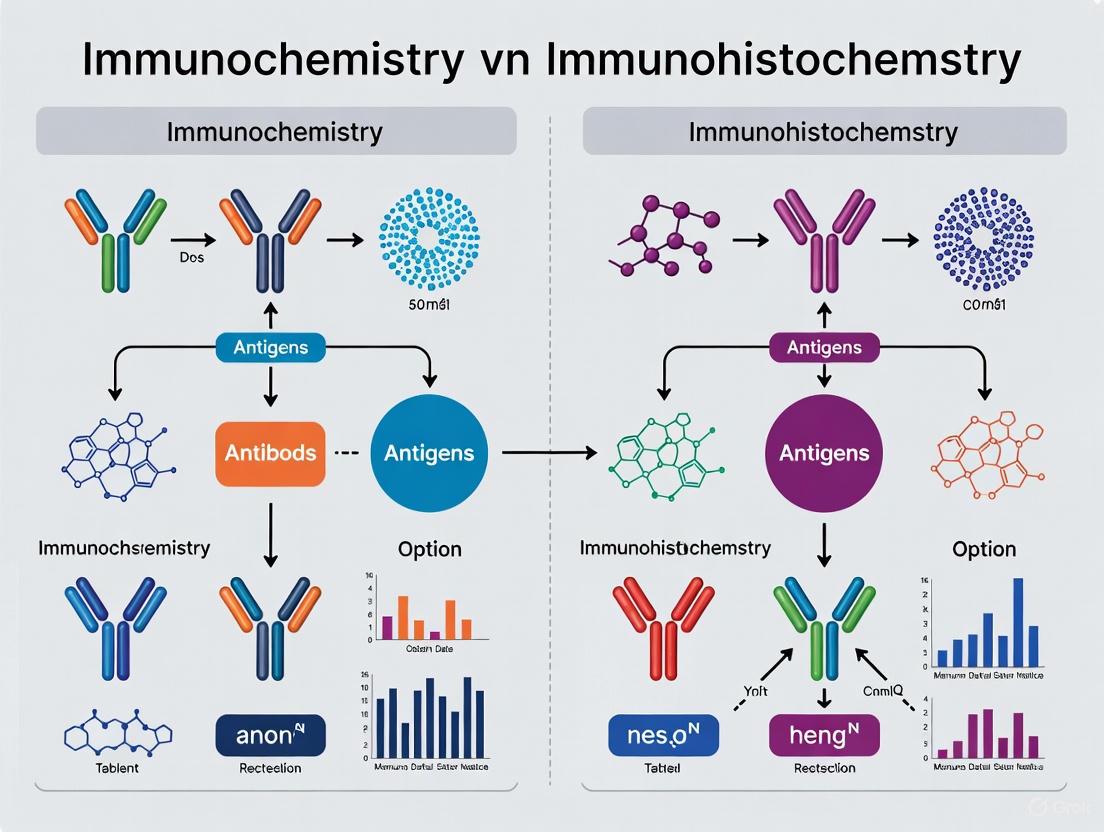
This article provides a comprehensive guide for researchers and drug development professionals on the distinct roles of immunochemistry (IC) and immunohistochemistry (IHC).
Immunochemistry vs Immunohistochemistry: A 2025 Guide for Biomedical Researchers
Abstract
This article provides a comprehensive guide for researchers and drug development professionals on the distinct roles of immunochemistry (IC) and immunohistochemistry (IHC). It clarifies foundational concepts, detailing that IHC is a specific application of IC focused on tissue analysis. The content covers methodological protocols, troubleshooting for common issues like antigen retrieval, and a comparative analysis with techniques like Western Blot and ICC. By exploring current applications in disease pathology and cancer diagnostics, as well as future directions including AI and multiplexing, this guide serves as a critical resource for experimental design and data interpretation in biomedical research.
Core Concepts: Defining Immunochemistry and Its Specialized Technique, Immunohistochemistry
Immunochemistry (IC) constitutes a foundational pillar of modern biological science and drug development, encompassing all analytical techniques that exploit the specific binding between an antibody and its antigen. This technical guide delineates the core principles, methodologies, and applications of immunochemical techniques, framing them within the critical context of their relationship to more specific applications like immunohistochemistry. For the research and development professional, a precise understanding of this hierarchy is paramount for selecting the appropriate assay to validate biomarkers, elucidate disease mechanisms, and advance therapeutic candidates. The following sections provide a comprehensive overview of the key techniques, complete with structured data on detection methods, experimental protocols, and essential reagent toolkits.
Core Concepts and Definitions
At its core, immunochemistry is an immunological method used for the detection of a target antigen within a sample [1]. The power of immunochemistry lies in the exquisite specificity of antibody-antigen interactions, which allows researchers to detect, quantify, and localize specific proteins or other molecules within complex biological mixtures.
The relationship between the broad field of immunochemistry and its subsidiary techniques is a common point of confusion. As illustrated in the diagram below, immunochemistry serves as the umbrella term, with techniques branching out based on sample type (e.g., tissue versus cells) and detection method (e.g., chemical versus fluorescent).
This nomenclature clarifies that while immunohistochemistry (IHC) is a type of immunochemistry performed on tissue sections, preserving architectural context [2], immunocytochemistry (ICC) is performed on samples of individual cells, such as cultured cell monolayers or smears, often without an extracellular matrix [1]. The distinction between sample types is critical for experimental reproducibility and antibody validation [1].
Key Immunochemical Techniques and Methodologies
The breadth of immunochemistry is embodied in its diverse and powerful techniques. The table below summarizes the core methodologies that leverage antibody-antigen interactions for various analytical goals.
Table 1: Core Immunochemical Techniques and Applications
| Technique | Core Principle | Sample Type | Key Output/Analysis | Primary Application |
|---|---|---|---|---|
| Enzyme-Linked Immunosorbent Assay (ELISA) [3] | Detection of immobilized antigens via enzyme-linked antibodies producing a measurable color change. | Soluble proteins (e.g., serum, supernatant). | Colorimetric/fluorometric signal quantified against a standard curve. | High-throughput quantification of specific analytes in solution. |
| Western Blot (Immunoblot) [3] | Proteins separated by size via electrophoresis, transferred to a membrane, and detected with specific antibodies. | Protein extracts from cells or tissues. | Band intensity and molecular weight on a membrane. | Protein identification, relative quantification, and molecular weight determination. |
| Immunoprecipitation (IP) [3] | Isolation of a specific antigen (and its binding partners) from a complex solution using antibody-coated beads. | Protein extracts. | Precipitated proteins analyzed by Western blot or mass spectrometry. | Protein complex isolation, protein-protein interaction studies. |
| Chromatin Immunoprecipitation (ChIP) [3] | IP of cross-linked protein-DNA complexes to identify genomic binding sites of specific proteins. | Cross-linked chromatin. | Associated DNA analyzed by PCR or sequencing (ChIP-seq). | Mapping transcription factor binding sites, histone modification profiles. |
| Immunohistochemistry (IHC) [2] [3] | Antibody-based detection of antigens in tissue sections, typically visualized with a colored precipitate. | Tissue sections (paraffin-embedded or frozen). | Cellular/localization data within intact tissue architecture under a brightfield microscope. | Diagnostic pathology, biomarker localization in tissue context. |
| Immunocytochemistry (ICC) [1] [3] | Antibody-based detection of antigens in permeabilized cells, often visualized with fluorophores. | Cultured cells, smears, suspensions. | Subcellular localization data via fluorescence microscopy. | Subcellular protein localization and co-localization studies in cells. |
| Flow Cytometry [3] | Laser-based analysis of fluorescently-labeled antibodies bound to individual cells in a fluid stream. | Cell suspensions (e.g., blood, cultured cells). | Multi-parameter analysis of cell surface and intracellular markers per cell. | Immunophenotyping, cell cycle analysis, sorting of cell populations (FACS). |
Detection Methods: Chemistry vs. Fluorescence
A critical technical consideration across IHC, ICC, and other immunochemical applications is the choice of detection method, which fundamentally impacts sensitivity, multiplexing capability, and data output [1].
Table 2: Comparison of Immunochemical Detection Methodologies
| Feature | Chromogenic/Chemical Detection | Fluorescent Detection |
|---|---|---|
| Principle | Enzyme (e.g., HRP, AP) catalyzes a reaction producing a colored precipitate [3]. | Fluorophore is excited by specific light and emits light of a longer wavelength [3]. |
| Visualization | Standard brightfield microscope. | Fluorescence or confocal microscope. |
| Signal Permanence | High; stains are permanent and archivable [4]. | Moderate; prone to photobleaching, requires special mounting media [4]. |
| Multiplexing | Limited, typically 1-2 markers per slide due to color overlap [4]. | Excellent; multiple targets can be visualized simultaneously (multiplexing) [4]. |
| Sensitivity & Dynamic Range | Moderate [4]. | High to very high [4]. |
| Quantification | Possible with advanced image analysis (densitometry) [5]. | Superior, more straightforward for intensity measurement. |
| Best For | Diagnostic workflows, archival material, labs with standard microscopy [4]. | Spatial biology, co-localization studies, high-plex analysis [4]. |
To eliminate ambiguity, the field is increasingly adopting precise terminology that specifies both sample type and detection method: immunohistofluorescence (IHF) for fluorescent detection on tissues and immunocytofluorescence (ICF) for fluorescent detection on cells [1].
Experimental Protocols: Core Workflows
Protocol for Sandwich ELISA
The Sandwich ELISA is a highly specific and sensitive quantitative technique for measuring antigen concentration. Its workflow involves precise steps to ensure accurate capture and detection.
Detailed Methodology:
- Coating: A capture antibody specific to the target antigen is adsorbed onto the surface of a microplate well [3].
- Blocking: The well is treated with an inert protein solution (e.g., BSA) to block any non-specific binding sites, preventing false-positive signals.
- Sample Incubation: The sample containing the antigen of interest is added to the well. The antigen binds to the immobilized capture antibody. Unbound components are washed away.
- Detection Antibody Incubation: A second enzyme-conjugated antibody (the detection antibody), which recognizes a different epitope on the antigen, is added. This forms the "antibody-antigen-antibody" sandwich. Another wash removes unbound detection antibody [3].
- Substrate Addition: A substrate solution for the conjugated enzyme (e.g., HRP or AP) is added. The enzyme catalyzes a reaction that converts the substrate into a colored or fluorescent product [3].
- Signal Detection & Quantification: The intensity of the color or fluorescence is measured with a plate reader. The signal is proportional to the amount of antigen present in the sample, and its concentration is determined by interpolation from a standard curve [3].
Protocol for Western Blot
Western Blot is a fundamental technique for confirming the identity and size of a protein, as well as its relative abundance in a complex mixture.
Detailed Methodology:
- Sample Preparation: Proteins are extracted from cells or tissues and denatured using heat and a reducing agent (e.g., SDS) to linearize them.
- Gel Electrophoresis: Denatured proteins are loaded onto a polyacrylamide gel and an electric current is applied. Proteins are separated based on their molecular weight [3].
- Transfer (Blotting): The separated proteins are transferred from the gel onto a solid membrane (e.g., nitrocellulose or PVDF) to create a replica, providing a superior surface for antibody binding [3].
- Blocking: The membrane is incubated with a blocking protein solution to prevent non-specific antibody binding.
- Primary Antibody Incubation: The membrane is probed with a primary antibody specific to the target protein.
- Secondary Antibody Incubation: The membrane is incubated with an enzyme-conjugated secondary antibody that recognizes the primary antibody [3].
- Detection: A substrate appropriate for the enzyme is added. Detection is achieved either by a colorimetric reaction or, more commonly, by using a chemiluminescent substrate that emits light, which is captured on X-ray film or by a digital imager [3].
The Scientist's Toolkit: Essential Research Reagent Solutions
The successful execution of any immunochemical experiment relies on a suite of critical reagents and materials.
Table 3: Essential Reagents and Materials for Immunochemistry
| Reagent / Material | Function and Importance |
|---|---|
| Primary Antibodies | The core reagent that provides specificity by binding to the target antigen. Critical choices include monoclonal vs. polyclonal, host species, and clonality. |
| Secondary Antibodies | Conjugated antibodies that bind to the primary antibody, serving as the signal-amplifying detection reagent. The conjugation (enzyme/fluorophore) defines the detection method. |
| Enzymes (HRP, AP) | Horseradish Peroxidase (HRP) and Alkaline Phosphatase (AP) are conjugated to secondary antibodies to catalyze colorimetric or chemiluminescent reactions for detection [3]. |
| Chromogenic Substrates (DAB, AEC) | Molecules like Diaminobenzidine (DAB) or 3-Amino-9-Ethylcarbazole (AEC) are converted by enzymes into an insoluble, colored precipitate at the antigen site [2]. |
| Fluorophores (e.g., Alexa Fluor dyes) | Fluorescent dyes conjugated to antibodies. When excited by specific wavelengths of light, they emit light, allowing for detection and multiplexing [3]. |
| Blocking Buffers (BSA, Serum) | Solutions of inert proteins (e.g., Bovine Serum Albumin) or sera used to saturate non-specific binding sites on the sample surface or membrane, reducing background noise. |
| Permeabilization Agents (Triton X-100, Saponin) | Detergents that dissolve cellular membranes, allowing antibodies to access intracellular targets for ICC and for some IHC applications [2]. |
| Antigen Retrieval Buffers (Citrate, EDTA) | Critical for IHC on formalin-fixed paraffin-embedded (FFPE) tissues; these buffers break protein cross-links formed during fixation to expose hidden epitopes [2]. |
Immunochemistry, as the overarching discipline of antibody-based analysis, provides an indispensable and versatile toolkit for life science research and drug development. Mastery of its core principles—including the distinct roles of its subsidiary techniques like IHC and ICC, and the strategic selection between detection methodologies—is fundamental for designing robust, reproducible, and informative experiments. As the field advances, particularly in areas of high-plex spatial biology, the foundational knowledge of immunochemical protocols and reagents detailed in this guide will continue to underpin innovation in biomarker discovery, diagnostic pathology, and the development of novel biologics.
Immunohistochemistry (IHC) represents a pivotal branch of immunochemistry (IC) techniques specifically designed to visualize target antigens within their native tissue context. This technique exploits the precise binding of antibodies to their corresponding antigens in situ, allowing researchers to localize specific proteins, biomarkers, and cellular structures within intact tissue architecture. Unlike solution-based immunochemical methods that homogenize tissues, IHC preserves spatial relationships and morphological context, providing critical insights into cellular heterogeneity, tissue microenvironment interactions, and pathological alterations [6].
The fundamental principle underlying IHC involves utilizing labeled antibodies to detect antigens in tissue sections, with visualization achieved through enzymatic or fluorescent tags. This capability to correlate molecular expression with histological features makes IHC indispensable for both research and diagnostic applications, particularly in cancer biology, neuroscience, and drug development [7] [6]. The technique has evolved significantly since its inception, with advancements in detection systems, antigen retrieval methods, and quantification approaches enhancing its sensitivity, specificity, and reproducibility.
Technical Foundations: IHC Methodology and Protocol Standardization
The execution of reliable IHC requires careful attention to multiple technical parameters, each significantly influencing experimental outcomes. The process begins with proper tissue acquisition and fixation, which preserves antigen integrity while maintaining morphological structure. Common fixatives include formalin, with 4% paraformaldehyde (PFA) being widely used for perfusion and immersion fixation protocols [8]. Following fixation, tissues undergo processing through dehydration, clearing, and paraffin embedding for sectioning, or may be preserved through cryopreservation for frozen section analysis [9].
Critical Protocol Steps and Methodological Variations
Sample Preparation and Sectioning: For light microscopy, tissue sections typically range from 5-15μm for paraffin-embedded samples and 6-30μm for frozen sections [9]. Section thickness must be consistent within experiments to ensure comparable staining intensity. Mounting on positively charged or silanized glass slides enhances tissue adherence throughout the rigorous staining process [9] [5].
Antigen Retrieval: Formalin fixation often masks antigenic epitopes through protein cross-linking, necessitating retrieval methods to restore antibody binding capability. Two primary approaches dominate current practice:
- Heat-Induced Epitope Retrieval (HIER): Utilizing high temperature in various buffers (citrate, EDTA, or Tris-EDTA) to break cross-links [9]. The specific buffer, pH, and heating duration (typically 15-30 minutes) require optimization for different antigen-antibody combinations.
- Protease-Induced Epitope Retrieval (PIER): Employing enzymatic digestion (e.g., trypsin, pepsin) to partially digest proteins and expose epitopes [9]. Incubation times must be carefully controlled to avoid tissue damage.
Staining and Detection Systems: IHC employs either direct (primary antibody conjugated to label) or indirect (secondary antibody targeting primary) detection approaches [6]. The indirect method amplifies signal and enhances sensitivity. Chromogenic detection utilizes enzymes such as horseradish peroxidase (HRP) or alkaline phosphatase (AP) with substrates like 3,3'-Diaminobenzidine (DAB) or Vector Red to produce insoluble colored precipitates at antigen sites [9] [5] [10]. Alternatively, immunofluorescence (IF) employs fluorophore-conjugated antibodies for visualization [6].
Table 1: Core Detection Methodologies in Immunohistochemistry
| Method | Detection Principle | Visualization | Key Applications | Advantages/Limitations |
|---|---|---|---|---|
| Chromogenic IHC | Enzyme-conjugated antibodies catalyze chromogen precipitation | Colored precipitate visible by light microscopy | Diagnostic pathology, research applications | Permanent slides, conventional microscopy compatible; Limited multiplexing capability [6] [10] |
| Fluorescence IHC (IF) | Fluorophore-conjugated antibodies emit light at specific wavelengths | Fluorescence signal detected by specialized microscopy | Multiplex staining, co-localization studies | Higher resolution, multiplexing capability; Signal fading (photobleaching), specialized equipment required [6] |
| Alkaline Phosphatase-Based | Alkaline phosphatase with Vector Red substrate | Bright red precipitate | Quantitative microdensitometry | Excellent for quantification, permanent mounting, light stability [5] |
Comparative Analysis: IHC Validation and Quantitative Assessment
The validation of IHC findings requires rigorous comparison with both alternative methodologies and quantitative reference standards. Studies consistently demonstrate strong correlation between IHC and other immunochemical techniques, though methodological differences influence specific applications.
Concordance with Immunocytochemistry (ICC)
A prospective study comparing IHC with immunocytochemistry on fine-needle aspiration cytology demonstrated high diagnostic reliability for hormone receptor status assessment in breast carcinoma [11]. The research revealed exceptional concordance rates between the techniques, validating ICC as a valuable preliminary assessment tool when tissue samples are limited.
Table 2: Comparative Performance of Immunocytochemistry versus Immunohistochemistry for Breast Cancer Biomarker Assessment
| Biomarker | Sensitivity (%) | Specificity (%) | Positive Predictive Value (%) | Negative Predictive Value (%) | Overall Concordance with IHC (%) |
|---|---|---|---|---|---|
| Estrogen Receptor (ER) | 96.3 | 100 | 100 | 95.7 | 98 |
| Progesterone Receptor (PR) | 94.3 | 100 | 100 | 94 | 97 |
| Her2/neu | 72 | 95.5 | 85.7 | 90.1 | 89 |
Quantitative Digital Analysis versus Pathologist Scoring
Traditional IHC assessment relies on semi-quantitative pathologist scoring using ordinal scales (e.g., 0, 1+, 2+, 3+), but this approach suffers from subjectivity and inter-observer variability [7] [10]. Digital image analysis provides continuous variable data that offers enhanced reproducibility and statistical power. A prostate cancer study evaluating estrogen receptor-β2 demonstrated significantly higher reproducibility for digital analysis compared to pathologist visual scoring, with Spearman correlation of 0.99 for digital methods versus 0.84 for pathologist scoring between analysis runs [7].
Artificial intelligence-aided platforms further advance quantification accuracy. A study comparing semi-quantitative scoring with an AI-assisted image analysis platform (Pathronus) found that only the digital approach consistently reproduced statistical significance between experimental groups established by quantitative fluorescent IHC reference data [10]. The convolutional neural network-based system could identify cells of interest, differentiate organelles, and quantify chromogenic labeling after appropriate training.
Experimental Protocols: Detailed Methodologies
Standard IHC Protocol for Formalin-Fixed Paraffin-Embedded (FFPE) Tissues
The following protocol outlines the essential steps for chromogenic IHC on FFPE tissue sections, incorporating critical steps for optimal antigen preservation and detection [9]:
Deparaffinization and Rehydration:
- Incubate slides in xylene (2 changes, 3 minutes each)
- Transfer through graded ethanol series: 100% (2 changes), 95%, 70%, 50% (3 minutes each)
- Rinse in running tap water for 10 minutes
Antigen Retrieval:
- Heat-induced retrieval in 10mM sodium citrate buffer (pH 6.0) at approximately 98°C for 20 minutes
- Cool slides to room temperature before proceeding
- Alternative: Protease-induced retrieval with 0.05% trypsin in 0.1% calcium chloride (pH 7.8) at 37°C for 10 minutes
Blocking and Antibody Incubation:
- Block endogenous peroxidase with 0.3% hydrogen peroxide in TBS for 15 minutes (HRP-based detection)
- Block non-specific binding with appropriate serum or protein block for 1 hour at room temperature
- Incubate with primary antibody diluted in blocking buffer overnight at 4°C
- Wash with TBS or PBS containing 0.025% Triton X-100 (3 times, 10 minutes each)
Detection and Visualization:
- Incubate with biotinylated secondary antibody for 1 hour at room temperature
- Prepare ABC reagent according to manufacturer instructions
- Incubate with ABC reagent for 30 minutes at room temperature
- Develop with DAB substrate for approximately 10 minutes, monitoring color development
- Rinse in distilled water (3 changes, 3 minutes each)
Counterstaining and Mounting:
- Counterstain with hematoxylin (30 seconds to 2 minutes)
- Dehydrate through graded alcohols (95%, 100% twice) and xylene (2 changes)
- Mount with permanent mounting medium
Tissue Preparation and Fixation Protocol
Proper tissue preservation is fundamental to successful IHC outcomes [8]:
Perfusion Fixation:
- Deeply anesthetize animal using approved anesthetic protocol
- Pin animal to dissection surface and expose thoracic cavity
- Insert needle into left ventricular chamber and perfuse with PBS to flush blood
- Switch to ice-cold 4% PFA in PBS for fixation
- Dissect tissue and post-fix in 4% PFA overnight at 4°C
Tissue Processing:
- Wash fixed tissue in PBS (3 times)
- Cryoprotect in 30% sucrose solution in PBS at 4°C for 3 days
- Embed in OCT compound and store at -80°C
- Section at appropriate thickness (5-50μm depending on application)
Visual Guide: IHC Experimental Workflow
The Scientist's Toolkit: Essential Research Reagents and Materials
Table 3: Essential Reagents and Materials for Immunohistochemistry
| Reagent Category | Specific Examples | Function | Technical Considerations |
|---|---|---|---|
| Fixatives | 4% Paraformaldehyde (PFA), 10% Neutral Buffered Formalin | Preserve tissue architecture and antigen integrity | Fixation time critically impacts antigen preservation; prolonged fixation may mask epitopes [8] |
| Embedding Media | Paraffin, OCT Compound | Support tissue for sectioning | Choice depends on sectioning method (paraffin vs. cryostat) [9] |
| Antigen Retrieval Reagents | Sodium citrate buffer (pH 6.0), EDTA buffer (pH 8.0), Tris-EDTA (pH 9.0), Trypsin, Pepsin | Reverse formaldehyde-induced cross-links | pH and method (HIER vs. PIER) require optimization for specific antibodies [9] |
| Primary Antibodies | Monoclonal (e.g., clone 1D5 for ER), Polyclonal | Specifically bind target antigens | Validation for IHC essential; species reactivity critical [11] [8] |
| Detection Systems | HRP-conjugated secondaries, AP-conjugated secondaries, Fluorescent secondaries | Amplify and visualize primary antibody binding | Enzyme substrates include DAB (brown), Vector Red (red); fluorophores include Alexa Fluor dyes [9] [5] [6] |
| Counterstains | Hematoxylin, DAPI, Nuclear Fast Red | Provide morphological context | Hematoxylin for chromogenic, DAPI for fluorescent IHC [9] [8] |
| Mounting Media | Aqueous, Organic | Preserve staining and optimize microscopy | Aqueous for fluorescence, organic for chromogenic IHC [9] |
Advanced Applications and Future Directions in IHC
The evolution of IHC continues to address research and clinical needs through technological innovations. Color normalization algorithms represent one significant advancement, correcting for staining variations caused by differences in operator protocols, exposure times, and scanner specifications [12]. These computational approaches, including sparse stain separation and self-sparse fuzzy clustering, standardize image interpretation and facilitate more accurate digital analysis, particularly crucial for biomarker scoring in breast cancer diagnostics.
Quantitative IHC has advanced substantially through digital pathology platforms and artificial intelligence. Traditional semi-quantitative scoring systems (0, 1+, 2+, 3+) suffer from inter-observer variability and limited dynamic range [7] [10]. Modern approaches employing continuous variable data from digital image analysis demonstrate superior reproducibility and statistical power for biomarker assessment. These technologies enable high-throughput analysis of tissue microarrays, revealing prognostic associations that may be undetectable by visual scoring alone [7].
The integration of IHC with complementary techniques continues to expand its applications. Multiplex IHC and immunofluorescence allow simultaneous detection of multiple biomarkers within a single tissue section, revealing cellular interactions and heterogeneity within the tissue microenvironment [6]. When combined with molecular techniques like in situ hybridization, IHC provides comprehensive profiling of tissue pathophysiology, enhancing both research insights and diagnostic precision in the era of personalized medicine.
This technical guide traces the foundational journey from Paul Ehrlich's seminal antibody work to the development of modern immunodetection methodologies. The document delineates the critical historical milestones that forged the disciplines of immunochemistry and immunohistochemistry, providing a comprehensive analysis of their distinct principles, applications, and methodologies. Designed for researchers, scientists, and drug development professionals, this whitepaper integrates detailed experimental protocols, quantitative data comparisons, and visual workflows to elucidate the technical evolution within a broader thesis framework differentiating these intertwined yet distinct research fields. The content emphasizes how Ehrlich's theoretical constructs—the side-chain theory and magic bullet concept—directly catalyzed the development of targeted detection systems that now form the cornerstone of both diagnostic pathology and biomedical research.
The conceptual architecture of modern immunodetection is built upon foundations established by Paul Ehrlich (1854-1915), whose work seamlessly merged chemistry, biology, and medicine [13]. His pioneering research provided the theoretical scaffold for understanding specific molecular interactions, effectively birthing the fields of hematology, immunology, and pharmacology [13] [14]. Ehrlich's career progressed through three definitive phases, each contributing essential principles to immunochemical sciences [13].
Table 1: Paul Ehrlich's Career Phases and Key Contributions
| Career Phase | Timeline | Major Contributions | Emerging Disciplines |
|---|---|---|---|
| Early Research | 1878-1890 | Development of cell-specific dyes; differentiation of leukocyte subsets | Modern Hematology, Cell Staining |
| Theoretical Development | 1890-1900 | Side-chain theory; receptor-ligand concept; serum standardization | Immunology, Pharmacology |
| Applied Chemotherapy | 1900-1915 | Development of arsphenamine (Salvarsan); "Magic Bullet" concept | Chemotherapy, Drug Development |
Ehrlich's most enduring legacy resides in his formulation of the side-chain theory in 1897, which proposed that cells possess specific "side chains" (later termed receptors) that interact with toxins and nutrients [13] [15]. He postulated that upon binding, cells would overproduce and shed these receptors into the bloodstream as "antitoxins" or what we now call antibodies [15]. This theoretical model directly anticipated the fundamental principle of antibody-antigen specificity that underpins all contemporary immunodetection techniques. Furthermore, his "magic bullet" (Zauberkugel) concept—the idea that molecules could be designed to selectively target pathogens or diseased cells—provided the philosophical foundation for targeted therapies and diagnostic reagents [13].
Defining the Disciplines: Immunochemistry vs. Immunohistochemistry
Within the framework of Ehrlich's foundational work, two distinct technical disciplines evolved: immunochemistry and immunohistochemistry. While often conflated, they represent different methodological approaches with specific applications, a distinction crucial for research and diagnostic accuracy [16].
Table 2: Core Distinctions Between Immunodetection Techniques
| Parameter | Immunochemistry (IC) | Immunohistochemistry (IHC) | Immunocytochemistry (ICC) |
|---|---|---|---|
| Sample Type | General (solution-based) | Tissue sections (with extracellular matrix) [16] | Individual cells (without extracellular matrix) [16] |
| Spatial Context | No preservation of tissue architecture | Preserves tissue architecture and morphology [17] | Cellular morphology only, no tissue context |
| Primary Applications | Quantification (ELISA, Western Blot), serum therapy [18] | Disease diagnosis, tumor classification, biomarker localization in tissue [17] [19] | Cellular localization, cultured cell analysis |
| Detection Context | Isolated from biological context | In situ localization within tissue microenvironment [17] | In situ localization at cellular level |
| Historical Origin | Ehrlich's serum standardization & antitoxin work [13] | Coons et al. (1941) immunofluorescence [20] | Adaptation of IHC to cell cultures |
The critical distinction lies in the sample type and the preservation of architectural context. Immunochemistry (IC) is a broad term for techniques using immunological reactions for chemical analysis, often in solutions. In contrast, Immunohistochemistry (IHC) specifically refers to the application of immunochemical techniques to tissue sections (histo), thereby preserving the spatial context of antigen expression within its native histological environment [16] [17]. A common point of confusion arises with detection methods. The suffix "-chemistry" traditionally implied enzymatic colorimetric detection (e.g., DAB producing a brown precipitate), while "-fluorescence" indicates fluorescent detection [16]. Updated nomenclature now recommends more precise terms:
- Immunohistofluorescence (IHF): Fluorescent detection on tissue sections [16].
- Immunocytofluorescence (ICF): Fluorescent detection on individual cells [16].
This distinction is vital for reproducibility and appropriate antibody validation, as the fixation, permeabilization, and antigen retrieval requirements differ significantly between tissue and cell samples [16].
Historical Timeline of Key Milestones
The evolution from theoretical concept to routine laboratory technique involved key innovations across a century of research. The timeline below captures the pivotal moments in this journey, connecting Ehrlich's foundational theories to modern methodologies.
The Pioneering Work of Albert Coons and the Birth of IHC
While Ehrlich provided the theoretical framework, the practical implementation of immunohistochemistry began with Albert Hewett Coons and his colleagues in 1941 [20] [19]. They conceptualized and implemented the first immunofluorescence procedure by using fluorescein isothiocyanate (FITC)-labelled antibodies to localize pneumococcal antigens in infected tissues [20]. This landmark achievement demonstrated for the first time that antibodies could be used as specific probes to visualize target molecules within their precise histological context, thereby bridging the gap between immunology and histology. The period from the 1960s onward saw the introduction of immunoenzymatic techniques, which utilized enzymes like horseradish peroxidase (HRP) and alkaline phosphatase (AP) as antibody labels [17]. This critical advancement eliminated the need for expensive fluorescence microscopy equipment and provided permanent staining preparations that were compatible with standard light microscopy [17] [21].
The Monoclonal Revolution and Standardization
A quantum leap in immunodetection occurred in 1975 with the development of monoclonal antibody technology by Georges Köhler and César Milstein, for which they received the Nobel Prize in 1984 [20]. Unlike the heterogeneous polyclonal antibody preparations used previously, monoclonal antibodies provided an unlimited supply of chemically uniform reagents with defined specificity, dramatically improving the reproducibility, specificity, and standardization of both immunochemical and immunohistochemical assays [17]. This innovation propelled IHC from a specialized research tool to an indispensable technique in diagnostic pathology and drug development.
Core Principles and Methodologies
The Fundamental Principle of IHC
The principle of IHC revolves around the specific binding of an antibody to its target antigen within tissue sections, followed by visualization via a detectable label [17]. The process can utilize either monoclonal antibodies (specific to a single epitope) or polyclonal antibodies (a mixture of antibodies recognizing multiple epitopes on the same antigen) [17]. The labels employed include fluorescent compounds, enzymes that catalyze colorimetric reactions, and other markers that permit microscopic visualization.
Table 3: Key Research Reagent Solutions and Their Functions
| Reagent Category | Specific Examples | Primary Function | Technical Considerations |
|---|---|---|---|
| Fixation Agents | Formaldehyde, Paraformaldehyde, Acetone, Methanol | Preserve tissue architecture & prevent degradation | Formaldehyde crosslinking may mask epitopes, requiring retrieval [19] |
| Embedding Media | Paraffin Wax (FFPE), Optimal Cutting Temperature (OCT) Compound | Support tissue for thin-sectioning | FFPE enables long-term storage; frozen sections preserve labile antigens [19] |
| Primary Antibodies | Monoclonal (Mouse anti-HDAC4), Polyclonal (Rabbit anti-VEZF) | Specific recognition of target antigen | Monoclonal: high specificity; Polyclonal: often higher sensitivity [17] |
| Detection Systems | HRP-Conjugated Secondaries, Streptavidin-Biotin Complexes, Alkaline Phosphatase (AP) | Amplify signal and enable visualization | Streptavidin-biotin offers significant signal amplification |
| Chromogens/ Fluorophores | DAB (brown), AEC (red), FITC (green), Dylight (red) | Generate visible signal for microscopy | DAB is permanent & alcohol-resistant; AEC is alcohol-soluble [19] |
| Antigen Retrieval Solutions | Citrate Buffer (pH 6.0), EDTA/TRIS Buffer (pH 9.0) | Reverse formaldehyde crosslinks & unmask epitopes | HIER (Heat-Induced Epitope Retrieval) is most common method [19] |
Critical Experimental Workflows
The reliability of IHC data is contingent upon rigorous sample preparation and staining protocols. The following workflow diagrams detail the core processes for both FFPE and frozen tissue samples, highlighting the critical steps that ensure preservation of morphology and antigenicity.
FFPE Tissue Processing and Staining Workflow
Detailed Protocol: FFPE IHC
- Tissue Fixation: Immerse tissue promptly in 10% neutral buffered formalin for 18-24 hours at room temperature. The fixation time must be optimized; under-fixation compromises morphology, while over-fixation causes excessive crosslinking and antigen masking [19].
- Processing & Embedding: Subject the fixed tissue to a series of graded alcohols (e.g., 70%, 95%, 100% ethanol) for dehydration, followed by a clearing agent like xylene. The tissue is then infiltrated with and embedded in paraffin wax to form a block [19].
- Sectioning & Mounting: Cut thin sections of 4-5 μm using a microtome. Float sections on a warm water bath to remove wrinkles, then mount onto adhesive-coated glass slides (e.g., poly-L-lysine or silane-coated). Dry slides in an oven (50-60°C) to ensure adhesion [19].
- Deparaffinization & Antigen Retrieval: Prior to staining, immerse slides in xylene (or xylene-substitute) to remove paraffin, then rehydrate through graded alcohols to water. Perform Heat-Induced Epitope Retrieval (HIER) by incubating slides in a target-specific buffer (e.g., citrate buffer, pH 6.0 or EDTA/TRIS buffer, pH 9.0) using a pressure cooker, steamer, or microwave [19]. Alternative proteolytic-induced epitope retrieval (PIER) using enzymes like proteinase K can be used for specific antigens.
- Immunostaining:
- Blocking: Incubate sections with a protein block (e.g., normal serum, BSA, or commercial blocking solutions) for 30 minutes to reduce non-specific background staining [19].
- Primary Antibody: Apply optimally diluted primary antibody (monoclonal or polyclonal) and incubate for 1-2 hours at room temperature or overnight at 4°C. Dilution must be determined empirically [17].
- Secondary Antibody & Detection: Apply an enzyme-conjugated (e.g., HRP) secondary antibody or a fluorescently-labeled secondary for 30-60 minutes. For enzymatic detection, incubate with a chromogen substrate such as 3,3'-Diaminobenzidine (DAB) which produces a brown precipitate, or 3-Amino-9-Ethylcarbazole (AEC) which produces a red precipitate [19].
- Counterstaining & Mounting: Counterstain with hematoxylin (for chromogenic IHC) to visualize nuclei or Hoechst/DAPI (for immunofluorescence) [19]. Finally, apply aqueous or organic mounting medium and a coverslip for microscopic analysis.
Frozen Tissue Section IHC Workflow
Detailed Protocol: Frozen Section IHC
- Tissue Freezing: Immediately after harvest, embed tissue in O.C.T. compound on a cryomold and snap-freeze by immersion in liquid nitrogen-cooled isopentane or directly in liquid nitrogen. Store frozen blocks at -80°C until sectioning [19].
- Sectioning: Equilibr the frozen block in the cryostat chamber (typically -20°C). Cut sections of 5-10 μm thickness and mount on adhesive-coated slides. Air-dry slides for 30-60 minutes or overnight [19].
- Post-fixation: Fix air-dried sections in pre-cooled acetone (-20°C) for 5-10 minutes or in 4% paraformaldehyde for 10-15 minutes at room temperature. This step permeabilizes membranes and fixes antigens [19].
- Immunostaining: Proceed with blocking, primary antibody incubation, secondary antibody incubation, detection, and counterstaining as described for the FFPE protocol. Note that antigen retrieval is often unnecessary for frozen sections, making the protocol faster and preserving more labile epitopes, though morphology is generally inferior to FFPE sections.
Applications in Research and Diagnostic Contexts
The applications of immunodetection techniques have expanded dramatically, fulfilling Ehrlich's vision of targeted molecular identification in both research and clinical settings.
Table 4: Diagnostic and Research Applications of IHC and IC
| Application Domain | Specific Techniques | Utility and Examples |
|---|---|---|
| Oncologic Pathology | IHC (Chromogenic) | Tumor subtyping (e.g., cytokeratin for carcinoma), prognosis (e.g., Ki-67 proliferation index), predictive biomarker detection (e.g., HER2/neu, PD-L1) [17] [19] |
| Infectious Disease | IHC, Immunofluorescence, ELISA | Detection of pathogens (e.g., Mycobacterium tuberculosis, influenza virus) in tissues [18] |
| Autoimmune Disease | Indirect Immunofluorescence, Western Blot, ELISA | Detection of specific autoantibodies (e.g., in rheumatoid arthritis, systemic lupus erythematosus) [18] |
| Neuroscience Research | IHF, ICF | Mapping neurotransmitter and receptor distribution in brain tissue (e.g., VEZF in human brain) [19] |
| Drug Development | IHC, ELISA, Flow Cytometry | Target validation, assessment of drug efficacy (e.g., detecting changes in disease markers like p21), and pharmacodynamic biomarker analysis [17] [19] |
Current Status, Limitations, and Future Perspectives
Despite its established role, IHC faces challenges including subjectivity in interpretation, inter-laboratory variability, and difficulties in multiplexing [17]. The future of IHC is being shaped by several technological frontiers. The integration of digital pathology and artificial intelligence (AI) is enabling automated, high-throughput image analysis, which minimizes subjectivity and allows for the extraction of complex quantitative data from tissue sections [17]. Multiplex IHC techniques now allow for the simultaneous detection of 6-10 or more biomarkers on a single tissue section, providing a systems-level view of the tumor microenvironment and cellular interactions [17]. Furthermore, efforts toward advanced standardization, including standardized scoring systems, automated stainers, and rigorous validation protocols for antibodies, are critical for enhancing reproducibility, especially in clinical diagnostics and regulated drug development [17].
The journey from Paul Ehrlich's side-chain theory to modern immunodetection platforms represents a paradigm of translational science. Ehrlich's conceptual leaps—specific molecular interactions, the receptor concept, and the magic bullet—provided the intellectual framework that guided the development of first immunofluorescence by Coons and subsequent refinements like monoclonal antibodies and antigen retrieval. The critical distinction between immunochemistry and immunohistochemistry lies in the preservation of morphological and spatial context, with IHC providing unique insights into the tissue microenvironment that are indispensable for both diagnostic pathology and research. As the field advances with AI, multiplexing, and increased standardization, the core principle established by Ehrlich over a century ago remains unchanged: the exquisite specificity of the antibody-antigen interaction is a powerful tool for understanding and diagnosing disease at the molecular level.
In the realm of biomedical research, techniques that utilize antibody-antigen interactions to visualize specific components within biological samples are indispensable. These methods, collectively known as immunostaining, transform surgical pathology from a subjective discipline into a more objective science [22]. The fundamental principle involves using appropriately-labeled antibodies to bind specifically to their target antigens in situ, allowing researchers and clinicians to image discrete components [19] [23]. While the core immunological principle is consistent, the critical distinction lies in the sample type being analyzed—a choice that dictates the entire experimental workflow, the information yielded, and the ultimate application of the results. This guide delves into this central dichotomy, framing it within the broader context of immunochemistry research to equip scientists and drug development professionals with the knowledge to select the optimal methodology for their research objectives.
Core Principles and Definitions
The choice of immunostaining technique is fundamentally dictated by the sample type, which in turn determines whether the primary data output is cellular information or tissue architecture context.
Immunocytochemistry (ICC) is defined as a technique for visualizing the presence and location of specific antigens in all types of cells, including cultured and suspended cells, rather than whole tissue sections [23]. It provides high-resolution data on subcellular localization, protein expression, and in situ macromolecule interactions within individual cells [23].
Immunohistochemistry (IHC) is used for analyzing the level and localization of a specific antigen within the complete tissue structure [23]. This technique preserves the histologic architecture, enabling the pathologist to confirm that positive cells are the cells in question—an confirmation not possible with molecular methods like flow cytometry [22]. IHC is crucial for diagnosing diseases like cancer and for research on tissue-specific protein assays [23].
The following workflow diagram illustrates the critical methodological branches determined by the initial choice of sample type:
Comparative Analysis: ICC vs. IHC
The divergence in sample type between ICC and IHC leads to significant differences in their applications, advantages, and limitations. The following table provides a structured, quantitative comparison to guide methodological selection.
Table 1: Technical Comparison of ICC and IHC
| Parameter | Immunocytochemistry (ICC) | Immunohistochemistry (IHC) |
|---|---|---|
| Sample Type | Cultured or suspended cells [23] | Intact tissue sections [23] |
| Primary Output | Subcellular localization; biomarker presence in cells [23] | Antigen localization within proper histological context [19] [22] |
| Spatial Context | Limited to the cultured cell environment | Preserved tissue architecture (e.g., tumor microenvironment) [23] [4] |
| Resolution | High resolution for fine structures (with fluorescent dyes) [23] | Lower resolution for fine structures [23] |
| Multiplexing Potential | Easy with enzymes; difficult with fluorescent dyes [23] | Difficult due to colorimetric limitations [23] |
| Key Applications | Cell biology research, identification of specific biomarkers [23] | Disease diagnosis (e.g., cancer), drug development, research on tissue-specific protein assays [19] [23] |
Detailed Experimental Protocols
The initial choice of sample type dictates distinct and critical protocols for sample preparation to ensure the preservation of morphology and antigenicity.
Sample Preparation for ICC
- Cell Culture and Seeding: Grow cells on sterile, biocompatible surfaces like glass coverslips placed in multiwell plates [23].
- Fixation: Immerse cells in a fixative, commonly paraformaldehyde, to preserve cellular structure and prevent degradation [23] [4]. The goal is to crosslink proteins without completely masking the target antigen epitopes.
- Permeabilization and Blocking: Treat fixed cells with a mild detergent (e.g., Triton X-100) to permeabilize the cell membrane, allowing antibodies access to intracellular targets. Subsequently, incubate with a blocking buffer (e.g., containing bovine serum albumin or normal serum) to bind to non-specific sites and minimize background staining [23].
Sample Preparation for IHC
- Tissue Acquisition: Human and animal biopsies or whole organs are collected. Tissue must be rapidly preserved to prevent protein breakdown and degradation of architecture [19].
- Fixation: Immerse tissue in fixative, most commonly formaldehyde (formalin), to covalently crosslink proteins. Prolonged or improper fixation can mask target antigens [19] [22].
- Embedding and Sectioning:
- Paraffin-Embedding (FFPE): Formalin-fixed tissues are dehydrated, cleared, and embedded in paraffin wax to facilitate thin sectioning (typically 4-5 μm) with a microtome [19] [23]. This is the most common method for routine histology.
- Frozen Sections (Cryopreservation): Tissues are encased in a cryogenic medium and snap-frozen in liquid nitrogen. Thin sections (5-7 μm) are cut on a cryostat (freezing microtome) [19] [4]. This method is used for antigens destroyed by routine fixation and paraffin embedding.
- Antigen Retrieval: For FFPE tissues, a critical step called epitope or antigen retrieval is often required. Heat-Induced Epitope Retrieval (HIER), which involves boiling the de-paraffinized sections in various buffers (e.g., citrate or Tris-EDTA), is commonly used to break methylene bridges formed during fixation and unmask antigenic epitopes [19] [23] [4].
The following diagram summarizes these distinct preparatory pathways:
Detection Methods and Visualization
After sample preparation, the detection of antibody-antigen complexes can be achieved through different methods, primarily chromogenic (colorimetric) or fluorescent, each with distinct properties.
Table 2: Comparison of Key Detection Methodologies
| Detection Method | Principle | Signal Duration | Equipment Needed | Best For |
|---|---|---|---|---|
| Chromogenic (IHC/ICC) | Enzymes (e.g., HRP, AP) react with a substrate (e.g., DAB, Vector Red) to produce a colored precipitate [19] [23] | Permanent, archivable [4] [5] | Brightfield microscope [4] | Diagnostic workflows, regulatory archiving, crisp morphology review [4] |
| Immunofluorescence (IF) | Fluorophore-conjugated antibodies are excited by specific light and emit light of a longer wavelength, which is captured [23] [4] | Temporary (subject to photobleaching) [23] | Fluorescence microscope [4] | High-resolution imaging, multiplexing (2-8 markers), co-localization studies [23] [4] |
The Scientist's Toolkit: Essential Research Reagents
Successful immunostaining relies on a suite of carefully validated reagents. The table below details key solutions and their critical functions in the experimental workflow.
Table 3: Essential Reagents for Immunostaining Experiments
| Reagent | Function | Technical Considerations |
|---|---|---|
| Fixatives (e.g., Formalin, Paraformaldehyde) | Preserve tissue architecture and cellular morphology by crosslinking proteins; prevent antigen degradation [19] [23]. | Prolonged fixation can mask epitopes; may require optimization for specific antigens [22]. |
| Primary Antibodies | Bind specifically to the target antigen of interest [23]. | Specificity and optimal working dilution must be validated for each lot and application [22]. |
| Secondary Antibodies | Conjugated to a detectable marker (enzyme or fluorophore); bind to the primary antibody to enable detection [23]. | Must be produced in a species different from the primary antibody to avoid cross-reactivity [23]. |
| Blocking Buffers (e.g., BSA, Serum) | Reduce nonspecific binding of antibodies to off-target sites, thereby minimizing background staining [23]. | Compatibility with the sample and antibody should be optimized [23]. |
| Chromogenic Substrates (e.g., DAB, Vector Red) | Enzymatic conversion by HRP/AP produces a colored, precipitating reaction product at the antigen site [19]. | DAB is toxic; Vector Red offers excellent qualities for quantitative microdensitometry and is light-stable [5]. |
| Mounting Media | Preserve the stained sample under a coverslip for microscopy. | Antifade media are essential for fluorescence to reduce photobleaching [23]. |
The distinction between analyzing isolated cells (ICC) and intact tissue architecture (IHC) is indeed the critical fork in the road for immunostaining research. ICC provides high-resolution insights into subcellular events, making it a powerhouse for fundamental cell biology. IHC, by preserving the histological context, is indispensable for understanding disease pathology within the native tissue microenvironment, driving advancements in diagnostic pathology and drug development. The choice is not about which technique is superior, but which is appropriate for the biological question at hand. By understanding their fundamental differences in sample type, preparation, and output—as outlined in this guide—researchers can make informed decisions that ensure their experiments yield reliable, meaningful, and publication-ready data.
Within immunostaining techniques, the conflation of terms related to sample type and detection method has historically been a source of ambiguity, potentially impacting experimental reproducibility. This guide delineates the modern, precise nomenclature for Immunohistochemistry (IHC), Immunocytochemistry (ICC), Immunohistofluorescence (IHF), and Immunocytofluorescence (ICF). By framing these distinctions within the context of immunochemistry research, we provide researchers and drug development professionals with a clarified framework that explicitly separates the nature of the biological sample from the mechanism of detection. Adopting this precise terminology enhances communication, improves antibody validation protocols, and strengthens the foundation of biomedical research.
Immunochemistry research relies on techniques that use antibody-epitope interactions to detect and localize target antigens within a biological sample [24]. For decades, the terminology describing these techniques has often been used interchangeably, leading to potential confusion. Specifically, the term "Immunofluorescence" (IF) has been frequently used as a catch-all for any fluorescent-based immunostaining, obscuring critical information about the sample origin [25].
This ambiguity poses a practical challenge. When an antibody is validated only for "Immunofluorescence," a researcher is left to guess whether it has been tested on their specific sample type—be it a tissue section or cultured cells [25]. This guide establishes a refined lexicon that decouples two key experimental variables:
- Sample Type: Does the analysis involve tissue (
-histo-) or isolated cells (-cyto-)? - Detection Method: Is the signal generated via a chemical reaction (
-chemistry) or a fluorescent emission (-fluorescence)?
This distinction is not merely semantic; it is fundamental to designing reproducible experiments, accurately validating reagents, and clearly communicating scientific findings.
Core Terminology and Definitions
The following definitions form the cornerstone of precise terminology in immunostaining. They are designed to be explicit, leaving no room for misinterpretation regarding the sample or detection method used.
Foundational Definitions Based on Sample Type
- Immunohistochemistry (IHC): Refers to the immunostaining of tissue sections [24] [2]. The sample preserves the original tissue architecture and extracellular matrix [25]. Tissues are typically formalin-fixed paraffin-embedded (FFPE) or frozen and sectioned into thin slices [24] [26].
- Immunocytochemistry (ICC): Refers to the immunostaining of individual cells [24] [27]. This includes cultured cell lines (often grown in monolayers), primary cells, or cell suspensions such as blood smears and aspirates [2]. These samples lack the surrounding tissue architecture and extracellular matrix [25].
Advanced Definitions Integrating Detection Method
- Immunohistofluorescence (IHF): The detection of a target in tissue using an antibody and subsequent visualization using a fluorophore [25]. This term replaces the ambiguous "Immunofluorescence" when working with tissue samples, providing crucial context for antibody validation and experimental setup.
- Immunocytofluorescence (ICF): The detection of a target in cells using an antibody and subsequent visualization using a fluorophore [25]. This is the precise term for what is often generically labeled "ICC/IF" in commercial antibody listings.
The following table summarizes this modern nomenclature framework, providing a clear reference for distinguishing these techniques.
Table 1: Modern Nomenclature for Immunostaining Techniques
| Detection Method | Tissue Samples (-histo-) |
Cell Samples (-cyto-) |
|---|---|---|
Chemical Detection (-chemistry) |
Immunohistochemistry (IHC) | Immunocytochemistry (ICC) |
Fluorescent Detection (-fluorescence) |
Immunohistofluorescence (IHF) | Immunocytofluorescence (ICF) |
Sample Origin: The Histo versus Cyto Distinction
The most fundamental differentiator between IHC/IHF and ICC/ICF is the biological sample itself, which directly dictates preparation protocols.
Immunohistochemistry (IHC/IHF) Sample Preparation
IHC and IHF analyze tissue in its physiological context. The workflow aims to preserve tissue architecture and requires specific processing steps.
- Sample Source: Tissues are removed from a patient or animal model [2].
- Fixation: Tissues are chemically fixed, most commonly with formaldehyde-based fixatives like formalin or paraformaldehyde (PFA), to preserve tissue integrity and prevent degradation [26].
- Embedding and Sectioning: Fixed tissues are embedded in paraffin wax or frozen, and then cut into thin sections (typically 4-10 μm thick) mounted on slides [2] [26].
- Antigen Retrieval: A critical step for FFPE tissues, as formaldehyde fixation can cross-link proteins and mask epitopes. Heat-induced (HIER) or proteolytic-induced (PIER) retrieval methods are used to restore antigenicity [24] [2].
- Permeabilization: While sometimes required, this step is less universal than in ICC, as the sectioning process can partially expose intracellular targets [2].
Immunocytochemistry (ICC/ICF) Sample Preparation
ICC and ICF focus on isolated cells, offering a simplified system but lacking tissue context.
- Sample Source: Cultured cells (immortalized or primary) grown in monolayers on coverslips, or cells from suspensions like blood smears [2].
- Fixation: Cells are fixed using methods appropriate for cultured cells, including formaldehyde-based cross-linking fixatives or precipitative fixatives like methanol and ethanol [26].
- Permeabilization: A mandatory step for detecting intracellular targets. Detergents like Triton X-100 are used to perforate the cell membrane, allowing antibodies to access the interior of the cell [2].
- No Antigen Retrieval: Typically, antigen retrieval is not required for alcohol-fixed cells, though it may be applied depending on the fixation method [26].
The diagram below illustrates the core workflow divergence driven by sample type.
Diagram 1: Sample Preparation Workflow: IHC vs. ICC
Detection Methods: Chemistry versus Fluorescence
The second critical distinction lies in the method used to visualize the antibody-antigen complex. The same detection principles apply to both tissue and cell samples.
Chromogenic Detection (-chemistry)
Chromogenic detection uses enzymes conjugated to antibodies to produce a colored precipitate at the antigen site.
- Mechanism: An enzyme such as Horseradish Peroxidase (HRP) is conjugated to the primary or, more commonly, a secondary antibody. This enzyme then converts a soluble chromogenic substrate (e.g., DAB which produces a brown precipitate, or AEC which produces a red precipitate) into an insoluble, colored product at the location of the target antigen [24] [27].
- Visualization: The stained samples are visualized using standard bright-field microscopy [28].
- Key Advantage: The staining is permanent and compatible with routine histological counterstains like hematoxylin, providing excellent morphological context [28] [6].
Fluorescent Detection (-fluorescence)
Fluorescent detection uses fluorophores to emit light at a specific wavelength when excited by light of another wavelength.
- Mechanism: A fluorophore (e.g., FITC, TRITC, or Alexa Fluor dyes) is conjugated to the primary or secondary antibody. When excited by light of a specific wavelength, the fluorophore emits light of a longer wavelength, which is detected using a fluorescence microscope [24] [6].
- Direct vs. Indirect: The fluorophore can be conjugated directly to the primary antibody (direct method) or, more commonly, to a secondary antibody that binds to the primary (indirect method). The indirect method offers greater sensitivity due to signal amplification [24] [6].
- Key Advantage: Enables multiplexing, or the detection of multiple different targets simultaneously within a single sample by using fluorophores with distinct emission spectra [26] [6].
Table 2: Comparison of Chromogenic and Fluorescent Detection Methods
| Feature | Chromogenic Detection (-chemistry) |
Fluorescent Detection (-fluorescence) |
|---|---|---|
| Signal Type | Colored precipitate | Light emission |
| Conjugate | Enzyme (e.g., HRP) | Fluorophore (e.g., Alexa Fluor) |
| Microscopy | Bright-field | Fluorescence |
| Multiplexing | Limited | Excellent (typically 2-4 targets) |
| Permanence | Permanent, fades slowly | Temporary, subject to photobleaching |
| Morphology Context | Excellent (with counterstain) | Good (often with DAPI counterstain) |
| Primary Application | Diagnostic pathology, single-target analysis | Co-localization studies, complex cellular analysis |
Integrated Experimental Workflows
Combining the concepts of sample type and detection method leads to the complete experimental workflow for IHF and ICF, which represent the most advanced application of these techniques. The following diagram and protocol detail this integrated process.
Diagram 2: Generalized IHF/ICF Fluorescent Staining Workflow
Detailed Protocol for Immunohistofluorescence (IHF)
This protocol is adapted from established methodologies [26] [29] and highlights steps critical for success.
1. Sample Preparation (as per Diagram 1)
- Dewaxing and Rehydration: For FFPE tissues, sequentially incubate slides in xylene (or substitute) and graded ethanol solutions (100%, 95%, 70%) to water.
- Antigen Retrieval: Perform Heat-Induced Epitope Retrieval (HIER) by incubating the slide in a suitable buffer (e.g., citrate, pH 6.0 or EDTA, pH 9.0) and heating in a pressure cooker, steamer, or water bath for 10-20 minutes. Allow the slide to cool slowly to room temperature.
2. Immunostaining
- Permeabilization and Blocking: Wash slides in PBS. Incubate with a blocking buffer (e.g., 5% normal serum from the secondary antibody host species, 1-3% BSA in PBS) containing 0.1-0.3% Triton X-100 for 1 hour at room temperature to block non-specific binding and permeabilize membranes.
- Primary Antibody Incubation: Apply the primary antibody diluted in blocking buffer to the sample. Incubate in a humidified chamber for 1 hour at room temperature or overnight at 4°C for enhanced specificity.
- Washing: Wash the sample 3-4 times for 5-10 minutes each with PBS or a mild detergent solution like PBS-Tween to remove unbound primary antibody.
- Secondary Antibody Incubation: Apply the fluorophore-conjugated secondary antibody, specific to the host species of the primary antibody, diluted in blocking buffer. Incubate for 1 hour at room temperature in the dark to prevent fluorophore photobleaching.
- Washing and Counterstaining: Wash as before. Incubate with a nuclear counterstain such as DAPI (1 µg/mL) for 5-10 minutes at room temperature.
3. Mounting and Visualization
- Mounting: Apply a few drops of an antifade mounting medium to the sample and carefully lower a coverslip, avoiding air bubbles. Seal the edges with clear nail polish if necessary for long-term storage.
- Imaging: Visualize the staining using a fluorescence microscope equipped with appropriate filter sets for the fluorophores used. Acquire images promptly or store slides at 4°C in the dark.
Table 3: Research Reagent Solutions for IHF/ICF
| Reagent / Solution | Function / Purpose | Common Examples |
|---|---|---|
| Paraformaldehyde (PFA) | Cross-linking fixative that preserves cellular structure and antigenicity. | 4% PFA in PBS [26] |
| Methanol | Precipitative fixative; can be faster but may not preserve all antigens. | 100% cold Methanol [26] |
| Triton X-100 | Detergent used to permeabilize cell membranes for intracellular antibody access. | 0.1-0.3% in PBS [2] |
| Normal Serum / BSA | Used as a blocking agent to reduce non-specific antibody binding. | 5% normal goat serum, 1-3% BSA [26] |
| Primary Antibody | Binds specifically to the target antigen of interest. | Target-specific (e.g., anti-Ki-67, anti-E-Cadherin) [24] |
| Fluorophore-conjugated Secondary Antibody | Binds to the primary antibody, providing a detectable signal and amplification. | Alexa Fluor 488, 555, 647; NorthernLights conjugates [24] [25] |
| DAPI | Counterstain that binds to DNA, labeling cell nuclei. | 1 µg/mL in PBS [24] |
| Antifade Mounting Medium | Preserves fluorescence and reduces photobleaching during imaging and storage. | ProLong Diamond, Vectashield |
The deliberate and precise use of the terms Immunohistochemistry (IHC), Immunocytochemistry (ICC), Immunohistofluorescence (IHF), and Immunocytofluorescence (ICF) is a simple yet powerful step toward enhancing rigor and reproducibility in immunochemistry research. By explicitly defining both the sample type and the detection method, this modern nomenclature eliminates ambiguity, guides appropriate experimental design and reagent selection, and ensures clear communication among scientists and drug development professionals. As techniques continue to advance, particularly in multiplexing and quantitative analysis, a standardized lexicon becomes not just beneficial, but essential for the progression of scientific discovery and its translation into clinical applications.
Protocols in Practice: From Sample Preparation to Diagnostic and Research Applications
Within the broader thesis exploring the distinctions between immunochemistry (IC) and immunohistochemistry (IHC) research, mastery of sample preparation is not merely a preliminary step but the very foundation upon which reliable and reproducible data is built. The critical choice between Formalin-Fixed Paraffin-Embedded (FFPE) and frozen tissue sections directly dictates the success of subsequent analytical techniques, particularly those relying on antibody-antigen interactions. Immunohistochemistry, which involves the localization of specific antigens within tissue sections, is profoundly influenced by the preparation method, which affects tissue architecture, antigenicity, and macromolecule integrity [30] [31]. In contrast, immunochemistry encompasses a broader set of techniques for detecting antigens, not necessarily in situ, and often benefits from the superior preservation of native biomolecule conformation afforded by frozen tissues [32].
This technical guide provides an in-depth comparison of FFPE and frozen section methodologies, framing them within the context of IHC and IC research. It is designed to equip researchers, scientists, and drug development professionals with the knowledge to select the optimal preparation protocol, thereby ensuring the highest quality data for informing diagnostic and therapeutic decisions.
Core Principles: FFPE and Frozen Section Methodologies
The two primary methods for tissue preservation employ fundamentally different approaches to stabilize biological samples, each with a distinct impact on tissue components.
Formalin-Fixed Paraffin-Embedded (FFPE) Tissues
The FFPE process is a cornerstone of histopathology, prized for its ability to preserve morphological detail and enable long-term storage at room temperature [30] [33]. The standard workflow is as follows:
- Fixation: Fresh tissue is immersed in 10% neutral buffered formalin for 18-24 hours. Formalin (formaldehyde) creates methylene cross-links between proteins, effectively halting degradation and stabilizing the tissue structure [32].
- Dehydration & Clearing: The fixed tissue is dehydrated through a series of increasing ethanol concentrations (e.g., 70%, 95%, 100%) to remove water. This is followed by a clearing agent, typically xylene, which is miscible with both alcohol and paraffin [34].
- Infiltrating & Embedding: The tissue is infiltrated with molten paraffin wax (e.g., at ~60°C) under vacuum conditions, which then solidifies upon cooling to create a stable block ideal for thin-sectioning [30] [34].
- Sectioning & Staining: Sections of 2-5 µm thickness are cut using a microtome, mounted on charged glass slides (e.g., poly-lysine or electrostatic-coated slides), and dried [34]. Prior to most analyses, particularly IHC, sections must be deparaffinized in xylene and rehydrated through a graded series of alcohols to water [33]. A critical step for IHC on FFPE tissues is antigen retrieval, which uses heat, enzymes, or a combination to break the formalin-induced cross-links and restore antibody access to epitopes [31] [35].
Frozen Tissues
Frozen tissue preparation prioritizes the preservation of biomolecules in their native, biologically active state and is significantly faster than the FFPE protocol.
- Stabilization & Freezing: The cornerstone of this method is rapid freezing, often via "snap-freezing" by immersion in isopentane cooled by liquid nitrogen or directly in liquid nitrogen. This rapid process minimizes the formation of destructive ice crystals [30] [31]. Tissues may be embedded in a supporting medium like Optimal Cutting Temperature (OCT) compound or a water-soluble freezing medium like Neg-50 [34].
- Storage: Frozen tissue blocks are stored at or below -80°C to maintain stability. DNA and RNA are well-preserved under these conditions for extended periods, though long-term storage beyond one year is not generally recommended for all analyses [31].
- Sectioning & Fixation: Sections of 5-10 µm thickness are cut using a cryostat (a microtome housed in a freezing chamber) and mounted on slides. A key distinction from FFPE is that fixation occurs after sectioning. Slides are typically fixed in cold acetone, ethanol, or other precipitating fixatives for a short duration (seconds to minutes) [31]. Alcohol-based fixation does not create protein cross-links, so an antigen retrieval step is usually not required, which helps preserve native protein conformation [31].
Figure 1: A comparative workflow of FFPE and frozen tissue processing for IHC.
Comparative Analysis: A Technical Deep Dive
Selecting between FFPE and frozen tissues requires a nuanced understanding of their performance across key technical parameters. The table below provides a structured, quantitative comparison to guide this decision.
Table 1: Technical comparison of FFPE and frozen tissues for research applications
| Parameter | FFPE Tissues | Frozen Tissues |
|---|---|---|
| Tissue Morphology | Excellent; preserves fine architectural details for pathological diagnosis [30] [31] | Good to Moderate; ice crystals can disrupt subcellular detail, sections are thicker [31] |
| Antigen Preservation | Variable; formalin cross-linking masks epitopes, often requiring antigen retrieval [30] [31] | Superior; preserves native protein conformation, no cross-linking, antigen retrieval not needed [31] [32] |
| Nucleic Acid Integrity | Degraded; DNA/RNA is fragmented and cross-linked, requiring specialized extraction [30] [36] | High-quality; DNA and RNA are preserved intact, ideal for sequencing [30] [36] [32] |
| Protein Integrity & PTM | Denatured; proteins are cross-linked and denatured, affecting biochemical assays [30] | Native state; proteins are preserved in active form, suitable for PTM studies (e.g., phosphorylation) [31] [32] |
| Storage Requirements | Room temperature; stable for decades, cost-effective for biobanking [30] [33] | Ultra-low temperature freezer (-80°C); vulnerable to power failures, higher cost [30] [32] |
| IHC/IC Specificity | High after antigen retrieval; but some antibodies may not work due to denatured epitopes [35] | High; antibodies bind to native epitopes, often lower background [31] |
| Turnaround Time | Slow; multi-day process for fixation, processing, and embedding [30] | Rapid; can be performed in minutes to hours, crucial for intra-operative diagnosis [37] |
| Best for Techniques | Routine histology (H&E), diagnostic IHC, archival studies [30] [32] | Nucleic acid extraction (PCR, RNA-Seq), native protein analysis (proteomics), enzyme assays [36] [32] |
Impact on Immunohistochemistry vs. Immunochemistry
The distinction between IHC and IC is critical when evaluating these sample types. IHC relies heavily on the preservation of both tissue morphology and antigenicity. While FFPE can achieve this after antigen retrieval, the process is harsh and can destroy some epitopes. Frozen sections, while morphologically inferior, often provide superior results for IHC with antibodies sensitive to formalin-induced denaturation [31]. For broader IC applications—such as Western blotting, ELISA, or flow cytometry where tissue architecture is not the endpoint—frozen tissues are typically preferred. The native conformation of proteins extracted from frozen samples leads to more reliable and quantitative data in these solution-based assays [35] [32].
Advanced Protocols and Emerging Techniques
Detailed Protocol: Immunohistochemistry on FFPE Tissues
The following is a standard protocol for IHC on FFPE tissue sections, highlighting critical steps that influence experimental outcomes [31] [35] [34].
Deparaffinization and Rehydration:
- Immerse slides in fresh xylene (or xylene substitute), 2 changes, 5 minutes each.
- Rehydrate through a graded ethanol series: 100% ethanol (2 changes), 95% ethanol, 70% ethanol, 2 minutes each.
- Rinse briefly in deionized water.
Antigen Retrieval (Critical for FFPE):
- Heat-Induced Epitope Retrieval (HIER) is most common.
- Place slides in a preheated target retrieval solution (e.g., citrate buffer pH 6.0 or Tris-EDTA buffer pH 9.0) in a decloaking chamber or water bath at 95-100°C for 20-30 minutes.
- Cool slides in the buffer for 20-30 minutes at room temperature.
- Rinse with distilled water and transfer to wash buffer (e.g., PBS or TBS).
Immunostaining:
- Blocking: Incubate sections with a protein block (e.g., 2.5-5% normal serum from the secondary antibody host species or BSA in PBS) for 30 minutes to reduce non-specific binding.
- Primary Antibody: Apply appropriately diluted primary antibody in blocking buffer. Incubate in a humidified chamber for 1 hour at room temperature or overnight at 4°C.
- Washing: Wash slides 3 times for 5 minutes each in wash buffer.
- Secondary Antibody: Apply enzyme-conjugated (e.g., HRP) polymer-based secondary antibody for 30 minutes at room temperature.
- Washing: Repeat washing step as above.
Detection and Counterstaining:
- Chromogenic Development: Apply a substrate-chromogen solution (e.g., DAB for HRP, which produces a brown precipitate) for 1-10 minutes. Monitor development under a microscope.
- Counterstaining: Immerse slides in hematoxylin for 30-60 seconds to stain nuclei.
- Dehydration and Mounting: Dehydrate sections through a graded alcohol series (70%, 95%, 100%), clear in xylene, and mount with a permanent mounting medium and a coverslip.
Detailed Protocol: Immunohistochemistry on Frozen Tissues
This protocol for frozen sections is faster and omits the antigen retrieval step [31].
Sectioning and Fixation:
- Cut fresh frozen tissue into 5-10 µm sections using a cryostat and mount on charged slides (e.g., Epredia Polysine slides) [34].
- Air-dry slides for 30-60 minutes.
- Fix slides in pre-cooled acetone, ethanol, or 4% paraformaldehyde for 2-10 minutes at -20°C or room temperature.
- Rinse briefly in wash buffer (PBS).
Immunostaining:
- Blocking: Proceed with protein blocking for 30 minutes.
- Primary & Secondary Antibody: Apply primary and secondary antibodies as described in the FFPE protocol. Incubation times may be shortened.
- Washing: Wash between steps with PBS.
Detection and Mounting:
- Develop with a chromogen as described.
- Aqueous mounting is often sufficient. Dehydration through alcohols is not required and can dissolve certain cellular components.
Emerging Techniques and Innovations
The field of tissue-based research is rapidly evolving, with new technologies bridging the gaps between traditional methods.
- AI-Enhanced Stimulated Raman Histology (SRH): This label-free technique, combined with AI, allows for rapid intraoperative assessment of frozen tissue sections with accuracy comparable to traditional H&E-stained frozen sections, as demonstrated in prostate cancer surgery [37].
- Super-Resolution Microscopy (SRM) on FFPE: Techniques like STED, STORM, and Expansion Microscopy are now being applied to FFPE samples, allowing for nanoscale visualization of subcellular structures in archived tissues, far exceeding the resolution limit of conventional light microscopy [33].
- Advanced Molecular Techniques from FFPE: Novel protocols are continuously being developed to overcome the limitations of FFPE for molecular analysis. For instance, the scFFPE-ATAC method is a breakthrough that enables single-cell chromatin accessibility profiling from FFPE samples by integrating a specialized transposase and a DNA damage rescue strategy [38].
Table 2: Essential research reagents for IHC experiments
| Reagent / Solution | Function / Purpose | Example Product / Component |
|---|---|---|
| Formalin (10% Neutral Buffered) | Cross-links proteins to fix and preserve tissue morphology. | [30] |
| Paraffin Wax | Infiltrates and embeds tissue for structural support during microtomy. | Epredia Histoplast PE [34] |
| OCT Compound / Neg-50 | Water-soluble embedding medium for supporting tissue during cryosectioning. | Neg-50 Frozen Section Medium [34] |
| Antigen Retrieval Buffer | Breaks formalin-induced cross-links to unmask epitopes for antibody binding. | Citrate Buffer (pH 6.0), Tris-EDTA Buffer (pH 9.0) [35] |
| Protein Block | Reduces non-specific background staining by blocking reactive sites. | Normal Serum, BSA [35] |
| Primary Antibody | Binds specifically to the target antigen of interest. | Antibodies specific to cytokeratin, CD31, etc. [35] |
| Polymer-based Secondary Antibody | Conjugated to an enzyme (e.g., HRP), it binds to the primary antibody for detection. | DAKO EnVision+ System [35] |
| Chromogen Substrate (DAB) | Enzyme substrate that produces a colored, insoluble precipitate at the antigen site. | 3,3'-Diaminobenzidine [35] |
| Hematoxylin | Counterstain that labels cell nuclei blue/purple. | Epredia 7211 [34] |
| Mounting Medium | Preserves the stained section under a coverslip for microscopy. | Non-aqueous (FFPE) or Aqueous (Frozen) media [34] |
Making the Informed Choice: A Decision Framework
The choice between FFPE and frozen tissues is not a matter of which is universally better, but which is more appropriate for the specific research question and technical requirements. The following diagram outlines a strategic decision-making workflow.
Figure 2: A strategic decision framework for selecting between FFPE and frozen tissue preparation methods.
Mastery of sample preparation is a critical competency that directly influences the validity and impact of research framed within the context of immunochemistry and immunohistochemistry. As this guide has detailed, the FFPE method offers unparalleled morphological preservation and biobanking stability, making it the gold standard for diagnostic pathology and large-scale archival studies. The frozen section technique excels in preserving the native state of biomolecules, providing superior results for molecular biology, proteomics, and specialized IHC applications where antigen integrity is paramount.
The ongoing innovation in tissue-based technologies, such as AI-enhanced imaging and super-resolution microscopy, is continually expanding the utility of both FFPE and frozen archives. By understanding the fundamental principles, comparative strengths, and detailed protocols outlined in this whitepaper, researchers and drug development professionals can make an informed, strategic choice in sample preparation, thereby ensuring that their foundational experimental step supports robust, reliable, and translatable scientific discoveries.
Tissue fixation is a foundational step in biomedical research, serving as the critical link between biological samples and high-quality experimental data. Within the context of immunochemistry and immunohistochemistry research, fixation choice directly determines the preservation of cellular architecture, antigen integrity, and biomolecule viability. This technical guide examines the properties, applications, and performance characteristics of formaldehyde, paraformaldehyde (PFA), and alcohol-based fixatives, providing researchers with evidence-based selection criteria. The distinction between immunochemistry (encompassing techniques like immunocytochemistry/ICC performed on cells) and immunohistochemistry (IHC performed on tissue sections) is particularly relevant, as fixation requirements can differ based on sample type and subsequent analytical methods [2]. While both methodologies rely on antibody-antigen interactions, IHC typically requires more robust preservation of tissue architecture, whereas ICC often prioritizes epitope accessibility in cultured cells or suspensions.
The ideal fixative should permanently stabilize proteins, nucleic acids, and tissue structure without altering biological relevance. However, all fixation methods involve trade-offs between morphological preservation, antigenicity retention, and molecular integrity. Understanding these compromises enables researchers to align fixation protocols with specific experimental endpoints, whether for diagnostic pathology, drug discovery, or basic research applications. This guide synthesizes current comparative data to optimize fixation strategies for modern laboratory workflows.
Chemical Properties and Mechanisms of Action
Formaldehyde and Paraformaldehyde (PFA)
Formaldehyde (typically used as 10% neutral buffered formalin, equivalent to 4% formaldehyde) and its polymerized form paraformaldehyde (PFA) function as crosslinking fixatives. These compounds create covalent methylene bridges (-CH2-) between reactive groups in proteins, primarily between lysine residues and adjacent nitrogen atoms [39]. This cross-linking action extensively stabilizes the three-dimensional tissue architecture by creating a molecular network that preserves spatial relationships within cells and extracellular matrix. PFA is essentially polymerized formaldehyde that depolymerizes in solution to yield formaldehyde monomers; it is commonly prepared as 4% solutions for fixation and generally provides slightly purer fixation than commercial formalin, which may contain methanol stabilizers.
The crosslinking mechanism provides exceptional morphological preservation, making formaldehyde-based fixation the historical gold standard for histological evaluation [40] [41]. However, this same mechanism can mask epitopes by altering protein conformation or creating steric hindrance that prevents antibody binding. This frequently necessitates additional antigen retrieval steps, such as heat-induced epitope retrieval (HIER) or proteolytic enzyme treatment, to reverse some crosslinks and restore immunoreactivity [39]. Formaldehyde fixation can also affect the detection of post-translational modifications and requires careful validation for phosphoprotein studies [39].
Alcohol-Based Fixatives
Alcohol-based fixatives, primarily methanol and ethanol (often used in combination with acetic acid in formulations like Methacarn or EMA), function through a fundamentally different protein precipitation mechanism [39]. At concentrations typically exceeding 70% for ethanol and 80% for methanol, these dehydrating agents remove water molecules from tissues, disrupting hydrophobic interactions and hydrogen bonds that maintain protein tertiary structure [42]. This dehydration causes proteins to unfold and precipitate in place, effectively fixing them without creating covalent crosslinks.
This non-crosslinking action generally preserves epitope accessibility, often eliminating the need for aggressive antigen retrieval methods [39]. The absence of chemical modification to biomolecules makes alcohol fixation particularly advantageous for downstream nucleic acid extraction and analysis [42] [41]. However, the precipitation mechanism can cause greater tissue shrinkage and sometimes inferior cytoplasmic detail compared to formaldehyde fixation [40]. Alcohol-based fixatives may also make tissues more brittle, creating sectioning challenges for some sample types.
Table 1: Fundamental Properties and Mechanisms of Major Fixative Classes
| Fixative Type | Common Formulations | Primary Mechanism | Chemical Interactions | Tissue Penetration Rate |
|---|---|---|---|---|
| Formaldehyde/PFA | 10% NBF, 4% PFA | Crosslinking | Forms methylene bridges between proteins | Moderate to slow [42] |
| Alcohol-Based | 100% Methanol, 100% Ethanol, Methacarn, EMA | Precipitation/Dehydration | Disrupts hydrogen bonds and hydrophobic interactions | Fast [42] |
Comparative Experimental Data and Performance Metrics
Morphological Preservation
Multiple comparative studies have quantified the performance differences between fixation methods. A 2025 study comparing 10% neutral buffered formalin (NBF) with an alcohol-based fixative (70% ethanol-methanol-acetic acid) evaluated 60 tissue samples using semi-quantitative scoring of nuclear detail, cytoplasmic clarity, and architectural preservation. The results demonstrated formalin's superiority for morphological purposes, with significantly higher scores for nuclear detail (2.7 ± 0.3 vs. 2.3 ± 0.4) and architectural preservation (2.6 ± 0.2 vs. 2.1 ± 0.3) [40]. However, the same study noted increased tissue shrinkage in alcohol-fixed samples (scoring 2.0 ± 0.4 vs. 1.1 ± 0.3 for formalin) [40].
These findings align with the historical adoption of formalin in diagnostic pathology, where cellular and architectural detail are paramount. The crosslinking action of formalin preserves subtle morphological features that remain challenging to maintain with alcohol-based alternatives, particularly for delicate tissues or when evaluating fine nuclear characteristics. Nevertheless, alcohol fixation provides adequate morphology for many research applications, particularly when balanced against other advantages.
Immunoreactivity and Antigen Preservation
Despite formalin's advantages in morphological preservation, alcohol-based fixatives consistently demonstrate superior performance in immunohistochemical applications. In the same 2025 study, alcohol-fixed tissues showed significantly stronger immunostaining intensity for both cytokeratin (86.6% with 3+ staining vs. 63.3% in formalin-fixed) and CD3 markers (83.3% with 3+ staining vs. 66.6% in formalin-fixed) [40]. Additionally, background staining was more prominent in formalin-fixed samples (36.7% for cytokeratin vs. 13.3% with alcohol fixation) [40].
The enhanced immunoreactivity in alcohol-fixed tissues stems from the absence of protein crosslinking, which preserves epitopes in their native conformation and increases antibody accessibility. This often allows for lower antibody concentrations and can eliminate the need for antigen retrieval optimization, streamlining experimental workflows [42]. For phosphorylated proteins and certain post-translational modifications, alcohol fixation is particularly advantageous as it prevents the translocation artifacts that can occur with formalin fixation [39].
Biomolecular Integrity
For studies requiring nucleic acid extraction, alcohol-based fixatives provide decisive advantages. A 2022 study comparing fixation methods for bone samples found that methacarn (an alcohol-based fixative) yielded RNA with high concentration and purity comparable to unfixed frozen controls, whereas formalin-based methods (FFPE and R+FFPE) produced statistically significantly lower RNA quality and quantity [43]. Crucially, RT-qPCR amplification succeeded only with methacarn-fixed and unfixed samples, while formalin-fixed samples failed to produce correctly amplified gene products [43].
Similar results were reported for DNA analysis, with alcohol-based EMA fixation yielding significantly higher quantities of quality genomic DNA compared to formalin fixation [42]. The crosslinking action of formalin creates molecular barriers to efficient nucleic acid extraction and can cause fragmentation that compromises downstream applications. This makes alcohol fixation particularly valuable for integrated studies combining histological examination with transcriptomic or genomic analyses from the same specimen.
Table 2: Quantitative Performance Comparison of Fixation Methods
| Performance Metric | Formalin/PFA | Alcohol-Based | Experimental Evidence |
|---|---|---|---|
| Nuclear Detail Score | 2.7 ± 0.3 | 2.3 ± 0.4 | [40] |
| Tissue Shrinkage | 1.1 ± 0.3 | 2.0 ± 0.4 | [40] |
| Strong IHC (Cytokeratin) | 63.3% | 86.6% | [40] |
| Strong IHC (CD3) | 66.6% | 83.3% | [40] |
| RNA Quality | Significantly lower | Comparable to fresh frozen | [43] |
| PCR Amplification | Failed | Successful | [43] |
Methodological Protocols
Standardized Fixation Protocol for Formaldehyde/PFA
For consistent results with formaldehyde-based fixation, follow this standardized protocol:
- Sample Preparation: For tissue samples, limit thickness to 4-5mm to ensure adequate fixative penetration. For cell cultures, rinse briefly with PBS before fixation.
- Fixative Volume: Use a fixative volume 50-100 times greater than the tissue volume to ensure complete immersion and adequate concentration [39].
- Fixation Time: Optimal fixation typically occurs between 4-24 hours at room temperature. Prolonged fixation can increase epitope masking, while insufficient fixation risks autolysis [39].
- Post-fixation Processing: Following formalin fixation, store tissues in 70% ethanol if delayed processing is necessary. Process through graded alcohols, clearing agents, and paraffin embedding using standard protocols.
- Antigen Retrieval: For IHC/ICC, implement heat-induced epitope retrieval (HIER) using citrate (pH 6.0) or Tris-EDTA (pH 9.0) buffers, or enzymatic retrieval with proteinase K for 5-15 minutes depending on the target antigen [40].
Alcohol-Based Fixation Protocol
For alcohol-based fixation methods:
- Fixative Preparation: Prepare Methacarn (methanol:chloroform:acetic acid, 6:3:1) or EMA (ethanol:methanol:acetic acid, 3:1:1) fresh before use [43] [42].
- Fixation Time: Fixation occurs more rapidly than with formalin, often achieving optimal preservation within 1-8 hours [42]. For bone samples requiring decalcification, one week in methacarn followed by EDTA decalcification has proven effective [43].
- Processing Considerations: Alcohol-fixed tissues may require careful handling during processing due to increased brittleness. Section thickness may need adjustment (5-7μm for IF) to prevent tissue loss [4].
- Antigen Retrieval: Typically unnecessary for alcohol-fixed tissues. If required, use mild retrieval methods as alcohol-fixed tissues are more susceptible to damage from harsh treatments [39].
Experimental Workflow and Decision Pathways
The following workflow diagram illustrates the decision process for selecting appropriate fixation methods based on research objectives:
Fixation Method Decision Workflow
Research Reagent Solutions Toolkit
Table 3: Essential Reagents for Fixation Methods
| Reagent/Fixative | Composition | Primary Applications | Key Considerations |
|---|---|---|---|
| 10% NBF | 4% formaldehyde in buffer | Diagnostic histology, morphological studies | Excellent morphology; requires antigen retrieval; health hazards [40] |
| 4% PFA | Polymerized formaldehyde in solution | ICC, electron microscopy, delicate tissues | Pure formaldehyde source; requires fresh preparation |
| Methacarn | Methanol:chloroform:acetic acid (6:3:1) | Combined histology/IHC/nucleic acid analysis [43] | Preserves RNA/DNA; superior for bone samples [43] |
| EMA | Ethanol:methanol:acetic acid (3:1:1) | IHC with nucleic acid extraction [42] | Fast penetration; superior antigenicity; tissue shrinkage [42] |
| Pure Methanol | 100% methanol | Phosphoprotein studies, ICC [39] | Prevents translocation artifacts; requires cold temperature |
| Pure Ethanol | 100% ethanol | General precipitation, cytology | Less brittle than methanol; >70% concentration required [39] |
Integration with Immunochemical Detection Methods
Immunohistochemistry (IHC) vs. Immunofluorescence (IF)
The choice between IHC and IF detection methods often influences fixation strategy. IHC employs enzyme-based chromogenic detection (e.g., HRP/DAB) that produces permanent slides viewable with standard brightfield microscopy, making it ideal for diagnostic archives and morphological correlation [6] [4]. IF uses fluorescent dyes that provide higher sensitivity and enable multiplexing (detecting multiple targets simultaneously) but requires specialized fluorescence microscopy and suffers from photobleaching over time [6] [4].
For IHC, formalin fixation remains prevalent in diagnostic settings due to its compatibility with archival samples and excellent morphological preservation. However, alcohol fixation often provides superior results for research IHC due to enhanced antigen preservation [40]. For IF, the choice depends on experimental goals: formaldehyde better preserves cellular structure but may require optimization for epitope accessibility, while alcohols often provide stronger signals with less background, particularly for intracellular targets [44].
Impact on Multiplexing Capabilities
The move toward multiplexed protein detection highlights important fixation considerations. High-plex immunofluorescence (measuring 10-60 markers simultaneously) benefits tremendously from fixation methods that preserve multiple epitopes without cross-reactivity [4]. Alcohol-based fixation generally offers advantages for multiplexed applications due to minimal epitope alteration, though some antigens may still require formalin fixation for optimal detection.
The following diagram illustrates how fixation choices integrate with downstream detection methodologies:
Detection Method Selection Based on Fixation and Research Goals
Fixation methodology represents a critical determinant of success in immunochemical research. Formaldehyde and PFA provide superior morphological preservation and remain essential for diagnostic pathology and studies requiring exquisite architectural detail. Alcohol-based fixatives offer significant advantages for immunohistochemistry, nucleic acid analysis, and multiplexed applications due to enhanced epitope preservation and biomolecular integrity. The emerging research landscape increasingly favors strategic selection of fixation methods based on specific analytical endpoints, with some laboratories implementing dual approaches or novel fixatives like methacarn that balance morphological and molecular preservation. As biomedical research continues to demand multimodal analysis from limited samples, optimization of fixation protocols will remain fundamental to generating reliable, reproducible data across immunochemistry and immunohistochemistry applications.
Antigen retrieval is a critical technical foundation for modern immunohistochemistry (IHC), enabling researchers to overcome a fundamental challenge posed by tissue preparation. The widespread use of formalin fixation and paraffin-embedding (FFPE) for preserving tissue morphology creates protein cross-links that mask epitopes—the specific antigen regions recognized by antibodies [45] [46]. These methylene bridges physically obstruct antibody access, impairing binding capability and potentially rendering targets undetectable [47] [48]. Within the broader context of immunochemistry research, this specific challenge distinguishes IHC from other techniques like Western blot or ELISA, where antigens are typically in a soluble, accessible state without cross-linking artifacts.
The development of effective antigen retrieval methodologies has dramatically expanded the capability to study protein expression within morphologically intact tissue contexts [48]. Two primary approaches have emerged: Heat-Induced Epitope Retrieval (HIER) and Proteolytic-Induced Epitope Retrieval (PIER). These techniques, through different mechanisms, reverse the masking effects of fixation, thereby restoring an antibody's ability to bind its target and significantly enhancing the sensitivity and reproducibility of IHC staining [45] [48]. This procedural step is often unnecessary in other immunochemistry applications, marking a key methodological differentiator for IHC.
Core Mechanisms: How HIER and PIER Work
Heat-Induced Epitope Retrieval (HIER)
HIER operates by applying heat to tissue sections immersed in a specific buffer solution. The predominant theory suggests that high-temperature heating breaks the formalin-induced methylene cross-links that mask epitopes [45] [48]. The process involves conformational changes in the fixed proteins, essentially a re-naturation that restores the secondary and tertiary structure of the epitope, making it recognizable to the antibody once again [49] [47]. Some researchers also propose that the heat treatment may facilitate the extraction of diffusible blocking proteins and assist in calcium ion extraction, further contributing to epitope exposure [48].
Proteolytic-Induced Epitope Retrieval (PIER)
PIER, an earlier established method, relies on enzymatic digestion to unmask epitopes. Enzymes such as proteinase K, trypsin, or pepsin degrade the protein crosslinks themselves and cleave unrelated peptides that may be sterically hindering the epitope [45] [49]. The mechanism is one of targeted proteolysis; by selectively digesting the proteins surrounding the epitopes, the enzymatic treatment physically clears a path for antibody access [50] [46]. However, this method carries an inherent risk of damaging the antigen of interest or adversely affecting tissue morphology if over-digestion occurs [49] [51].
The following diagram illustrates the decision-making workflow for selecting and optimizing an antigen retrieval method.
Comparative Analysis: HIER vs. PIER
The choice between HIER and PIER involves a careful consideration of advantages and limitations relative to the specific research requirements. The table below provides a structured comparison of these two core methodologies.
Table 1: Comparative Analysis of HIER and PIER
| Feature | Heat-Induced Epitope Retrieval (HIER) | Proteolytic-Induced Epitope Retrieval (PIER) |
|---|---|---|
| Fundamental Principle | Uses heat to break cross-links and restore epitope structure [45] [47] | Uses enzymes (e.g., Proteinase K, Trypsin) to digest cross-linking proteins [45] [49] |
| Primary Mechanism | Breaking of methylene bridges via thermal energy; protein unfolding [45] [48] | Enzymatic degradation of peptides masking the epitope [49] [50] |
| Key Advantages | Controlled, reproducible conditions; broader range of antigens; better tissue morphology preservation [49] [50] [46] | Effective for difficult-to-recover epitopes; less damaging for certain delicate tissues; no special equipment needed [50] [46] |
| Key Limitations & Risks | Overheating can damage tissues/antigens; requires optimization of buffer pH and heating parameters [51] [50] | Harsher method; can destroy tissue morphology and the antigen itself; lower success rate for immunoreactivity [49] [46] |
| Typical Applications | Generally the first-line method; especially effective for nuclear and high-molecular-weight proteins [46] | Preferred when heat treatment damages epitope/tissue or is specifically recommended [51] [50] |
Recent research continues to refine the application of these methods. A 2024 study on osteoarthritis cartilage demonstrated that for the glycoprotein CILP-2, PIER using Proteinase K and hyaluronidase yielded superior staining compared to HIER or a combination of both methods. The application of heat in this specific context reduced the positive effect of the enzyme and led to frequent section detachment [51]. This finding underscores that the optimal retrieval method can be highly antigen- and tissue-dependent.
Experimental Protocols and Optimization
Standardized HIER Protocol Using a Microwave
The following protocol is adapted from Abcam's technical guidelines and represents a commonly used HIER approach [52].
Materials and Reagents:
- Microwave (domestic or scientific)
- Microwaveable vessel with slide rack
- Antigen retrieval buffer (e.g., Sodium Citrate pH 6.0, Tris-EDTA pH 9.0)
- Deparaffinized and rehydrated tissue sections on slides
Methodology:
- Place slides in a vessel containing sufficient antigen retrieval buffer to cover them completely.
- Microwave the vessel at 95°C for 8 minutes.
- Carefully remove the vessel and allow slides to cool for 5 minutes.
- Return the vessel to the microwave and heat at 95°C for a further 4 minutes.
- Cool the slides to room temperature within the buffer (approximately 20-30 minutes) before proceeding with immunohistochemical staining.
Notes: Alternative heating sources include pressure cookers, steamers, or water baths. A pressure cooker, for instance, may only require 1-5 minutes at 120°C to achieve equivalent retrieval [45] [52]. Scientific microwaves with temperature control are preferred over domestic models to ensure even heating and prevent section dissociation due to violent boiling [52].
Standardized PIER Protocol Using Trypsin
This protocol provides a foundational approach for enzymatic retrieval, with parameters that often require optimization [52] [46].
Materials and Reagents:
- 37°C incubator
- Humidified chamber
- Enzymatic solution: 0.1% Trypsin
- Deparaffinized and rehydrated tissue sections on slides
Methodology:
- Prepare a 0.1% trypsin solution and pre-warm it to 37°C.
- Pipette the enzyme solution directly onto the tissue section, ensuring complete coverage.
- Place the slides in a humidified container and incubate at 37°C for 10-30 minutes.
- After incubation, transfer the slides to a container of tap water to stop the enzymatic reaction.
- Rinse slides under running water for 3 minutes.
- Proceed with the standard immunohistochemical staining protocol.
Notes: The enzyme concentration, type, and incubation time must be optimized for each antigen-antibody pair and tissue type. Over-digestion can severely compromise tissue architecture and antigenicity [49] [50].
Optimization Strategies
Optimizing antigen retrieval is empirical and crucial for success. A systematic matrix approach is highly recommended, especially for HIER, where pH, buffer composition, time, and temperature are key variables [47] [48].
Table 2: Optimization Matrix for Heat-Induced Epitope Retrieval (HIER)
| Time | Citrate Buffer (pH 6.0) | EDTA Buffer (pH 8.0) | Tris-EDTA Buffer (pH 9.0) |
|---|---|---|---|
| 4 minutes | Slide #1 | Slide #2 | Slide #3 |
| 8 minutes | Slide #4 | Slide #5 | Slide #6 |
| 12 minutes | Slide #7 | Slide #8 | Slide #9 |
The effect of pH on staining can vary significantly between antigens. Patterns include the "Stable Type" (minimal pH effect), "V Type" (good staining at high and low pH, poor in the middle), "Increasing Type" (improvement with higher pH), and "Decreasing Type" (weaker staining with higher pH) [46]. Therefore, testing a pH range is essential. For PIER, optimization focuses on enzyme concentration, incubation time, and temperature [50].
The Scientist's Toolkit: Essential Reagent Solutions
Successful antigen retrieval relies on a set of core reagents. The following table details key solutions and their specific functions in the retrieval process.
Table 3: Key Research Reagent Solutions for Antigen Retrieval
| Reagent Solution | Composition & pH | Primary Function & Application |
|---|---|---|
| Sodium Citrate Buffer [49] [52] | 10 mM Sodium Citrate, 0.05% Tween 20, pH 6.0 | A widely used, standard buffer for HIER; a good starting point for many antigens. |
| Tris-EDTA Buffer [49] [52] | 10 mM Tris Base, 1 mM EDTA, 0.05% Tween 20, pH 8.0 - 9.0 | Effective for a broad range of antigens; particularly recommended for nuclear antigens. |
| EDTA Buffer [49] [52] | 1 mM EDTA, 0.05% Tween 20, pH 8.0 | Often more effective than citrate buffer, especially for nuclear-positive antibodies. |
| Proteinase K [49] [51] | 20-30 µg/mL in appropriate buffer (e.g., Tris-HCl) | A potent protease used in PIER to digest cross-linking proteins; concentration and time critical. |
| Trypsin [49] [50] | 0.05% to 0.1% in dH₂O, pH ~7.6 | A common enzymatic agent for PIER; requires precise concentration and incubation control. |
| Pepsin [49] [50] | 0.1% to 0.4% in 10 mM HCl | An enzyme used in PIER, often effective for interstitial antigens like collagen and fibronectin. |
Within the expansive toolkit of immunochemistry, the specialized techniques of HIER and PIER are indispensable for unlocking the full potential of immunohistochemistry. They directly address the central challenge of epitope masking in FFPE tissues, a concern largely absent from other immunochemistry methods. The choice between HIER and PIER is not a matter of superiority but of context, dictated by the specific antigen, tissue type, antibody characteristics, and fixation history.
As IHC continues to be a cornerstone technique in both basic research and clinical diagnostics, particularly in the era of biomarker discovery and targeted drug development, robust and well-optimized antigen retrieval protocols become increasingly critical. A systematic, empirical approach to selecting and refining these methods is fundamental to generating reliable, reproducible, and high-quality data, thereby reinforcing the vital role of IHC in bridging cellular morphology with precise protein localization.
In the broader field of immunochemistry, which encompasses techniques for detecting antigens in various media, immunohistochemistry (IHC) specifically focuses on the localization of proteins within tissue sections. This technical guide centers on the two principal detection methodologies used in IHC: chromogenic and fluorescent detection. The choice between these systems is a critical decision point in experimental design, impacting everything from sensitivity and multiplexing capability to the required imaging infrastructure and long-term sample preservation. Chromogenic detection, most commonly using enzymes like Horseradish Peroxidase (HRP) with substrates such as 3,3'-Diaminobenzidine (DAB), produces a colored precipitate visible with a standard bright-field microscope [53] [54]. In contrast, fluorescent detection relies on fluorophore-conjugated antibodies that emit light at specific wavelengths upon excitation, requiring a fluorescence microscope for visualization [55] [56]. This review provides an in-depth comparison of these systems, detailing their mechanisms, advantages, limitations, and optimal applications to guide researchers and drug development professionals in selecting the most appropriate technology for their specific needs.
Fundamental Principles and Mechanisms
Chromogenic Detection
Chromogenic detection is an enzyme-mediated process that results in a permanent, colored precipitate at the antigen site. The mechanism involves a conjugated enzyme, typically Horseradish Peroxidase (HRP) or Alkaline Phosphatase (AP), which catalyzes the conversion of a soluble chromogenic substrate into an insoluble, colored product [57] [53].
- Key Enzymes and Substrates: HRP is most frequently paired with DAB, yielding a brown precipitate, or with 3-amino-9-ethyl carbazole (AEC), which produces a red product [57]. AP can be used with substrates like BCIP/NBT (blue) or Fast Red (red) [57].
- Signal Amplification: To enhance sensitivity, indirect methods are employed. These include:
- Avidin-Biotin Complex (ABC): Utilizes biotinylated secondary antibodies and a pre-formed complex of avidin and biotinylated enzyme. The tetravalent nature of avidin allows for large complex formation, resulting in high signal intensity [57] [55].
- Labeled Streptavidin-Biotin (LSAB): A variant that uses streptavidin (which has less non-specific tissue binding than avidin) conjugated directly to the enzyme, facilitating better tissue penetration [57] [55].
- Polymer-based Methods: These systems use a dextran or synthetic polymer backbone to which multiple enzyme molecules and secondary antibodies are attached. This method offers high sensitivity and avoids background from endogenous biotin, which can be problematic in tissues like liver and kidney [57] [55] [56].
Fluorescent Detection
Fluorescent detection relies on the property of fluorophores to absorb light at a specific wavelength and emit light at a longer, characteristic wavelength [57] [55].
- Direct vs. Indirect Detection: In the direct method, the fluorophore is conjugated to the primary antibody. This is simpler but offers less signal amplification. The indirect method, where a fluorophore-conjugated secondary antibody binds to the primary antibody, is more common as it provides signal amplification and greater flexibility [55] [56].
- Key Fluorophores: Common fluorophores include Alexa Fluor dyes (e.g., Alexa Fluor 488, 546, 647), which offer high brightness and photostability [58]. In multiplex IHC, fluorophores like Opal 520, Opal 570, and Opal 670 are used in conjunction with tyramide signal amplification (TSA) for high-resolution, quantitative analysis at the single-cell level [59].
- Spectral Considerations: For multiplexing, fluorophores must be carefully selected to minimize spectral overlap. The narrow emission spectra of fluorescent dyes allow for easier separation of signals compared to chromogenic dyes [55] [56].
Figure 1: Comparative Workflow of Chromogenic and Fluorescent Detection. The chart outlines the fundamental steps in indirect IHC detection for both chromogenic (green) and fluorescent (red) methods, culminating in a visible signal.
Comparative Performance Analysis
Quantitative Comparison Table
The following table summarizes the core characteristics of chromogenic and fluorescent detection systems based on data from technical reports and comparative studies.
Table 1: Performance and Practical Characteristics of Chromogenic and Fluorescent Detection
| Characteristic | Chromogenic Detection | Fluorescent Detection |
|---|---|---|
| Sensitivity | Generally higher sensitivity due to effective signal amplification (e.g., ABC, LSAB, polymer methods) [55] [56]. | Lower inherent sensitivity for low-abundance targets, but can be amplified via methods like tyramide signal amplification (TSA) [59] [55]. |
| Dynamic Range | Narrower dynamic range; enzymatic reaction can saturate, making it difficult to visualize rare and highly abundant targets on the same slide [55] [58]. | Higher dynamic range (2-3 times that of chromogenic stains); signal intensity is directly proportional to target concentration, allowing quantification over a wider range [59] [58]. |
| Multiplexing Capability | Difficult; limited by the number of distinct chromogens and the challenge of differentiating mixed colors, especially with co-localized antigens [55] [56]. | Superior; a large number of fluorophores with narrow emission spectra enable simultaneous detection of multiple targets (e.g., 4-plex or more) [59] [55] [56]. |
| Target Co-localization | Poor; overlapping chromogenic stains blend and can yield misleading results, making precise co-localization analysis challenging [55]. | Excellent; multiple fluorescent signals can be analyzed independently and overlaid to provide a complete picture of protein interactions within the same cellular structure [55] [56]. |
| Signal Persistence | Long-lasting; stains like DAB are highly stable and photostable, allowing slides to be stored for years [57] [55] [56]. | Prone to photobleaching; exposure to light diminishes the signal over time, requiring careful storage in the dark [55] [56]. |
| Equipment Requirements | Standard bright-field microscope [57] [56]. | Specialized fluorescence microscope with specific light sources and filter sets [57] [56]. |
| Tissue Autofluorescence | Not an issue. | A significant source of background noise, particularly in formalin-fixed paraffin-embedded (FFPE) tissues like spleen and kidney, and in the green-red spectrum [60] [54]. |
Key Advantages and Challenges in Application
Contextual Advantages of Chromogenic Detection: Its high sensitivity and the permanence of the stain make it ideal for clinical diagnostics and archival purposes. The compatibility with common bright-field microscopes lowers the barrier for adoption in most pathology laboratories [53] [58]. The use of hematoxylin as a counterstain provides excellent morphological context, which is crucial for pathological assessment [53].
Inherent Challenges with Fluorescent Detection: Beyond photobleaching, a major challenge is tissue autofluorescence, which can obscure specific signals [54]. This can be mitigated by using fluorophores in the far-red to near-infrared spectrum or through spectral unmixing techniques in multispectral imaging [59] [60]. Furthermore, while fluorescence allows for superior quantification, the signal can be masked by a dense counterstain, though this is less of an issue than with chromogenic stains [58].
Experimental Protocols and Methodologies
Protocol for Fluorescence-based Multiplex IHC (mIHC)
This protocol, adapted from a study on colorectal cancer biomarkers, details the procedure for a 4-plex fluorescence stain for nuclear targets like CDX2 and SOX2 [59].
- Sample Preparation: Use 4 µm thick sections from Formalin-Fixed Paraffin-Embedded (FFPE) tissue microarray (TMA) blocks. Bake slides at 60°C for 30 minutes, followed by deparaffinization in xylene and rehydration through a graded ethanol series to water [59] [58].
- Antigen Retrieval: Perform heat-induced epitope retrieval (HIER) using a target retrieval solution (e.g., pH 9) at 97°C for 20 minutes in a pre-heated PT module [59] [58].
- Antibody Stripping and Sequential Staining: Utilizing the Opal Multiplex IHC method, the process involves sequential cycles of staining, imaging, and antibody stripping for multiple biomarkers on the same tissue section [59].
- Primary Antibody Incubation: Incubate tissue with the first primary antibody (e.g., CDX2, 1:50) for 30 minutes.
- Secondary Antibody and Fluorophore Incubation: Apply an HRP-conjugated secondary antibody followed by a fluorophore-conjugated tyramide (Opal reagent, e.g., Opal 520 at 1:100) for 10 minutes for signal amplification.
- Antibody Stripping: Perform microwave treatment to denature and remove the primary and secondary antibody complex, preparing the tissue for the next staining cycle.
- Repeat: Repeat steps a-c for the second biomarker (e.g., SOX2, detected with Opal 570).
- Epithelial Segmentation and Counterstaining: In the final cycle, incubate with a cocktail of epithelial markers (e.g., anti-pan Cytokeratin) detected by a far-red fluorophore (e.g., Opal 670) to accurately define the epithelial region for digital analysis. Finally, counterstain nuclei with DAPI [59].
- Spectral Library and Imaging: Create a spectral library by performing single-plex stains for each fluorophore and a slide with no fluorophore for autofluorescence. Use a multispectral imaging system to scan the slides and unmix the individual fluorescent signals [59].
Protocol for Chromogenic IHC with DAB
This is a standard protocol for single-plex chromogenic IHC, as used in studies comparing ER detection in breast cancer [58].
- Sample Preparation and Antigen Retrieval: Identical to steps 1 and 2 of the mIHC protocol [53] [58].
- Endogenous Peroxidase Blocking: Incubate slides in a solution of 0.75% H₂O₂ in methanol for 30 minutes at room temperature to block endogenous peroxidase activity, which can cause background staining [53] [58].
- Protein Blocking: Apply a protein block (e.g., 0.3% Bovine Serum Albumin) for 30 minutes to reduce non-specific antibody binding [58].
- Primary Antibody Incubation: Incubate with the primary antibody (e.g., ER SP1, 1:100) for 1 hour at room temperature [58].
- Detection System Application: Incubate with a detection system, such as the anti-rabbit EnVision (a polymer-based system) for 1 hour [53] [58].
- Chromogen Development: Apply DAB substrate solution for 5 minutes. Monitor the development of the brown precipitate closely under a microscope to prevent over-development [53] [58].
- Counterstaining and Mounting: Counterstain with hematoxylin for 1 minute to visualize nuclei. Dehydrate, clear, and mount the slides with an organic mounting medium for long-term preservation [57] [53] [54].
Figure 2: Standard Chromogenic IHC Workflow with DAB. The flowchart details the sequential steps from tissue preparation to final analysis, highlighting the enzymatic development and counterstaining stages.
The Scientist's Toolkit: Essential Research Reagents
Successful IHC experimentation relies on a suite of carefully selected reagents. The following table catalogs essential materials and their functions for both chromogenic and fluorescent detection systems.
Table 2: Essential Reagents for IHC Detection Systems
| Reagent Category | Specific Examples | Function | Key Considerations |
|---|---|---|---|
| Enzymes for Chromogenics | Horseradish Peroxidase (HRP), Alkaline Phosphatase (AP) | Catalyzes the conversion of a soluble substrate into an insoluble, colored precipitate. | HRP is most common; requires endogenous peroxidase blocking. AP is an alternative to avoid peroxidase interference [57] [53]. |
| Chromogenic Substrates | DAB (brown), AEC (red), BCIP/NBT (blue), Fast Red (red) | Provides the visible color at the site of antigen-antibody binding. | DAB is permanent and intense; AEC is alcohol-soluble and requires aqueous mounting [57] [53]. |
| Fluorophores | Alexa Fluor dyes (e.g., 488, 546, 647), Opal dyes (e.g., 520, 570, 670) | Emits light of a specific wavelength upon excitation, enabling detection and multiplexing. | Choose fluorophores with minimal spectral overlap for multiplexing. Opal dyes are designed for sequential IHC with TSA [59] [55]. |
| Signal Amplification Systems | Avidin-Biotin Complex (ABC), Labeled Streptavidin-Biotin (LSAB), Polymer-based systems, Tyramide Signal Amplification (TSA) | Increases the signal at the target site, enhancing detection sensitivity. | Polymer systems avoid endogenous biotin background. TSA provides very high sensitivity for fluorescence [59] [57] [55]. |
| Counterstains | Hematoxylin (chromogenic), DAPI (fluorescent), Nuclear Fast Red (chromogenic) | Provides contrast by staining tissue structures, most commonly nuclei. | Hematoxylin is blue/violet; DAPI is blue. Must not obscure the primary signal [57] [53]. |
| Mounting Media | Organic mounting media (e.g., for DAB), Aqueous anti-fade mounting media (e.g., ProLong Diamond) | Adheres coverslip to slide, preserves tissue, and enhances imaging. | Organic media are for chromogenic stains; aqueous anti-fade media are essential for preserving fluorescence [57] [61]. |
Applications and Case Studies in Research
Case Study 1: Quantitative Biomarker Analysis in Colorectal Cancer
A 2020 study directly compared multiplex fluorescence IHC with conventional chromogenic IHC for assessing protein expression in colorectal cancer TMA samples [59]. The researchers stained for five biomarkers (CDX2, SOX2, SOX9, E-cadherin, and β-catenin).
- Findings: Both methods confirmed known prognostic associations for CDX2. However, fluorescence-based mIHC combined with digital image analysis (DIA) offered superior resolution for differentiating between high and low protein expression levels. The linear dynamic range of fluorescent signals enabled more precise quantification [59].
- Unique Biological Insight: The single-cell analysis capability of mIHC revealed a strong negative correlation between the differentiation markers CDX2 and SOX2, which was more readily quantifiable than with chromogenic methods [59].
- Limitation Identified: The study noted inherent challenges in using DIA for membrane staining (e.g., E-cadherin), which was sometimes better assessed visually, highlighting that subcellular localization can influence the optimal detection method [59].
Case Study 2: Automated Measurement of Estrogen Receptor in Breast Cancer
A 2016 study compared three methods for assessing Estrogen Receptor (ER) in breast cancer: pathologist visual scoring, automated scoring of chromogenic IHC (Aperio), and quantitative immunofluorescence (QIF) using the AQUA technology [58].
- Objective Quantification: Both automated methods (Aperio and QIF) showed excellent reproducibility (R² > 0.95) and provided continuous, quantitative scores, unlike the bimodal distribution from subjective pathologist readings [58].
- Increased Sensitivity: A key finding was that in 8 out of 19 discrepant cases, clear nuclear positivity was detected by fluorescence but was not visible by chromogenic detection. This was attributed to low positivity levels that were masked by the hematoxylin counterstain in the chromogenic method [58].
- Clinical Utility: Kaplan-Meier analysis confirmed that all methods were significant for 10-year disease-free survival prediction, but the fluorescence-based method offered the advantage of a signal that is not obscured by counterstaining, potentially reducing false-negative assessments [58].
The choice between chromogenic and fluorescent detection systems in IHC is not a matter of one being universally superior, but rather of selecting the right tool for the specific research question. Chromogenic detection, with its high sensitivity, permanence, and compatibility with standard laboratory microscopy, remains the gold standard for many diagnostic applications and single-plex studies where morphological context is paramount. Conversely, fluorescent detection excels in applications requiring multiplexing, precise co-localization studies, and quantitative analysis due to its wider dynamic range and ability to spectrally separate multiple signals. As the field of biomarker discovery and drug development moves towards increasingly complex analyses, the integration of fluorescence-based mIHC with advanced digital image analysis represents a powerful and evolving frontier for precise, quantitative tissue biomarker studies.
Immunohistochemistry (IHC) is a foundational technique in biomedical research and clinical diagnostics that utilizes antibody-antigen binding to detect specific proteins within the context of intact tissue architecture [62]. Unlike immunochemistry techniques that analyze homogenized samples, IHC preserves the critical spatial relationships between cells and their extracellular matrix, providing essential contextual information that is lost in bulk analysis methods [63] [64]. This unique capability to visualize biological processes in situ makes IHC indispensable for understanding complex disease pathologies, validating therapeutic targets, and guiding clinical decisions across a spectrum of human diseases.
The technique's evolution from single-marker detection to highly multiplexed platforms has significantly expanded its research applications [65]. By combining the specificity of antibodies with the spatial resolution of histology, IHC enables researchers to investigate protein expression, cell-type distributions, and cellular interactions directly within disease-affected tissues [62]. This technical guide explores the top applications of IHC in three major disease areas—cancer, neurodegeneration, and inflammation—within the context of distinguishing IHC from broader immunochemistry approaches.
Technical Distinction: Immunohistochemistry vs. Immunochemistry
Understanding the distinction between immunohistochemistry and general immunochemistry is crucial for selecting appropriate experimental approaches. While both techniques rely on antibody-antigen interactions, they differ fundamentally in sample preparation, preservation of tissue context, and analytical output.
Table 1: Key Technical Differences Between Immunochemistry and Immunohistochemistry
| Parameter | Immunochemistry (IC) | Immunohistochemistry (IHC) |
|---|---|---|
| Sample Type | Cell extracts or homogenized tissues [64] | Intact tissue sections (frozen or paraffin-embedded) [63] [64] |
| Spatial Context | Lost during sample processing | Preserved tissue architecture and extracellular matrix [63] [62] |
| Detection Focus | Total protein quantity | Protein localization within tissue structures and cell types [62] |
| Primary Applications | Protein quantification, antibody validation [64] | Disease pathology, cell typing, diagnostic pathology [62] |
| Complementary Techniques | Western blot, ELISA [64] | Immunofluorescence, in situ hybridization, spatial transcriptomics [62] |
A critical related technique is immunocytochemistry (ICC), which, like IHC, preserves cellular context but analyzes isolated cells rather than intact tissues [63]. The distinction becomes particularly important when selecting detection methods, as both IHC and ICC can utilize either chromogenic (chemical) or fluorescent detection, leading to more precise nomenclature such as "immunohistofluorescence" (IHF) when fluorescence is used with tissue samples [63].
IHC Applications in Cancer Research
Cancer research represents the most extensive application area for IHC, where it serves critical functions in tumor classification, microenvironment analysis, and therapy guidance.
Tumor Classification and Subtyping
IHC enables precise classification of tumors based on lineage-specific marker expression, providing diagnostic and prognostic information that guides treatment decisions [62]. This application is particularly valuable in cancer types with multiple subtypes requiring different therapeutic approaches.
Table 2: Essential IHC Markers for Tumor Classification in Clinical Practice
| Cancer Type | Key Markers | Diagnostic/Prognostic Utility |
|---|---|---|
| Breast Cancer | HER2, ER, PR, Ki-67 [65] | Subtyping into luminal A/B, HER2-enriched, and triple-negative; guides endocrine and targeted therapy [62] |
| Lung Cancer | TTF-1, Napsin A, p40 [62] | Distinguishes adenocarcinoma (TTF-1+, Napsin A+) from squamous cell carcinoma (p40+) [62] |
| Lymphoma | CD3, CD20, CD15, CD30 [62] | Differentiates Hodgkin vs. non-Hodgkin lymphoma; identifies B-cell (CD20+) and T-cell (CD3+) lineages |
| Gastrointestinal | CDX2, SATB2, CK20 [62] | Determines origin of adenocarcinomas and guides treatment selection |
Tumor Microenvironment (TME) Mapping
The tumor microenvironment consists of complex interactions between cancer cells, immune cells, stromal cells, and vascular components that significantly influence disease progression and treatment response [62]. Multiplex IHC (mIHC) enables simultaneous detection of multiple markers on a single tissue section, revolutionizing TME analysis by revealing spatial relationships and cellular interactions [65].
Experimental Protocol for Multiplex IHC:
- Tissue Preparation: Cut 4-5μm formalin-fixed paraffin-embedded (FFPE) sections and mount on charged slides [4]
- Deparaffinization and Antigen Retrieval: Heat-induced epitope retrieval using citrate or Tris-EDTA buffer at 95-100°C for 20-40 minutes [4]
- Multiplex Staining Cycle:
- Primary antibody application (30-60 minutes)
- HRP-conjugated secondary antibody (10-30 minutes)
- Tyramide signal amplification (5-10 minutes)
- Antibody stripping (microwave or chemical treatment)
- Repetition: Repeat cycle for each marker with different chromogenic substrates [65]
- Counterstaining and Mounting: Hematoxylin counterstain, dehydration, and permanent mounting [4]
Advanced mIHC platforms like Akoya PhenoCycler-Fusion can detect up to 60 protein markers on a single slide, enabling comprehensive TME profiling for immunotherapy development [4].
Therapy Guidance and Predictive Biomarker Analysis
IHC has become indispensable for identifying patients who will benefit from targeted therapies and immunotherapies, forming the foundation of precision oncology [62].
Table 3: Key Predictive Biomarkers Detected by IHC in Clinical Oncology
| Biomarker | Therapeutic Class | Cancer Types | Clinical Decision Impact |
|---|---|---|---|
| HER2 | HER2-targeted therapies (trastuzumab) [62] | Breast, gastric [62] | Determines eligibility for HER2-directed treatments [62] |
| PD-L1 | Immune checkpoint inhibitors [62] | Lung, melanoma, various [62] | Predicts response to anti-PD-1/PD-L1 therapies [62] |
| MSI Status | Immunotherapy (pembrolizumab) [66] | Colorectal, endometrial, various | Identifies hypermutated tumors responsive to immunotherapy |
| ER/PR | Endocrine therapy (tamoxifen, aromatase inhibitors) [62] | Breast cancer | Guides hormonal treatment selection |
IHC Applications in Neurodegenerative Disease Research
In neurodegenerative disease research, IHC provides critical insights into protein pathology, neuroimmune interactions, and cellular vulnerability patterns.
Protein Aggregation Pathology
IHC enables visualization and quantification of characteristic protein aggregates in neurodegenerative diseases, including amyloid-β plaques and hyperphosphorylated tau tangles in Alzheimer's disease, and α-synuclein in Parkinson's disease [62] [67]. The spatial distribution and burden of these pathologies correlate with disease progression and cognitive decline, providing essential biomarkers for diagnostic confirmation and therapeutic development.
Experimental Protocol for Protein Aggregate Detection:
- Tissue Fixation: Perfusion fixation with 4% paraformaldehyde followed by post-fixation for 24-48 hours
- Sectioning: Cryostat or microtome sectioning at 20-40μm thickness
- Antigen Retrieval: Proteinase K or formic acid treatment for amyloid epitope exposure
- Blocking: 2-5% normal serum with 0.1-0.3% Triton X-100 for 1-2 hours
- Primary Antibody Incubation: Anti-Aβ (6E10, 4G8), anti-phospho-tau (AT8), or anti-α-synuclein antibodies for 24-48 hours at 4°C
- Signal Amplification: Biotinylated secondary antibodies with ABC kit amplification
- Visualization: DAB chromogen development with hematoxylin counterstaining [62]
Neuroimmune Interactions and Glial Activation
Recent research has highlighted the critical role of neuroimmune interactions in neurodegenerative diseases, with IHC serving as the primary tool for investigating these processes [67]. Microglia, the brain's resident immune cells, show distinct activation states in Alzheimer's disease that can be characterized using IHC markers like IBA1, CD68, and TMEM119 [67]. Astrocyte reactivity, detected with GFAP immunohistochemistry, provides insights into secondary inflammatory processes [62].
Emerging evidence indicates that border-associated macrophages and meningeal immune cells contribute to disease progression through impaired waste clearance and chronic inflammation [67]. The neuro-immune axis extends beyond the brain, with gut-brain communication via the vagus nerve influencing neuroinflammation in Parkinson's disease models [67].
Diagram 1: Neuroimmune Interactions in Neurodegeneration. This pathway illustrates how peripheral and central immune responses contribute to neurodegenerative disease progression through complex feedback loops.
Cellular Vulnerability and Circuit Mapping
IHC enables identification of vulnerable neuronal populations using markers like NeuN for mature neurons, ChAT for cholinergic neurons, and tyrosine hydroxylase for dopaminergic neurons. Combined with pathological staining, this approach reveals selective vulnerability patterns—for example, the preferential loss of dopaminergic neurons in substantia nigra in Parkinson's disease, and early vulnerability of entorhinal cortex neurons in Alzheimer's disease.
IHC Applications in Inflammatory Disease Research
Inflammatory diseases involve complex immune cell interactions that can be precisely characterized using IHC-based approaches.
Immune Cell Infiltration and Subset Identification
IHC enables comprehensive profiling of immune cell populations in inflamed tissues, providing critical information about disease mechanisms and potential therapeutic targets [62]. By detecting lineage-specific markers, researchers can quantify and localize different immune cell subsets within pathological lesions.
Table 4: Essential Immune Cell Markers for Inflammatory Disease Research
| Immune Cell Type | Key Markers | Research Applications |
|---|---|---|
| T Lymphocytes | CD3, CD4, CD8, FOXP3 [62] | Quantify cytotoxic (CD8+), helper (CD4+), and regulatory T cells (FOXP3+) in autoimmune and chronic inflammatory conditions |
| B Lymphocytes | CD20, CD79a [62] | Identify B-cell aggregates in chronic inflammation and autoimmune disorders |
| Macrophages | CD68, IBA1, CD163 [62] | Distinguish pro-inflammatory (M1) vs. anti-inflammatory (M2) polarization states |
| Dendritic Cells | CD11c, CD103, Langerin | Characterize antigen-presenting cell populations in mucosal and cutaneous inflammation |
| Neutrophils | Myeloperoxidase, NE | Assess acute inflammation and neutrophil extracellular trap formation |
Cytokine and Signaling Pathway Activation
Localization of cytokine expression and signaling pathway activation within inflammatory lesions provides mechanistic insights that bulk assays cannot capture. IHC detection of cytokines like TNF-α, IL-1β, IL-6, and IL-17, along with phosphorylation-specific antibodies for signaling molecules (pSTAT, pNF-κB, pMAPK), reveals spatially restricted activation patterns that drive disease pathology.
Experimental Protocol for Phospho-Epitope Detection:
- Rapid Tissue Fixation: Immediate fixation after collection (within 10 minutes) to preserve phosphorylation states
- Specialized Antigen Retrievation: High-pH Tris-EDTA buffer with pressure cooking for 10 minutes
- Phosphatase Inhibition: Include phosphatase inhibitors (NaF, Na3VO4) in blocking and antibody solutions
- Signal Amplification: Tyramide-based amplification systems for enhanced sensitivity
- Validation: Compare with total protein and isotype-matched controls to confirm specificity
Structural Alteration and Tissue Remodeling
Chronic inflammation leads to significant tissue remodeling that can be assessed using IHC. Collagen deposition (Masson's trichrome, picrosirius red), epithelial barrier integrity (mucins, tight junction proteins), and vascular changes (CD31, SMA) represent key structural parameters that correlate with disease progression and treatment response in conditions like inflammatory bowel disease, rheumatoid arthritis, and chronic dermatitis.
Essential Research Reagent Solutions
Successful IHC experiments require carefully selected reagents and optimization for specific research applications.
Table 5: Essential Research Reagent Solutions for IHC Applications
| Reagent Category | Specific Examples | Function and Application Notes |
|---|---|---|
| Primary Antibodies | Anti-HER2, Anti-Aβ, Anti-CD3 [62] | Target-specific binding; require extensive validation for specific tissue types and fixation conditions [64] |
| Detection Systems | HRP-conjugated secondaries, ABC kits, Tyramide signal amplification [4] | Signal generation and amplification; selection depends on sensitivity requirements and multiplexing strategy |
| Chromogenic Substrates | DAB (brown), AEC (red), Vector Blue, Vector VIP [4] | Enzyme-mediated color precipitation; DAB provides permanent staining while AEC is alcohol-soluble |
| Fluorescent Dyes | Alexa Fluor series, Cy dyes, DAPI [4] | Direct fluorescence emission; enable multiplexing but require specialized imaging and have photobleaching risk |
| Antigen Retrieval Reagents | Citrate buffer (pH 6.0), Tris-EDTA (pH 9.0), proteinase K [4] | Reverse formaldehyde-induced epitope masking; optimization required for each antibody-antigen combination |
| Blocking Solutions | Normal serum, BSA, casein, commercial blocking reagents [64] | Reduce nonspecific background staining; serum should match secondary antibody host species |
Advanced Methodological Approaches
Multiplex IHC Workflow
Modern IHC increasingly utilizes multiplex approaches to maximize information obtained from precious tissue samples, particularly in cancer immunotherapy development and complex inflammatory disorders [65].
Diagram 2: Sequential Multiplex IHC Workflow. This experimental flowchart illustrates the iterative process for detecting multiple markers on a single tissue section using sequential staining, amplification, and antibody stripping cycles.
Quantitative Digital Pathology Integration
The integration of whole-slide imaging and artificial intelligence-based analysis has transformed IHC from a qualitative technique to a robust quantitative method [66]. Digital pathology platforms enable:
- Automated cell counting and classification
- Spatial relationship analysis (cell-to-cell distances, neighborhood analysis)
- Intensity quantification for biomarker expression levels
- Multispectral imaging to separate overlapping chromogens
These advanced analytical approaches are particularly valuable for complex patterns like the tumor immune microenvironment, where the spatial arrangement of immune cells relative to cancer cells predicts treatment response [62] [65].
Immunohistochemistry remains an indispensable technique in disease research, providing unique spatial context that distinguishes it from other immunochemistry methods. Its applications span cancer classification, neurodegenerative disease pathology, and inflammatory mechanism elucidation, enabled by continuous technical advancements in multiplexing, signal detection, and quantitative analysis. As IHC continues to evolve through integration with omics technologies and artificial intelligence, its role in validating therapeutic targets, understanding disease mechanisms, and guiding treatment decisions will further expand across biomedical research and clinical practice.
The shift towards precision medicine in oncology relies on diagnostic tools that can accurately characterize tumors at the molecular level. Immunohistochemistry (IHC) has emerged as a cornerstone technology in this paradigm, enabling clinicians to visualize protein biomarkers directly within tissue architecture to guide therapeutic decisions. IHC must be distinguished from the broader field of immunochemistry, which encompasses all chemical analyses of immunological reactions, and from the related technique immunocytochemistry (ICC), which is performed on individual cells rather than intact tissue sections [68]. This distinction is clinically significant: IHC preserves the histological context of the tumor microenvironment, including stromal interactions and tissue architecture, while ICC is limited to cellular morphology without extracellular matrix [68] [2]. The critical importance of this contextual information becomes evident when analyzing the key predictive biomarkers HER2, PD-L1, and ER/PR, which now routinely direct treatment selection for multiple cancer types, ensuring patients receive therapies most likely to benefit their specific disease profile.
Technical Foundation: Distinguishing Immunohistochemistry from Related Methods
Core Definitions and Methodological Principles
Immunohistochemistry is a technique that localizes specific antigens in tissues by exploiting the principle of antibody-antigen binding, with subsequent visualization via enzymatic or fluorescent detection systems [19]. The fundamental distinction between IHC and immunocytochemistry (ICC) lies in the sample type. IHC analyzes tissue sections that preserve extracellular matrix and tissue architecture, whereas ICC analyzes individual cells, such as cultured cells or smears, typically without extracellular matrix [68] [2]. This difference is not merely semantic but has profound implications for diagnostic accuracy and clinical utility in cancer diagnostics.
The confusion between these techniques is compounded by detection method terminology. Both IHC and ICC can utilize enzymatic (colorimetric) or fluorescent detection methods. To enhance precision, updated nomenclature recommends specific terms: immunohistofluorescence (IHF) for fluorescent detection on tissues and immunocytofluorescence (ICF) for fluorescent detection on cells, while reserving immunohistochemistry (IHC) and immunocytochemistry (ICC) for methods using enzymatic detection on tissues and cells, respectively [68].
Detection Methodologies and Visualization Systems
The detection of antibody-antigen binding in IHC can be achieved through direct or indirect methods, each with distinct advantages. Direct detection uses a primary antibody conjugated directly to a label, offering simplicity and reduced background but lower signal amplification. Indirect detection uses an unlabeled primary antibody followed by a labeled secondary antibody, providing significant signal amplification through multiple secondary antibodies binding to each primary antibody [69].
For visualization, two primary systems dominate IHC practice:
- Chromogenic Detection: Enzymes such as Horseradish Peroxidase (HRP) or Alkaline Phosphatase (AP) are conjugated to antibodies and catalyze the conversion of substrate compounds into insoluble, colored precipitates at the antigen site [69] [19]. Common substrates include 3,3'-Diaminobenzidine (DAB), which produces a brown precipitate, and 3-amino-9-ethylcarbazole (AEC), which produces a red precipitate [19].
- Fluorescent Detection: Fluorophores are conjugated to antibodies, and when excited by specific wavelengths of light, emit light of a different wavelength, enabling visualization [69]. This method is particularly valuable for multiplexing, where multiple antigens are detected simultaneously using different fluorophores with non-overlapping emission spectra [69].
Table 1: Comparison of Key Immunostaining Techniques
| Parameter | Immunohistochemistry (IHC) | Immunocytochemistry (ICC) |
|---|---|---|
| Sample Type | Tissue sections (FFPE or frozen) | Individual cells (cultured cells, smears) |
| Spatial Context | Preserves tissue architecture and extracellular matrix | Lacks tissue architecture and extracellular matrix |
| Primary Applications | Cancer diagnosis, tumor grading, biomarker localization | Cellular localization studies, cytology specimens |
| Common Detection | Enzymatic (e.g., HRP/DAB) or fluorescent | Primarily fluorescent, though enzymatic can be used |
| Sample Processing | Often requires antigen retrieval for FFPE samples | Typically requires cell permeabilization |
Biomarker-Specific Testing Protocols and Clinical Applications
HER2 Testing in Breast Cancer
HER2 (Human Epidermal Growth Factor Receptor 2) is a transmembrane tyrosine kinase receptor that is overexpressed in approximately 15-20% of breast cancers and is associated with aggressive disease behavior [70]. Standardized IHC testing for HER2 follows strict guidelines to ensure accurate and reproducible results that directly impact therapeutic decisions.
The IHC protocol for HER2 begins with formalin-fixed, paraffin-embedded (FFPE) tissue sections mounted on adhesive-coated glass slides [19]. After deparaffinization and rehydration, heat-induced epitope retrieval (HIER) is typically performed using citrate or EDTA buffer to unmask antigenic sites obscured by formalin fixation [19]. Following peroxidase blocking to quench endogenous enzyme activity, sections are incubated with anti-HER2 primary antibodies. Detection is achieved using enzyme-conjugated secondary antibodies and chromogenic substrates like DAB, resulting in brown staining at the site of antigen-antibody binding [19]. Counterstaining with hematoxylin provides nuclear detail, and the slides are coverslipped for microscopic evaluation [19].
HER2 expression is scored on a scale of 0 to 3+ based on the intensity and completeness of membrane staining in invasive tumor cells:
- Score 0: No staining or membrane staining in <10% of tumor cells
- Score 1+: Faint/barely perceptible incomplete membrane staining in >10% of tumor cells
- Score 2+: Weak to moderate complete membrane staining in >10% of tumor cells
- Score 3+: Strong complete membrane staining in >10% of tumor cells [70]
Scores of 0 or 1+ are considered HER2-negative, while a score of 3+ is HER2-positive. Cases scoring 2+ are considered equivocal and require reflex testing by in situ hybridization (ISH) to determine HER2 gene amplification status [70]. Recent updates to HER2 classification include the categories of HER2-low (IHC 1+ or IHC 2+/ISH-negative) and HER2-ultralow (IHC >0 but <1+), which may benefit from novel antibody-drug conjugates such as trastuzumab deruxtecan [70].
Diagram 1: HER2 IHC Testing Workflow. This flowchart illustrates the standardized protocol for HER2 immunohistochemical testing, from tissue preparation through microscopic scoring.
PD-L1 Testing for Immunotherapy Selection
Programmed Death-Ligand 1 (PD-L1) expression on tumor cells and immune cells serves as a predictive biomarker for response to immune checkpoint inhibitors, particularly in cancers such as non-small cell lung cancer (NSCLC), melanoma, and others [71]. PD-L1 testing presents unique challenges due to dynamic expression patterns and different companion diagnostic assays with distinct scoring systems.
The analytical workflow for PD-L1 IHC shares fundamental steps with HER2 testing but requires careful attention to pre-analytical variables and specific antibody clones. After FFPE section preparation, deparaffinization, and antigen retrieval, tissue sections are incubated with PD-L1-specific primary antibodies corresponding to the specific companion diagnostic assay (e.g., 22C3, 28-8, SP142, or SP263 clones) [71]. Detection follows standard chromogenic methods, but interpretation varies significantly based on the specific assay and tumor type.
PD-L1 scoring incorporates two key metrics:
- Tumor Proportion Score (TPS): The percentage of viable tumor cells showing partial or complete membrane staining at any intensity [71].
- Combined Positive Score (CPS): The number of PD-L1 staining cells (tumor cells, lymphocytes, macrophages) divided by the total number of viable tumor cells, multiplied by 100 [71].
Critical considerations for PD-L1 testing include intratumoral heterogeneity, temporal variations in expression, and the impact of previous therapies on PD-L1 expression levels [71]. While high PD-L1 expression generally correlates with better response to immune checkpoint inhibitors, it is an imperfect predictor alone, and research continues to identify additional biomarkers to improve patient selection [71].
Estrogen and Progesterone Receptor Testing in Breast Cancer
Hormone receptor testing for estrogen receptor (ER) and progesterone receptor (PR) represents one of the earliest and most critical applications of IHC in cancer diagnostics. These biomarkers determine eligibility for endocrine therapies that significantly improve outcomes in hormone receptor-positive breast cancer [70] [72].
The analytical protocol for ER/PR IHC follows a similar pathway to HER2 testing but uses nuclear-specific scoring systems. After standard tissue processing, antigen retrieval, and blocking steps, sections are incubated with anti-ER (e.g., clone 6F11) and anti-PR primary antibodies [73]. Detection employs enzyme-conjugated secondary antibodies with chromogenic development, and hematoxylin counterstaining highlights nuclear morphology.
Scoring of ER and PR is based on the percentage of tumor cell nuclei showing positive staining, with any nuclear staining ≥1% considered positive according to current ASCO/CAP guidelines [72]. Cases with 1-10% staining are classified as ER-low-positive, though the clinical benefit of endocrine therapy in this group remains less certain [72]. Breast cancers positive for either ER or PR are classified as hormone receptor-positive and are typically candidates for endocrine therapies such as tamoxifen or aromatase inhibitors [70].
Recent advances in machine learning have demonstrated the potential to predict ER, PR, and HER2 status directly from hematoxylin and eosin (H&E)-stained slides, achieving high specificity (0.9982) and positive predictive value (0.9992) for identifying hormone receptor-positive patients [72]. While not yet replacing IHC, these computational approaches show promise for quality assurance and identifying potential misdiagnoses [72].
Table 2: Key Biomarkers in Breast Cancer Diagnosis and Treatment
| Biomarker | Biological Function | Clinical Significance | Therapeutic Implications |
|---|---|---|---|
| HER2 | Transmembrane tyrosine kinase receptor promoting cell growth and division | Overexpression in 15-20% of breast cancers; associated with aggressive disease | Anti-HER2 targeted therapies (e.g., trastuzumab, pertuzumab, ado-trastuzumab emtansine) |
| Estrogen Receptor (ER) | Nuclear hormone receptor activated by estrogen | Expression in ~70% of breast cancers; favorable prognosis with endocrine therapy | Endocrine therapies (e.g., tamoxifen, aromatase inhibitors, fulvestrant) |
| Progesterone Receptor (PR) | Nuclear hormone receptor activated by progesterone | Often co-expressed with ER; may indicate functional ER pathway | Endocrine therapies; PR positivity may predict better response to tamoxifen |
| PD-L1 | Immune checkpoint protein that suppresses T-cell activity | Expression in various cancers; predictive for immunotherapy response | Immune checkpoint inhibitors (e.g., pembrolizumab, atezolizumab) |
Advanced Methodologies and Quality Assurance
Standardization and Interpretation Challenges
The transition from qualitative assessment to standardized, semiquantitative scoring represents a critical advancement in diagnostic IHC. However, significant challenges remain in achieving consistent interpretation across laboratories and platforms. For most IHC markers beyond the well-established HER2, ER, and PR, standardized scoring systems are lacking, making comparison of results across different studies difficult [74].
Six major approaches dominate IHC interpretation in both research and clinical practice:
- Descriptive morphological parameters - Qualitative description of staining patterns and intensity
- Quantitative cell counting - Absolute enumeration of positively stained cells
- Semiquantitative H-score - Incorporates both staining intensity and percentage of positive cells
- Allred scoring system - Combines proportion and intensity scores specifically for breast cancer biomarkers
- Image analysis-based quantification - Digital pathology approaches for objective measurement
- Cut-point classification - Binary or ternary classification (positive/negative) based on established thresholds [74]
The "H-score" represents one of the most comprehensive semiquantitative approaches, calculated as: 3×percentage of strongly staining cells + 2×percentage of moderately staining cells + 1×percentage of weakly staining cells, yielding a range of 0-300 [74]. This method accounts for both the intensity and distribution of staining, providing more nuanced information than simple binary classification.
Emerging Technologies and Future Directions
Technological innovations are rapidly transforming the landscape of diagnostic immunohistochemistry. Liquid biopsy approaches analyzing circulating tumor DNA (ctDNA) offer a minimally invasive alternative for biomarker assessment and monitoring treatment response [71]. Multi-analyte tests combining DNA mutation analysis, methylation profiling, and protein biomarkers demonstrate the ability to detect multiple cancer types simultaneously [71].
Artificial intelligence and machine learning are revolutionizing IHC interpretation by identifying subtle patterns in large datasets that may elude human observers [71] [72]. Deep learning systems can now predict receptor status directly from H&E-stained slides with remarkable accuracy, potentially serving as second-read tools for quality assurance [72]. In one multi-institutional study, such systems identified 31 cases of misdiagnosed ER, PR, and HER2 status upon restaining and reassessment [72].
Multi-cancer early detection (MCED) tests, such as the Galleri test currently undergoing clinical trials, represent the frontier of cancer diagnostics, aiming to detect over 50 cancer types simultaneously through ctDNA analysis [71]. While not yet replacing tissue-based IHC, these technologies may eventually transform population-wide screening paradigms.
Diagram 2: Evolution of Cancer Diagnostic Technologies. This progression shows the transition from traditional methods toward integrated, multi-modal diagnostic platforms.
The Scientist's Toolkit: Essential Research Reagents and Materials
Table 3: Essential Research Reagents for Immunohistochemistry
| Reagent Category | Specific Examples | Primary Function |
|---|---|---|
| Tissue Preservation | Formalin, Paraformaldehyde, Paraffin wax | Tissue fixation and structural preservation for morphological analysis |
| Antigen Retrieval Solutions | Citrate buffer (pH 6.0), EDTA/TRIS buffer (pH 9.0) | Reverse formaldehyde-induced crosslinks to expose epitopes for antibody binding |
| Primary Antibodies | Anti-HER2, Anti-ER (clone 6F11), Anti-PR, Anti-PD-L1 (clones 22C3, 28-8, SP142, SP263) | Specific binding to target antigens of clinical interest |
| Detection Systems | HRP-conjugated secondary antibodies, Alkaline Phosphatase-conjugated secondaries, Streptavidin-biotin complexes | Signal amplification and visualization of antibody-antigen binding |
| Chromogenic Substrates | DAB (3,3'-Diaminobenzidine), AEC (3-amino-9-ethylcarbazole) | Enzyme-mediated conversion to insoluble colored precipitates at antigen sites |
| Counterstains | Hematoxylin, Hoechst stain | Provide contrasting nuclear staining for morphological context |
| Blocking Reagents | Normal serum, BSA, Casein | Reduce non-specific antibody binding and minimize background staining |
| Mounting Media | Aqueous mounting media, Organic mounting media | Preserve stained sections under coverslips for microscopic analysis |
Immunohistochemistry remains an indispensable technology in the era of precision oncology, providing critical diagnostic and predictive information that directly guides therapeutic decisions. The distinction between IHC and broader immunochemistry approaches is fundamental, as the preservation of tissue architecture enables assessment of biomarker expression within the morphological context of the tumor microenvironment. As technological advancements in digital pathology, artificial intelligence, and multi-omics integration continue to evolve, the standardization, accuracy, and clinical utility of IHC for biomarkers like HER2, PD-L1, and ER/PR will further improve, ultimately enhancing patient selection for targeted therapies and improving outcomes across multiple cancer types.
Solving Common Challenges: A Guide to Artifact Reduction and Signal Optimization
Preventing and Overcoming High Background Staining
In biomedical research and drug development, the accurate visualization of target antigens is paramount. This process is primarily achieved through immunostaining techniques, which are broadly categorized based on the sample type analyzed. Immunohistochemistry (IHC) is performed on tissue sections, preserving the architectural context of the extracellular matrix, whereas Immunocytochemistry (ICC) is used for individual cells, such as cultured cells or smears, which lack this structural context [2] [75]. Both techniques can utilize enzymatic or fluorescent detection methods. A critical challenge that uniformly affects the fidelity of both IHC and ICC assays is high background staining, which obscures specific signal and compromises data integrity [76] [77]. This guide details the experimental protocols and reagent solutions necessary to diagnose, prevent, and overcome this pervasive issue, ensuring the reliability of research outcomes.
Diagnosing the Causes of High Background
High background staining, which leads to a poor signal-to-noise ratio, can arise from numerous sources. A systematic approach to diagnosis is the first step in remediation. The experimental workflow below outlines the key investigative pathways for identifying the root cause of background interference.
Experimental Protocols for Troubleshooting
Once a potential cause is identified, targeted experimental protocols are required for verification and resolution. The following methodologies are cited from established technical resources.
3.1 Protocol: Testing for Endogenous Enzyme Activity Interference from endogenous peroxidases or phosphatases is a common culprit [77].
- Method: Incubate a test tissue sample with the detection substrate alone (e.g., DAB) for a length of time equal to that of the full antibody incubation protocol.
- Interpretation: A strong background signal development suggests interference from endogenous enzymes.
- Solution: Quench endogenous peroxidases by incubating samples with 3% H₂O₂ in methanol or water. For endogenous phosphatases, use the inhibitor levamisole [76] [77].
3.2 Protocol: Assessing Secondary Antibody Specificity Nonspecific binding of the secondary antibody can cause high background [76].
- Method: Run a control sample through the entire staining procedure but omit the primary antibody.
- Interpretation: A strong or moderate background signal indicates cross-reactivity or nonspecific binding by the secondary antibody.
- Solution: Increase the concentration of normal serum from the secondary antibody host species in the blocking buffer to as high as 10% (v/v). Alternatively, reduce the concentration of the secondary antibody or use a secondary antibody that has been pre-adsorbed against the immunoglobulin of the sample species [76] [77].
3.3 Protocol: Optimizing Primary Antibody Concentration An excessively high concentration of the primary antibody is a frequent cause of high background [77].
- Method: Perform staining on positive control samples using a dilution series of the primary antibody.
- Interpretation: Identify the dilution at which specific target staining is strong while nonspecific background is minimized.
- Solution: Use the highest dilution (lowest concentration) that provides optimal specific signal. Adding NaCl to the antibody diluent to a final concentration of 0.15 M to 0.6 M can also reduce ionic-based nonspecific interactions [77].
Quantitative Data and Reagent Solutions
4.1 Quantitative Comparison of Staining Assessment Methods The move towards automation in stain quantification highlights the importance of reducing background for accurate analysis. The table below summarizes data from a study comparing pathologist visual scoring with computer-aided analysis [78].
Table 1: Comparison of IHC Staining Assessment Methods for S100A1 in Ovarian Serous Carcinoma
| Assessment Method | Metric for IHC Staining | Correlation with Pathologist (Spearman) | Statistical Significance (p-value) |
|---|---|---|---|
| Computer-aided Software | % Positive Staining (%Pos) | 0.88 | < 0.0001 |
| Computer-aided Software | Intensity × % Positive (OD*%Pos) | 0.90 | < 0.0001 |
4.2 The Scientist's Toolkit: Key Research Reagent Solutions A selection of essential reagents for preventing and mitigating high background staining is listed below [76] [77].
Table 2: Essential Reagents for Troubleshooting High Background Staining
| Reagent / Kit | Function / Purpose |
|---|---|
| Normal Serum (from secondary host species) | Blocks non-specific binding sites to prevent antibody cross-reactivity. |
| Peroxidase Suppressor (e.g., 3% H₂O₂) | Quenches activity of endogenous peroxidases to prevent false-positive signals. |
| Avidin/Biotin Blocking Kit | Blocks endogenous biotin or lectins that interfere with biotin-streptavidin detection systems. |
| Levamisol | Inhibits endogenous alkaline phosphatase activity. |
| Pre-adsorbed Secondary Antibody | Reduces non-specific binding by minimizing cross-reactivity with non-target immunoglobulins. |
| Sodium Borohydride | Reduces autofluorescence induced by aldehyde-based fixatives. |
| Trypan Blue, Pontamine Sky Blue, Sudan Black | Dyes used to quench tissue autofluorescence, particularly in fluorescent detection. |
Advanced Considerations: The Role of AI and Workflow Evaluation
Emerging technologies like artificial intelligence (AI) are being applied to immunostaining analysis. For instance, deep learning algorithms can now automatically quantify protein expression levels via H-scores in IHC images with high precision and consistency [79]. However, a note of caution is necessary: the application of AI, such as virtual staining, must be carefully evaluated for each specific biological task. Research indicates that while virtual staining can improve performance with simpler analytical networks, it may decrease the accuracy of more complex, high-capacity networks, particularly in cell classification tasks [80]. This underscores the data processing inequality principle—processing an image cannot increase its inherent information and may even remove crucial details [80].
High background staining remains a significant hurdle in both IHC and ICC, with implications for the accuracy of biomedical research and drug development. By understanding the fundamental differences between immunochemistry techniques and implementing a systematic, protocol-driven approach to troubleshooting—from validating reagents with appropriate controls to leveraging new computational tools—researchers can effectively overcome this challenge. Ensuring optimal staining quality is not merely a technical exercise; it is a foundational requirement for generating reliable, reproducible, and meaningful scientific data.
The pursuit of reliable and reproducible protein detection is fundamental to biomedical research and diagnostic pathology. This pursuit is framed by a family of techniques often grouped under the term "immunochemistry," yet critical distinctions exist between its members. Immunohistochemistry (IHC) and immunocytochemistry (ICC) are both immunological techniques that use antibody-antigen interactions to detect specific targets, but they differ fundamentally in their sample sources. IHC is performed on tissue sections that preserve the original tissue architecture and extracellular matrix, providing spatial context for antigen localization within a pathological or anatomical structure [2] [81]. In contrast, ICC is performed on individual cells—such as cultured cell lines, aspirates, or blood smears—which lack this structural context [2] [81].
A separate distinction involves the detection method. While both IHC and ICC can use enzymatic detection that produces a colored precipitate, techniques using fluorescently-labeled antibodies are best described as immunofluorescence (IF). When specifying the sample type with IF, the terms immunohistofluorescence (IHF) for tissues and immunocytofluorescence (ICF) for cells provide the greatest clarity [81]. For researchers and drug development professionals, understanding these distinctions is not merely semantic; it is critical for selecting the appropriate validated antibodies, controls, and protocols. The core challenge common to all these techniques, especially with formalin-fixed paraffin-embedded (FFPE) tissues, is the phenomenon of weak or absent signal, which often roots back to issues with antibody compatibility and, most critically, the effectiveness of antigen retrieval [82] [83].
The Core Challenge: Epitope Masking and the Necessity of Retrieval
The widespread use of formalin fixation in histology presents a major hurdle for immunodetection. Formalin works by creating methylene bridges between protein molecules, effectively cross-linking them to preserve tissue morphology. A significant side effect of this process is antigen masking, where the three-dimensional structure of the protein epitope is altered or hidden, preventing the primary antibody from binding to its target [83]. This is the primary reason for weak or absent staining in IHC experiments.
Antigen retrieval is the laboratory technique designed to reverse this masking. The process aims to break the formalin-induced cross-links, thereby restoring the epitope's accessibility to the antibody [52]. The discovery of antigen retrieval in 1991 revolutionized IHC, making it possible to detect a vast array of antigens in archived FFPE tissue blocks [83]. The effectiveness of this step is arguably the most significant variable influencing the success or failure of an IHC experiment, making its optimization a cornerstone of troubleshooting weak signal.
Systematic Troubleshooting of Weak or No Signal
A logical, step-by-step approach is essential for diagnosing the cause of poor signal. The following workflow provides a structured method for identifying and resolving the most common issues. The diagram below outlines the key decision points in this diagnostic process, from initial controls to specific investigative steps.
Investigate Antibody-Related Causes
Before delving into complex protocol optimization, first rule out fundamental issues with the primary reagent.
- Problem: Antibody Incorrect for Application or Target. The antibody may not be validated for IHC, or it may be specific for a denatured epitope (as in western blot) and not recognize the native protein in tissues [82]. The target protein itself may not be expressed in the tissue sample.
Solution: Always use an antibody that the manufacturer has validated for IHC. Confirm the expected expression pattern of your target using existing protein databases or literature. For phosphorylated targets, include phosphatase inhibitors in all buffers to prevent dephosphorylation post-collection [82].
Problem: Suboptimal Antibody Concentration or Incubation. Using an antibody concentration that is too low, or an incubation time that is too short, will result in insufficient binding [82].
Solution: Perform an antibody titration experiment to determine the optimal dilution. Increase the primary antibody incubation time; overnight incubation at 4°C is a standard and reliable approach [84].
Problem: Antibody Degradation. Antibodies lose potency over time due to improper storage, repeated freeze-thaw cycles, or microbial contamination [77].
- Solution: Aliquot antibodies into small, single-use volumes and store them at the recommended temperature (typically -20°C or -80°C). Avoid repeated freeze-thaw cycles. Always note the expiration date [82] [77].
Optimize Antigen Retrieval for Maximum Signal
If antibody issues are ruled out, antigen retrieval is the most critical area for optimization. The two primary methods are Heat-Induced Epitope Retrieval (HIER) and Proteolytic-Induced Epitope Retrieval (PIER). The table below compares their key characteristics.
Table 1: Comparison of Antigen Retrieval Methods
| Feature | Heat-Induced Epitope Retrieval (HIER) | Proteolytic-Induced Epitope Retrieval (PIER) |
|---|---|---|
| Mechanism | Uses high heat (95-120°C) to disrupt protein cross-links [83] [52]. | Uses proteolytic enzymes (e.g., trypsin, proteinase K) to digest proteins and break cross-links [83]. |
| Primary Advantage | Higher success rate; generally more effective and widely used [83] [85]. | Operates at lower temperatures (37°C); simpler equipment [83]. |
| Primary Disadvantage | Requires specialized heating equipment. Risk of tissue damage if over-heated [52]. | Higher risk of damaging tissue morphology and destroying the epitope itself [83]. |
| Common Buffers | Citrate (pH 6.0), Tris-EDTA (pH 8.0-9.0) [52]. | Trypsin, Proteinase K, Pepsin [83]. |
A Strategic Framework for Optimizing HIER
For the majority of targets, HIER is the preferred method. Its optimization hinges on several interdependent variables. The following diagram illustrates the strategic approach to finding the optimal HIER conditions, moving from broad screening to focused refinement.
Step 1: Selecting the Right Retrieval Buffer. The pH of the retrieval buffer is paramount. In the absence of a manufacturer's protocol, begin by testing a low-pH buffer (e.g., 10 mM Sodium Citrate, pH 6.0) and a high-pH buffer (e.g., 10 mM Tris-EDTA, pH 9.0) side-by-side [52] [85]. The optimal buffer is antigen-dependent.
Step 2: Choosing the Heating Method. The heating method affects the temperature and intensity of retrieval.
- Pressure Cooker: Operates at ~120°C. Often provides the most intense retrieval, ideal for difficult targets. Incubation time is short (typically 3-10 minutes at full pressure) [52].
- Microwave: Operates at ~98°C. Provides a good balance of effectiveness and control. A common incubation time is 20 minutes from the onset of boiling [84] [52].
- Steamer/Water Bath: Operates at 95-100°C. A gentler method that is useful for fragile tissues or antigens that are easily destroyed by higher heat [52].
Step 3: Optimizing Incubation Time. Create a simple matrix experiment to optimize time and pH simultaneously. Using the preferred heating method, test a range of incubation times (e.g., 1, 5, and 15 minutes) with the different buffer pH levels [85]. This empirical approach is the most reliable way to find the "sweet spot" for your specific antigen-antibody pair.
Table 2: Example Matrix for Optimizing HIER Time and Buffer pH
| Incubation Time | Citrate Buffer (pH 6.0) | Tris-EDTA Buffer (pH 9.0) |
|---|---|---|
| 5 minutes | Slide #1 | Slide #2 |
| 10 minutes | Slide #3 | Slide #4 |
| 15 minutes | Slide #5 | Slide #6 |
Address Other Critical Protocol Elements
- Fixation Issues: Prolonged fixation can over-cross-link epitopes, making them impossible to retrieve. Conversely, delayed or inadequate fixation can lead to antigen degradation [82]. Fix tissue as soon as possible after collection and standardize fixation times.
- Detection System Failure: The enzyme-substrate reaction must work properly. Use a fresh, active substrate preparation. Polymer-based detection systems are more sensitive than traditional avidin-biotin (ABC) systems and are recommended for weak signals [84]. Ensure buffers like those containing sodium azide are not used with HRP, as azide is an inhibitor [77].
The Scientist's Toolkit: Essential Reagents for Effective Retrieval
Successful troubleshooting and optimization require high-quality reagents. The following table details key solutions used in antigen retrieval and IHC protocols.
Table 3: Essential Research Reagent Solutions for IHC Troubleshooting
| Reagent / Solution | Primary Function | Application Note |
|---|---|---|
| Sodium Citrate Buffer (pH 6.0) | A low-pH solution for HIER; effective for unmasking a wide range of epitopes [52]. | One of the most common retrieval buffers. A good starting point for many nuclear and cytoplasmic antigens. |
| Tris-EDTA Buffer (pH 9.0) | A high-pH solution for HIER; often more effective for certain nuclear antigens and transcription factors [52]. | The chelating agent EDTA helps extract calcium ions from protein cross-links, enhancing unmasking [83]. |
| Proteinase K | A broad-spectrum serine protease used for PIER [83]. | Useful for some tightly masked epitopes, but requires careful optimization of time and concentration to avoid tissue damage. |
| SignalStain Antibody Diluent | A commercial diluent optimized for primary antibody stability and binding [84]. | Using the correct diluent can significantly improve signal-to-noise ratio compared to generic buffers like TBST/5% NGS. |
| Polymer-Based Detection Reagents | HRP-conjugated polymers provide high-sensitivity detection without using a biotin-streptavidin system [84]. | Avoids background from endogenous biotin in tissues like liver and kidney. More sensitive than ABC methods. |
| Sodium Borohydride | A chemical reducing agent used to reduce autofluorescence caused by aldehyde fixation [77]. | Treat tissue sections with ice-cold sodium borohydride (1 mg/mL) in PBS or TBS after fixation. |
Addressing weak or no signal in immunochemistry research demands a systematic and knowledgeable approach. The process begins with a clear understanding of the technical landscape—distinguishing IHC from ICC and the implications of this distinction for protocol design. When signal is absent, the logical progression moves from verifying antibody integrity and application to the central, and often determinative, step of antigen retrieval optimization. The strategic optimization of HIER, focusing on buffer pH, heating method, and incubation time through controlled matrix experiments, is the most powerful tool a researcher has to rescue a failing experiment. By applying this structured troubleshooting framework and leveraging the appropriate reagents, scientists and drug developers can transform ambiguous or negative results into clear, reproducible, and biologically meaningful data, thereby advancing the reliability of their research outcomes.
Managing Over-fixation and Epitope Masking in Tissue Samples
Immunohistochemistry (IHC) is a cornerstone technique in biomedical research and clinical diagnostics that combines immunological and histological principles to detect specific proteins, antigens, or other molecules within tissue samples while preserving their structural integrity [86]. The technique relies on the precise interaction between an antibody and its target epitope, a specific region on an antigen [87]. However, the very first step of the process—tissue fixation—can critically compromise this interaction if not properly optimized. Over-fixation, particularly with aldehyde-based fixatives like formalin, creates excessive methylene cross-links between proteins, effectively burying or distorting the target epitope and preventing antibody binding, a phenomenon known as epitope masking [26] [88]. This guide details the mechanisms behind this challenge and provides evidence-based, actionable protocols to recover antigenicity, ensuring reliable and reproducible IHC results.
Immunochemistry vs. Immunohistochemistry: A Foundational Distinction
Understanding the broader context of immunostaining techniques is essential. While often used interchangeably, key distinctions lie in the sample type and the detection method.
Sample Type: The terms "immunocytochemistry" (ICC) and "immunohistochemistry" (IHC) are primarily distinguished by the sample they analyze [89] [26].
- Immunocytochemistry (ICC) is used for individual cells, such as cultured cells or smears, often without their extracellular matrix [89] [90].
- Immunohistochemistry (IHC) is performed on tissue sections (e.g., paraffin-embedded or frozen samples), preserving the architecture of the extracellular matrix [89] [88].
Detection Method: The suffix of the term indicates the detection chemistry [89].
-chemistry(e.g., IHC, ICC): Refers to enzymatic colorimetric detection methods (e.g., HRP with DAB) that produce a permanent, colored precipitate [89] [4].-fluorescence(e.g., IHF, ICF): Refers to fluorescent detection using fluorophore-conjugated antibodies, which emit light when excited by specific wavelengths [89] [6]. The umbrella term for this detection method is Immunofluorescence (IF).
Table: Nomenclature for Immunostaining Techniques
| Sample Type | Chemical Detection (-chemistry) |
Fluorescent Detection (-fluorescence) |
|---|---|---|
Tissue (histo-) |
Immunohistochemistry (IHC) | Immunohistofluorescence (IHF) |
Cells (cyto-) |
Immunocytochemistry (ICC) | Immunocytofluorescence (ICF) |
For the remainder of this guide, we will use IHC to refer to the analysis of tissue sections, acknowledging that the solutions for epitope masking apply to both chromogenic and fluorescent detection methods.
The Problem: How Over-fixation Leads to Epitope Masking
The Chemistry of Fixation
The most common fixatives in IHC are cross-linking fixatives, primarily formaldehyde-based solutions like formalin and paraformaldehyde (PFA). These work by creating methylene bridges (-CH₂-) between the side chains of amino acids (e.g., lysine, arginine) in proteins, locking them into a rigid, three-dimensional network [26]. This process stabilizes cellular structures and prevents proteolytic degradation. However, prolonged fixation leads to an over-cross-linked state, where the dense mesh of cross-links physically obstructs the antibody's access to its target epitope [88].
Consequences for Research and Diagnostics
Epitope masking manifests as false-negative or weak staining, which can lead to misinterpretation of protein expression levels [91] [86]. In clinical diagnostics, this can impact critical decisions, such as the assessment of therapeutic targets like HER2 in breast cancer or PD-L1 in immunotherapy [86]. The problem is particularly acute with formalin-fixed, paraffin-embedded (FFPE) tissues, the gold standard for tissue archiving in pathology.
The following diagram illustrates the direct relationship between over-fixation and the failure to detect a target protein.
Solutions and Experimental Protocols for Antigen Recovery
The breakthrough in modern IHC came with the development of Antigen Retrieval (AR) techniques, which reverse the epitope-masking effects of cross-linking fixation. The core principle is to break the methylene cross-links without damaging the tissue morphology.
Heat-Induced Epitope Retrieval (HIER)
HIER is the most widely used and effective AR method. It involves heating the tissue sections in a buffer solution to break the cross-links, effectively "unwinding" the proteins and re-exposing the epitopes [88].
Detailed HIER Protocol:
Deparaffinization and Rehydration:
- Immerse slides in xylene (or xylene substitute) for 5-10 minutes. Repeat with a fresh bath.
- Hydrate through a graded series of ethanol: 100% (twice), 95%, 70%, and 50%, for 2-5 minutes each.
- Rise briefly in distilled water.
Antigen Retrieval Buffer Preparation:
- Prepare a retrieval buffer. The pH is critical and must be optimized for the specific antibody [88].
- Common Buffers:
- Citrate Buffer (pH 6.0): Effective for a wide range of epitopes.
- Tris-EDTA Buffer (pH 8.0-9.0): Often required for more challenging targets, such as nuclear or phospho-proteins.
Heating Method:
- Place the slides in a coplin jar filled with preheated retrieval buffer. Several methods can be used, with the microwave being a common and effective choice [88].
- Microwave Oven: Heat at high power until the buffer boils, then continue at a lower power (or with intermittent cycles) to maintain a sub-boiling temperature (92-98°C) for 15-20 minutes.
- Pressure Cooker: Offers faster, more uniform heating and can enhance signals for some antibodies. Heat until full pressure is achieved, then maintain for 2-5 minutes [88].
- Water Bath/Steamer: A gentler alternative, incubate at 92-98°C for 20-30 minutes.
Cooling:
- Remove the jar from the heat source and allow it to cool at room temperature for 20-30 minutes. This cooling step is essential for stabilizing the unwound proteins.
Washing:
- Rinse the slides with distilled water, then proceed to the immunostaining steps (blocking, antibody incubation, etc.).
Proteolytic-Induced Epitope Retrieval (PIER)
PIER is an enzymatic method that predates HIER. It uses proteases like proteinase K, trypsin, or pepsin to cleave peptide bonds and physically digest the proteins around the epitope [91] [88]. However, it requires precise optimization, as over-digestion can destroy both the epitope and the tissue morphology.
PIER Protocol Considerations:
- Enzyme Selection: Choose based on the target antigen and tissue type (e.g., pepsin is often used for collagen-rich tissues).
- Concentration and Time: Typical incubations are at 37°C for 5-20 minutes. Concentration and time must be determined empirically to avoid under- or over-digestion.
Table: Comparison of Antigen Retrieval Methods
| Parameter | Heat-Induced Epitope Retrieval (HIER) | Proteolytic-Induced Epitope Retrieval (PIER) |
|---|---|---|
| Mechanism | Breaks cross-links via heat/chemical energy | Cleaves peptide bonds via enzymatic digestion |
| Efficacy | High for most targets, especially nuclear proteins | Variable; can be superior for some specific epitopes |
| Risk | Potential for tissue detachment or over-retrieval | High risk of tissue damage and epitope destruction |
| Complexity | Moderate (requires heating apparatus) | Low (simple incubation) |
| Optimization | Buffer pH, heating method, time | Enzyme type, concentration, incubation time |
The following workflow integrates antigen retrieval as a critical step in the standard IHC protocol for FFPE tissues.
Prevention: Optimizing the Fixation Step
The most effective strategy is to prevent over-fixation from occurring.
- Fixation Time: Standard fixation in 10% neutral buffered formalin should typically continue for 18-24 hours at room temperature. Prolonged fixation (e.g., several days or weeks) should be avoided [26].
- Tissue Thickness: For immersion fixation, tissue pieces should be less than 10 mm in thickness to allow for rapid and uniform penetrance of the fixative [26].
- Fixative Volume: Use a volume of fixative that is 10-20 times the volume of the tissue to ensure effective concentration [91].
The Researcher's Toolkit: Essential Reagents for Managing Epitope Masking
Successful reversal of epitope masking relies on a set of key reagents and tools.
Table: Essential Research Reagent Solutions
| Reagent / Tool | Function / Purpose | Key Considerations |
|---|---|---|
| Sodium Citrate Buffer (pH 6.0) | A standard HIER buffer for unmasking a wide range of epitopes. | A good starting point for method development [88]. |
| Tris-EDTA Buffer (pH 8.0-9.0) | A higher-pHI HIER buffer for more challenging targets (e.g., nuclear proteins). | Essential for many phospho-specific antibodies [88]. |
| Proteinase K / Pepsin | Enzymes for PIER; cleave peptide bonds to expose epitopes. | Requires careful titration to avoid tissue damage [88]. |
| Validated Primary Antibodies | Antibodies specifically tested and validated for use in IHC on FFPE tissue. | Critical for success; check datasheet for recommended AR protocols [88]. |
| Microwave Oven / Pressure Cooker | Standard equipment for performing HIER. | Provides consistent and uniform heating; pressure cookers can enhance signal for some targets [88]. |
Advanced Applications and Future Perspectives
Successfully managing epitope masking opens the door to advanced IHC applications. Multiplex IHC/IF, which allows for the simultaneous detection of 2-8 (or even up to 60 with ultra-high-plex platforms) markers on a single slide, is powerful for analyzing complex cellular environments like the tumor microenvironment [4] [86]. This technique heavily depends on robust AR to ensure all targets are accessible.
The field is also being transformed by digital pathology and artificial intelligence (AI). AI algorithms can now assist in the automated interpretation of complex staining patterns, improving objectivity and quantification [91] [86]. In 2025, the FDA granted Breakthrough Device Designation to a computational pathology companion diagnostic that uses AI to improve the scoring of the TROP2 biomarker, showcasing the future of integrated IHC analysis [86].
Managing over-fixation and epitope masking is not merely a technical hurdle but a fundamental aspect of rigorous and reliable immunohistochemistry. A deep understanding of the underlying chemistry, coupled with the systematic application of optimized antigen retrieval protocols, is essential for unlocking the full potential of tissue-based research and diagnostics. By adhering to best practices in fixation prevention and employing robust HIER techniques, researchers can ensure that their staining results accurately reflect biological truth, thereby fueling advancements in drug development and personalized medicine.
Autofluorescence and Quenching Techniques for Clean IF Results
In immunofluorescence (IF) and immunohistofluorescence (IHF), the specific signal from antibody-conjugated fluorophores can be severely hindered by autofluorescence (AF)—the background fluorescence emitted by endogenous biomolecules within biological samples [92] [93]. This intrinsic signal often reduces the signal-to-noise ratio, obscuring the detection of low-abundance targets and complicating image interpretation and quantification [92]. Managing autofluorescence is therefore critical for achieving reliable, publication-quality results, particularly in complex tissues like the myocardium, which contain high levels of autofluorescent pigments such as heme and lipofuscin [94].
This technical guide details the sources of autofluorescence and evidence-based strategies for its suppression, providing a framework for optimizing fluorescence-based imaging within the broader context of immunostaining techniques. A clear distinction between these techniques is essential: Immunohistochemistry (IHC) and Immunocytochemistry (ICC) refer to the sample type (tissue sections or cultured cells, respectively), while the suffix (-chemistry or -fluorescence) specifies the detection method (chromogenic or fluorescent) [95]. This article focuses specifically on Immunofluorescence (IF) and Immunohistofluorescence (IHF), where autofluorescence presents a unique challenge.
Autofluorescence originates from various endogenous molecules and can also be introduced through sample preparation. The table below categorizes common sources and their characteristics.
Table 1: Common Sources of Autofluorescence in Biological Samples
| Source Type | Example | Characteristics/Reasons for AF |
|---|---|---|
| Endogenous Biomolecules [92] | Collagen & Elastin | Components of the extracellular matrix; prominent in connective tissues. |
| Lipofuscin | Pigmented byproduct of intracellular catabolism; accumulates in post-mitotic cells (e.g., neurons, myocytes). | |
| NADH & Flavins (FAD, FMN) | Metabolic coenzymes; strong AF, particularly in the green spectrum. | |
| Heme | Iron-protoporphyrin complex in hemoglobin and myoglobin; found in heme-rich tissues like myocardium [94]. | |
| Fixation-Induced [92] [26] | Aldehyde Fixatives (Formalin, PFA, Glutaraldehyde) | React with amine groups to form fluorescent Schiff's bases; glutaraldehyde is especially problematic. |
| Exogenous Materials [92] | Plastic Culture Ware | Can autofluoresce; glass-bottomed dishes are recommended for imaging. |
A critical step in any IF experiment is to evaluate the level of inherent autofluorescence by including an unstained control (a sample processed identically but without the fluorescently-labeled antibody) and observing it under all relevant fluorescence channels [92].
Techniques for Managing and Quenching Autofluorescence
Several strategies can mitigate autofluorescence, ranging from simple reagent selection to advanced instrumentation.
Chemical Quenching Agents
Chemical quenchers are reagents applied to samples to reduce autofluorescence. Their efficacy can vary depending on the tissue type and the primary source of AF.
Table 2: Common Autofluorescence Quenching Agents and Protocols
| Quenching Agent | Mechanism / Use | Example Protocol & Considerations |
|---|---|---|
| Sudan Black B [94] [92] | Reduces lipofuscin-based autofluorescence. | Incubate tissue sections with a Sudan Black B solution (e.g., 0.1% in 70% ethanol) before antibody staining. Note: May reduce overall imaging depth in some tissues [94]. |
| TrueBlack [94] | Lipofuscin quencher. | Used according to manufacturer's instructions. Note: Trends of reduced imaging depth have been observed in myocardial tissue [94]. |
| Glycine [96] | Used in conjunction with acetamide in a photobleaching buffer. | Prepare 'Light Treatment' buffer: 1x PBS, 4% Glycine, 4% acetamide, 0.05% Sodium Azide [96]. |
| Sodium Borohydride [92] | Neutralizes Schiff's bases formed by aldehyde fixation. | Treat aldehyde-fixed samples with a solution of sodium borohydride (e.g., 0.1% w/v in PBS) to reduce fluorescent cross-links. |
| Trypan Blue [94] | A quenching agent tested in various tissues. | Did not significantly impact Signal-to-Noise Ratio (SNR) in myocardial tissue; compatibility with other tissues may vary [94]. |
| Copper Sulfate [93] | Used in some chemical quenching protocols. | Incubate tissue in a solution of CuSO4 to reduce AF. |
Photobleaching
This method uses high-intensity light to chemically degrade fluorophores responsible for autofluorescence prior to antibody staining.
- Protocol: A robust method involves rinsing tissue sections in PBS, then incubating them in a "Light Treatment" buffer containing 4% Glycine and 4% acetamide. The sections are sealed in a plate and exposed to high-intensity, broad-spectrum light (>400 Lux) for 40-48 hours at room temperature [96]. This treatment, known as chemically-assisted photobleaching, effectively reduces AF while helping to preserve the specific immunofluorescence signal.
Sample Preparation and Experimental Design Strategies
- Fixation: To minimize aldehyde-induced AF, consider using ice-cold methanol as an alternative fixative [92].
- Fluorophore Selection: Choose fluorophores whose emission spectra are distinct from the dominant autofluorescence. For green AF, using Near-Infrared (NIR) fluorescent conjugates like Alexa Fluor 647 can significantly improve the signal-to-background ratio [92].
- Antibody Titration: Maximize the signal-to-background ratio by carefully titrating all fluorescent reagents to find the concentration that provides the strongest specific signal with the lowest background [92].
Advanced Instrumentation and Digital Methods
- Fluorescence Lifetime Imaging Microscopy (FLIM): This powerful technique distinguishes specific fluorescence from autofluorescence based on the distinct lifetime decay profiles of fluorophores. A 2025 study demonstrated a high-speed FLIM method that uses phasor analysis to effectively separate immunofluorescence signals from autofluorescence in various tissues without the need for chemical treatments [93].
- Spectral Imaging and Unmixing: Spectral flow cytometry and microscopy collect the entire emission spectrum of every fluorophore. Advanced algorithms can then "unmix" the combined signal, separating the contribution of specific labels from the autofluorescence background, which has a characteristic spectrum [97].
The Researcher's Toolkit: Essential Reagents for Quenching
Table 3: Research Reagent Solutions for Autofluorescence Management
| Reagent / Kit | Primary Function | Research Context |
|---|---|---|
| ReadyProbes Tissue Autofluorescence Quenching Kit [98] | Chemical quenching of tissue autofluorescence. | A commercial, ready-to-use solution for reducing broad-spectrum background in tissue sections. |
| TrueBlack Lipofuscin Autofluorescence Quencher [94] | Selective reduction of lipofuscin-based AF. | Optimal for tissues like brain, heart, and liver where lipofuscin accumulates. |
| Sudan Black B [94] [92] | Chemical quencher for lipofuscin and general AF. | A well-established, cost-effective reagent; requires preparation in ethanol. |
| Sodium Borohydride (NaBH4) [92] | Quenches aldehyde-induced fluorescence. | Critical for samples fixed with glutaraldehyde or over-fixed with formalin/PFA. |
| Glycine/Acetamide Buffer [96] | Buffer for chemically-assisted photobleaching. | Used in a high-intensity light exposure protocol to chemically bleach AF. |
| Anti-GFP Antibody Conjugates [92] | Switches detection away from the green channel. | Useful if GFP signal is masked by green autofluorescence; allows use of a red-emitting secondary antibody. |
Workflow and Conceptual Diagrams
Experimental Workflow for AF Management
The diagram below outlines a systematic workflow for diagnosing and addressing autofluorescence in immunofluorescence experiments.
FLIM-Based Signal Separation
Fluorescence Lifetime Imaging Microscopy (FLIM) separates signals based on their unique fluorescence decay lifetimes, a property independent of intensity.
Autofluorescence remains a significant challenge in immunofluorescence, but a methodical approach allows for its effective management. Researchers should begin by diagnosing the source of background signal using an unstained control. For many applications, empirical testing of established chemical quenchers like Sudan Black B or integrated protocols like chemically-assisted photobleaching will yield significant improvements. As imaging technologies advance, techniques like high-speed FLIM and spectral unmixing are becoming more accessible and offer powerful, label-free paths to achieving clean, quantifiable results. By systematically applying these techniques, scientists can overcome the hurdle of autofluorescence to generate highly reliable and informative imaging data.
Optimizing Antibody Dilutions and Incubation Conditions
The precision of antibody-based detection hinges on meticulous optimization of dilutions and incubation conditions. This process is fundamentally informed by the broader context of the immunochemical technique being employed—whether it is immunocytochemistry (ICC) for cells in culture or immunohistochemistry (IHC) for intact tissue sections [99] [26]. While both techniques rely on antibody-antigen interactions, their sample types present unique challenges. ICC typically involves cultured cells without an extracellular matrix, whereas IHC preserves the complex architecture of tissue, which can significantly impact antibody penetration and background staining [99] [100]. Consequently, an optimization strategy that works for ICC may not be directly transferable to IHC, underscoring the necessity for technique-specific protocols. This guide provides a structured approach to optimization, ensuring reliable and reproducible results for researchers and drug development professionals.
Core Principles of Antibody Optimization
The "Why" Behind Optimization
A manufacturer's recommended antibody dilution is a suggested starting point, not a guaranteed formula for success [101]. These recommendations are based on the vendor's specific experimental conditions, including their cell lysates, buffers, and imaging systems. Your own experimental system—defined by your sample type, fixation method, and detection platform—will have unique characteristics that necessitate empirical optimization [101]. Key factors that drastically influence signal strength include:
- Incubation times, pH, and temperature
- Abundance of the target protein in your sample
- The affinity and avidity of the primary antibody
- The choice of blocking reagent [101]
Skipping optimization can lead to inconclusive results due to a lack of signal (if the antibody is too dilute) or blown-out signal and high background (if the antibody is too concentrated) [101].
Foundational Variables for Optimization
Before designing an optimization experiment, several key variables must be considered, as they are deeply interconnected with dilution and incubation conditions.
Sample Fixation and Antigen Retrieval (for IHC/ICC): The choice of fixative (e.g., formaldehyde, alcohols) and the protocol for antigen retrieval are critical. Overfixation with formaldehyde can mask target epitopes through cross-linking, while alcohol-based fixatives may not preserve morphology as effectively and are often incompatible with antigen retrieval techniques [26]. The method of antigen retrieval (e.g., Heat-Induced Epitope Retrieval) must be optimized to gently remove these cross-links and expose the antigen of interest [102].
Detection Method: The choice between chromogenic and fluorescent detection influences optimization needs.
- Chromogenic Detection (IHC/ICC): Uses enzymes like Horseradish Peroxidase (HRP) to produce a colored precipitate. It is permanent and viewable on a standard brightfield microscope but is typically limited to detecting 1-2 markers per slide [4].
- Fluorescent Detection (IF/IHF/ICF): Uses fluorophore-conjugated antibodies. It allows for multiplexing (2-8 markers, or up to 60 with advanced platforms) and offers superior sensitivity, but is prone to photobleaching and requires a fluorescence microscope [99] [4]. The distinction between sample type and detection method has led to updated nomenclature, such as immunohistofluorescence (IHF) and immunocytofluorescence (ICF), to avoid ambiguity [99].
Blocking Buffer and System: The choice of blocking buffer (e.g., protein-based like BSA, or commercial formulations like Intercept) and the underlying buffer system (TBS or PBS) is crucial for minimizing non-specific background. It is essential to maintain consistency in the buffer system throughout the entire protocol for blocking, antibody dilutions, and washes [103]. For example, TBS-based buffers are generally preferred for detecting phospho-proteins [103].
The following workflow diagrams the logical process of antibody optimization, integrating these foundational variables.
Experimental Protocols for Optimization
Protocol 1: Antibody Dilution Titration
This protocol is essential for determining the optimal working concentration of a primary antibody for any immunochemistry application [101].
Methodology:
- Prepare the Sample: Process, fix, and section your tissues or cells according to your standard protocol. If possible, use a control sample with known high and low expression of the target antigen.
- Design the Dilution Series: Using the manufacturer's recommended dilution as a midpoint, prepare a series of at least five antibody dilutions. For example, if the recommendation is 1:1000, test 1:200, 1:500, 1:1000, 1:2000, and 1:4000 [101].
- Apply Antibodies: Follow your standard staining procedure (blocking, antigen retrieval if needed), but apply the different antibody dilutions to serial sections or adjacent wells.
- Incubate and Detect: Incubate with the primary antibody, then proceed with the appropriate secondary antibody and detection system.
- Image and Analyze: Image all samples under identical conditions. The optimal dilution provides the strongest specific signal with the cleanest background. It is often a dilution slightly higher than the point where background staining begins to appear.
Protocol 2: Blocking Buffer and Condition Optimization
This protocol, adapted from Li-Cor's Western blot guidance, can be modified for IHC/ICC to evaluate different blocking buffers and their associated buffer systems [103].
Methodology:
- Prepare Identical Blots/Sections: Run your protein gel and transfer to membrane as usual, or prepare multiple identical tissue sections or cell spots.
- Cut and Assign: If using a membrane, cut it into several strips after transfer. Assign each strip to a different blocking buffer condition.
- Block: Block each strip/section with a different blocking buffer (e.g., Intercept TBS, Intercept PBS, a protein-free blocker, and your standard blocker like BSA) for one hour at room temperature [103].
- Maintain Buffer Consistency: Dilute your primary and secondary antibodies in a diluent made from the same blocking buffer (with added detergent like 0.2% Tween 20) [103].
- Wash Appropriately: Perform all wash steps with a buffer that matches the blocking system (e.g., TBS-T for TBS-based blockers, PBS-T for PBS-based blockers) [103].
- Compare Results: Image and compare the strips/sections. The best condition will yield the strongest target signal with the lowest non-specific background and cleanest membrane/section.
Quantitative Analysis in Optimization
Incorporating quantitative analysis can significantly enhance the objectivity of optimization. For IHC, a quantitative IHC (qIHC) method has been developed that converts antibody-antigen complexes into countable dots, allowing for precise protein measurement directly in FFPE tissue [104]. Furthermore, computer-assisted image analysis can calculate an H-score, which integrates both the intensity of staining and the percentage of positive cells, providing a more robust and reproducible metric than subjective semi-quantitative scoring [105]. These methods are particularly valuable for validating that optimized conditions fall within a linear dynamic range of detection.
The Scientist's Toolkit: Essential Research Reagents
The following table details key reagents and their functions critical for successful antibody-based experiments.
| Reagent | Function & Rationale |
|---|---|
| Primary Antibody | Binds specifically to the protein target of interest. Requires optimization of dilution and incubation time [101]. |
| Blocking Buffer | Reduces non-specific binding of antibodies to the sample. Choice (BSA, serum, commercial formulations) depends on the application [103] [102]. |
| Fixative | Preserves tissue/cell morphology and immobilizes antigens. Common choices: Formalin, Paraformaldehyde (PFA), Methanol. Impacts epitope availability [26]. |
| Antigen Retrieval Buffers | Reverses formaldehyde-induced cross-links to expose hidden epitopes. Citrate and Tris-EDTA buffers are common, with pH being a key variable [102]. |
| Detection Kit | Contains secondary antibodies and substrates for visualization. Enzyme-based (HRP/AP) for chromogenic, or fluorophore-conjugated for fluorescence [26] [4]. |
| Buffer Systems (TBS/PBS) | Provide a stable ionic and pH environment. Must be consistent throughout the protocol. TBS is often preferred for phospho-protein detection [103]. |
Advanced Applications and Future Directions
The field of immunochemistry is evolving with automation and high-throughput technologies. Automated stainers like the Leica Bond RX ensure run-to-run consistency, which is vital for reproducibility in both research and diagnostics [4]. Furthermore, the integration of high-throughput experimentation and machine learning is transforming antibody discovery and engineering. These approaches use large-scale datasets on antibody sequences and functions to train predictive models, enabling the rational design of antibodies with optimized affinity, specificity, and stability [106]. This data-driven paradigm promises to accelerate therapeutic development. Advanced multiplexing platforms, such as the Akoya PhenoCycler-Fusion, can detect 60+ protein markers on a single slide, pushing the boundaries of spatial biology and requiring sophisticated optimization of antibody panels to minimize cross-talk and ensure specific signal assignment [4].
The experimental workflow for a typical IHC/ICC optimization experiment, from sample preparation to imaging, is summarized below.
Validating Antibody Specificity for Reliable Protein Localization
Within the broader context of immunochemistry and immunohistochemistry (IHC) research, validating antibody specificity is not merely a preliminary step but a foundational requirement for generating reliable data. Immunochemistry encompasses all immunological techniques for detecting target antigens using antibody-binding events, whereas immunohistochemistry specifically refers to the application of these techniques on tissue sections, preserving tissue architecture and extracellular matrix [107]. The critical distinction lies in the sample type: immunocytochemistry (ICC) analyzes individual cells without extracellular matrix, while IHC examines cells within their native tissue context [107]. For protein localization studies, this distinction is paramount, as the same antibody can perform differently across these applications due to differences in epitope accessibility, fixation methods, and cellular context.
The consequences of using poorly validated antibodies extend beyond failed experiments to include misinterpretation of protein localization and function, ultimately compromising research reproducibility and therapeutic development pipelines. Researchers and drug development professionals must therefore implement rigorous, application-specific validation protocols to ensure antibody specificity matches their intended experimental context, particularly for protein localization studies where spatial distribution directly informs biological function.
Foundational Principles: The Five Pillars of Antibody Validation
The International Working Group for Antibody Validation (IWGAV) has established five complementary strategies to demonstrate antibody specificity using methods that require minimal prior knowledge of the target protein [108] [109]. These pillars provide a systematic framework for confirming that an antibody binds specifically to its intended target across different experimental contexts.
Table 1: The Five Pillars of Antibody Validation
| Validation Pillar | Core Principle | Key Methodologies | Primary Application Strengths |
|---|---|---|---|
| Genetic Strategies | Compare protein expression before and after target disruption | CRISPR/Cas9 knockout, siRNA/shRNA knockdown | Confirms target identity through expression modulation |
| Orthogonal Strategies | Compare with antibody-independent quantification methods | Mass spectrometry, RNA sequencing, qPCR | Verifies specificity through correlation with independent methods |
| Independent Antibodies | Compare results from antibodies targeting different epitopes | Multiple clones against non-overlapping epitopes | Confirms specificity through consistent staining patterns |
| Tagged Protein Expression | Express tagged target protein as reference standard | GFP, FLAG, His tags in recombinant systems | Validates detection against known positive control |
| Biological Validation | Use biological modulators to alter protein expression | Chemical inducers, inhibitors, cell differentiation | Confures specificity through predictable expression changes |
These validation strategies are not mutually exclusive; rather, they provide complementary evidence when used in combination. For protein localization studies specifically, genetic strategies and independent antibody correlation offer particularly compelling evidence, while orthogonal methods provide quantitative support for expression patterns.
Methodological Approaches: Experimental Protocols for Validation
Genetic Validation Using Knockout/Knockdown
Genetic approaches provide the most direct evidence for antibody specificity by modulating target protein expression and assessing corresponding signal reduction.
Protocol: CRISPR/Cas9 Knockout Validation
- Design guide RNAs: Target early exons of the gene of interest to maximize frameshift mutations
- Transfect target cells: Use appropriate delivery method (lipofection, electroporation) for your cell line
- Select and clone: Apply selection pressure (e.g., puromycin) and isolate single-cell clones
- Verify knockout: Confirm complete protein ablation via Western blot or functional assay
- Perform immunostaining: Process wild-type and knockout cells identically for IHC/ICC
- Compare signals: Specific antibodies show dramatically reduced or absent staining in knockout cells
Troubleshooting Notes: For essential genes, consider inducible knockout systems or partial knockdown approaches. With RNA interference (siRNA/shRNA), optimal protein knockdown depends on protein turnover rates, requiring confirmation at multiple timepoints [110]. Always include transfection controls and confirm knockdown efficiency at both RNA (RT-qPCR) and protein levels.
Orthogonal Validation with Transcriptomics/Proteomics
Orthogonal validation correlates antibody-dependent signals with antibody-independent quantification methods across multiple biological samples.
Protocol: Transcriptomics Correlation for IHC/ICC
- Select cell line panel: Choose 3-5 cell lines with varying expression levels of your target
- Generate transcriptomics data: Perform RNA sequencing or qPCR to quantify mRNA expression
- Process parallel samples: Fix and stain identical cell pellets for IHC/ICC
- Quantify staining intensity: Use image analysis software to quantify protein signals
- Calculate correlation: Compare protein detection patterns with mRNA expression levels
- Establish specificity: Specific antibodies show significant correlation (typically Pearson >0.5) [108]
Implementation Considerations: This approach requires sufficient expression variability across your cell panel (preferably >5-fold difference) to achieve meaningful correlation [108]. For public data utilization, the Human Protein Atlas provides transcriptomics data for many cell lines, while targeted proteomics (PRM) or unbiased mass spectrometry (TMT) offer protein-level orthogonal validation [108].
Epitope Mapping with Independent Antibodies
This approach utilizes multiple antibodies recognizing distinct epitopes on the same target protein to confirm specificity through consistent staining patterns.
Protocol: Independent Antibody Validation
- Select antibody panel: Choose 2-3 antibodies targeting non-overlapping epitopes
- Define optimal conditions: Titrate each antibody independently to establish optimal dilution
- Process identical samples: Stain parallel sections from the same tissue block
- Compare localization patterns: Specific antibodies show indistinguishable subcellular distribution
- Quantify correlation: For quantitative applications, calculate correlation coefficient between signals
Practical Challenges: Epitope information is often unavailable commercially, requiring empirical testing. Additionally, different antibody affinities may yield varying signal intensities despite similar patterns. This method works best when combined with other validation pillars.
Table 2: Essential Research Reagent Solutions for Antibody Validation
| Reagent Category | Specific Examples | Primary Function in Validation |
|---|---|---|
| Genetic Modification Tools | CRISPR/Cas9 systems, siRNA/shRNA | Target disruption to confirm specificity |
| Cell Line Panels | Human Protein Atlas lines, commercial cell arrays | Provide expression variability for correlation studies |
| Tagging Systems | GFP, FLAG, HA tags, recombinant expression vectors | Express known positive controls for detection |
| Detection Reagents | Fluorophore conjugates, enzyme substrates, amplification systems | Enable signal visualization and quantification |
| Omics Technologies | RNA sequencing kits, mass spectrometry platforms | Provide orthogonal quantification for correlation |
Application-Specific Considerations: IHC, ICC, and Multiplexing
Technique Selection: IHC versus ICC
The distinction between immunohistochemistry (IHC) and immunocytochemistry (ICC) extends beyond semantics to fundamental methodological differences that impact antibody validation. IHC analyzes tissue architecture with preserved extracellular matrix, while ICC examines isolated cells, requiring different fixation, permeabilization, and antigen retrieval approaches [107]. These technical differences mean an antibody validated for one application may not perform identically in the other, necessitating application-specific validation.
Updated terminology further distinguishes detection methods: immunohistofluorescence (IHF) and immunocytofluorescence (ICF) specify fluorescent detection in tissues and cells respectively, while IHC and ICC traditionally refer to enzymatic detection [107]. This precision in nomenclature is crucial for communicating validation standards and experimental reproducibility.
Advanced Applications: Multiplexed Protein Localization
Multiplexed immunohistochemistry enables simultaneous visualization of multiple protein targets within the same tissue section, revolutionizing spatial biology studies of tumor microenvironments, immune cell interactions, and cellular signaling networks [111] [4]. This approach combines tissue microarray (TMA) technology with multiplexed staining to investigate numerous biomarkers across hundreds of tissue specimens in a single experiment [111].
Validation Challenges in Multiplexing: For multiplexed applications, antibody validation must address additional concerns including cross-reactivity between detection systems, epitope stability through multiple retrieval cycles, and signal bleed-through between channels. Traditional single-plex validation may be insufficient, requiring confirmation within the multiplexed context itself.
Visualizing Validation Strategies: Workflows and Relationships
Experimental Selection Workflow
The following diagram illustrates a systematic approach for selecting appropriate validation strategies based on experimental context and available resources:
Orthogonal Validation Concept
The conceptual framework for orthogonal validation demonstrates the correlation between antibody-dependent and antibody-independent methods:
Validating antibody specificity for protein localization requires a multifaceted approach that aligns with both the technical application (IHC vs. ICC) and the biological context. The five pillars of antibody validation provide a robust framework, but their implementation must be tailored to specific research questions and experimental systems. For drug development professionals and researchers, establishing rigorous validation protocols that combine genetic, orthogonal, and independent antibody strategies represents the most reliable path to generating reproducible protein localization data. As multiplexing technologies advance and spatial biology becomes increasingly central to therapeutic development, comprehensive antibody validation will remain indispensable for translating experimental findings into clinical applications.
Technique Selection: How IHC Compares to ICC, Western Blot, and ELISA
Immunohistochemistry (IHC) and Immunocytochemistry (ICC) are foundational techniques in biomedical research and clinical diagnostics that use antibody-antigen interactions to visualize specific proteins within biological samples. While the terms are sometimes used interchangeably, they represent distinct methodologies with unique applications and technical requirements. IHC is performed on samples derived from tissues that have been histologically processed into thin sections, preserving the original architecture of the surrounding tissue [2]. In contrast, ICC relies on the same enzyme reactions as IHC but is performed on samples consisting of cells grown in a monolayer or cells in suspension which are deposited on a slide [2]. This fundamental difference in sample type dictates variations in processing protocols, applications, and the type of biological information that can be obtained.
The technique was first reported in 1942 by Coons et al., who developed a fluorescently-linked antibody to visualize pneumococcal bacteria [112]. Since then, the field has expanded dramatically with the advent of antigen retrieval methods that allow IHC to be performed conveniently on formalin-fixed paraffin-embedded (FFPE) tissue [113]. Both techniques have become standard tools in medical research laboratories and clinical settings, with IHC playing an essential role in clinical diagnostics in anatomic pathology [113]. Understanding the distinctions between these methods is crucial for selecting the appropriate approach for specific research questions or diagnostic challenges within the broader context of immunochemistry research.
Fundamental Distinctions: Sample Origin and Processing
The primary difference between IHC and ICC lies in the biological sample analyzed. IHC investigates protein expression in tissue where structure and organization have been preserved, allowing researchers to examine cellular relationships within their native architectural context [112]. For IHC, tissues are removed from the patient or animal and either frozen or chemically preserved (fixed) and then embedded in paraffin wax [2]. Sections as thin as 4 μm are sliced from these tissue blocks and mounted onto slides in preparation for antibody-mediated staining [2]. This preservation of tissue architecture enables the study of how protein localization relates to tissue organization and cellular interactions in their physiological context.
In contrast, ICC analyzes cells isolated from their native environment. Sample sources for ICC can be from any suspension of cells, obtained from patients or animals (e.g., blood smears, swabs, and aspirates) or cultured cells grown in monolayers, usually on sterile glass coverslips [2]. For ICC, most, if not all, of the extracellular matrix and other stromal components are removed, leaving only whole cells [2]. This isolation from tissue context provides a simplified system for studying cell-intrinsic protein localization and expression without the complexity of intercellular interactions found in intact tissues. The table below summarizes the key distinctions between these techniques:
Table 1: Core Differences Between IHC and ICC
| Parameter | Immunohistochemistry (IHC) | Immunocytochemistry (ICC) |
|---|---|---|
| Sample Type | Tissue sections (FFPE or frozen) [112] [24] | Cultured cells (adherent/suspension), smears, aspirates [2] [24] |
| Spatial Context | Preserves native tissue architecture and cell relationships [112] | Analyzes isolated cells without tissue context [2] |
| Primary Applications | Diagnostic pathology, cancer classification, biomarker validation [113] | Cell biology studies, protein localization, signaling pathway analysis [114] |
| Fixation Methods | Typically formalin-based cross-linking fixatives [112] | Paraformaldehyde, methanol, acetone, or ethanol [115] |
| Processing Complexity | High (embedding, sectioning, antigen retrieval often required) [112] | Lower (cells grown directly on coverslips, shorter processing) [116] |
| Key Advantage | Maintains pathological relevance and tissue context | Enables precise subcellular localization in controlled conditions |
Besides the biological source, IHC and ICC differ significantly in the amount of sample processing required before antibody-mediated staining. ICC is associated with whole cells that must be permeabilized, either through a fixation procedure or a separate permeabilization step, to facilitate antibody penetration to intracellular targets [2]. Depending on the thickness of the section and the method of fixation, IHC samples may not have to undergo a separate permeabilization step. However, most formalin-fixed, paraffin-embedded (FFPE) IHC sections must be further processed prior to antibody staining to uncover latent epitopes on antigenic targets through a process usually referred to as epitope or antigen retrieval [2].
Technical Protocols: Methodologies and Procedures
Sample Preparation Workflows
The journey from biological sample to analyzable preparation follows distinct paths for IHC and ICC. For IHC, the process begins with tissue fixation using cross-linking fixatives like formaldehyde or paraformaldehyde, which preserve tissue architecture by creating protein cross-links [112]. After fixation, tissues undergo embedding in paraffin wax (for FFPE samples) or optimal cutting temperature (OCT) compound (for frozen tissues) to provide structural support for sectioning [112]. Sectioning is performed using a microtome (for paraffin-embedded tissues) or cryostat (for frozen tissues) to produce thin sections typically 4-7 μm thick that are mounted on adhesive slides [112] [113]. A critical step unique to IHC, particularly for FFPE tissues, is antigen retrieval, which reverses the cross-links formed during formalin fixation that mask antigenic epitopes [113].
For ICC, the protocol begins with cell culture on coated coverslips or chamber slides to promote adhesion [115]. Cells are then fixed using methods such as 4% paraformaldehyde for 10-20 minutes at room temperature or organic solvents like chilled methanol, ethanol, or acetone for 5-10 minutes [115]. Following fixation, ICC typically requires a permeabilization step using detergents like Triton X-100 or saponin to dissolve cellular membranes and allow antibody access to intracellular targets [115]. This step is particularly crucial when using aldehyde-based fixatives like paraformaldehyde, as these preserve morphology but do not adequately permeabilize membranes for antibody penetration.
Staining and Detection Methods
Once samples are processed, the core immunodetection steps share similarities between IHC and ICC, though with some important considerations. Both techniques begin with blocking to reduce nonspecific antibody binding, typically using normal serum from the host species of the secondary antibody or bovine serum albumin (BSA) [115] [117]. Primary antibody incubation follows, with concentration and incubation time requiring optimization for each antibody-antigen pair [113]. After washing, a labeled secondary antibody directed against the species of the primary antibody is applied [117].
Detection methods fall into two main categories: chromogenic and fluorescent. Chromogenic detection uses enzymes such as horseradish peroxidase (HRP) or alkaline phosphatase (AP) conjugated to antibodies, which convert soluble substrates like 3,3'-diaminobenzidine (DAB) into insoluble colored precipitates at antigen sites [24] [117]. Immunofluorescence (IF) detection utilizes fluorochrome-conjugated antibodies that emit light at specific wavelengths when excited by appropriate light sources [24]. While IF was traditionally associated with ICC and fluorescent IHC is becoming increasingly common, especially for multiplex applications where multiple antigens are detected simultaneously [24] [114].
The following diagram illustrates the key procedural differences in sample preparation between IHC and ICC:
Research and Clinical Applications
Diagnostic and Clinical Applications of IHC
In clinical settings, IHC has become an indispensable tool in anatomic pathology for cell classification and diagnosis. It is frequently utilized to assist in the classification of neoplasms, determination of a metastatic tumor's site of origin, and detection of tiny foci of tumor cells inconspicuous on routine hematoxylin and eosin (H&E) staining [113]. Furthermore, it is increasingly being used to provide predictive and prognostic information, such as in testing for HER2 amplification in breast cancer [113]. IHC also serves to identify markers for molecular alterations in neoplasms, including IDH1 and ATRX mutations in brain tumors [113]. The ability to visualize protein expression within the context of preserved tissue architecture makes IHC uniquely valuable for understanding disease pathology and guiding treatment decisions.
The clinical utility of IHC depends heavily on proper validation and quality control. Guidelines for the standardization and analytic validation of immunohistochemical tests have been established by the College of American Pathologists [113]. Quality control is critical, and a positive and negative control should be performed with each run. Positive controls are tissues that contain an antigen known to stain with a certain antibody, ideally run on the same slide as the tissue of interest. Negative controls consist of the sample tissue that undergoes identical staining conditions minus the primary antibody or with a non-immune immunoglobulin from the same species [113].
Research Applications of ICC
ICC is particularly valuable in basic research settings where investigating subcellular protein localization and dynamics in controlled environments is essential. It is an ideal technique when experimental aims revolve around target co-localization with other proteins of interest, subcellular target localization, and expression profiles in different cell-cycle or cell-type subpopulations [114]. ICC has distinct advantages over related techniques such as Western blots and enzyme-linked immunosorbent assays (ELISAs) because it preserves the spatial organization of proteins within cells rather than providing a homogenized measure of protein abundance [114].
The technique is particularly powerful when combined with advanced microscopy approaches. With the expansion of available fluorescent labels and advancements in fluorescence microscopy, researchers are increasingly choosing ICC/IF for multi-parametric experiments that are flexible and robust [114]. Multiplex IF experiments allow the simultaneous detection of several antigens, enabling researchers to study complex protein interactions and signaling pathways within single cells [114]. The combination of ICC with high-content screening systems further extends its utility for drug discovery and functional genomics applications.
Table 2: Key Reagents and Their Functions in IHC and ICC
| Reagent Category | Specific Examples | Primary Function | Technical Notes |
|---|---|---|---|
| Fixatives | Formalin, Paraformaldehyde, Methanol, Acetone [115] | Preserve cellular architecture and prevent degradation | Aldehydes cross-link; organic solvents precipitate proteins [117] |
| Permeabilization Agents | Triton X-100, Tween-20, Saponin, Digitonin [115] | Dissolve membrane lipids for antibody access | Concentration and incubation time require optimization [115] |
| Blocking Agents | BSA, Normal Serum, Commercial Blockers [115] [117] | Reduce nonspecific antibody binding | Serum should match secondary antibody host species [115] |
| Detection Systems | HRP, Alkaline Phosphatase, Fluorophores [117] [118] | Visualize antibody-antigen binding | Enzymatic (chromogenic) or fluorescent options [24] |
| Antigen Retrieval Reagents | Citrate Buffer (pH 6.0), EDTA (pH 8.0-9.0), Proteases [112] [113] | Reverse formalin-induced cross-links | Heat-induced (HIER) or protease-induced (PIER) methods [113] |
Technical Considerations and Optimization
Critical Steps for Experimental Success
Several technical aspects require careful optimization to ensure successful IHC or ICC experiments. For IHC, antigen retrieval is often the most critical step, particularly when working with FFPE tissues. The most common method is heat-induced epitope retrieval (HIER) using microwave ovens, pressure cookers, autoclaves, or water baths [113]. The pH of the retrieval buffer significantly impacts results, with citrate buffer (pH 6.0) being effective for unmasking a wide range of epitopes, while some epitopes may require a more basic buffer like EDTA (pH 8.0) [112]. For ICC, the fixation and permeabilization conditions must be carefully optimized to balance preservation of cellular morphology with adequate antibody access to intracellular targets.
Background staining presents a common challenge in both techniques. In IHC, background may be due to nonspecific antibody binding or endogenous enzyme activities [113]. Endogenous peroxidase activity can be inhibited by pretreating tissues with hydrogen peroxide, while endogenous alkaline phosphatase can be blocked with levamisole [117]. For ICC, inadequate blocking often results in high background staining [115]. Blocking with normal serum from the same species as the secondary antibody or with BSA can significantly reduce nonspecific binding [115]. Autofluorescence can also cause background problems in fluorescence-based detection, which can be addressed using various quenching procedures [118].
Controls and Validation
Appropriate controls are essential for interpreting IHC and ICC results accurately. All experiments should include positive controls, negative controls, and no-primary antibody controls [117]. Positive controls validate the protocol by using tissues or cells known to express the target antigen [113]. Negative controls assess specificity by omitting the primary antibody or replacing it with a non-immune immunoglobulin from the same species [113]. For antibody characterization, adsorption controls using excess antigen to pre-absorb the primary antibody provide the most rigorous specificity test, though these are rarely used routinely due to the difficulty of obtaining purified antigen [117].
The choice between monoclonal and polyclonal antibodies represents another important consideration. In general, monoclonal antibodies, which target a single epitope, tend to be more specific, while polyclonal antibodies, which can bind many different epitopes, tend to be more sensitive [113]. For clinical applications, monoclonal antibodies are generally preferred due to their higher specificity and batch-to-batch consistency. For research applications, polyclonal antibodies may be advantageous when detecting unknown epitopes or when increased sensitivity is required.
IHC and ICC represent complementary techniques in the immunochemistry toolkit, each with distinct strengths and applications. IHC provides the crucial context of tissue architecture, making it indispensable for clinical diagnostics and pathological evaluation. ICC offers simplified preparation and precise subcellular localization, ideal for controlled cell biology studies. The choice between these techniques should be guided by the specific research question, with IHC selected for tissue-contextualized protein expression and ICC chosen for detailed analysis of protein distribution at the cellular level. As both fields advance with improvements in multiplexing, signal amplification, and computational analysis, the synergistic application of IHC and ICC will continue to drive discoveries in basic research and clinical diagnostics.
Immunohistochemistry (IHC) and Western blot are foundational techniques in biomedical research that exploit the specific binding of antibodies to antigens for protein detection. Despite sharing this fundamental principle, they provide complementary yet distinct information, making them suitable for different research and diagnostic applications. IHC offers researchers the unique ability to visualize protein distribution within the context of intact tissue architecture, preserving spatial relationships between cells and structures. In contrast, Western blot provides robust quantitative data on protein molecular weight and expression levels, enabling precise comparisons between samples. The choice between these techniques is not a matter of superiority but depends on the specific research question, requiring a clear understanding of their respective strengths, limitations, and optimal applications. This guide details the technical nuances of both methods to inform experimental design in research and drug development.
Core Technique Comparison: IHC and Western Blot
Fundamental Differences and Shared Principles
Both techniques rely on the specific binding of antibodies to target antigens. However, they diverge significantly in their sample requirements, detection methods, and the nature of the data they yield. The table below provides a structured comparison of their core characteristics.
Table 1: Core Characteristics of IHC and Western Blot
| Feature | Immunohistochemistry (IHC) | Western Blot |
|---|---|---|
| Sample Type | Tissue sections (preserved architecture) [2] [24] | Tissue or cell lysates (homogenized) [119] |
| Key Output | Protein localization within tissue context [119] | Protein molecular weight and relative quantity [119] [120] |
| Detection Method | Chromogenic (enzyme/substrate) or fluorescence [119] [6] | Colorimetric, chemiluminescent, or fluorescent [119] |
| Data Nature | Semi-quantitative, contextual localization [28] | Quantitative [120] |
| Tissue Architecture | Preserved | Destroyed |
| Throughput | Lower, more complex sample processing | Higher, amenable to multiple samples per gel |
Visualizing the Technique Selection Workflow
The following diagram outlines the decision-making process for choosing between IHC and Western blot based on the primary goal of the experiment.
Experimental Protocols and Methodologies
Sample Preparation Workflows
The initial steps for IHC and Western blot are critically different, dictated by the need to either preserve or disrupt tissue structure.
IHC Sample Preparation: The objective is to maintain the tissue's structural integrity. Tissue is first fixed (commonly with formalin) to preserve its architecture and prevent degradation [2]. It is then embedded in a supportive medium like paraffin wax or cryomedia and sliced into thin sections (typically 3–5 µm thick) using a microtome [119] [2]. These sections are mounted on glass slides. For formalin-fixed, paraffin-embedded (FFPE) tissues, a crucial antigen retrieval step is required, which uses heat or enzymes to unmask epitopes that were cross-linked during fixation [2] [24].
Western Blot Sample Preparation: The objective is to solubilize proteins while destroying tissue architecture. Tissue or cells are lysed using a denaturing buffer containing detergents (e.g., RIPA buffer) and reducing agents to disrupt non-covalent bonds and break disulfide bridges [121]. The lysate is then centrifuged to remove insoluble debris, and the total protein concentration of the supernatant is determined [121]. Finally, the protein sample is mixed with Laemmli buffer, which contains SDS and is heated to fully denature the proteins, coating them with a negative charge [121].
Core Staining and Detection Procedures
IHC Staining Protocol:
- Blocking: Incubate the tissue section with a protein block to prevent non-specific antibody binding.
- Primary Antibody Incubation: Apply an antibody specific to the target antigen.
- Secondary Antibody Incubation: Apply an enzyme-conjugated secondary antibody that recognizes the primary antibody.
- Chromogenic or Fluorescent Detection:
- Chromogenic: Add a substrate (e.g., DAB) that the enzyme converts into an insoluble, colored precipitate at the antigen site [6] [24].
- Fluorescent: Use a fluorophore-conjugated secondary antibody. The fluorophore is excited by specific light and emits light of a longer wavelength, which is detected by a fluorescence microscope [6].
- Counterstaining and Visualization: A counterstain like hematoxylin is often used to provide morphological context. The slide is then visualized under a light or fluorescence microscope [28].
Western Blot Detection Protocol:
- Gel Electrophoresis: The denatured protein samples are loaded into a polyacrylamide gel and separated by molecular weight using an electric current.
- Protein Transfer: The separated proteins are transferred from the gel onto a membrane (nitrocellulose or PVDF), creating a replica of the gel.
- Blocking: The membrane is incubated with a blocking solution to prevent non-specific antibody binding.
- Antibody Probing: The membrane is sequentially incubated with a primary antibody specific to the target protein and then an enzyme- or fluorophore-conjugated secondary antibody.
- Signal Detection: The membrane is exposed to a substrate or light source. In chemiluminescence, the enzyme reacts with the substrate to produce light, which is captured by a digital imager. Fluorescently labeled antibodies are directly excited and detected [119] [120].
Detailed Workflow Diagrams
The distinct protocols for IHC and Western blot are visualized in the following workflows.
Technical Considerations and Data Interpretation
Quantitative Analysis and Normalization
A critical distinction lies in the quantitative rigor of the two techniques.
Western Blot is Quantitative: Western blot is designed for quantitative comparison of protein levels across samples. This requires careful normalization to account for variations in protein loading and transfer efficiency [120]. The traditional method uses Housekeeping Proteins (HKPs) like GAPDH or β-actin as loading controls. However, HKP expression can vary with experimental conditions, tissue type, and pathology, leading to inaccuracies [121] [120]. Total Protein Normalization (TPN), which normalizes the target protein signal to the total protein loaded in each lane, is now considered the gold standard for quantitative Western blotting as it is not affected by changes in individual protein expression [121] [120].
IHC is Semi-Quantitative: IHC provides data on the presence and distribution of a protein but is generally considered semi-quantitative. Staining intensity can be scored (e.g., 0, 1+, 2+, 3+) by a pathologist or quantified using digital image analysis software. However, it does not provide the same level of precise, numerical quantification as Western blot and cannot confirm protein identity based on molecular weight [119].
Advantages, Limitations, and Validation
Understanding the inherent strengths and weaknesses of each technique is vital for robust experimental design.
Table 2: Advantages and Limitations of IHC and Western Blot
| Aspect | Immunohistochemistry (IHC) | Western Blot |
|---|---|---|
| Key Advantages | - Preserves tissue architecture and spatial context [119]- Identifies cell-specific protein expression- Gold standard for diagnostic pathology [6] | - Confirms protein identity via molecular weight [119]- Provides quantitative data on expression levels [119] [120]- Can detect multiple targets simultaneously (multiplexing) [119] |
| Key Limitations | - Semi-quantitative at best [119]- Cannot verify protein size [119]- More complex sample preparation | - Destroys tissue architecture- Requires protein denaturation, may lose conformational epitopes- Housekeeping protein normalization can be unreliable [121] [120] |
| Antibody Validation | Critical; requires testing on control tissues with known expression. | Critical; must show a single band at the expected molecular weight [122]. |
Applications in Research and Diagnostics
Primary Application Fields
The different outputs of IHC and Western blot direct them toward distinct applications in basic research and clinical diagnostics.
IHC Applications: IHC is indispensable in cancer diagnostics and research for identifying tumor type, origin, and prognostic markers [119] [28]. It is widely used to classify and differentiate tumors based on biomarker expression (e.g., HER2, ER, Ki-67) [28]. Furthermore, it is a vital tool in neuroscience to map protein expression within specific brain regions and to detect infectious agents within tissues [119].
Western Blot Applications: Western blot serves as a confirmatory diagnostic tool for infectious diseases like HIV and BSE (mad cow disease) [119]. It is a cornerstone in basic research fields like molecular biology, biochemistry, and cell biology to study changes in protein expression, post-translational modifications (e.g., phosphorylation), and to validate genetic manipulations [119] [122]. Its ability to provide quantitative data makes it essential for measuring dynamic cellular responses.
The Scientist's Toolkit: Essential Reagents and Materials
Successful execution of IHC and Western blot relies on a suite of specialized reagents and instruments.
Table 3: Essential Research Reagent Solutions for IHC and Western Blot
| Item | Function | Application |
|---|---|---|
| Primary Antibodies | Specifically bind to the target protein antigen. | IHC & Western Blot |
| Enzyme-Conjugated Secondary Antibodies | Bind to primary antibodies and facilitate detection via enzymatic reaction. | IHC (HRP/AP) & Western Blot (HRP) |
| Chromogenic Substrates (DAB, AEC) | Enzymatic conversion produces a colored, insoluble precipitate at the antigen site. | IHC (Chromogenic) |
| Fluorophores | Emit light upon excitation for detection. | IHC (IF) & Western Blot (Fluorescent) |
| Chemiluminescent Substrates | Enzymatic reaction produces light for detection on digital imagers. | Western Blot |
| Total Protein Stain (Ponceau S, No-Stain Reagent) | Labels all proteins on a membrane for accurate normalization. | Western Blot (TPN) [121] [120] |
| Antigen Retrieval Buffers | Unmask hidden epitopes in fixed tissue samples. | IHC (FFPE tissues) [24] |
| Blocking Reagents | Reduce non-specific background signal. | IHC & Western Blot |
IHC and Western blot are powerful, complementary techniques in the molecular biologist's arsenal. The decision to use one over the other is guided by the fundamental question of whether contextual localization or precise quantification and sizing is the primary research objective. IHC excels in visualizing protein expression within the intact tissue microenvironment, making it irreplaceable for pathology and morphological studies. Western blot provides robust, quantitative data on protein expression and identity, confirming the presence of a specific protein based on its molecular weight. For the most comprehensive analysis, particularly in drug development and complex disease research, these techniques are often used in tandem, with IHC identifying candidate proteins in a tissue context and Western blot providing quantitative validation of their expression levels.
The selection of appropriate protein detection and analysis techniques is a cornerstone of effective research and diagnostic strategy. Within the broader field of immunochemistry, which encompasses all methods using antibody-antigen interactions, techniques like Immunohistochemistry (IHC) and the Enzyme-Linked Immunosorbent Assay (ELISA) serve distinct and critical roles. This guide frames IHC and ELISA within the central thesis of immunochemistry research: the fundamental trade-off between obtaining contextual, spatial information and achieving sensitive, high-throughput quantification.
IHC is a powerful tool for visualizing the distribution and localization of specific antigens within intact tissue sections, preserving architectural context [123]. Conversely, ELISA is a plate-based technique designed for the sensitive and quantitative detection of antigens in liquid samples like cell lysates or biological fluids [124]. The choice between them is not a matter of which is superior, but rather which is optimal for answering a specific biological question.
Technical Deep Dive: Methodologies & Mechanisms
Immunohistochemistry (IHC): Contextual Protein Visualization
IHC is used to detect and analyze protein expression while maintaining the composition, cellular characteristics, and structure of native tissues [125]. Its primary strength lies in providing semi-quantitative data on protein expression within its morphological context.
Detailed IHC Protocol:
- Sample Preparation: Tissue is harvested and fixed (commonly with formalin) to preserve structure. It is then embedded in paraffin or optimal cutting temperature (OCT) compound and sectioned into thin slices (4-10 µm) mounted on slides [2].
- Deparaffinization and Rehydration: For formalin-fixed, paraffin-embedded (FFPE) tissues, slides are immersed in xylene and a series of graded alcohols to remove the paraffin and hydrate the tissue.
- Antigen Retrieval: A critical step for FFPE tissues, as formalin cross-linking can mask epitopes. This is typically achieved by heating the slides under pressure in a buffered solution [2].
- Blocking: Endogenous enzyme activity (e.g., from peroxidases) is quenched, and non-specific binding sites are blocked using a protein solution (e.g., serum or BSA).
- Primary Antibody Incubation: The slide is incubated with an antibody specifically targeting the protein of interest.
- Secondary Antibody Incubation: An enzyme-conjugated (e.g., Horseradish Peroxidase - HRP or Alkaline Phosphatase - AP) secondary antibody, directed against the host species of the primary antibody, is applied.
- Detection: A chromogenic substrate is added. Enzymes like HRP convert substrates such as 3,3'-Diaminobenzidine (DAB) into an insoluble, colored precipitate at the antigen site [126].
- Counterstaining and Mounting: Tissues are counterstained (e.g., with hematoxylin to visualize nuclei), dehydrated, cleared, and mounted with a coverslip for long-term preservation [126].
Enzyme-Linked Immunosorbent Assay (ELISA): Sensitive Protein Quantification
ELISA is a highly sensitive and quantitative technique that detects antigens immobilized to a solid surface (typically a multi-well plate)[ccitation:8]. It excels at measuring protein concentrations in a high-throughput manner.
Detailed Sandwich ELISA Protocol (One Common Format):
- Coating: A "capture" antibody specific to the target antigen is adsorbed onto a polystyrene microplate.
- Blocking: The plate is incubated with a blocking buffer (e.g., BSA or non-fat dry milk) to cover any remaining protein-binding sites.
- Sample and Standard Incubation: The sample containing the antigen of interest, along with a series of known-concentration standards for generating a calibration curve, is added to the wells. The antigen binds to the capture antibody, and unbound material is washed away.
- Detection Antibody Incubation: A second, "detection" antibody specific to a different epitope on the target antigen is added. This antibody is typically conjugated to an enzyme like HRP.
- Substrate Incubation: An enzyme substrate is added. For HRP, 3,3',5,5'-Tetramethylbenzidine (TMB) is a common chromogenic substrate that produces a soluble blue product. The reaction is stopped with acid, changing the color to yellow.
- Quantification: The absorbance of each well is measured using a plate reader. The intensity of color, and thus the absorbance, is directly proportional to the amount of antigen present in the sample or standard [124].
Comparative Analysis: IHC vs. ELISA
The core differences between IHC and ELISA can be summarized across several technical and application-oriented parameters. The table below provides a structured, quantitative comparison for researchers.
| Parameter | Immunohistochemistry (IHC) | Enzyme-Linked Immunosorbent Assay (ELISA) |
|---|---|---|
| Sample Type | Tissue sections (frozen or FFPE) [125] | Cell lysates, serum, plasma, culture media [124] |
| Protein State | In situ, fixed [123] | Native, unfixed, solubilized [124] |
| Primary Output | Protein localization and distribution | Precise antigen concentration [124] |
| Quantification | Semi-quantitative [123] | Fully quantitative [124] |
| Spatial Context | High (preserves tissue and cellular architecture) [125] | None (sample is homogenized) |
| Throughput | Low to medium | High (96- or 384-well plate format) [124] |
| Multiplexing Capability | Possible with multiple labels, but technically challenging [6] | Typically single-plex per well; requires bead-based assays for multiplexing [124] |
| Sensitivity | Medium [124] | High (can detect low-abundance targets) [124] |
| Key Applications | Disease diagnosis (e.g., cancer subtyping), biomarker localization, basic research in context [125] [6] | Biomarker quantification, serology, drug development, diagnostic screening (e.g., HIV, COVID-19) [124] |
A 1999 comparative study on human tumor tissue highlights the practical implications of these technical differences. The study found that while IHC scores and ELISA values for components of the plasminogen activation system were correlated (Spearman coefficients 0.41-0.78), the relationship for individual tumor cases was ambiguous. A higher IHC score category was associated with an increased median ELISA value, but there was significant overlap, meaning the techniques are not directly interchangeable [127]. This underscores that IHC and ELISA provide complementary, not identical, information.
The Scientist's Toolkit: Essential Research Reagents
Successful execution of IHC and ELISA relies on a suite of specialized reagents. The following table details key solutions and their functions.
| Reagent / Solution | Primary Function | Key Considerations |
|---|---|---|
| Primary Antibodies | Specifically bind to the target protein antigen. | Clonality (monoclonal vs. polyclonal), host species, and validation for the specific application (IHC or ELISA) are critical [125]. |
| Enzyme-Conjugated Secondary Antibodies | Bind to the primary antibody and facilitate detection via their conjugated enzyme. | Must be raised against the host species of the primary antibody. HRP and AP are most common [126]. |
| Chromogenic Substrates (DAB, TMB) | Enzymatic conversion produces a detectable colored signal. | DAB: Insoluble, brown precipitate for IHC and Western blot [126].TMB: Soluble, turns yellow when stopped; used for ELISA [126]. |
| Blocking Buffers (BSA, Serum) | Reduce non-specific antibody binding to minimize background noise. | Choice of blocker (e.g., non-fat milk, BSA, or animal serum) depends on the assay and requires optimization. |
| Antigen Retrieval Buffers | Reverse formaldehyde-induced cross-links in FFPE tissues to expose hidden epitopes. | Critical for IHC on FFPE tissues. Can be citrate- or EDTA-based and require heat-induced epitope retrieval (HIER) [2]. |
| Paraformaldehyde (PFA) | Cross-linking fixative that preserves tissue and cellular structure for IHC and ICC. | Provides excellent morphological preservation but can mask some epitopes, necessitating antigen retrieval [2]. |
The dichotomy between IHC and ELISA embodies a fundamental principle in immunochemistry: the trade-off between contextual insight and quantitative power. IHC provides an unparalleled view of protein expression within the intact tissue microenvironment, making it indispensable for diagnostic pathology and understanding disease morphology. In contrast, ELISA offers robust, quantitative data essential for biomarker validation, pharmacokinetic studies, and high-throughput screening.
The most sophisticated research strategies do not choose one over the other but integrate both techniques to build a comprehensive understanding of biological systems. For instance, IHC can first identify a protein's relevance and specific localization within a diseased tissue, while ELISA can then be employed to precisely quantify its expression levels across a large cohort of patient samples. By understanding their distinct strengths and limitations, researchers and drug development professionals can strategically deploy IHC and ELISA to advance scientific discovery and diagnostic precision.
In the fields of cell biology, histology, and diagnostic pathology, techniques that leverage the specificity of antibody-antigen interactions are fundamental. Immunostaining is an umbrella term for these methods, which are used to detect the presence, localization, and abundance of specific molecules within a sample [128] [23]. The choice of a specific technique is paramount, as it directly impacts the validity, interpretability, and applicability of the research or diagnostic data.
This guide focuses on clarifying the distinctions between the primary immunostaining techniques—Immunohistochemistry (IHC), Immunocytochemistry (ICC), and Immunofluorescence (IF)—within the broader context of immunochemistry research. A critical understanding of their individual advantages and limitations, framed by the research question and available resources, is essential for effective experimental design and technique selection [129] [6].
Core Concepts and Definitions
The terminology in immunostaining specifies two key aspects: the sample type and the detection method.
- Sample Type: This is denoted by the root of the word.
Histo-(from the Greek histos, meaning tissue) refers to tissue samples that preserve natural tissue architecture and the extracellular matrix [128] [129]. Techniques using tissue samples are termed Immunohistochemistry (IHC).Cyto-(from the Greek cyto, meaning cell) refers to individual cells, such as cultured cells or smears, typically without an extracellular matrix [128] [129]. Techniques using cell samples are termed Immunocytochemistry (ICC).
- Detection Method: This is denoted by the suffix.
-chemistryindicates a chromogenic detection method. An enzyme (e.g., Horseradish Peroxidase - HRP or Alkaline Phosphatase - AP) conjugated to an antibody catalyzes a reaction that produces an insoluble, colored precipitate at the antigen site [128] [6]. This is visible with a standard light microscope.-fluorescenceindicates a fluorescent detection method. A fluorophore (fluorescent dye) conjugated to an antibody emits light of a specific wavelength when excited by light of another wavelength. The signal is detected using a fluorescence microscope [128] [129].
For precision, hybrid terms like Immunohistofluorescence (IHF) and Immunocytofluorescence (ICF) are increasingly used to unambiguously describe the sample type and detection method [129]. However, Immunofluorescence (IF) remains a widely used term that can apply to both tissue and cell samples [128] [23].
Visualizing the Immunostaining Workflow
The following diagram illustrates the general workflow for immunostaining, highlighting key decision points and steps common to both IHC and ICC.
General Immunostaining Workflow
Comparative Analysis: IHC, ICC, and IF
Selecting the appropriate technique requires a clear understanding of their comparative strengths and weaknesses. The following tables provide a detailed breakdown.
Technique Comparison: Advantages and Limitations
Table 1: Comprehensive comparison of immunostaining techniques based on sample type and detection method.
| Feature | IHC (Immunohistochemistry) | ICC (Immunocytochemistry) | IF (Immunofluorescence) |
|---|---|---|---|
| Definition | Detection of targets in tissue sections using chromogenic detection [128] [129]. | Detection of targets in cells (e.g., cultured cells) using chromogenic detection [128] [129]. | Detection of targets in tissues or cells using fluorescent detection [128] [6] [23]. |
| Sample Context | Preserves tissue architecture and extracellular matrix; provides physiological context [129] [130]. | Lacks native tissue context; ideal for homogeneous cell populations or engineered models [26]. | Can be applied to both tissues (spatial context) and cells (subcellular detail). |
| Detection & Signal | Colorimetric precipitate (e.g., brown DAB). Viewed with brightfield microscope [6] [130]. | Colorimetric precipitate. Viewed with brightfield microscope. | Light emission from fluorophores. Viewed with fluorescence microscope [6] [23]. |
| Key Advantages | - Permanent slides for long-term archiving [4].- Excellent tissue morphology assessment [130].- Widely adopted in clinical diagnostics [6].- Compatible with standard brightfield microscopes [4]. | - Simpler sample preparation than IHC [23].- Allows for analysis of specific cell types in culture.- Can be combined with live-cell assays (post-fixation). | - High-resolution imaging of fine structures [6] [23].- Superior multiplexing (detecting multiple targets simultaneously) [4].- Excellent for co-localization studies [4].- High sensitivity and dynamic range [4]. |
| Key Limitations | - Limited multiplexing (typically 1-2 markers) [4].- Lower resolution compared to IF [6].- Enzymatic reaction can damage tissue [23]. | - Lacks tissue-level context.- Limited multiplexing with chromogenic detection.- Morphology may not represent in vivo state. | - Photobleaching: Fluorescence fades over time [6] [23] [4].- Requires specialized, often expensive, fluorescence equipment [6] [4].- Autofluorescence from tissues can cause background [23]. |
| Primary Applications | Cancer diagnosis, tumor grading, biomarker validation, and determining the site of origin of metastases [130] [86]. | Studying subcellular localization, signaling pathways, and protein expression in defined cell lines [23]. | Spatial biology, immune cell profiling in tumor microenvironments, and high-resolution co-localization studies [131] [4]. |
Technical and Practical Considerations
Table 2: A practical breakdown of technical specifications to guide experimental planning and resource allocation.
| Parameter | IHC | IF (Standard) | Ultra-high-plex IF |
|---|---|---|---|
| Max Markers/Slide | 1-2 [4] | 2-8 [4] | 10-60+ [4] |
| Signal Stability | High (Permanent, archivable) [4] | Moderate (Photobleaching risk) [23] [4] | Moderate (Software-corrected) [4] |
| Sensitivity/Dynamic Range | Moderate [4] | High [4] | Very High [4] |
| Multiplexing Capability | Difficult [23] | Easy [23] | Excellent (Primary strength) [131] [4] |
| Equipment Needed | Brightfield microscope [4] | Fluorescence microscope [6] [4] | Advanced scanner + AI analytics [4] |
| Typical Turnaround Time | 3-5 days [4] | 5-7 days [4] | 7-10 days [4] |
| Cost/Complexity | Lower [4] | Moderate to High [6] [4] | High [4] |
Detailed Methodologies and Protocols
A successful immunostaining experiment, regardless of the specific technique, relies on a series of optimized and carefully executed steps.
Core Protocol Steps
Sample Collection and Fixation:
- Purpose: To preserve tissue/cell morphology and prevent degradation of the target antigen [128] [26].
- Methods: For tissues, this can be achieved by perfusion (fixative pumped through vasculature) or immersion (tissue dissected and placed in fixative) [26]. Cultured cells are typically fixed directly on coverslips or in plates [23].
- Common Fixatives:
- Aldehydes (e.g., 4% Paraformaldehyde - PFA): The most common fixatives. They create cross-links between proteins, preserving structure well but potentially masking epitopes, which may require subsequent antigen retrieval [128] [26].
- Precipitative Fixatives (e.g., Methanol, Acetone): Precipitate proteins and can permeabilize membranes simultaneously. They preserve some antigens better but may not maintain morphology as well as aldehydes [26].
Sample Preparation and Sectioning:
- Tissues are typically embedded in a supportive medium. Formalin-Fixed Paraffin-Embedding (FFPE) is the clinical gold standard, offering excellent morphology but requiring deparaffinization and antigen retrieval. Frozen sections (embedded in OCT compound) are faster and preserve antigenicity better but offer slightly lower morphological detail [128] [23].
- Cells are grown and fixed on glass coverslips or in chamber slides [23].
Antigen Retrieval:
- Purpose: To reverse the cross-links formed by aldehyde fixation and "unmask" epitopes, making them accessible to antibodies. This is a critical step for most FFPE samples [128].
- Methods: Heat-Induced Epitope Retrieval (HIER) using a microwave or pressure cooker in a buffer (e.g., citrate or EDTA), or Proteolytic-Induced Epitope Retrieval (PIER) using enzymes like proteinase K or trypsin [128].
Permeabilization and Blocking:
- Permeabilization: Uses surfactants (e.g., Triton X-100, Tween-20, saponin) to render membranes porous, allowing antibodies to access intracellular targets [128].
- Blocking: Incubation with a protein solution (e.g., Bovine Serum Albumin - BSA, or normal serum from the host species of the secondary antibody) to bind non-specific sites and reduce background staining [128] [23].
Antibody Incubation:
- Direct Method: A single incubation with a primary antibody directly conjugated to a label (enzyme or fluorophore). It is faster and minimizes cross-reactivity but is less sensitive and offers limited antibody options [23].
- Indirect Method: Incubation with an unlabeled primary antibody, followed by a labeled secondary antibody that recognizes the primary. This provides signal amplification (multiple secondary antibodies bind to one primary) and greater flexibility, making it the most common approach [23].
Detection and Visualization:
- Chromogenic (IHC/ICC): An enzyme-conjugated antibody (e.g., HRP) catalyzes a reaction with a chromogen substrate (e.g., DAB, which produces a brown precipitate) [130]. The reaction is stopped, and the sample is mounted for brightfield microscopy.
- Fluorescent (IF): The fluorophore-conjugated antibody is excited by specific wavelengths of light, and the emitted light is captured. Samples must be mounted in anti-fade media to retard photobleaching [23].
Counterstaining and Mounting:
- Counterstains provide contrast. Hematoxylin is used in IHC to stain nuclei blue. DAPI is used in IF to stain nuclei blue, marking all cells in a sample [130].
- Samples are mounted under a glass coverslip with an appropriate mounting medium for preservation and imaging.
Multiplex Immunostaining Workflow
Multiplexing, particularly advanced multiplex IF, requires specialized workflows to accurately label and distinguish multiple markers on a single tissue section.
Cyclic Multiplexing Workflow
Essential Reagents and Materials
The quality and specificity of reagents are critical for successful immunostaining. The following table outlines key components of the researcher's toolkit.
Table 3: Essential research reagent solutions and their functions in immunostaining protocols.
| Reagent Category | Specific Examples | Function |
|---|---|---|
| Fixatives | Paraformaldehyde (PFA), Formalin, Methanol, Acetone [26] | Preserves tissue and cell architecture by cross-linking or precipitating proteins, preventing decay and antigen degradation. |
| Permeabilization Agents | Triton X-100, Tween-20, Saponin, Digitonin [128] | Disrupts cell membranes to allow antibodies to access intracellular targets. |
| Blocking Agents | Normal Serum, Bovine Serum Albumin (BSA) [128] [23] | Reduces non-specific binding of antibodies to the sample, minimizing background staining. |
| Antibodies | Primary Antibodies (rabbit, mouse, goat), Secondary Antibodies (conjugated to enzymes or fluorophores) [128] [23] | Primary antibodies provide specificity by binding the target antigen. Secondary antibodies enable detection and signal amplification. |
| Detection Systems | Chromogenic: HRP/DAB, AP/Red Chromogen [130].Fluorescent: FITC, TRITC, Cyanine dyes (Cy3, Cy5) [23]. | Enzymes produce a visible, colored precipitate. Fluorophores emit light upon excitation, enabling visualization. |
| Mounting Media | Aqueous (for fluorescence), Organic (for chromogenic) [23] | Preserves the stained sample under a coverslip. Anti-fade agents in fluorescent media slow photobleaching. |
The selection of an immunostaining technique is a strategic decision that balances the research question with practical constraints. IHC remains the workhorse for diagnostic pathology and single-marker studies where tissue context and permanent record-keeping are paramount. ICC is the method of choice for cell-based studies where the focus is on subcellular localization in a controlled environment. IF, particularly multiplex IF, offers unparalleled power for complex spatial analyses and multi-target detection but demands greater technical and financial investment.
The ongoing integration of automation, artificial intelligence (AI) for image analysis, and the development of novel reagents and platforms are continuously pushing the boundaries of these techniques [131] [86]. By understanding the fundamental advantages and limitations outlined in this guide, researchers and drug development professionals can make an informed choice, ensuring their experimental approach is robust, reliable, and perfectly suited to their scientific goals.
Integrating IHC into Multi-Omic Workflows with Transcriptomics and Proteomics
The integration of immunohistochemistry (IHC) into multi-omics workflows represents a significant advancement in how researchers study complex biological systems, particularly in cancer research. Multi-omics approaches, which involve the simultaneous analysis of multiple biological data layers, have transformed our understanding of disease mechanisms by integrating genomics, transcriptomics, proteomics, and metabolomics [132]. Within this framework, IHC provides crucial spatial protein context that is often lost in bulk molecular analyses.
A critical foundation for this integration lies in precisely understanding the distinction between immunochemistry and immunohistochemistry techniques. Immunochemistry (IC) serves as the broad methodological umbrella encompassing techniques that utilize antibody-antigen interactions for target detection. Immunohistochemistry (IHC) is a specific application of these principles performed on tissue sections (the root "histo" referring to tissue), preserving the architecture of the extracellular matrix [133]. This contrasts with immunocytochemistry (ICC), which is used on individual cells without extracellular matrix, such as cultured cells or smears [133].
Furthermore, the detection method must be considered separately from the sample type. While enzymatic colorimetric detection (e.g., DAB) traditionally falls under the "-chemistry" suffix, fluorescent detection is increasingly specified with the "-fluorescence" suffix (e.g., immunohistofluorescence or IHF) to avoid ambiguity [133]. This precision in terminology is not merely semantic; it is fundamental for ensuring methodological reproducibility and appropriate reagent selection when designing integrated multi-omics studies, especially as these technologies move toward clinical application [134].
Technical Foundations: The Multi-Omics Landscape and IHC's Role
The Multi-Omics Paradigm
Biological systems operate through complex, interconnected layers, including the genome, transcriptome, proteome, and metabolome [132]. Multi-omics integration provides a holistic view of the molecular landscape of cancer and other complex diseases, facilitating the identification of novel therapeutic targets and the development of personalized treatment strategies [132] [135]. The core value of integration lies in its ability to correlate data across these layers, moving from partial observations to a systems-level understanding [136].
Spatial biology, a key advancement in this field, preserves crucial molecular context that traditional methods often lose. Rather than homogenizing tissue samples and losing all positional data, spatial biology techniques allow researchers to visualize and quantify proteins, RNA, and other biomolecules exactly where cells produce and use them [137]. For fields like neuroscience and oncology, this spatial context makes the difference between understanding isolated molecular events and grasping how those events coordinate across complex cellular networks [137].
Individual Omics Components
Table 1: Core Omics Technologies in Integrated Workflows
| Omics Component | What It Detects | Key Technologies | Primary Applications | Limitations |
|---|---|---|---|---|
| Genomics | Complete set of DNA, including genes, mutations, CNVs, SNPs [132] | Next-generation sequencing (NGS), WGS, WES [132] [136] | Disease risk assessment, identification of driver mutations, pharmacogenomics [132] | Does not account for gene expression or environmental influence; large data volume and complexity [132] |
| Transcriptomics | RNA transcripts produced by the genome [132] | RNA-seq, spatial transcriptomics, single-cell RNA-seq [137] [135] | Gene expression profiling, biomarker discovery, cell heterogeneity analysis [132] [137] | RNA is less stable than DNA; provides snapshot view, not long-term; requires complex bioinformatics [132] |
| Proteomics | Structure, function, and abundance of proteins [132] [137] | IHC/ICC, mass spectrometry, spatial proteomics [132] [137] [17] | Biomarker discovery, drug target identification, linking genotype to phenotype [132] | Complex structures and dynamic ranges; difficult quantification and standardization [132] |
| Epigenomics | Heritable changes in gene expression not involving DNA sequence changes [132] | Methylation arrays, ChIP-seq | Cancer research, developmental biology, explaining regulation beyond DNA sequence [132] | Changes are tissue-specific and dynamic; complex data interpretation [132] |
The Specific Value of IHC in Multi-Omics
IHC provides unique advantages that complement other omics technologies. Unlike Western blotting or ELISA, IHC not only estimates protein expression levels but precisely locates target proteins within the tissue architecture without digestion, using a standard light microscope without needing specialized equipment [17]. This spatial protein context is invaluable for understanding cellular function within its native tissue microenvironment.
In the multi-omics context, IHC moves beyond traditional diagnostic applications to provide critical validation of findings from genomic and transcriptomic analyses. While sequencing technologies can identify potential protein targets, IHC confirms the presence, distribution, and abundance of these proteins at the tissue and cellular level [17]. This is particularly important for understanding intra-tumoral heterogeneity (ITH), where the coexistence of genetically and phenotypically diverse subclones within a single tumor presents a major challenge for targeted therapies [136].
Methodological Approaches for IHC Integration
Direct Integration with Transcriptomics
The most technically advanced integration combines IHC with in situ hybridization (ISH) for direct spatial correlation of protein and RNA data. However, this approach presents significant technical challenges due to opposing optimal conditions for each technique [137].
Critical Protocol Modifications for Successful IHC-ISH Integration:
Successful integration requires confronting fundamental conflicts between IHC and ISH protocols. IHC antibodies degrade during the protease treatments that ISH requires, while the RNases present during IHC protocols destroy RNA targets needed for ISH detection [137]. Recent studies have identified specific modifications to address these competing demands:
RNase Inhibition: Tissues must be pretreated with recombinant ribonuclease inhibitors (e.g., RNaseOUT) before and during IHC labeling to protect RNA integrity [137].
Antibody Crosslinking: Following IHC labeling, antibodies require crosslinking to the tissue—standard formaldehyde fixation alone cannot withstand the harsh protease treatments necessary for ISH protocols [137].
Sequential Staining Optimization: The order of operations is critical. Typically, IHC is performed first with RNase protection, followed by crosslinking, then ISH with protease treatment. When executed properly, these modifications enable robust dual detection of both protein and mRNA targets in the same tissue section [137].
Multiplexed IHC for Enhanced Phenotyping
Multiplex immunohistochemistry and immunofluorescence (mIHC/IF) technologies represent another approach to integration, enabling the detection of multiple protein markers simultaneously on a single tissue section. These technologies can define complex immunophenotypes in tissue, quantify immune cell subsets, and assess the spatial arrangement of marker expression [134].
Table 2: Multiplex IHC/IF Technologies for Spatial Proteomics
| Technology | Basic Description | Markers per Section | Imaging Area | Key Applications |
|---|---|---|---|---|
| Multiplex IHC (Chromogenic) | Simultaneous/sequential application of immunostaining without removal of previous marker [134] | 3-5 [134] | Whole slide [134] | Defining cell neighborhoods and tissue architecture with standard brightfield microscopy [137] [134] |
| MICSSS | Iterative cycles of immunostaining, scanning, removal of chromogenic enzyme substrate and blocking previous primary antibody [134] | 10+ [134] | Whole slide [134] | High-plex chromogenic IHC for complex cellular phenotyping [134] |
| Multiplex IF (TSA-based) | Iterative cycles of immunostaining using tyramide signal amplification (TSA) [134] | 5-8 [134] | Up to whole slide [134] | Sensitive fluorescence detection of multiple targets with single-cell resolution [134] |
| Multiplex IF (Non-TSA) | Cyclical staining approaches using DNA barcodes or stain/stripping methods [134] | 30-60 [134] | Up to whole slide [134] | Ultra-high-plex protein detection for comprehensive cellular atlas building [134] |
| Digital Spatial Profiling | Antibodies bound to UV-cleavable fluorescent DNA tags; numerical values correspond to antibody counts [134] | 40-50 [134] | ROI=0.28 mm² (tiling possible) [134] | Highly multiplexed, quantitative spatial analysis of predefined regions [134] |
Computational Integration Strategies
The integration of IHC data with other omics layers requires sophisticated computational approaches. Two primary strategies have emerged:
Network Integration: Multiple omics datasets are mapped onto shared biochemical networks to improve mechanistic understanding. In this approach, analytes (genes, transcripts, proteins, and metabolites) are connected based on known interactions (e.g., a transcription factor mapped to the transcript it regulates or metabolic enzymes mapped to their associated metabolite substrates and products) [135].
AI and Machine Learning Integration: Advances in artificial intelligence and machine learning enable the development of more powerful analytical tools to extract meaningful insights from multi-omics data. These technologies can detect intricate patterns and interdependencies, providing insights that would be impossible to derive from single-analyte studies [135].
For mIHC/IF data analysis specifically, best practices have been established by the Society for Immunotherapy of Cancer, including critical steps for image analysis and data management [134]:
- Image Acquisition: Selection of appropriate regions of interest (ROI) or whole-slide imaging based on research question and heterogeneity
- Color Deconvolution and Spectral Unmixing: Essential for accurate assignment of marker expression in both chromogenic and fluorescent applications
- Tissue and Cell Segmentation: Identifying tissue compartments and individual cells for spatial analysis
- Phenotyping and Algorithm Verification: Assigning cell types based on marker expression and validating analysis pipelines
Applications in Research and Clinical Translation
Addressing Intra-Tumoral Heterogeneity
Intra-tumoral heterogeneity (ITH) represents a formidable barrier in oncology, characterized by the coexistence of genetically and phenotypically diverse subclones within a single tumor [136]. ITH challenges the core assumption of targeted therapy—that a single molecular signature can guide treatment—and directly contributes to drug resistance, disease relapse, and diagnostic uncertainty [136].
IHC plays a crucial role in characterizing ITH by revealing the spatial distribution of protein expression patterns across different tumor regions. When integrated with genomic and transcriptomic data, IHC helps validate whether identified mutations actually translate to functional protein expression and how this expression varies across tumor subclones [136]. For example, the TRACERx Renal study employed multi-region molecular analysis across numerous clear cell renal cell carcinoma samples, uncovering spatially distinct subclones with unique molecular signatures [136].
Biomarker Discovery and Validation
The integration of IHC into multi-omics workflows has proven particularly valuable for biomarker discovery and validation. Some multiplex IHC/IF biomarkers have demonstrated impressive predictive value for immunotherapy response, with area under the curve (AUC) statistics on the order of 0.8, which is consistent with potential companion diagnostics [134]. Specific examples include:
- Quantifying the proportion of intratumoral CD8+CD39+ cells in non-small cell lung carcinoma [134]
- Assessing the density of CD8+FoxP3+ T cells in patients with non-small cell lung carcinoma [134]
- Evaluating the density of programmed cell death protein-1 (PD-1)+ to PD-L1+ cells within specific proximity in Merkel cell carcinoma [134]
These combinatorial biomarkers, enabled by multiplex IHC/IF, provide more accurate predictive models than single-parameter assays.
Drug Development and Therapeutic Targeting
In pharmaceutical development, IHC is used to assess drug efficacy by detecting changes in disease targets [17]. When integrated with other omics data, IHC provides critical pharmacodynamic information about drug-target engagement and its spatial distribution within tissues. This is particularly important for understanding why some patients respond to targeted therapies while others develop resistance.
Multi-omics integration, including IHC, also drives the next generation of cell and gene therapy approaches such as CRISPR [135]. By utilizing multi-analyte datasets and advanced computational tools, researchers gain valuable insights into the molecular and immune landscapes of diseases, informing more effective personalized treatment strategies [135].
Essential Research Reagents and Technologies
Table 3: Key Research Reagent Solutions for IHC-Multi-Omics Integration
| Reagent/Technology | Function | Application in Multi-Omics |
|---|---|---|
| RNase Inhibitors (e.g., RNaseOUT) | Protects RNA from degradation during IHC procedures [137] | Essential for preserving RNA integrity during sequential IHC-ISH workflows [137] |
| Antibody Crosslinking Reagents | Covalently links antibodies to tissue after IHC labeling [137] | Protects protein epitopes from degradation during subsequent ISH protease treatments [137] |
| ViewRNA ISH Kits | Branched DNA ISH probes for RNA detection [137] | Enables highly sensitive mRNA detection at single-molecule level while preserving spatial context [137] |
| ReadyLabel Antibody Labeling Kits | Labels unconjugated primary antibodies with fluorescent dyes [137] | Provides flexibility when directly labeled antibodies are unavailable for specific targets [137] |
| Tyramide Signal Amplification (TSA) Reagents | Enzyme-mediated signal amplification for low-abundance targets [134] | Enhances detection sensitivity in multiplex immunofluorescence applications [134] |
| Spectral Imaging Systems | Simultaneously resolves multiple fluorescence signals [137] [134] | Enables visualization of numerous RNA and protein targets simultaneously with spectral unmixing [137] [134] |
| Multiplex IHC/IF Validation Controls | Positive and negative controls for assay validation [134] | Ensures specificity and sensitivity of individual markers in multiplex panels [134] |
Future Perspectives and Challenges
The future of IHC in multi-omics workflows holds exciting prospects as technological advancements and research developments continue to shape this indispensable technique. Two directions are particularly promising:
Integration of Digital Pathology and AI: Digital pathology platforms allow for the scanning and analysis of entire tissue slides, enabling high-throughput image acquisition. AI algorithms can then assist in the automated interpretation of complex staining patterns, providing more accurate and reproducible quantitative data [17]. This is especially valuable for analyzing the massive datasets generated by multiplex IHC/IF technologies.
Standardization and Clinical Translation: As multi-omics technologies mature and move toward clinical application, standardization becomes increasingly critical. Collaboration among academia, industry, and regulatory bodies will be essential to establish standards and create frameworks that support the clinical application of multi-omics [135]. The development of best practice guidelines for multiplex IHC/IF by organizations like the Society for Immunotherapy of Cancer represents an important step in this direction [134].
However, significant challenges remain. The integration of disparate data types and interpretation of complex biological interactions present substantial computational hurdles [132]. Additionally, issues of data harmonization, model interpretability, and cumulative noise across modalities remain major barriers to clinical translation [136]. Future research will need to focus on developing integrative network-based models to address challenges related to heterogeneity, reproducibility, and data interpretation [132]. A standardized framework for multi-omics data integration could revolutionize cancer research, optimizing the identification of novel drug targets and enhancing our understanding of cancer biology [132].
The integration of immunohistochemistry into multi-omics workflows represents a powerful approach to understanding complex biological systems. By providing crucial spatial protein context that complements genomic and transcriptomic data, IHC helps bridge the gap between molecular alterations and their functional consequences in tissue architecture. While technical challenges remain in protocol optimization, data integration, and standardization, continued advancements in multiplex IHC/IF technologies, computational methods, and AI-driven analysis promise to further enhance this integration. As these approaches mature and move toward clinical application, they hold the potential to revolutionize personalized medicine by enabling more precise diagnosis, prognosis, and treatment selection based on a comprehensive understanding of disease biology.
The Role of IHC in Validating Transcriptomic and Proteomic Discovery Data
The advent of high-throughput omics technologies has revolutionized biological discovery, enabling the unbiased profiling of thousands of molecules in a single experiment. Spatial transcriptomics can map gene expression patterns across tissue architectures, while spatial proteomics provides a detailed view of protein distribution and abundance within their native tissue context [137]. However, these discovery-based approaches generate vast candidate lists requiring confirmation through orthogonal methods with high spatial resolution. Immunohistochemistry (IHC) serves as a critical bridge in this validation pipeline, translating computational findings into biologically meaningful insights within morphological context.
The distinction between immunochemistry and immunohistochemistry is fundamental to understanding their respective roles in research. While "immunochemistry" refers broadly to antibody-based detection of antigens, immunohistochemistry (IHC) specifically applies these techniques to tissue sections, preserving architectural relationships that are essential for understanding cellular function and tissue microenvironment [138] [17]. This spatial preservation capability makes IHC uniquely positioned to validate spatial omics discoveries, allowing researchers to confirm target localization in the precise cellular and subcellular contexts identified through initial screening.
IHC Validation Framework for Omics Data
Analytical Validation Principles
Before deploying IHC to verify omics findings, the technique itself must undergo rigorous validation to ensure results are reliable, reproducible, and accurate. The College of American Pathologists (CAP) updated their guidelines in 2024 to address the evolving needs of IHC validation, particularly for complex biomarkers discovered through multi-omics approaches [139]. These guidelines establish standardized approaches for antibody validation, protocol optimization, and result interpretation.
Table 1: Key CAP Guideline Recommendations for IHC Assay Validation (2024 Update)
| Validation Aspect | Requirement | Purpose |
|---|---|---|
| Overall Concordance | ≥90% agreement for all IHC assays | Harmonizes previous variable requirements for different markers |
| Assay-Scoring System Validation | Separate validation for each scoring system used with an assay | Ensures reliability when different scoring systems are applied based on tumor site or indication |
| Cytology Specimens | Minimum 10 positive and 10 negative cases for alternative fixatives | Addresses variable sensitivity in cytology specimens compared to FFPE tissues |
| FDA-Cleared Assays | Explicit verification requirements | Provides clear pathway for implementing previously validated commercial assays |
For omics validation, the CAP recommends using multiple comparator methods during IHC assay development, ordered from most to least stringent: comparison to cell lines with known protein content, non-immunohistochemical methods (e.g., flow cytometry), testing in reference laboratories, and comparison against expected architectural and subcellular localization patterns [139]. This multi-pronged approach is particularly valuable when validating novel biomarkers discovered through proteomics or transcriptomics where established standards may not yet exist.
Technical Protocol for IHC
The foundation of reliable IHC validation lies in standardized, optimized technical protocols. The following methodology outlines key considerations for implementing IHC specifically for omics verification:
Tissue Handling and Fixation
- Fixation: Use 10% neutral buffered formalin (NBF) for 24 hours at room temperature with appropriate tissue-to-fixative ratio (1:1 to 1:20) [140]. Rapid fixation is critical for antigens vulnerable to ischemia, such as phosphoproteins.
- Sectioning: Cut paraffin-embedded tissues at 4μm thickness for optimal morphology and antigen preservation [140].
- Antigen Retrieval: Employ heat-induced epitope retrieval (HIER) using appropriate buffers (pH 6-10) and heating methods (microwave, pressure cooker, or water bath) to reverse formaldehyde-induced cross-links [140].
Staining and Detection
- Blocking: Apply protein block using 5%-10% normal serum from the same species as the secondary antibody for 30 minutes to overnight to reduce nonspecific background [140].
- Antibody Incubation: Optimize primary antibody concentration and incubation conditions (30-60 minutes at room temperature to overnight at 4°C) through titration [17].
- Detection: Use appropriate detection systems (e.g., peroxidase-based with DAB substrate) with careful timing (1-3 minutes) to maximize signal-to-noise ratio [140].
- Counterstaining: Apply hematoxylin for 1 minute for nuclear visualization [140].
Critical Controls
- Positive Controls: Tissues with known expression of the target antigen must be included to validate staining patterns and intensity [17].
- Negative Controls: Omission of primary antibody assesses background staining levels [17].
- Specificity Controls: Use blocking peptides, siRNA knockdown, or genetic models to confirm antibody specificity, particularly crucial for novel targets identified through omics screens [141].
Diagram 1: IHC Validation Workflow for Omics Discovery. This workflow outlines the systematic process from initial target identification through biological confirmation, highlighting the central role of rigorous IHC validation.
Case Studies: IHC Validation of Spatial Multi-Omics Findings
Validation of Ovarian Cancer Progression Mechanisms
A recent spatial proteo-transcriptomic study of borderline ovarian tumors and their progression to low-grade serous carcinoma (LGSC) exemplifies the critical role of IHC in validating multi-omics discoveries. The researchers employed Deep Visual Proteomics (DVP) - which integrates AI-based cell recognition with laser microdissection and mass spectrometry - alongside spatial transcriptomics to map molecular changes during malignant transformation [142]. This unbiased approach generated numerous candidate proteins and pathways potentially driving invasion.
To confirm these findings, the team performed IHC validation on key targets across patient samples representing the disease spectrum: serous borderline tumors (SBT), micropapillary SBT (SBT-MP), primary LGSC (LGSC-PT), and metastases (LGSC-Met) [142]. IHC confirmed the spatial localization and expression patterns of critical proteins identified through omics screening, including c-MET, NNMT, and FOLR1 [142]. This orthogonal validation provided confidence in the biological significance of the omics-derived candidates and supported subsequent functional studies to investigate their roles in ovarian cancer progression.
Integrated Spatial Transcriptomics and Proteomics in Lung Cancer
A 2025 study developed an innovative wet-lab and computational framework to perform both spatial transcriptomics and proteomics on the same tissue section, enabling direct correlation between RNA and protein expression at cellular resolution [143]. Using Xenium for transcriptomics and hyperplex immunohistochemistry (hIHC) with the COMET platform for proteomics on identical sections, researchers analyzed lung carcinoma samples from patients with different immunotherapy responses.
The study revealed systematically low correlations between transcript and protein levels for many targets, consistent with known post-transcriptional regulation but now resolved at unprecedented spatial resolution [143]. IHC validation in this context confirmed that protein-level measurements provided complementary information to transcriptomic data, particularly for understanding immune cell function within the tumor microenvironment. This approach allowed direct validation of both transcriptional and proteomic findings without spatial discordance introduced by analyzing adjacent sections.
Table 2: Key Regulatory Genes Identified Through Integrated Proteomics and Transcriptomics in Breast Cancer
| Gene Symbol | Protein Name | Expression Pattern | Proposed Role in ER+/PR- Breast Cancer |
|---|---|---|---|
| HPN | Hepsin | Up-regulated | Tumor suppressor gene associated with unfavorable prognosis |
| FSCN1 | Fascin-1 | Up-regulated | Promotes cell invasion and migration |
| FGD3 | FYVE, RhoGEF and PH domain-containing protein 3 | Down-regulated | Putative tumor suppressor gene |
| LRIG1 | Leucine-rich repeats and immunoglobulin-like domains protein 1 | Down-regulated | Risk-associated gene with prognostic significance |
| TBC1D7 | TBC1 domain family member 7 | Down-regulated | Risk-associated gene involved in mTOR signaling |
Technical Considerations for Multi-Omics Integration
Combining IHC with RNA In Situ Hybridization
True spatial multi-omics increasingly requires simultaneous detection of proteins and RNA within the same tissue section. However, standard IHC and RNA in situ hybridization (ISH) protocols have inherently incompatible requirements: ISH needs protease treatments that destroy antibody epitopes, while IHC reagents often contain RNases that degrade RNA targets [137]. Successful integration requires specific modifications:
RNase Inhibition: Pretreat tissues with recombinant ribonuclease inhibitors before and during IHC labeling to preserve RNA integrity [137].
Antibody Crosslinking: After IHC labeling, crosslink antibodies to the tissue using standard formaldehyde fixation alone cannot withstand subsequent ISH protease treatments [137].
Sequential Detection: Carefully optimize the order of detection based on target abundance and vulnerability, typically performing IHC first followed by ISH with appropriate signal amplification [137].
This integrated approach enables researchers to directly correlate transcriptional activity with protein expression in precisely the same cells, providing powerful validation of omics discoveries and revealing potential post-transcriptional regulatory mechanisms.
Quantitative Analysis and Interpretation
While IHC is traditionally semi-quantitative, validating omics discoveries requires more rigorous quantification approaches. Digital pathology platforms enable high-throughput image acquisition and analysis, while AI algorithms assist in automated interpretation of complex staining patterns [17]. These tools help overcome the subjectivity of visual assessment and provide quantitative data that can be directly correlated with transcriptomic and proteomic measurements.
When interpreting IHC validation results, researchers must consider multiple parameters: spatial arrangement, percentage of positively stained cells, staining intensity, and established thresholds [17]. Discrepancies between omics predictions and IHC validation may reflect genuine biological phenomena such as post-translational regulation, rapid protein turnover, or technical factors including antibody specificity and epitope accessibility [143].
Table 3: Key Research Reagent Solutions for IHC Validation of Omics Data
| Reagent Category | Specific Examples | Function in IHC Validation |
|---|---|---|
| Validated Primary Antibodies | CST IHC-validated antibodies [141] | Target-specific detection with verified specificity through multiple methods |
| Antibody Validation Tools | Cell pellets with known expression [141], xenograft models [141] | Confirm antibody specificity using controlled expression systems |
| Specificity Controls | Blocking peptides [141], phosphatase treatment [141] | Verify signal specificity and rule out non-specific binding |
| Detection Systems | HRP/DAB systems [140], fluorescent conjugates [137] | Amplify and visualize antibody-antigen interactions |
| Spatial Multi-omics Platforms | COMET system [143], Xenium [143] | Enable correlated transcriptomic and proteomic analysis |
| Image Analysis Software | Weave software [143], HALO [143] | Register, visualize, and analyze multi-omics data |
Diagram 2: IHC in the Multi-Omics Validation Pipeline. This diagram illustrates the central role of IHC in confirming discoveries from spatial transcriptomics and proteomics, ultimately leading to biological insight and therapeutic applications.
Immunohistochemistry remains an indispensable tool for translating high-throughput omics discoveries into biologically verified insights with spatial context. As spatial multi-omics technologies continue to evolve, generating increasingly complex datasets, the role of IHC in validation workflows becomes ever more critical. By implementing rigorous validation frameworks, leveraging integrated detection methods, and employing quantitative analysis approaches, researchers can effectively bridge the gap between discovery-based omics and targeted validation, ultimately accelerating the translation of molecular findings into therapeutic insights. The continued refinement of IHC methodologies, particularly through integration with digital pathology and AI-based analysis, will further enhance its utility as a validation pillar in the multi-omics era.
Conclusion
Immunochemistry, with immunohistochemistry as a pivotal technique, remains an indispensable tool that bridges molecular discovery and clinical application. The key takeaway is that IHC's unique power lies in its ability to provide spatial context for protein expression within intact tissue architecture, a feature not offered by other analytical methods. For researchers and clinicians, mastering the distinctions between IC, IHC, and ICC, along with their optimal protocols and troubleshooting, is fundamental for accurate data interpretation and diagnostic precision. Future directions point toward increased automation, AI-powered digital pathology analysis, sophisticated multiplexing to map complex environments like the tumor microenvironment, and deeper integration with spatial transcriptomics. These advancements will further solidify the role of IHC in personalized medicine and targeted therapeutic development.
References
- 1. Immunohistochemistry vs Immunocytochemistry: Updated ... [https://www.stressmarq.com/blog/immunohistochemistry-vs-immunocytochemistry/?srsltid=AfmBOoqVtv_u4rsF5OfKVwg6RzSi9hNQ0mALLlvGz9kiUUgVGSa-Ty5M]
- 2. Immunohistochemistry (IHC) vs. Immunocytochemistry (ICC) [https://www.thermofisher.com/us/en/home/life-science/protein-biology/protein-biology-learning-center/protein-biology-resource-library/pierce-protein-methods/immunohistochemistry-immunocytochemistry.html]
- 3. Antibody methods and techniques [https://www.abcam.com/en-us/technical-resources/guides/antibody-basics/antibody-methods-and-techniques]
- 4. IHC vs IF: Key Differences, Use Cases & Which to Choose [https://www.ihisto.io/post/ihc-vs-if-comparison]
- 5. Comparison of Different Detection Methods in Quantitative ... [https://pmc.ncbi.nlm.nih.gov/articles/PMC1850311/]
- 6. IHC vs IF: A Thorough Comparison for Research [https://www.histologix.com/insights-news/ihc-vs-if-a-thorough-comparison-for-research/]
- 7. Quantitative comparison and reproducibility of pathologist ... [https://diagnosticpathology.biomedcentral.com/articles/10.1186/s13000-016-0511-5]
- 8. Immunohistochemistry (Histology + Imaging)-Mendelsohn ... [https://www.protocols.io/view/immunohistochemistry-histology-imaging-mendelsohn-dyuq7wvw.html]
- 9. Immunohistochemistry Protocols [https://www.antibodies.com/applications/immunohistochemistry/ihc-protocol]
- 10. Comparison of Semi-Quantitative Scoring and Artificial ... [https://www.mdpi.com/2218-273X/12/1/19]
- 11. Comparison of Immunocytochemistry and ... - PMC [https://pmc.ncbi.nlm.nih.gov/articles/PMC5015499/]
- 12. Color Normalization in Breast Cancer Immunohistochemistry ... [https://pmc.ncbi.nlm.nih.gov/articles/PMC12468545/]
- 13. Paul Ehrlich (1854-1915) and His Contributions to the ... [https://pmc.ncbi.nlm.nih.gov/articles/PMC6738855/]
- 14. Paul Ehrlich [https://en.wikipedia.org/wiki/Paul_Ehrlich]
- 15. The many sides of Paul Ehrlich | Nature Immunology [https://www.nature.com/articles/ni.3601]
- 16. Immunohistochemistry vs Immunocytochemistry: Updated ... [https://www.stressmarq.com/blog/immunohistochemistry-vs-immunocytochemistry/?srsltid=AfmBOorbljDUB1ytA0ewQa2G9CVEnWNaqgluvq8u88jFknuwOL6Vlzil]
- 17. Review of immunohistochemistry techniques: Applications, ... [https://www.sciencedirect.com/science/article/abs/pii/S0740257024000467]
- 18. What are the applications of immunochemical techniques? [https://www.aatbio.com/resources/faq-frequently-asked-questions/what-are-the-applications-of-immunochemical-techniques]
- 19. Overview of Immunohistochemistry (IHC) [https://www.thermofisher.com/us/en/home/life-science/protein-biology/protein-biology-learning-center/protein-biology-resource-library/pierce-protein-methods/overview-immunohistochemistry.html]
- 20. Immunohistochemistry in Historical Perspective: Knowing ... [https://pubmed.ncbi.nlm.nih.gov/34859396/]
- 21. Immunohistochemical techniques and their applications in the ... [https://pmc.ncbi.nlm.nih.gov/articles/PMC1568194/]
- 22. Immunohistochemistry - PMC - PubMed Central - NIH [https://pmc.ncbi.nlm.nih.gov/articles/PMC7151845/]
- 23. Brief guide to immunostaining - PMC [https://pmc.ncbi.nlm.nih.gov/articles/PMC11699723/]
- 24. ICC vs IHC vs IF ? Do You Know The Difference? [https://www.bio-techne.com/applications/imaging/immunohistochemistry/icc-ihc-if]
- 25. Immunohistochemistry vs Immunocytochemistry: Updated ... [https://www.stressmarq.com/blog/immunohistochemistry-vs-immunocytochemistry/?srsltid=AfmBOop-_-5ThO6Wp1T-57X4tGcaR3f_xdSgGN5aaGa69ty1SESQ7ivX]
- 26. Immunohistochemistry (IHC): The Complete Guide [https://www.antibodies.com/applications/immunohistochemistry]
- 27. What Is the Difference Between Immunohistochemistry and ... [https://www.rockland.com/resources/immunohistochemistry-versus-immunocytochemistry/?srsltid=AfmBOoqVlCOQ0s5Inzn-ULdfIRlVHk4GTf6HxMDztvS--qsGq2miOxew]
- 28. What are the differences between IHC and ISH and how do ... [https://www.enzo.com/note/what-are-the-differences-between-ihc-and-ish-and-how-do-they-help-in-the-fight-against-cancer/]
- 29. Immunohistochemistry and Immunofluorescence [https://pubmed.ncbi.nlm.nih.gov/36418703/]
- 30. FFPE vs Frozen Tissue Samples [https://www.biochain.com/blog/ffpe-vs-frozen-tissue-samples/]
- 31. IHC Sample Preparation (Frozen sections vs Paraffin) [https://www.bio-techne.com/applications/imaging/immunohistochemistry/sample-preparation-for-ihc-experiments]
- 32. FFPE vs. Fresh Frozen Tissue: Which is Better? [https://superiorbiodx.com/blog/ffpe-vs-frozen-tissue/]
- 33. Optical super-resolution histology of formalin-fixed paraffin- ... [https://www.nature.com/articles/s41467-025-64626-1]
- 34. 艾普迪组织切片全流程解决方案 - 柏澳集商城 [https://www.biology-market.com/articlelisttech_show/show-2022010009-tech.html]
- 35. Effect of Immunohistochemistry on Molecular Analysis of ... [https://pmc.ncbi.nlm.nih.gov/articles/PMC3201191/]
- 36. Comparison of Fresh Frozen Tissue With Formalin-Fixed ... [https://pmc.ncbi.nlm.nih.gov/articles/PMC7083147/]
- 37. 在机器人辅助根治性前列腺切除术中,利用人工智能增强型受 ... [https://www.ebiotrade.com/newsf/2025-11/20251115091006770.htm]
- 38. scFFPE-ATAC for high-throughput single cell chromatin ... [https://www.protocols.io/view/scffpe-atac-for-high-throughput-single-cell-chroma-g6ntbzdep.html]
- 39. IHC/ICC Sample Fixation (Formalin vs. Alcohol) [https://www.bio-techne.com/applications/imaging/immunohistochemistry/sample-fixation-for-ihc-icc]
- 40. Comparative Evaluation of Formalin and Alcohol-Based ... [https://icr-heart.com/article/comparative-evaluation-of-formalin-and-alcohol-based-fixatives-on-tissue-morphology-and-immunostaining-in-routine-histopathology-2432/]
- 41. Alcohol-based tissue fixation in place of formaldehyde, ... [https://www.labconscious.com/green-lab-tips/2022/7/25/alcohol-based-tissue-fixation]
- 42. Alcoholic fixation over formalin fixation: A new, safer option ... [https://pmc.ncbi.nlm.nih.gov/articles/PMC8716893/]
- 43. Comparison of Different Fixation Methods for Combined ... [https://pmc.ncbi.nlm.nih.gov/articles/PMC9326524/]
- 44. Formaldehyde vs. Alcohol Fixation for Immunofluorescence ... [https://www.cellsignal.com/learn-and-support/videos-and-webinars/formaldehyde-vs-alcohol-if?srsltid=AfmBOop589m9hHeNTgS76Js6E0wewD6BussDvmyPAfIY8FKyZ5FgmQ10]
- 45. IHC Epitope Retrieval (HIER vs. PIER) [https://www.novusbio.com/epitope-retrieval?srsltid=AfmBOorAEUtDI6mKd22ExR2EcvyW5XVmh_L6YgFyItyEFAblBEcA_rgt]
- 46. Antigen Retrieval in Immunohistochemistry [https://www.bosterbio.com/blog/post/antigen-retrieval-in-immunohistochemistry?srsltid=AfmBOoqSdD7ydq2VMBACNWjH42eDzR4v2F3jqFRWyS1BK_P9y4cM-WiE]
- 47. Unmasking Epitopes Using Antigen Retrieval For Formalin- ... [https://vectorlabs.com/blog/unmasking-epitopes-using-antigen-retrieval/?srsltid=AfmBOoqVbwN_VNMH41DqHtMt7OdXMLO8Sm2gWqc1qoOExoYkEX6djjP5]
- 48. Antigen Retrieval - an overview [https://www.sciencedirect.com/topics/medicine-and-dentistry/antigen-retrieval]
- 49. Antigen Retrieval Techniques For Immunohistochemistry [https://bitesizebio.com/13454/antigen-retrieval-techniques-for-immunohistochemistry-unmask-that-antigen/]
- 50. Optimizing Your Antigen Retrieval Method - HIER vs PIER [https://www.bosterbio.com/blog/post/optimizing-your-antigen-retrieval-method-hier-vs-pier?srsltid=AfmBOorcHLoyGIPJYJ63uWXEAmX4l-n0snRWKO3dzcIbawsmxPHIIEDV]
- 51. Comparison of Antigen Retrieval Methods for ... [https://pmc.ncbi.nlm.nih.gov/articles/PMC11417793/]
- 52. IHC antigen retrieval protocol [https://www.abcam.com/en-us/technical-resources/protocols/ihc-antigen-retrieval]
- 53. Intro to Immunohistochemistry (IHC) Staining: Steps & Best ... [https://www.leicabiosystems.com/us/knowledge-pathway/immunohistochemistry-an-overview-steps-to-better-ihc-staining/]
- 54. Fluorescent and Chromogenic Immunohistochemistry [https://sysy-histosure.com/ihc-p-guidelines/fluorescent-and-chromogenic-ihc-p]
- 55. IHC detection systems: Advantages and Disadvantages [https://www.bio-techne.com/applications/imaging/immunohistochemistry/ihc-detection]
- 56. Fluorescent vs. Chromogenic Detection in ... [https://www.biossusa.com/blogs/news/fluorescent-vs-chromogenic-detection-ihc?srsltid=AfmBOopLPiec56Tkb0e205GJTPCfZlXu3nr3X51o1TDhUYh1apgkSpwB]
- 57. Detection and amplification systems [https://www.abcam.com/en-us/technical-resources/guides/ihc-guide/detection-and-amplification-systems]
- 58. Automated measurement of estrogen receptor in breast cancer: a comparison of fluorescent and chromogenic methods of measurement | Laboratory Investigation [https://www.nature.com/articles/labinvest201673]
- 59. Digital image analysis of multiplex fluorescence IHC in colorectal cancer recognizes the prognostic value of CDX2 and its negative correlation with SOX2 | Laboratory Investigation [https://www.nature.com/articles/s41374-019-0336-4]
- 60. Quantitative Comparison of the Sensitivity of Detection ... [https://pubmed.ncbi.nlm.nih.gov/15142408/]
- 61. Fluorescent Probes for Photoconversion of ... [https://www.thermofisher.com/us/en/home/references/molecular-probes-the-handbook/technical-notes-and-product-highlights/fluorescent-probes-for-photoconversion-of-diaminobenzidine-reagents.html]
- 62. Top applications of immunohistochemistry [https://www.abcam.com/en-us/stories/articles/top-applications-of-immunohistochemistry]
- 63. Immunohistochemistry vs Immunocytochemistry: Updated ... [https://www.stressmarq.com/blog/immunohistochemistry-vs-immunocytochemistry/?srsltid=AfmBOoqRYg6Vd994P6OUGFmqy5bu1mJiAllKsHDmYS6yZRPcrdysxS7C]
- 64. When IHC is the application choice [https://www.cellsignal.com/applications/immunohistochemistry/when-use-immunohistochemistry?srsltid=AfmBOopxHqdj_rn2cgA3PAjeDO7gh6C4q0oUvXX3v44I2FgkiVbStErR]
- 65. Top 5 Applications of Multiplex Immunohistochemistry in ... [https://www.celnovte.com/solution/top-5-applications-of-multiplex-immunohistochemistry-in-oncology/]
- 66. Experts Forecast Cancer Research and Treatment ... [https://www.aacr.org/blog/2025/01/10/experts-forecast-cancer-research-and-treatment-advances-in-2025/]
- 67. Immune-informed brain aging research offers new ... [https://news.mit.edu/2025/immune-informed-brain-aging-research-offers-new-treatment-possibilities-1008]
- 68. Immunohistochemistry vs Immunocytochemistry: Updated ... [https://www.stressmarq.com/blog/immunohistochemistry-vs-immunocytochemistry/?srsltid=AfmBOorcmim3-VxJJt7-BZTjNdZHU941cX0f4HhYw566tzhKkEG7X7Yy]
- 69. IHC Sample Visualization [https://www.ptglab.com/support/immunohistochemistry-protocol/ihc-sample-visualization/?srsltid=AfmBOoopiWh21-CZD7oaG-Lz0x_ofZb_ec_zAjplPYu8DfeqiWfunu7F]
- 70. Biomarker Testing: Breast Cancer [https://www.facingourrisk.org/info/risk-management-and-treatment/cancer-treatment/by-cancer-type/breast/biomarkers-genetic-testing]
- 71. Cancer Biomarkers: Reflection on Recent Progress, Emerging ... [https://pmc.ncbi.nlm.nih.gov/articles/PMC12468363/]
- 72. Clinical utility of receptor status prediction in breast cancer ... [https://www.nature.com/articles/s43856-024-00695-5]
- 73. A Multicenter Study Directly Comparing the Diagnostic ... [https://pmc.ncbi.nlm.nih.gov/articles/PMC5266589/]
- 74. Different approaches for interpretation and reporting of ... [https://diagnosticpathology.biomedcentral.com/articles/10.1186/s13000-014-0221-9]
- 75. Immunohistochemistry vs Immunocytochemistry: Updated ... [https://www.stressmarq.com/blog/immunohistochemistry-vs-immunocytochemistry/?srsltid=AfmBOoqnspL2gFlQHY4GKGqznPJUQVtl9Ei-Wiz6vslg1lLFAFYJXTrO]
- 76. High background in immunohistochemistry [https://www.abcam.com/en-us/technical-resources/troubleshooting/high-background-in-immunohistochemistry]
- 77. IHC Troubleshooting Guide [https://www.thermofisher.com/us/en/home/life-science/protein-biology/protein-biology-learning-center/protein-biology-resource-library/pierce-protein-methods/ihc-troubleshooting-guide.html]
- 78. Quantitative comparison of immunohistochemical staining ... [https://pmc.ncbi.nlm.nih.gov/articles/PMC3379953/]
- 79. Deep Learning–Based H-Score Quantification of ... [https://www.sciencedirect.com/science/article/pii/S0893395223003034]
- 80. Scientists urge careful evaluation before applying AI virtual ... [https://www.news-medical.net/news/20251118/Scientists-urge-careful-evaluation-before-applying-AI-virtual-staining-in-healthcare-workflows.aspx]
- 81. Comparison Between Immunocytochemistry and ... [https://www.news-medical.net/whitepaper/20200128/Comparison-Between-Immunocytochemistry-and-Immunohistochemistry.aspx]
- 82. Immunohistochemistry Troubleshooting [https://www.antibodies.com/applications/immunohistochemistry/ihc-troubleshooting]
- 83. Antigen Retrieval in IHC: Why It Matters and How to Get ... [https://www.atlasantibodies.com/knowledge-hub/blog/antigen-retrieval-in-ihc-why-it-matters-and-how-to-get-it-right/]
- 84. Immunohistochemistry (IHC) Troubleshooting Guide & the ... [https://www.cellsignal.com/learn-and-support/troubleshooting/ihc-troubleshooting-guide?srsltid=AfmBOoox8uB_c2-v3zdy2jmKvSZ-lMRlEM8dU4TtgeVzflAY-Y1rqGw3]
- 85. Optimizing HIER Antigen Retrieval for IHC [https://www.bosterbio.com/blog/post/protocol-for-optimizing-hier-antigen-retrieval-conditions?srsltid=AfmBOoqDO7wV-z_HJ_LVkd3UmTUE9sxlvH8E4K6mTaQ2m2MuXkxlQVyF]
- 86. Immunohistochemistry in Research and Diagnostics [https://www.delveinsight.com/blog/immunohistochemistry-explained-biomedical-research-diagnostics]
- 87. Computational Methods in Immunoinformatics: Epitope ... [https://pmc.ncbi.nlm.nih.gov/articles/PMC12508925/]
- 88. Immunohistochemistry (IHC) [https://www.cellsignal.com/learn-and-support/overview-of-ihc?srsltid=AfmBOorX1AtqjFyA-s5BXkJTxvH8FKUyvYPWTRB55Miq7Addugu7JqR-]
- 89. Immunohistochemistry vs Immunocytochemistry: Updated ... [https://www.stressmarq.com/blog/immunohistochemistry-vs-immunocytochemistry/?srsltid=AfmBOorHTqs7YzFFifaDhLviO7XrGL8bLr7M5uIitS52VDWBN8sVKchf]
- 90. When IHC is the application choice [https://www.cellsignal.com/applications/immunohistochemistry/when-use-immunohistochemistry?srsltid=AfmBOorrNjG7Iex1V6RcoQQyexK74YHkOOBYTvZr5Xi9exj8T2NkT_5G]
- 91. Review of immunohistochemistry techniques: Applications, ... [https://www.sciencedirect.com/science/article/abs/pii/S0740257024000467?utm_source=chatgpt.com]
- 92. Autofluorescence [https://www.jacksonimmuno.com/secondary-antibody-resource/immuno-techniques/autofluorescence/]
- 93. A robust method for autofluorescence-free ... [https://www.nature.com/articles/s41598-025-89142-6]
- 94. Immersion‐Based Clearing and Autofluorescence ... [https://pmc.ncbi.nlm.nih.gov/articles/PMC12589860/]
- 95. Immunohistochemistry vs Immunocytochemistry: Updated ... [https://www.stressmarq.com/blog/immunohistochemistry-vs-immunocytochemistry/?srsltid=AfmBOoqpRqRwATJIYeSbC5HPqTZ23qDvBq92O0_YppnVqiinjsPw5dEl]
- 96. Fluorescence immunohistochemistry for quantitative ... [https://www.protocols.io/view/fluorescence-immunohistochemistry-for-quantitative-dxs57ng6.html]
- 97. Spectral Flow Cytometry: The Current State and Future of ... [https://pmc.ncbi.nlm.nih.gov/articles/PMC12193525/]
- 98. Immunohistochemistry-IHC | Thermo Fisher Scientific - US [https://www.thermofisher.com/us/en/home/life-science/cell-analysis/cellular-imaging/ihc.html]
- 99. Immunohistochemistry vs Immunocytochemistry: Updated ... [https://www.stressmarq.com/blog/immunohistochemistry-vs-immunocytochemistry/?srsltid=AfmBOorgRotd7I_Kg7_Q9ysRVcjFLisXw6zm6Mfh1-7J2g7ItVdSFPPh]
- 100. When IHC is the application choice [https://www.cellsignal.com/applications/immunohistochemistry/when-use-immunohistochemistry?srsltid=AfmBOopYDHuod0zT78NbP8IQmxtM_V728Awuqv7iwsAdQQTcTDHd3MTx]
- 101. Antibody Dilution Recommendations | PhosphoSolutions [https://www.antibodiesinc.com/blogs/news/antibody-dilution-recommendations-what-you-need-to-know?srsltid=AfmBOopteJySAxK0JgYm5cYQIeDolgFfiCh0Gao3LLZQ6T_k7_brDkwJ]
- 102. An Introduction to Immunohistochemistry [https://www.labcorp.com/education-events/articles/introduction-immunohistochemistry]
- 103. Blocking Buffer Optimization Protocol [https://www.licorbio.com/support/contents/applications/western-blots/blocking-buffer-optimization-protocol.html]
- 104. A novel quantitative immunohistochemistry method for ... [https://www.nature.com/articles/modpathol2016176]
- 105. Quantitative immunohistochemistry (IHC) analysis of ... [https://pmc.ncbi.nlm.nih.gov/articles/PMC8339853/]
- 106. Accelerating antibody discovery and optimization with high ... [https://jbiomedsci.biomedcentral.com/articles/10.1186/s12929-025-01141-x]
- 107. Immunohistochemistry vs Immunocytochemistry: Updated ... [https://www.stressmarq.com/blog/immunohistochemistry-vs-immunocytochemistry/?srsltid=AfmBOoojgT7CkZFFx5zTB0NwS8w1MN55fPBLPAk5uiLEJQCZLRGaRDBa]
- 108. Enhanced validation of antibodies for research applications [https://www.nature.com/articles/s41467-018-06642-y]
- 109. 5 Pillars of Antibody Validation [https://www.novusbio.com/5-pillars-validation?srsltid=AfmBOorHrQQqkE8QsBTvePyzU6otx4b9xdhh1BqH-qdPf8EMUo-ILug2]
- 110. Antibody Validation for Flow Cytometry [https://blog.addgene.org/antibody-validation-for-flow-cytometry]
- 111. Combination of Tissue Microarray Profiling and Multiplexed ... [https://pubmed.ncbi.nlm.nih.gov/37191793/]
- 112. Immunohistochemistry (IHC) [https://www.cellsignal.com/learn-and-support/overview-of-ihc?srsltid=AfmBOopR4RgOxIdVv621k-OA-k8Kc5HMRBrwLLb0fQz8BUgHCtZSvZjV]
- 113. An Introduction to the Performance of Immunohistochemistry [https://pmc.ncbi.nlm.nih.gov/articles/PMC6749998/]
- 114. Immunocytochemistry/Immunofluorescence Guide - ICC/IF ... [https://www.antibodies.com/applications/immunofluorescence]
- 115. Immunocytochemistry protocol [https://www.abcam.com/en-us/technical-resources/protocols/icc-protocol]
- 116. ICC vs IHC vs IF – Do You Know The Difference? [https://www.novusbio.com/support/icc-ihc-if?srsltid=AfmBOoqofglofTAPDfquUnBirk0pwNpjBGmEzn9TDRqf_6DfxprcOvQz]
- 117. Immunohistochemistry (IHC) Methods and Techniques [https://ihcworld.com/2024/01/26/introduction-to-immunohistochemistry-ihc-method-and-technique/]
- 118. Immunocytochemistry | Central Microscopy Research Facility [https://cmrf.research.uiowa.edu/immunocytochemistry]
- 119. A Comparison of Immunohistochemistry and Western Blot [https://www.news-medical.net/life-sciences/A-Comparison-of-Immunohistochemistry-and-Western-Blot.aspx]
- 120. 2024 Guide to Quantitative Western Blot Publication [https://www.thermofisher.com/blog/life-in-the-lab/2023-guide-to-quantitative-western-blot-publication/]
- 121. Total Protein Staining is Superior to Classical or Tissue ... [https://pmc.ncbi.nlm.nih.gov/articles/PMC7202473/]
- 122. Validating Antibodies for Quantitative Western Blot ... [https://www.nature.com/articles/s41598-018-29436-0]
- 123. Antibody methods and techniques | Abcam [https://www.abcam.com/protocols/antibody-methods-and-techniques]
- 124. ELISA: The Complete Guide [https://www.antibodies.com/applications/elisa]
- 125. When IHC is the application choice | Cell Signaling Technology [https://www.cellsignal.com/applications/immunohistochemistry/when-use-immunohistochemistry]
- 126. Chromogenic Detection for Western Blot, IHC, and ELISA [https://www.jacksonimmuno.com/secondary-antibody-resource/immuno-techniques/chromogenic-detection-for-western-blot-ihc-and-elisa/]
- 127. Comparison of immunohistochemistry with immunoassay ... [https://pubmed.ncbi.nlm.nih.gov/10188903/]
- 128. Immunohistochemistry Techniques, Strengths, Limitations ... [https://www.technologynetworks.com/analysis/articles/immunohistochemistry-techniques-strengths-limitations-and-applications-363107]
- 129. Immunohistochemistry vs Immunocytochemistry: Updated ... [https://www.stressmarq.com/blog/immunohistochemistry-vs-immunocytochemistry/?srsltid=AfmBOopFbS1ABqCyi9nWJW0mUerSeOrhOr4XEJPB_yF054LdEVb-KkTz]
- 130. Immunohistochemistry (IHC): How Antibodies Help ... [https://oncodaily.com/oncolibrary/immunohistochemistry]
- 131. Current Practice and Potential for Clinical Incorporation [https://pubmed.ncbi.nlm.nih.gov/39764760/]
- 132. Navigating Cancer Complexity: Integrative Multi-Omics ... [https://pmc.ncbi.nlm.nih.gov/articles/PMC12553891/]
- 133. Immunohistochemistry vs Immunocytochemistry: Updated ... [https://www.stressmarq.com/blog/immunohistochemistry-vs-immunocytochemistry/?srsltid=AfmBOoqGBaeEIMPrXFO6lB1u-_uFZgrWd_Fh22FUxg6RS9dXASRl7phG]
- 134. Society for Immunotherapy of Cancer - PubMed Central - NIH [https://pmc.ncbi.nlm.nih.gov/articles/PMC11749220/]
- 135. 2025 Trends: Multiomics [https://www.genengnews.com/topics/omics/2025-trends-multiomics/]
- 136. Integration of multi-omics approaches in exploring intra ... [https://cancerci.biomedcentral.com/articles/10.1186/s12935-025-03944-2]
- 137. Spatial Omics x Neuroscience: Dual ISH-IHC Brain Mapping [https://www.thermofisher.com/blog/life-in-the-lab/spatial-omics-dual-ish-ihc-brain-mapping/]
- 138. Immunohistochemistry vs Immunocytochemistry: Updated ... [https://www.stressmarq.com/blog/immunohistochemistry-vs-immunocytochemistry/?srsltid=AfmBOorG4TuvZXry0baIE-crbyflZI7alkDQQUuZryT_KOUxVYdYmxvc]
- 139. Principles of Analytic Validation of Immunohistochemical ... [https://www.cap.org/protocols-and-guidelines/cap-guidelines/current-cap-guidelines/principles-of-analytic-validation-of-immunohistochemical-assays]
- 140. Immunohistochemistry for Pathologists: Protocols, Pitfalls, ... [https://pmc.ncbi.nlm.nih.gov/articles/PMC5122731/]
- 141. Antibody Validation for Immunohistochemistry [https://www.cellsignal.com/about-us/our-approach-process/antibody-validation-immunohistochemistry?srsltid=AfmBOoosfISnXogEeEwZiI_RED-uVObAD3mQdV5ZwSdf9wm5mDdqSNCe]
- 142. Spatial proteo-transcriptomic profiling reveals the ... [https://www.sciencedirect.com/science/article/abs/pii/S1535610825002533]
- 143. An integrated approach for analyzing spatially resolved ... [https://pmc.ncbi.nlm.nih.gov/articles/PMC12304548/]