Polymer-Based vs. Biotin-Based Detection: A Comprehensive Guide for Biomedical Research and Diagnostics
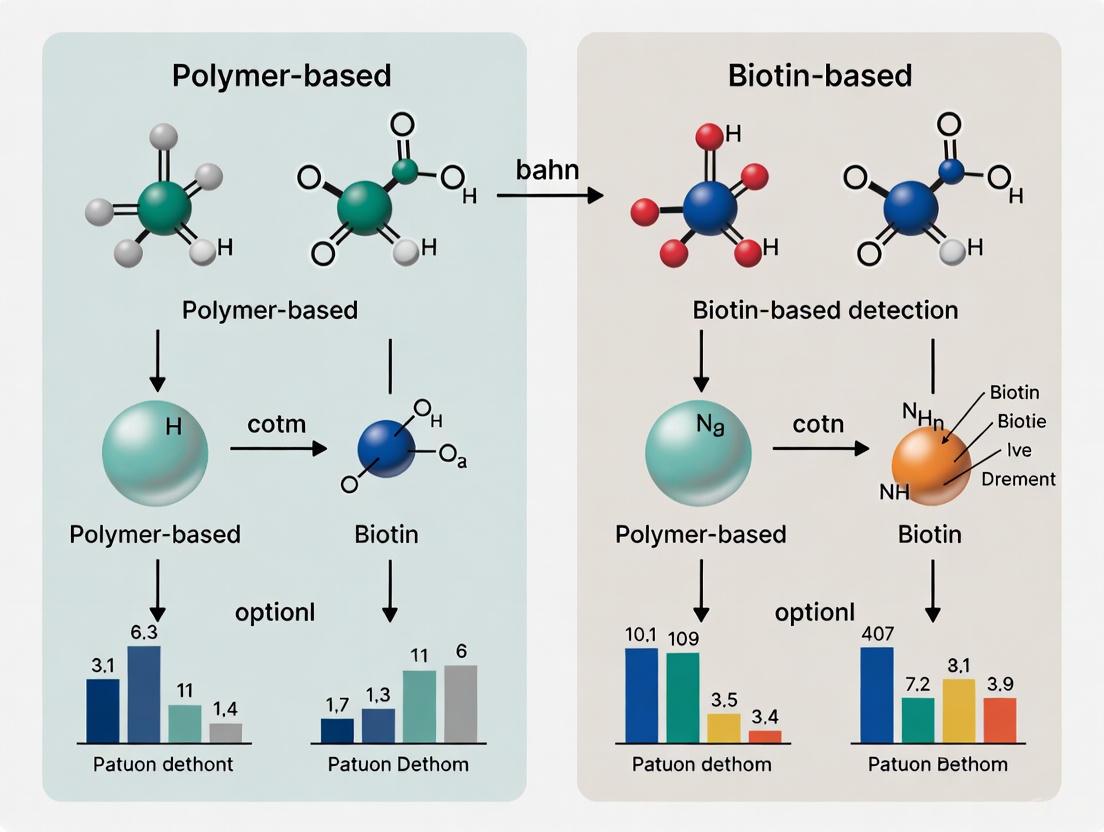
This article provides a thorough comparison of polymer-based and biotin-based detection systems in immunohistochemistry (IHC), tailored for researchers, scientists, and drug development professionals.
Polymer-Based vs. Biotin-Based Detection: A Comprehensive Guide for Biomedical Research and Diagnostics
Abstract
This article provides a thorough comparison of polymer-based and biotin-based detection systems in immunohistochemistry (IHC), tailored for researchers, scientists, and drug development professionals. It covers the foundational principles of both systems, including the mechanisms of avidin-biotin complexes (ABC, LSAB) and polymer-based technologies (e.g., ENVISION+, ImmPRESS). The scope extends to methodological applications, offering protocols for various experimental needs. A significant focus is placed on troubleshooting common issues like background staining and optimizing sensitivity. Finally, the article delivers a critical validation and comparative analysis of sensitivity, specificity, cost, and suitability for different tissue types and biomarkers, empowering professionals to select the optimal detection system for their research and diagnostic projects.
Core Principles: Understanding Biotin-Streptavidin and Polymer Detection Technologies
The biotin-streptavidin interaction represents one of nature's most robust non-covalent biological interactions, forming the foundation for numerous detection and diagnostic platforms in biological research. This interaction demonstrates extraordinary affinity (Kd ≈ 10⁻¹⁵ M) and remarkable resilience to extremes of pH, temperature, and denaturing agents. Within immunohistochemistry (IHC) and related immunoassay techniques, this system enables significant signal amplification through two principal methods: the Avidin-Biotin Complex (ABC) and Labeled Streptavidin-Biotin (LSAB) techniques. While both methods leverage the same fundamental interaction, they differ substantially in their complex size, penetration capability, and resultant sensitivity. This guide provides a comprehensive comparison of these foundational methods, detailing their mechanistic principles, experimental protocols, and performance characteristics within the broader context of detection system evolution, including emerging polymer-based technologies.
The Molecular Foundation: Biotin-Streptavidin Interaction
Fundamental Characteristics
The extraordinary utility of the biotin-streptavidin system in biological detection stems from its unique molecular properties. Biotin (also known as vitamin B7 or vitamin H) is a small water-soluble vitamin with a molecular weight of just 244.3 Daltons [1]. Its small size and the presence of a valeric acid side chain that can be chemically derivatized allow it to be conjugated to antibodies, proteins, and other biomolecules without significantly altering their biological activity or function [1] [2]. Once attached, biotin serves as a universal tag that can be recognized with high specificity by biotin-binding proteins.
Streptavidin, a tetrameric protein originally isolated from Streptomyces avidinii, serves as the primary binding partner in most modern applications [1]. Each streptavidin molecule contains four identical subunits, each capable of binding one biotin molecule, resulting in a total molecular weight of approximately 53-60 kDa [1] [3]. The binding interaction between streptavidin and biotin is characterized by several remarkable features that make it ideally suited for research applications.
Table 1: Key Characteristics of Biotin-Binding Proteins
| Characteristic | Avidin | Streptavidin | NeutrAvidin |
|---|---|---|---|
| Source | Egg white | Streptomyces avidinii | Engineered from avidin |
| Molecular Weight (kDa) | 67-68 | 53-60 | 60 |
| Biotin Binding Sites | 4 | 4 | 4 |
| Isoelectric Point (pI) | 10.0-10.5 | 6.8-7.5 | 6.3 |
| Affinity for Biotin (Kd) | ~1.3 × 10⁻¹⁵ M | ~0.04 × 10⁻¹⁵ M | ~1.3 × 10⁻¹⁵ M |
| Glycosylation | Yes (~10% of mass) | No | No (deglycosylated) |
| Nonspecific Binding | High | Low | Lowest |
Structural Basis for High Affinity
The exceptional strength of the biotin-streptavidin interaction arises from both structural compatibility and extensive molecular contacts. The biotin molecule fits into a binding pocket on streptavidin that is complementary in both shape and chemical properties [4]. This pocket provides multiple hydrogen bonds and hydrophobic interactions that collectively create an energy well requiring substantial force to disrupt. The interaction is so specific and stable that once formed, the bond remains intact under extreme physiological conditions, including wide pH variations, high salt concentrations, elevated temperatures, and the presence of organic solvents or denaturing agents [1] [5].
The structural basis for this remarkable affinity has been elucidated through protein engineering studies. Research has demonstrated that modified streptavidin variants, such as traptavidin, can exhibit even greater stability and slower biotin dissociation rates through reduced flexibility of the binding loop (L3/4) near biotin's valeryl tail and more consistent hydrogen bonding with biotin [4].
Biotin-Based Detection Methods: ABC vs. LSAB
Avidin-Biotin Complex (ABC) Method
The ABC method represents a three-step detection approach that creates large complexes containing multiple enzyme molecules for significant signal amplification [3] [6]. The technique capitalizes on the tetravalent nature of streptavidin/avidin to form extensive lattices with biotinylated enzymes prior to application on the tissue sample.
Experimental Protocol for ABC Method:
- Primary Antibody Incubation: Apply primary antibody specific to the target antigen to the tissue sample and incubate (typically 1 hour at room temperature to overnight at 4°C) [3].
- Biotinylated Secondary Antibody Incubation: Apply biotinylated secondary antibody with specificity for the primary antibody species and incubate (typically 1 hour at room temperature) [3].
- ABC Complex Formation and Application: Pre-incubate avidin/streptavidin with biotinylated enzyme (HRP or AP) in a specified ratio for approximately 15 minutes at room temperature to form complexes, then apply to the tissue sample [3] [6].
- Detection: Add appropriate chromogenic or chemiluminescent substrate to visualize the target antigen [6].
The key advantage of the ABC method lies in its amplification capacity. Each ABC complex contains multiple enzyme molecules (typically 3 enzyme molecules per avidin molecule) localized to a single antigenic site, dramatically increasing the signal intensity compared to direct detection methods [3] [6].
Labeled Streptavidin-Biotin (LSAB) Method
The LSAB method represents an evolution of the ABC technique, addressing some of its limitations while maintaining strong signal amplification. This method utilizes directly labeled streptavidin-enzyme conjugates rather than pre-formed complexes [3] [7].
Experimental Protocol for LSAB Method:
- Primary Antibody Incubation: Identical to ABC method - apply primary antibody specific to the target antigen and incubate [3].
- Biotinylated Secondary Antibody Incubation: Identical to ABC method - apply biotinylated secondary antibody and incubate [3].
- Enzyme-Streptavidin Conjugate Application: Apply streptavidin or NeutrAvidin directly conjugated to reporter enzyme (HRP or AP) without pre-complexing [3] [7].
- Detection: Add appropriate substrate to visualize target antigen [6].
The LSAB method offers significant advantages due to the smaller size of the detection complex. Unlike the large pre-formed ABC complexes, the streptavidin-enzyme conjugates used in LSAB can more readily penetrate tissue structures, potentially improving access to antigens and resulting in up to 8-fold greater sensitivity compared to the ABC method [3] [7]. Additionally, using streptavidin rather than native avidin reduces nonspecific binding due to streptavidin's near-neutral isoelectric point and lack of glycosylation [1] [3].
Table 2: Performance Comparison of IHC Detection Methods
| Parameter | ABC Method | LSAB Method | Polymer-Based Method |
|---|---|---|---|
| Complex Size | Large | Small | Variable (typically small) |
| Tissue Penetration | Limited | Excellent | Good to Excellent |
| Sensitivity | High (amplified) | Very High (8x ABC) | Highest |
| Steps | 3 | 3 | 2 |
| Endogenous Biotin Interference | Yes | Yes | No |
| Non-specific Binding | Moderate (avidin) / Low (streptavidin) | Low | Lowest |
| Background Staining | Moderate to High | Low | Minimal |
IHC Detection Workflow: ABC vs. LSAB Methods
Experimental Considerations and Protocol Optimization
Addressing Technical Challenges
Despite their widespread utility, both ABC and LSAB methods present specific technical challenges that require consideration during experimental design. A primary concern is endogenous biotin interference, particularly problematic when working with tissues naturally high in biotin content such as liver, kidney, brain, or mammary tissue [1] [7]. This endogenous biotin can bind detection reagents, creating false-positive signals and elevated background staining.
Mitigation strategies for endogenous biotin include:
- Blocking steps: Apply streptavidin and biotin blocking solutions sequentially prior to primary antibody incubation [7].
- Choice of detection system: Consider polymer-based methods for tissues with exceptionally high endogenous biotin [7] [6].
- Sample processing: Note that formalin fixation and paraffin embedding reduce endogenous biotin activity, while frozen sections retain higher levels [7].
Another significant consideration is nonspecific binding, which varies depending on the biotin-binding protein selected. Native avidin exhibits particularly high nonspecific binding due to its glycosylation and basic isoelectric point (pI ≈ 10.5), which can promote electrostatic interactions with negatively charged cellular components [1] [2]. Streptavidin (pI ≈ 6.8-7.5) demonstrates reduced nonspecific binding, while NeutrAvidin (deglycosylated avidin with pI ≈ 6.3) typically shows the lowest nonspecific binding among these options [1] [3].
Advanced Applications and Modifications
The fundamental biotin-streptavidin interaction has been adapted for numerous advanced applications beyond traditional IHC. In lateral flow immunoassays (LFIAs), the system enables highly sensitive detection of pathogens through the creation of robust detection conjugates [8] [9]. For example, researchers have developed "Molecular Velcro" systems using streptavidin-biotin immobilized nanobodies on gold nanoparticles for ultrasensitive detection of Salmonella typhimurium in food samples [8].
In cell separation techniques, biotinylated antibodies combined with streptavidin-coated surfaces or beads enable highly specific cell isolation. The extraordinary bond strength allows for rigorous washing conditions without dissociating the target complex, improving purity [5]. Newer platforms such as streptavidin-coated microbubbles exploit this interaction for gentle, efficient cell separation through buoyancy-activated cell sorting (BACS) [5].
The Researcher's Toolkit: Essential Reagents and Materials
Table 3: Essential Research Reagents for Biotin-Streptavidin Methods
| Reagent/Material | Function | Examples/Specifications |
|---|---|---|
| Biotinylation Kits | Label primary or secondary antibodies with biotin | NHS-ester biotin derivatives, site-specific biotinylation kits [1] |
| Streptavidin Conjugates | Detection of biotinylated molecules | HRP-streptavidin, AP-streptavidin, fluorescently-labeled streptavidin [3] [2] |
| Biotin-Blocking Solutions | Reduce background from endogenous biotin | Sequential streptavidin and biotin blocks [7] |
| Chromogenic Substrates | Visualize enzyme activity | DAB (brown), AEC (red), BCIP/NBT (blue-purple) [7] [6] |
| NeutrAvidin | Reduced nonspecific binding | Deglycosylated avidin with near-neutral pI [1] [3] |
| Biotinylated Secondary Antibodies | Link primary antibodies to detection system | Species-specific antibodies with multiple biotins per IgG [2] |
| Streptavidin-Coated Microbubbles | Cell separation applications | Buoyancy-activated cell sorting (BACS) [5] |
| Enhanced Polymer Systems | Signal amplification without biotin | Dextran-based polymer backbones with multiple enzyme molecules [7] [6] |
Comparative Analysis with Emerging Technologies
Biotin-Based vs. Polymer-Based Detection Systems
While biotin-streptavidin methods remain widely used, polymer-based detection systems have emerged as powerful alternatives, particularly for challenging applications [7] [6]. These systems typically consist of a synthetic polymer backbone conjugated to multiple secondary antibodies and enzyme molecules, creating a compact but highly amplified detection complex.
Key advantages of polymer-based systems include:
- Elimination of endogenous biotin interference: Complete avoidance of background from naturally occurring biotin [7] [6].
- Streamlined protocols: Typically two-step methods (primary antibody followed by polymer-enzyme reagent) compared to three-step ABC/LSAB protocols [6].
- Enhanced penetration: Smaller complex size compared to ABC methods improves access to intracellular antigens [7].
- Higher signal amplification: Some systems contain >100 enzyme molecules per polymer backbone, potentially exceeding the amplification of ABC methods [6].
Limitations of polymer-based systems include:
- Higher cost: Typically more expensive than biotin-streptavidin reagents [6].
- Steric hindrance: Large polymer complexes may still struggle to penetrate some tissue compartments or access certain epitopes [6].
- Reduced flexibility: Less modular than the customizable biotin-streptavidin approach.
Molecular Complexes: Biotin vs. Polymer Systems
Selection Guidelines for Detection Methods
Choosing between ABC, LSAB, and polymer-based methods requires careful consideration of experimental priorities and sample characteristics:
Select ABC Method when:
- Maximum signal amplification is required for low-abundance targets
- Cost considerations are paramount
- Tissue penetration is not limiting (e.g., surface antigens or cell smears)
- Endogenous biotin levels are minimal or adequately blocked
Select LSAB Method when:
- Balanced sensitivity and tissue penetration are needed
- Reduced background is desirable
- Working with densely packed tissues or intracellular targets
- Streptavidin-specific reagents are available
Select Polymer-Based Method when:
- Working with tissues high in endogenous biotin (liver, kidney)
- Rapid protocol completion is prioritized
- Maximum sensitivity with minimal background is critical
- Budget allows for premium detection reagents
The biotin-streptavidin interaction remains a cornerstone of biological detection technologies, providing an unmatched combination of affinity, specificity, and versatility. The ABC and LSAB methods that exploit this interaction have enabled decades of scientific discovery through their robust signal amplification capabilities. While newer polymer-based technologies offer advantages in certain applications, the biotin-streptavidin system continues to evolve through improved reagents like NeutrAvidin and traptavidin, engineered for reduced background and enhanced stability. Understanding the fundamental principles, comparative performance characteristics, and optimal application contexts for these detection methods empowers researchers to select the most appropriate approach for their specific experimental needs, balancing sensitivity, specificity, and practicality in the pursuit of scientific advancement.
In the pursuit of detecting increasingly elusive biomarkers for early-stage disease diagnosis, signal amplification has become a cornerstone of analytical biochemistry. For decades, systems leveraging the exceptionally strong binding (Kd ~10-15 M) between biotin and streptavidin have been the gold standard for signal amplification in techniques like ELISA and immunohistochemistry (IHC) [10]. These biotin-based systems function by enabling the binding of multiple enzyme-labeled streptavidin molecules to a single biotinylated antibody, thereby amplifying the detectable signal [11]. However, the inherent biotin content in certain tissues (e.g., placenta, mammary glands) can cause nonspecific staining, and the rigorous conditions needed to disrupt the biotin-streptavidin interaction (e.g., temperatures >70°C) can compromise assay integrity [10] [12].
The emergence of dextran polymer-based systems presents a powerful alternative. These systems utilize a backbone of dextran—a hydrophilic, biocompatible polysaccharide—to which numerous enzyme and antibody molecules are directly conjugated [13]. This architecture allows a single dextran polymer to carry approximately 40 molecules of Horseradish Peroxidase (HRP) and 11 antibody molecules, creating a dense, localized concentration of signaling molecules that can dramatically enhance detection sensitivity [13]. This guide provides a direct, data-driven comparison of these two amplification strategies, offering researchers a clear framework for selecting the optimal system for their specific applications in drug development and diagnostic research.
Performance Comparison: Quantitative Data Analysis
The following tables summarize the experimental performance data of dextran polymer-based and biotin-based detection systems across key metrics.
Table 1: Comparative Performance of Signal Amplification Systems in Immunohistochemistry (IHC)
| Amplification System | Sensitivity | Specificity | Assay Time | Background/Non-Specific Staining | Key Applications Cited |
|---|---|---|---|---|---|
| Dextran Polymer (EnVision+) | High (Considerable increase vs. conventional ISH) [12] | High (No loss of specificity) [12] | Shorter [12] | Low (Does not raise background problems) [12] | HPV detection in cervical biopsies [12]; General IHC [13] |
| Biotin-Streptavidin (ABC/LSAB) | High [11] | High (with biotin-blocking) [12] | Longer [12] | Moderate (Requires biotin-blocking step in biotin-rich tissues) [12] | General IHC and ELISA [10] [11] |
| Biotin-Tyramide (GenPoint) | Very High (Higher IOD than EnVision+) [12] | High [12] | Longer [12] | Moderate (Can raise background problems) [12] | High-sensitivity ISH and IHC [12] |
Table 2: Analytical Performance of Biotin-Selective Molecularly Imprinted Polymer (MIP) Sensors
| Sensor/Analyte | Sensitivity (Hz/mM) | Stability Constant, Ks (M⁻¹) | Response Time | Recovery Time | Reference |
|---|---|---|---|---|---|
| Biotin Methyl Ester on MIP Film | 1.8236 | 58.54 ± 4.51 | 32 s | ~4 min | [10] |
| Biotin Methyl Ester on Reference (REF) Film | 0.9157 | 39.34 ± 2.12 | Information Missing | Information Missing | [10] |
System Architectures and Experimental Protocols
Dextran Polymer-Based Systems (e.g., Poly-HRP Antibody Conjugate)
The synthesis of a dextran polymer-based detection conjugate is a multi-step chemical process aimed at creating a highly functionalized reagent [13].
Detailed Protocol (PHA Synthesis):
- Dextran Activation: Dissolve 60 mg of 30 kDa dextran in water to a concentration of 20 mg/mL. Add sodium periodate to a final concentration of 60 mM and react overnight at room temperature in the dark. This oxidation step opens sugar rings to create aldehyde groups. Dialyze the product against water to remove excess periodate [13].
- Thiol Group Introduction: Add cystamine dihydrochloride (100 moles per mole of dextran) to the oxidized dextran at pH 7.4-7.6. To reduce the formed Schiff bases, add sodium cyanoborohydride (50 mM final concentration) and shake for several hours. This step introduces free thiol groups onto the dextran backbone. Dialyze the resulting thiolated dextran against water containing 10 mM EDTA. Confirm thiolation using the Ellman's assay [13].
- Activation of HRP and Antibody: Separately, dissolve Horseradish Peroxidase (HRP) and the target antibody (e.g., goat anti-mouse IgG) in PBS. Add the crosslinker sulfo-MBS (m-maleimidobenzoyl-N-hydroxysuccinimide ester) to each solution and react for 2 hours at room temperature. This step functionalizes the HRP and antibody with maleimide groups. Dialyze both mixtures against PBS with EDTA to remove unreacted crosslinker [13].
- Conjugate Assembly: Combine one mole of thiolated dextran with 80 moles of HRP-MBS and 20 moles of antibody-MBS. Allow the reaction to proceed for 6 hours at 4°C. The maleimide groups on the HRP and antibody will covalently bind to the thiol groups on the dextran, forming the final Poly-HRP Antibody (PHA) conjugate [13].
Schematic of Dextran Polymer-Based Detection Conjugate
Biotin-Based and Molecularly Imprinted Polymer (MIP) Systems
Biotin-Based Systems (ABC Method): The Avidin-Biotin Complex (ABC) method is a classic protocol. First, a biotinylated secondary antibody is applied to the sample. Then, a pre-formed complex of avidin/streptavidin and biotinylated enzyme (e.g., HRP) is added. The extremely high affinity between avidin and biotin allows a large lattice of enzyme molecules to form on the primary antibody, leading to signal amplification [11].
Biotin-Selective Molecularly Imprinted Polymer (MIP) Films: MIPs offer a synthetic, reusable alternative to biological receptors for biotin capture [10].
- Surface Preparation: A gold-coated quartz resonator is first coated with a self-assembled monolayer (SAM) of hexadecanethiol. The photoinitiator benzophenone is then physisorbed onto this surface [10].
- Polymerization and Imprinting: A polymerization mixture containing the functional monomer (2-acrylamido-2-methylpropanesulfonic acid, AMPS), the crosslinker (N,N'-methylenebisacrylamide, MBA), and the template molecule (biotin methyl ester) in a 3:1 water-methanol solvent is added. UV irradiation initiates graft co-polymerization, forming a thin (3-5 nm) polymer film around the template molecules [10].
- Template Removal: After polymerization, the template molecules are washed out, leaving behind cavities in the polymer matrix that are complementary to the biotin molecule in size, shape, and functional group orientation [10].
- Detection: When used as a sensor, binding of biotin or biotinylated structures to these cavities increases the mass on the quartz crystal microbalance (QCM) resonator, causing a measurable change in its resonant frequency [10].
Workflow for Biotin-Selective MIP Sensor Creation and Use
The Researcher's Toolkit: Essential Reagents and Materials
Table 3: Key Research Reagents for Signal Amplification Systems
| Reagent/Material | Function | Example in Context |
|---|---|---|
| Dextran Polymer (30 kDa) | Serves as the inert, biocompatible backbone for high-density conjugation of signaling molecules [13]. | Core component of the Poly-HRP Antibody (PHA) conjugate [13]. |
| Sodium Periodate (NaIO₄) | Oxidizes dextran, creating aldehyde groups for subsequent chemical modification [13]. | Used in the initial activation step of dextran for PHA synthesis [13]. |
| Sulfo-MBS Crosslinker | A heterobifunctional crosslinker that covalently links thiolated dextran to amine groups on antibodies and HRP [13]. | Critical for conjugating MBS-activated HRP and antibody to the thiolated dextran backbone [13]. |
| Cystamine | Used to introduce free thiol groups onto the oxidized dextran polymer after reduction [13]. | Enables the covalent attachment of MBS-activated proteins in PHA synthesis [13]. |
| Molecularly Imprinted Polymer (MIP) | Synthetic polymer with tailor-made cavities for specific recognition of a target molecule (e.g., biotin) [10]. | Used as a reusable, stable recognition element in QCM sensors for detecting biotinylated compounds [10]. |
| Biotinylated Dextran Amine (BDA) | A neural tracer and labeling reagent that combines the properties of dextran with the detection utility of biotin [14] [15]. | Used for pre-labeling fetal neurons to trace neuronal projections and graft integration [15]. |
The data reveals a clear, application-dependent landscape for signal amplification. Dextran polymer-based systems excel in routine and clinical IHC due to their simplicity, speed, and low background, making them robust for many diagnostic applications [12]. Biotin-based systems, particularly tyramide signal amplification, remain powerful for extreme sensitivity needs but require careful optimization to mitigate background [12]. Meanwhile, biotin-selective MIPs represent a paradigm shift toward synthetic, reusable, and highly stable materials for sensor development, showing particular promise for automated assay platforms and detection in complex matrices [10] [11].
Future research is advancing these systems along several fronts. For dextran polymers, functionalization with novel nanomaterials and integration into multi-modal detection platforms are key trends [11] [16]. For MIPs, the integration is focused on combining them with high-performance nanomaterials and nucleic acid amplification strategies to push detection limits even further for trace biomolecules [11]. The choice between these systems ultimately hinges on the specific trade-offs a researcher is willing to make between sensitivity, specificity, operational convenience, and cost for a given application in drug development or clinical diagnostics.
Immunohistochemistry (IHC) is a powerful technique that exploits the specific binding between an antibody and antigen to detect and localize specific antigens in cells and tissue, typically examined with a light microscope [17]. This methodology has become an essential ancillary technique in clinical diagnostics and research pathology, providing critical diagnostic, prognostic, and predictive information supplemental to morphological tissue assessment [17] [18]. The core principle of IHC involves visualizing target antigens using specific antibodies, with detection systems ranging from simple direct methods to complex amplification protocols designed to enhance sensitivity for minimally expressed markers [18].
The evolution of IHC detection methods represents a continual pursuit of optimal balance between sensitivity and specificity. While direct detection methods (where the primary antibody is itself labeled) offer simplicity, they generally provide insufficient sensitivity for detecting most antigens found in routinely processed tissues [18]. This limitation prompted the development of indirect detection methods, which introduce secondary antibodies or more complex systems to amplify the signal [17] [18]. Among these, methods based on biotin-streptavidin interactions and polymer-based technologies have become cornerstones of modern IHC, each offering distinct advantages and limitations that must be carefully considered in experimental design [6].
This guide objectively compares polymer-based and biotin-based detection systems within the broader context of direct versus indirect detection methodologies, providing researchers with the experimental data and technical framework necessary to select optimal detection strategies for specific applications.
Core Detection Methodologies: From Basic to Advanced Systems
Direct and Indirect Methods: Fundamental Concepts
All IHC detection systems stem from two fundamental approaches. Direct detection is a one-step process using a primary antibody directly conjugated to a reporter enzyme (e.g., horseradish peroxidase or alkaline phosphatase) or fluorophore [18] [6]. While rapid and simple, this method lacks signal amplification, resulting in low sensitivity, and requires individually labeled primary antibodies for each target, increasing cost and reducing flexibility [6].
Indirect detection employs an unlabeled primary antibody followed by a labeled secondary antibody that recognizes the primary antibody [17]. This approach offers significant advantages, including signal amplification (as multiple secondary antibodies can bind to a single primary antibody), increased sensitivity, and greater flexibility—the same labeled secondary antibody can be used with various primary antibodies from the same species [17] [6]. The enhanced sensitivity of indirect methods makes them the preferred choice for most research and clinical applications [18].
Biotin-Based Detection Systems: Avidin-Biotin Complex (ABC) and Labeled Streptavidin-Biotin (LSAB)
Biotin-based systems represent a significant advancement in signal amplification. The Avidin-Biotin Complex (ABC) method is a three-step process: (1) primary antibody binds the antigen; (2) a biotinylated secondary antibody recognizes the primary antibody; (3) pre-formed complexes of avidin and biotinylated enzyme (ABC) bind to the biotinylated secondary antibody [6]. The extremely high affinity (Kd ≈ 10-15 M) between biotin and avidin enables strong signal amplification, as each tetrameric avidin molecule can bind multiple biotin molecules, creating large complexes with numerous reporter enzymes [19] [6].
The Labeled Streptavidin-Biotin (LSAB) method improved upon ABC by replacing avidin with streptavidin [6]. While both are tetrameric proteins with high biotin affinity, streptavidin is not glycosylated and has a neutral isoelectric point (compared to avidin's pI of 10), substantially reducing non-specific electrostatic binding to tissue components and resulting in lower background staining [6]. LSAB is reported to be approximately ten times more sensitive than ABC [6].
Diagram: LSAB (Labeled Streptavidin-Biotin) method workflow. This three-step detection system uses a biotinylated secondary antibody followed by a streptavidin-enzyme complex, providing high sensitivity through signal amplification.
Polymer-Based Detection Systems
Polymer-based systems represent a more recent evolution in IHC detection, designed to address limitations of biotin-based methods. These systems completely circumvent the biotin-streptavidin interaction, instead using enzyme-labeled polymers to achieve signal amplification [6]. One approach conjugates numerous secondary antibodies and enzyme molecules (up to 20 antibodies and 100 enzymes) to a dextran polymer backbone [6]. A more advanced approach creates compact complexes by polymerizing enzymes into small linear molecules attached to antibodies, resulting in high enzyme density with minimal steric interference [6]. These systems typically employ a two-step protocol: after primary antibody application, the polymer-based reagent (containing secondary antibodies and enzymes) is applied, making the procedure faster than three-step methods [20] [6].
Diagram: Polymer-based detection system. This two-step method uses a polymer backbone conjugated with multiple secondary antibodies and enzyme molecules, providing high signal amplification without biotin.
Comparative Performance Analysis: Polymer vs. Biotin Systems
Experimental Data and Performance Metrics
Independent studies have provided quantitative comparisons between detection systems. One study comparing two polymer-based systems (ENVISION+ and ImmPRESS) found that ImmPRESS yielded similar or higher reaction intensity than ENVISION+ in 16 of 18 antigens evaluated, though it produced abundant background with two antigens (calretinin and COX-2) that hindered interpretation [21]. The study also noted that ImmPRESS cost was 25% lower than ENVISION+ [21].
Manufacturer data demonstrates that polymer-based systems can significantly reduce primary antibody requirements. One technology brief showed that HRP-polymer conjugates reduced the amount of primary antibody needed by 3-fold and shortened incubation periods from overnight to one hour compared to ABC methods [20].
For biotin-based systems, the primary limitation involves endogenous biotin interference, particularly problematic in biotin-rich tissues like liver and kidney, often requiring additional blocking steps [6]. The large complex size in ABC methods can also impede efficient tissue diffusion, potentially limiting access to some antigens [6].
Table 1: Comprehensive Comparison of IHC Detection Methods
| Detection Method | Sensitivity | Steps | Key Advantages | Key Limitations |
|---|---|---|---|---|
| Direct | Low | 1 | Fast; simple protocol; low species cross-reactivity | No signal amplification; poor sensitivity; high cost (each primary must be labeled) |
| Indirect (Simple) | Moderate | 2 | Increased sensitivity vs. direct; flexible (same secondary for multiple primaries) | Limited signal amplification |
| PAP | High | 3 | Good signal amplification; no chemical conjugation; allows high primary antibody dilution | Species-specific complexes; time-consuming; may be insufficient for FFPE tissues |
| ABC | High | 3 | Strong signal amplification; allows primary antibody dilution | Endogenous biotin causes background; large complex size limits tissue penetration |
| LSAB | Very High | 3 | Reduced non-specific staining vs. ABC; stable complexes; high sensitivity | Potential background from endogenous biotin |
| Polymer-Based | Very High | 2 | No endogenous biotin issues; compact complexes; fast protocol; high specificity | Higher cost than earlier methods; potential steric interference with dextran polymers |
Technical Considerations for Method Selection
Choosing an optimal IHC detection system requires balancing multiple factors. Tissue type significantly impacts method selection—tissues with high endogenous biotin (liver, kidney) or high endogenous peroxidase activity (bone marrow, spleen) may require specialized approaches [17] [6]. Antigen abundance also dictates choice; low-abundance targets necessitate high-sensitivity systems like polymer or LSAB methods, while highly expressed antigens may be adequately detected with simpler methods [18]. The desired protocol complexity and available time should be considered, with polymer systems offering two-step convenience versus three-step biotin methods [6]. Finally, budget constraints may influence selection, as polymer methods typically cost more than biotin-based systems despite their advantages [6].
Experimental Protocols for Key Detection Methods
Standard IHC Protocol Foundation
All IHC detection methods share fundamental preparatory steps. Proper tissue preparation is critical, typically involving formalin-fixed paraffin-embedded (FFPE) tissue sections cut at 4-7μm thickness and mounted on charged adhesion slides [17]. Slides should be dried overnight or for several hours, then placed in a 60°C oven for at least 2 hours (ideally overnight) [17]. Deparaffinization and rehydration are performed by immersing slides in three washes of xylene (10 minutes each), followed by sequential dipping in graded alcohols (100%, 100%, 80%, to 70%) and immersion in deionized water [17].
Antigen retrieval is typically necessary for FFPE tissues to reverse formaldehyde-induced cross-links that mask epitopes [17]. Heat-induced epitope retrieval (HIER) using a microwave oven or pressure cooker is most common [17]. For microwave retrieval, slides are placed in retrieval buffer (e.g., 10mM citrate) and heated at 100°C for 5-10 minutes, then cooled for 15 minutes [17]. Following antigen retrieval, endogenous peroxidase activity should be blocked with 3% hydrogen peroxide for 5 minutes, followed by washing [17].
Polymer-Based Detection Protocol
After standard preparation and primary antibody incubation, apply the polymer-based detection reagent. These reagents typically contain secondary antibodies and enzyme molecules (HRP or AP) conjugated to a polymer backbone [6]. Incubate according to manufacturer recommendations (typically 30-60 minutes at room temperature). Wash thoroughly with buffer. Visualize using an appropriate chromogenic substrate (e.g., DAB for HRP, NovaRed for AP) [17] [6]. Counterstain, dehydrate, clear, and mount following standard histological practices [17].
Biotin-Based (LSAB) Detection Protocol
Following standard preparation and primary antibody application, apply biotinylated secondary antibody specific to the host species of the primary antibody. Incubate for 30-60 minutes at room temperature, then wash thoroughly with buffer [6]. Apply enzyme-conjugated streptavidin complex (typically HRP- or AP-labeled streptavidin). Incubate for 30-60 minutes at room temperature, then wash thoroughly [6]. Proceed with chromogenic detection, counterstaining, and mounting as described for the polymer protocol [17] [6].
Essential Research Reagent Solutions
Table 2: Essential Reagents for IHC Detection Methods
| Reagent Category | Specific Examples | Function | Application Notes |
|---|---|---|---|
| Antigen Retrieval Buffers | Citrate buffer (pH 6.0), Tris-EDTA (pH 9.0) | Reverse formaldehyde cross-links to expose epitopes | Choice depends on primary antibody and target antigen |
| Blocking Reagents | Normal serum, protein block, peroxidase block | Reduce non-specific background staining | Use serum from secondary antibody species; essential for biotin-rich tissues with biotin methods |
| Primary Antibodies | Monoclonal, polyclonal | Specifically bind target antigen | Monoclonal: more specific; Polyclonal: more sensitive |
| Detection Systems | Polymer-based kits, LSAB kits, ABC kits | Signal generation and amplification | Polymer: minimal background; Biotin-based: high sensitivity but potential interference |
| Chromogens | DAB, NovaRed, Vector Blue | Enzyme substrates producing visible precipitate | DAB is most common; produces brown precipitate that is alcohol-fast |
| Mounting Media | Aqueous, organic | Preserve and protect stained tissue | Aqueous for fluorescent detection; organic for chromogenic |
The evolution from direct to indirect detection methods, and further to sophisticated biotin and polymer systems, has dramatically expanded IHC capabilities. Biotin-based methods like LSAB remain valuable for their high sensitivity and established protocols, particularly when endogenous biotin is not a concern. However, polymer-based systems offer compelling advantages through simplified workflows, elimination of biotin-related artifacts, and robust signal amplification in a compact format.
When designing IHC experiments, researchers should consider the specific application requirements—diagnostic applications may prioritize reliability and established protocols, while research investigations might value flexibility and minimal background. The growing implementation of digital pathology and AI-assisted analysis places increasing importance on consistent, reproducible staining quality, an area where polymer systems excel due to their reduced variability [22].
By understanding the technical principles, performance characteristics, and practical considerations of each detection methodology, researchers can make informed decisions that optimize experimental outcomes and advance scientific discovery through high-quality immunohistochemical analysis.
Immunohistochemistry (IHC) relies on sophisticated detection systems to visualize antibody-antigen interactions in tissue samples. These systems consist of three core components: enzymes, chromogens, and reporter molecules, which work in concert to generate a visible signal at the antigen site. The choice between horseradish peroxidase (HRP) and alkaline phosphatase (AP) as reporter enzymes represents a fundamental decision that influences assay sensitivity, multiplexing capability, and compatibility with different tissue types. Similarly, chromogens like 3,3'-diaminobenzidine (DAB) and 3-amino-9-ethylcarbazole (AEC) provide distinct visual and stability characteristics. This guide objectively compares the performance of these key components within the evolving landscape of detection methodologies, particularly focusing on the shift from traditional biotin-based to advanced polymer-based systems, providing researchers with evidence-based selection criteria for their experimental designs.
Core Enzymes in IHC: HRP vs. AP
Horseradish Peroxidase (HRP)
HRP is a 44-kDa enzyme isolated from horseradish roots that catalyzes the oxidation of substrates in the presence of hydrogen peroxide (H₂O₂) [23]. Upon activation, HRP oxidizes electron donors such as substituted phenylenediamines, converting them to cationic electrophiles which subsequently react with electron-rich, aromatic compounds to yield a colored precipitate [23]. The enzyme's specificity for the second molecule of hydrogen peroxide is relatively low, enabling the development of numerous chromogen substrates and making HRP exceptionally versatile for chromogenic detection [23]. HRP is characterized by its small size, high stability, and exceptional turnover rate, allowing for relatively fast signal detection [24]. A significant advantage of HRP-based systems is the enzyme's compatibility with tyramide signal amplification (TSA), which enables extreme signal amplification through the catalyzed deposition of tyramide substrates [25].
When using HRP, researchers must consider endogenous peroxidase activity present in certain tissues (particularly erythrocytes and leukocytes), which can cause background staining. This is typically mitigated through pre-incubation with peroxidase inhibitors or specific blocking steps prior to primary antibody application [23]. Additionally, HRP activity can be compromised by azide, a common preservative in antibody solutions, requiring azide-free buffers for optimal performance.
Alkaline Phosphatase (AP)
AP is an 86-kDa enzyme, commonly isolated from calf intestines, that functions by hydrolyzing its substrates into phenolic compounds and phosphates [23]. These phenolic compounds then interact with colorless diazonium salts (chromogens) to yield a colored precipitation product [23]. Common AP substrates include substituted naphthol phosphate-diazonium salts such as Naphthol AS-MX-phosphate/Fast Red or Fast Blue, which produce red/orange or blue precipitates, respectively [23]. The BCIP/NBT (5-Bromo-4-Chloro-3-Indolyl Phosphate/Nitro blue Tetrazolium) system is another popular AP substrate combination that yields a dark blue/purple precipitate characterized by excellent sensitivity and stability [23].
AP-based detection offers the advantage of avoiding endogenous peroxidase interference, making it particularly valuable for tissues with high endogenous peroxidase activity. However, endogenous AP activity (particularly in intestinal, kidney, and placental tissues) can also produce background and may require inhibition with levamisole or other specific blockers. AP demonstrates optimal activity in alkaline conditions (pH 8-10), which differs from HRP's optimal pH range [23].
Table 1: Comparative Characteristics of HRP and AP Reporter Enzymes
| Characteristic | Horseradish Peroxidase (HRP) | Alkaline Phosphatase (AP) |
|---|---|---|
| Molecular Weight | 44 kDa [23] | 86 kDa [23] |
| Origin | Horseradish roots [23] | Calf intestines [23] |
| Reaction Type | Oxidation of substrates in presence of H₂O₂ [23] | Hydrolysis of substrates into phenolic compounds and phosphates [23] |
| Common Substrates | DAB, AEC, TMB [23] | Fast Red, Fast Blue, BCIP/NBT [23] |
| Endogenous Activity | Present in erythrocytes, leukocytes [23] | Present in intestine, kidney, placenta [23] |
| Inhibitors | Sodium azide, hydrogen peroxide [23] | Levamisole [23] |
| Optimal pH | Neutral to slightly acidic [26] | 8-10 (alkaline) [23] |
| Signal Amplification | Compatible with tyramide signal amplification [25] | Limited amplification options |
Enzyme Selection Considerations
The decision between HRP and AP involves multiple considerations. HRP is generally preferred for its rapid reaction kinetics, smaller size (enabling better tissue penetration), and compatibility with powerful amplification systems. AP systems often provide superior sensitivity for challenging targets and avoid peroxidase-related background in blood-rich tissues. For multiplexing experiments, combining both enzymes allows simultaneous detection of multiple targets, with HRP typically used for the primary target and AP for the secondary target, or vice versa [27].
Chromogen Chemistry and Performance
HRP Chromogens
DAB (3,3'-Diaminobenzidine)
DAB is the most widely used chromogen in IHC, producing a brown insoluble precipitate that is permanent and alcohol/xylene insoluble, allowing dehydration and clearing steps in tissue processing [25] [23]. The standard DAB reaction produces a medium sensitivity brown precipitate, but sensitivity can be significantly enhanced through modifications to the protocol. The addition of imidazole enhances the oxidation rate of DAB at neutral pH, resulting in a more intense, darker brown cytochemical stain [26] [23]. Similarly, the addition of cobalt chloride (Co²⁺) or nickel (Ni²⁺) ions reacts with DAB to form an electron-dense dark blue-black precipitate, resulting in higher sensitivity [26] [23]. Among these metal-enhanced options, DAB with Co²⁺ demonstrates the greatest resistance to turbidity during extended incubations [23].
DAB presents several advantages: it provides excellent contrast with hematoxylin counterstains, is highly stable permitting long-term storage, and yields a crisp, localized reaction product. However, as a potential carcinogen, it requires careful handling and proper disposal. Additionally, DAB can be difficult to distinguish from endogenous melanin pigment in heavily pigmented tissues [25].
AEC (3-amino-9-ethylcarbazole)
AEC produces a red reaction product with medium sensitivity that contrasts well with blue hematoxylin counterstains [23]. Unlike DAB, AEC is soluble in organic solvents such as ethanol and xylene, requiring aqueous mounting media for preservation [23]. This solubility limitation makes AEC less permanent than DAB, with potential for fading over time. AEC is particularly valuable when the brown DAB precipitate might be confused with endogenous pigment, or when a red color is preferred for photographic or presentation purposes.
TMB (3,3',5,5'-Tetramethylbenzidine)
TMB produces an intense blue reaction product and is considered the most sensitive chromogen for HRP [23]. However, TMB is soluble in organic solvents and requires aqueous mounting media [23]. The TMB reaction product can be less stable than DAB over time, and the method is considered more technically challenging, with variable results reported across different antibodies and tissue types [27]. TMB-based visualization methods including TrueBlue and Vector TMB are known to be "difficult" and may not perform consistently in all experimental situations [27].
AP Chromogens
Fast Red/Fast Blue
Fast Red and Fast Blue are diazonium salt-based chromogens that produce red/orange and blue precipitates, respectively [23]. These chromogens offer high color contrast but are prone to fading and/or blushing when exposed to alcohol or xylene [25]. They demonstrate good sensitivity but may produce background over time as the reaction products can gradually decompose under alkaline conditions [23].
BCIP/NBT
The BCIP/NBT system produces a dark blue/purple precipitate that is insoluble in organic solvents and compatible with permanent mounting media [23]. This chromogen combination offers several advantages over diazonium salts: the solution is easily prepared and stable, doesn't become turbid or change color under alkaline conditions, and doesn't produce the yellow-orange background sometimes seen with diazonium salts over time [23]. BCIP/NBT is generally preferred for applications requiring high sensitivity and permanent records.
Chromogen Performance Comparison
Table 2: Chromogen Characteristics and Performance Metrics
| Chromogen | Enzyme | Precipitate Color | Solubility | Sensitivity | Stability | Recommended Counterstain |
|---|---|---|---|---|---|---|
| DAB | HRP | Brown [23] | Insoluble in alcohol/xylene [23] | Medium [23] | High (permanent) [25] | Hematoxylin [23] |
| DAB with Imidazole | HRP | Dark Brown [26] [23] | Insoluble [23] | High [26] | High [26] | Hematoxylin |
| DAB with Ni²⁺ | HRP | Dark Blue/Black [23] | Insoluble [23] | High [23] | High | Neutral Red [23] |
| DAB with Co²⁺ | HRP | Dark Blue [23] | Insoluble [23] | High [23] | High (resists turbidity) [23] | Neutral Red [23] |
| AEC | HRP | Red [23] | Soluble in alcohol/xylene [23] | Medium [23] | Medium (requires aqueous mounting) [23] | Hematoxylin [23] |
| TMB | HRP | Blue/Dark Blue [23] | Soluble in alcohol/xylene [23] | Highest [23] | Low to Medium [27] | Hematoxylin [23] |
| Fast Red | AP | Red/Orange [23] | Prone to fading in alcohol/xylene [25] | Medium-High [23] | Medium [25] | Hematoxylin or Neutral Red |
| BCIP/NBT | AP | Dark Blue/Purple [23] | Insoluble in organic solvents [23] | High [23] | High [23] | Hematoxylin [23] |
Detection System Architectures
Biotin-Based Detection Systems
ABC (Avidin-Biotin Complex) Method
The ABC method leverages the exceptionally high affinity (Kd ~ 10⁻¹⁵ M) non-covalent interaction between biotin and avidin for signal amplification [6]. In this three-step approach: (1) a primary antibody binds the target antigen; (2) a biotinylated secondary antibody recognizes the primary antibody; (3) pre-formed complexes of avidin and biotinylated enzyme (ABC) bind to the biotin molecules on the secondary antibody [6]. Since each avidin tetramer can bind four biotin molecules, large ABC lattices containing multiple reporter enzymes form, creating substantial signal amplification at the antigen site [6]. The main advantage of this system is the elevated enzyme-to-antibody ratio, providing high sensitivity [6]. Limitations include potential difficulty with tissue penetration due to the large complex size, background from endogenous biotin (particularly in liver and kidney), and non-specific binding from avidin's positive charge (pI=10) and carbohydrate moiety [6].
LSAB (Labeled Streptavidin Biotin) Method
The LSAB method represents an evolution of the ABC technique, substituting avidin with streptavidin from Streptomyces avidinii [6]. While streptavidin maintains the tetrameric structure and high biotin affinity of avidin, it offers critical advantages: it is not glycosylated (eliminating lectin-like interactions) and has a near-neutral pI (reducing electrostatic nonspecific binding) [6]. The LSAB method follows a similar three-step protocol but uses enzyme-conjugated streptavidin rather than pre-formed complexes. This approach reduces background staining issues and provides approximately ten times greater sensitivity than the ABC method [6]. However, potential background from endogenous biotin remains a concern, particularly in biotin-rich tissues or frozen sections [6].
Polymer-Based Detection Systems
Polymer-based systems represent a significant advancement that completely circumvents biotin-related background issues while maintaining high sensitivity [6]. These systems employ large polymer backbones (typically dextran) conjugated with numerous secondary antibodies and enzyme molecules (up to 20 secondary antibodies and 100 enzyme molecules per polymer) [6]. This design creates an extremely high local enzyme concentration at the antigen site while utilizing a streamlined two-step protocol: (1) primary antibody binds antigen; (2) enzyme-loaded polymer conjugated with secondary antibodies binds primary antibody [6].
The main advantage of polymer systems is the elimination of endogenous biotin interference, substantially reducing background in biotin-rich tissues [6]. The compact design of second-generation polymer systems minimizes steric interference while maintaining high enzyme density [6]. Studies comparing polymer-based systems have demonstrated excellent performance; for example, the ImmPRESS system yielded similar or higher reaction intensity than ENVISION+ in 16 of 18 antigens tested, with 25% lower cost [21]. Potential limitations include the relatively high molecular weight of dextran polymers, which may impede penetration to some nuclear targets, and higher cost compared to biotin-based methods [6].
Comparison of Detection Method Performance
Table 3: Detection System Performance Characteristics
| Detection Method | Sensitivity | Signal Amplification | Protocol Steps | Endogenous Interference | Complex Size |
|---|---|---|---|---|---|
| Direct | Low | None | 1 | Enzyme-dependent | Small |
| Indirect | Medium | Low | 2 | Enzyme-dependent | Small |
| PAP | Medium-High | Medium | 3-4 | Peroxidases | Medium |
| ABC | High | High | 3 | Biotin, Avidin-related | Large |
| LSAB | Very High | Very High | 3 | Biotin | Medium |
| Polymer-based | Very High | Very High | 2 | Enzyme-dependent | Large |
Experimental Protocols and Methodologies
Chromogen Sensitivity Protocol (Comparative Study)
A standardized methodology for evaluating chromogen sensitivity was described in a comparative study of eight different chromogen protocols for demonstrating immunoreactive neurofilaments or glial filaments in rat cerebellum [26].
Materials and Methods:
- Tissue Preparation: Paraffin-embedded sections of rat cerebellum [26]
- Antibodies: Anti-neurofilament (NF) or anti-glial filament (GF) monoclonal antibodies [26]
- Detection System: Peroxidase-antiperoxidase (PAP) method [26]
- Chromogens Tested: AEC, DAB, O-tolidine, paraphenylenediamine-pyrocatechol (PPD-PC), and TMB [26]
- DAB Variations: Neutral pH, pH 5.1, neutral pH with cobalt chloride, neutral pH with imidazole [26]
Quantification Method: The relative sensitivity of chromogen protocols was quantified by comparing the dilution of anti-NF or anti-GF monoclonal antibodies at which immunoreactivity was extinguished using each protocol [26].
Key Findings: Results obtained with both anti-NF and anti-GF antibodies indicated that DAB with imidazole was the most sensitive chromogen protocol [26].
Polymer-Based System Comparison Protocol
A direct comparison of two polymer-based immunohistochemical detection systems (ENVISION+ and ImmPRESS) provides a methodology for evaluating detection system performance [21].
Materials and Methods:
- Tissue Samples: Formalin-fixed, paraffin-embedded animal tissues [21]
- Antigens Evaluated: 18 antigens located in cytoplasmic membrane (CD11d, CD18, CD79a), cytoplasm (calretinin, COX-1, COX-2, Glut-1, HepPar 1, KIT, Melan A, tryptase, uroplakin III), nucleus (MUM-1, PGP 9.5, thyroid transcription factor 1), and three infectious agents (Aspergillus, calicivirus, West Nile virus) [21]
- Experimental Design: Staining with ENVISION+ and ImmPRESS was performed simultaneously for each antigen [21]
- Evaluation Parameters: Reaction intensity and background staining were scored [21]
Results: ImmPRESS yielded similar or higher reaction intensity than ENVISION+ in 16 of 18 antigens, though it produced abundant background with two antigens (calretinin and COX-2) that hindered interpretation [21]. The ImmPRESS system demonstrated 25% lower cost compared to ENVISION+ [21].
Multiplex IHC Protocol with Spectral Imaging
Advanced multiplex IHC employing spectral imaging technology enables detection beyond traditional visual color limitations [27].
Materials and Methods:
- Chromogen Combination: HRP activity with DAB+ (brown) and AP activity with Liquid Permanent Red (LPR, red) [27]
- Nuclear Counterstain: Hematoxylin (blue) [27]
- Visualization: Spectral imaging system for unmixing of chromogen signals [27]
Protocol Advantages: This approach allows the use of highly sensitive and crisply localized chromogens without concern for visual distinguishability, as spectral unmixing separates the signals digitally [27]. The method enables quadruple IHC by sequentially combining two double staining procedures [27].
Research Reagent Solutions
Table 4: Essential Research Reagents for IHC Detection Systems
| Reagent Category | Specific Examples | Function/Purpose | Key Characteristics |
|---|---|---|---|
| Reporter Enzymes | Horseradish Peroxidase (HRP) [23] | Catalyzes chromogen oxidation in presence of H₂O₂ | 44 kDa, high turnover rate, susceptible to endogenous peroxidase activity [23] |
| Alkaline Phosphatase (AP) [23] | Hydrolyzes substrates to phenolic compounds | 86 kDa, optimal at pH 8-10, susceptible to endogenous AP in certain tissues [23] | |
| HRP Chromogens | DAB (3,3'-diaminobenzidine) [25] [23] | Forms brown insoluble precipitate | Alcohol/xylene insoluble, permanent, enhanced sensitivity with imidazole or metal ions [26] [23] |
| AEC (3-amino-9-ethylcarbazole) [23] | Forms red soluble precipitate | Alcohol/xylene soluble, requires aqueous mounting, contrasts well with blue [23] | |
| TMB (3,3',5,5'-tetramethylbenzidine) [23] | Forms blue soluble precipitate | Highest sensitivity for HRP, requires aqueous mounting, technically challenging [23] [27] | |
| AP Chromogens | Fast Red [23] | Forms red/orange precipitate | Prone to fading in organic solvents, good color contrast [25] [23] |
| BCIP/NBT [23] | Forms dark blue/purple precipitate | Insoluble in organic solvents, stable, high sensitivity [23] | |
| Liquid Permanent Red [27] | Forms red precipitate | Compatible with organic mounting after drying, crisp localization [27] | |
| Detection Systems | PAP (Peroxidase-Anti-Peroxidase) [6] | Signal amplification without chemical conjugation | High sensitivity, reduced background, species-specific [6] |
| ABC (Avidin-Biotin Complex) [6] | Biotin-avidin based amplification | High sensitivity, potential endogenous biotin interference [6] | |
| LSAB (Labeled Streptavidin Biotin) [6] | Streptavidin-biotin amplification | Reduced non-specific binding vs ABC, higher sensitivity [6] | |
| Polymer-Based Systems [21] [6] | Dextran polymer with multiple enzymes | Eliminates biotin interference, high sensitivity, potentially large complex size [21] [6] | |
| Novel Chromogens | DISCOVERY Purple, Yellow, Teal [25] | Fluorophore-based narrow absorbance chromogens | Enable multiplexing, translucent properties for colocalization studies [25] |
The evolution of IHC detection systems has progressed from basic direct detection to sophisticated amplification technologies that maximize sensitivity while minimizing background. The comparative data presented in this guide demonstrates that polymer-based systems offer significant advantages over traditional biotin-based methods, particularly in reducing endogenous interference while maintaining high sensitivity [21] [6]. Among chromogens, DAB remains the gold standard for general applications due to its permanence and robust signal, while specialized applications may benefit from alternative chromogens like AEC for red coloration or metal-enhanced DAB for maximum sensitivity [26] [23].
Future directions in IHC detection include the development of novel fluorophore-based chromogens with narrow absorption ranges that enable advanced multiplexing capabilities [25]. These emerging technologies, combined with spectral imaging systems that can digitally unmix overlapping signals, are pushing the boundaries of multiplex IHC beyond traditional limitations [27]. Additionally, the creation of standardized reference materials, such as HRP-expressing extracellular vesicles for normalization, promises to improve reproducibility across experiments and laboratories [24]. As these technologies mature, researchers will possess increasingly powerful tools for precise biomarker detection and spatial biology analysis, further advancing both research and diagnostic applications.
Protocols and Practical Applications: Implementing Detection Systems in the Lab
Immunohistochemistry (IHC) is a fundamental technique for detecting, localizing, and scoring specific cellular macromolecules within preserved tissues. The core of IHC lies in the specific binding of a primary antibody to its target antigen, which is then visualized through various detection systems. The choice of detection method significantly impacts the sensitivity, specificity, and overall success of an experiment, particularly when targeting low-abundance proteins or working with challenging samples. For researchers, scientists, and drug development professionals, selecting the appropriate detection system is crucial for generating reliable and reproducible data.
This guide provides a detailed, objective comparison between two major classes of IHC detection methods: biotin-based systems (including the Avidin-Biotin Complex (ABC) and Labeled Streptavidin-Biotin (LSAB) methods) and polymer-based systems. We will dissect the underlying principles, provide standardized step-by-step protocols, and present supporting experimental data to empower researchers to make an informed choice for their specific applications. The content is framed within the broader research context of advancing detection methodologies for improved diagnostic and research outcomes.
Principles of Detection Methodologies
The Biotin-Streptavidin Interaction
The extraordinary affinity between biotin and (strept)avidin forms the foundation of biotin-based detection systems. Biotin, also known as vitamin H or B7, is a small molecule (MW 244.3) that can be easily conjugated to antibodies without significantly affecting their biological activity [3] [28]. Avidin, a glycoprotein from egg white, and streptavidin, a non-glycosylated protein from Streptomyces avidinii, are both tetrameric proteins capable of binding four biotin molecules with remarkably high affinity (Kd ≈ 10⁻¹⁵ M) [3]. This strong, rapid, and stable interaction survives extremes of pH, temperature, and exposure to organic solvents, making it exceptionally useful for biomedical applications [3]. The key difference lies in their biochemical properties: avidin is glycosylated and has a basic isoelectric point (pI ~10-10.5), which can lead to higher non-specific binding, whereas streptavidin is not glycosylated and has a near-neutral pI, resulting in lower background [3]. To mitigate avidin's limitations, deglycosylated versions like NeutrAvidin (pI 6.3) have been developed, offering the lowest non-specific binding among biotin-binding proteins [3].
Polymer-Based Technology
Polymer-based detection systems were developed to address the limitations of biotin-based methods, particularly issues with endogenous biotin and the large size of avidin-biotin complexes [6] [29]. These systems circumvent biotin recognition entirely by using synthetic polymers to achieve signal amplification. In one approach, a large dextran polymer backbone is conjugated with numerous secondary antibody molecules and reporter enzymes (e.g., HRP or AP) [6]. A more advanced generation of this technology involves polymerizing enzymes into small linear molecules and attaching these short polymers to antibodies, creating a high density of active reporters while minimizing steric interference [6]. This design allows for a high enzyme-to-antibody ratio, leading to significant signal amplification without the need for biotin, thereby eliminating background from endogenous biotin present in tissues like the liver and kidney [6] [29].
Step-by-Step Experimental Protocols
ABC (Avidin-Biotin Complex) Method
The ABC method is a three-step technique that leverages the high affinity between biotin and avidin to form large complexes with multiple enzyme reporters, thereby amplifying the signal [3] [6].
Step 1: Primary Antibody Incubation
- Apply the unlabeled primary antibody to the tissue sample.
- Incubate to allow binding to the target antigen. Typical incubation times range from 1 hour at room temperature to overnight at 4°C [3].
Step 2: Secondary Antibody Incubation
- Apply a biotinylated secondary antibody with specificity for the host species of the primary antibody.
- Incubate to allow binding to the primary antibody. This step usually takes about 1 hour at room temperature [3].
Step 3: ABC Complex Formation and Incubation
- Pre-complexing: Prior to application, pre-incubate avidin (or streptavidin) with a biotinylated enzyme (e.g., HRP or Alkaline Phosphatase) for approximately 15 minutes at room temperature. The reagents are mixed in a specified ratio to prevent avidin saturation and form soluble complexes [3].
- Apply the pre-formed ABC complex to the tissue sample. The remaining free biotin-binding sites on the avidin will bind to the biotin on the secondary antibody already bound to the tissue [3].
- The result is a high concentration of enzyme localized at the antigen site.
Step 4: Detection
- Add an appropriate chromogenic substrate (e.g., DAB for HRP, which produces a brown precipitate, or AEC for HRP, which produces a red precipitate) [30] [29].
- The enzyme converts the soluble substrate into an insoluble, colored product that deposits at the site of antigen expression, allowing visualization.
LSAB (Labeled Streptavidin-Biotin) Method
The LSAB method is also a three-step procedure but uses enzyme-conjugated streptavidin, resulting in a smaller complex size than ABC and offering improved tissue penetration [3] [31] [29].
Step 1: Primary Antibody Incubation
- Identical to the ABC method. Incubate the tissue with the unlabeled primary antibody.
Step 2: Secondary Antibody Incubation
- Identical to the ABC method. Apply the biotinylated secondary antibody.
Step 3: Enzyme-Conjugated Streptavidin Incubation
Step 4: Detection
- Identical to the ABC method. Add the chromogenic substrate to generate a colored signal.
Polymer-Based Detection Method
Polymer-based methods are typically two-step protocols that are faster and avoid issues with endogenous biotin [6] [29].
Step 1: Primary Antibody Incubation
- Apply the unlabeled primary antibody to the tissue sample and incubate.
Step 2: Polymer Conjugate Incubation
Step 3: Detection
- Add the chromogenic substrate to produce the colored precipitate.
Performance Comparison and Experimental Data
Direct Comparison of Key Performance Parameters
The following table summarizes the fundamental characteristics and performance metrics of the three detection systems based on data from manufacturers and peer-reviewed studies [3] [6] [29].
Table 1: Comprehensive Comparison of IHC Detection Methods
| Parameter | ABC Method | LSAB Method | Polymer-Based Method |
|---|---|---|---|
| Principle | Avidin-Biotin-Enzyme Complex [3] | Streptavidin-Enzyme Conjugate [3] [29] | Polymer backbone with secondary antibodies and enzymes [6] [29] |
| Total Steps | 3 (+1 pre-complexing step) [3] | 3 [3] [29] | 2 [6] [29] |
| Complex Size | Large [3] [6] | Smaller [3] [29] | Varies (can be large, but designed for minimal steric hindrance) [6] |
| Sensitivity | High [3] [6] | High (up to 8x higher than ABC reported) [3] [28] | Highest [6] [29] [21] |
| Specificity / Background | High background potential due to avidin's basic pI and glycosylation, and endogenous biotin [3] [6] | Lower background due to streptavidin's neutral pI and lack of glycosylation [3] | Lowest background; no interference from endogenous biotin [6] [29] |
| Tissue Penetration | Lower (due to large complex size) [3] [6] | Higher (due to smaller complex size) [3] [29] | Good to high (depends on polymer design) [6] |
| Cost | Moderate | Moderate | Generally higher [6] |
Supporting Experimental Evidence
A comparative study of two polymer-based systems, ENVISION+ and ImmPRESS, evaluated 18 different antigens in formalin-fixed, paraffin-embedded tissues. The study found that the ImmPRESS system yielded similar or higher reaction intensity than ENVISION+ for 16 out of 18 antigens, demonstrating the high performance achievable with polymer technology. However, it also highlighted that performance can vary, as one system produced abundant background with two antigens (calretinin and COX-2), hindering interpretation [21]. This underscores the importance of both the polymer technology itself and its specific formulation.
Furthermore, the inherent limitations of biotin-based systems are well-documented. Tissues with high endogenous biotin levels (e.g., liver, kidney) or frozen sections are particularly prone to high background signals in ABC and LSAB methods, which can compromise detection accuracy [28] [31] [6]. While blocking steps can mitigate this, polymer-based systems completely circumvent this issue, making them the recommended choice for such challenging samples [28] [29].
The Scientist's Toolkit: Essential Research Reagents
Table 2: Key Reagents for IHC Detection Workflows
| Reagent / Material | Function / Description | Example Use Cases |
|---|---|---|
| Biotinylated Secondary Antibody | A secondary antibody conjugated to biotin molecules. Binds to the primary antibody and is detected by (strept)avidin. | Core component in both ABC and LSAB methods [28] [31]. |
| Avidin | A glycoprotein from egg white with four high-affinity binding sites for biotin. Used to form large complexes in the ABC method. | Forming the ABC complex in the ABC method [3] [6]. |
| Streptavidin / NeutrAvidin | Streptavidin is a bacterial protein with high affinity for biotin but lower non-specific binding than avidin. NeutrAvidin is a deglycosylated, neutral-pI form of avidin. | Streptavidin is used in the LSAB method; NeutrAvidin is used for the lowest background in biotin-based detection [3] [29]. |
| Streptavidin-Enzyme Conjugate | Streptavidin directly linked to a reporter enzyme (e.g., HRP). Eliminates the need for pre-complexing. | Core component of the LSAB method [3] [29]. |
| Polymer-Based Conjugate | A polymer backbone (e.g., dextran) conjugated to multiple secondary antibodies and enzyme molecules. | Core component of polymer-based detection systems [6] [29]. |
| Chromogenic Substrate (DAB, AEC) | Enzymes like HRP convert these soluble substrates into an insoluble, colored precipitate at the antigen site. | Signal visualization in chromogenic IHC for all methods discussed [30] [29]. |
| Endogenous Biotin Blocking Kit | A set of reagents (e.g., avidin and biotin solutions) used to block endogenous biotin in tissues prior to detection. | Critical for reducing background in biotin-based methods, especially in high-biotin tissues like liver and kidney [31] [29]. |
The choice between biotin-based (ABC/LSAB) and polymer-based detection systems is multifaceted, requiring careful consideration of the specific research requirements. Biotin-based systems, particularly the LSAB method, remain powerful tools for their high sensitivity and well-established protocols. However, the pervasive challenge of endogenous biotin interference and the complexity of multiple incubation steps can be significant drawbacks.
Polymer-based systems represent a significant advancement in IHC technology, offering a streamlined workflow, superior sensitivity, and the elimination of endogenous biotin-related background. This makes them particularly advantageous for modern research and diagnostic applications, including multiplexing and detection of low-abundance targets. While cost may be a consideration, the benefits of enhanced specificity, simplified protocol, and reliability in challenging samples often justify the investment. As the field progresses, the continued refinement of polymer and other non-biotin amplification technologies will further empower researchers in drug development and biomedical science to achieve more precise and unambiguous results.
Immunohistochemistry (IHC) serves as a foundational technique in research and diagnostic pathology, enabling the visualization and localization of specific cellular markers within tissue architecture. The selection of an appropriate detection system—predominantly polymer-based versus biotin-based methods—directly influences the sensitivity, specificity, and multiplexing capability of experimental outcomes. As biomedical research increasingly focuses on complex tissue microenvironments, such as the tumor immune landscape, the demand for highly multiplexed spatial proteomics has intensified [32] [33]. This guide provides an objective, data-driven comparison of polymer-based and biotin-based detection systems, framed within the context of advancing detection methodologies for sophisticated tissue analysis. We present a practical decision matrix to assist researchers, scientists, and drug development professionals in selecting the optimal system based on key experimental parameters: antigen abundance, tissue type, and multiplexing requirements.
Technical Foundations of IHC Detection Systems
Core Detection Methodologies
IHC detection systems operate on the principle of visualizing the specific interaction between a primary antibody and its target antigen. These systems can be broadly categorized into direct and indirect methods, with the latter providing signal amplification for enhanced sensitivity [6]. The evolution of these systems has progressed from simple direct conjugation to sophisticated polymer-based and biotin-streptavidin complexes.
Biotin-Based Methods rely on the high-affinity interaction between biotin and avidin or streptavidin. The two primary variants are the Avidin-Biotin Complex (ABC) and the Labeled Streptavidin-Biotin (LSAB) methods.
- ABC Method: This three-step procedure involves a biotinylated secondary antibody that links the primary antibody to a pre-formed complex of avidin and biotinylated enzyme. The large complexes contain multiple enzyme molecules, resulting in significant signal amplification [6] [34].
- LSAB Method: An evolution of ABC, LSAB uses streptavidin directly conjugated to a reporter enzyme. Streptavidin offers advantages over avidin due to its neutral isoelectric point and lack of carbohydrate moieties, which reduces non-specific background staining [6] [34].
Polymer-Based Methods represent a more recent advancement, where secondary antibodies and reporter enzymes are conjugated to an inert polymer backbone. This design allows for a high ratio of enzyme molecules to primary antibody, achieving substantial signal amplification without utilizing the biotin-streptavidin system [6] [34]. Some second-generation systems use compact, linear polymerized enzymes to minimize steric interference [6].
Molecular Mechanisms: A Visual Guide
The following diagram illustrates the fundamental structural and mechanistic differences between these detection systems.
Comparative Performance Analysis
The table below synthesizes the key characteristics of each detection system based on published technical data and performance studies [6] [34].
Table 1: Comprehensive Comparison of IHC Detection Systems
| Feature | Biotin-Based (ABC/LSAB) | Polymer-Based |
|---|---|---|
| Sensitivity | High (due to high enzyme:antibody ratio) [6] [34] | Very High (higher than ABC/LSAB) [6] [34] |
| Background/ Specificity | Potential for false positives from endogenous biotin; avidin-related non-specific binding (ABC) [6] [34] | Reduced background; minimal non-specific staining [6] [34] |
| Multiplexing Potential | Challenging due to endogenous biotin interference and complex size [34] | Excellent; avoids biotin cross-reactivity, facilitating multiplex assays [32] [34] |
| Protocol Steps | Three-step (ABC/LSAB) [6] | Two-step; faster and simpler [6] [34] |
| Tissue Penetration | Moderate; large complex size can hinder penetration (ABC) [6] | Good to Excellent; more compact complexes enhance penetration [6] |
| Cost & Accessibility | Established, widely available, and cost-effective [6] | Often more expensive, but cost-benefit may be favorable [6] |
Experimental Data from Comparative Studies
A direct comparative study of polymer-based systems provided quantitative performance insights. The ImmPRESS polymer-based system was compared to the ENVISION+ polymer-based system and the ABC method for detecting 18 diverse antigens in formalin-fixed, paraffin-embedded tissues [21]. The study scored reaction intensity and background staining, finding that the ImmPRESS system yielded similar or higher reaction intensity in 16 out of 18 antigens compared to ENVISION+ [21]. However, it also noted that ImmPRESS produced abundant background with two specific antigens (calretinin and COX-2), which hindered interpretation. This highlights that while polymer systems generally perform well, antibody-specific optimization may still be necessary. The study also noted a 25% lower cost for the ImmPRESS system compared to ENVISION+ [21], indicating that performance benefits do not necessarily come at a premium.
Decision Matrix for System Selection
The choice between polymer-based and biotin-based systems is not universal but should be guided by specific experimental conditions. The following matrix provides actionable guidance based on key parameters.
Table 2: Decision Matrix for Selecting a Detection System
| Experimental Condition | Recommended System | Rationale |
|---|---|---|
| High Endogenous Biotin Tissues (e.g., liver, kidney, frozen sections) [6] [34] | Polymer-Based | Avoids false positives and blocking steps by completely circumventing biotin recognition. |
| Low Abundance Antigens | Polymer-Based | Superior sensitivity ensures reliable detection of weak signals [6] [34]. |
| Highly Multiplexed Panels (e.g., > 6-plex) [32] [33] | Polymer-Based | Eliminates biotin cross-talk, enabling cleaner multi-target visualization. |
| Routine IHC on FFPE Tissue (e.g., single, abundant marker) | Biotin-Based (LSAB) | Provides sufficient sensitivity and is a cost-effective, well-established standard [6]. |
| Nuclear Antigens | Polymer-Based | Smaller functional complex size improves nuclear membrane penetration [6]. |
| Rapid Diagnostic Needs | Polymer-Based | Faster two-step protocol reduces staining time [6] [34]. |
The logic for applying this decision matrix is summarized in the workflow below.
Advanced Applications in Multiplexed Tissue Imaging
The transition toward complex spatial biology studies has positioned polymer-based systems as a cornerstone technology. Large-scale consortia like the IMMUcan consortium, which profiles the tumor microenvironment (TME) in over 2,500 patients across five cancer types, rely on robust multiplexed imaging workflows [32]. These workflows, which include multiplexed immunofluorescence (mIF) and imaging mass cytometry (IMC), require detection systems with high specificity and minimal background to accurately phenotype millions of cells and analyze tissue architecture [32].
Emerging multiplexing frameworks like PathoPlex demonstrate the necessity for high-performance detection. PathoPlex is a scalable framework that combines highly multiplexed imaging at subcellular resolution with open-source software, enabling the integrative analysis of over 140 proteins across 95 imaging cycles [33]. The successful application of such technologies in mapping disease-specific protein co-expression patterns in complex organs like the kidney underscores the critical importance of detection systems that offer high signal-to-noise ratios and minimal cross-reactivity—inherent strengths of polymer-based methods [33].
Furthermore, machine learning is being applied to impute single-cell protein abundance from multiplex tissue imaging (MTI) data [35]. The accuracy of such models is fundamentally dependent on the quality of the initial imaging data, which is directly influenced by the detection system's performance.
The Scientist's Toolkit: Essential Research Reagent Solutions
Table 3: Key Reagents for Advanced IHC Workflows
| Reagent / Solution | Function | Application Notes |
|---|---|---|
| Polymer-Based Detection Kits (e.g., POLYVIEW PLUS, ImmPRESS) | Provides secondary antibodies and enzymes on a polymer backbone for signal amplification and detection. | Ideal for multiplexing and sensitive detection; choose HRP or AP conjugates based on chromogen preference [6] [34]. |
| Biotin-Based Detection Kits (e.g., ABC, LSAB) | Utilizes the biotin-streptavidin interaction for high-sensitivity signal amplification. | A cost-effective standard; requires blocking of endogenous biotin in certain tissues [6] [34]. |
| Antigen Retrieval Buffers | Reverses formaldehyde-induced cross-links to expose epitopes for antibody binding. | Critical for FFPE tissues; citrate or EDTA-based buffers are selected based on the target antigen [36]. |
| Tissue Clearing Reagents (e.g., Ce3D) | Renders tissues transparent for deep imaging by reducing light scattering. | Enables 3D imaging of large tissue volumes; Ce3D preserves fluorescence and is compatible with immunolabeling [37]. |
| Multiplexing Analysis Software (e.g., IFQuant, spatiomic) | Computational tools for analyzing multiplexed imaging data, including cell segmentation and phenotyping. | IFQuant is a web-based tool for mIF analysis integrated with LIMS [32]. "Spatiomic" is a Python package for analyzing large spatial proteomics datasets [33]. |
The comparative analysis between polymer-based and biotin-based detection systems reveals a clear trajectory in IHC development. While biotin-based systems like LSAB remain reliable and cost-effective for routine, single-plex applications on standard FFPE tissues, polymer-based systems offer demonstrable advantages in sensitivity, specificity, and multiplexing capability. The experimental data and decision matrix provided underscore that for challenging but increasingly common scenarios—such as working with biotin-rich tissues, detecting low-abundance antigens, or conducting highly multiplexed spatial phenotyping—polymer-based systems are the superior choice. As research continues to decode the complexity of tissue microenvironments in health and disease, the selection of an appropriate, high-fidelity detection system will remain a foundational step in generating robust, reproducible, and biologically insightful data.
Chromogenic enzyme substrates are fundamental to immunohistochemistry (IHC), allowing researchers to visualize target antigens through precise colorimetric staining [38]. These substrates generate visible color upon reaction with enzyme detection reagents, enabling precise localization of target antigens in tissues [38]. The selection of appropriate chromogens significantly impacts assay sensitivity, contrast, and interpretability, particularly when comparing different detection methodologies such as polymer-based versus biotin-based systems. Among the numerous available chromogens, 3,3'-Diaminobenzidine (DAB), NovaRED, and 3-Amino-9-Ethylcarbazole (AEC) represent three widely utilized options with distinct performance characteristics. This guide provides an objective comparison of these chromogens, supported by experimental data, to inform evidence-based selection for research and diagnostic applications.
Comparative Analysis of DAB, NovaRED, and AEC Chromogens
The optimal chromogen choice depends on multiple factors including the detection system, experimental workflow, and desired outcome. The table below summarizes the key characteristics of DAB, NovaRED, and AEC for direct comparison.
Table 1: Performance Characteristics of DAB, NovaRED, and AEC Chromogens
| Characteristic | DAB | NovaRED | AEC |
|---|---|---|---|
| Color | Brown [38] [39] [40] | Red [38] [41] | Red [38] [39] |
| Compatible Enzyme | Horseradish Peroxidase (HRP) [38] [39] | Horseradish Peroxidase (HRP) [38] | Horseradish Peroxidase (HRP) [38] [39] |
| Mounting Media | Non-aqueous or Aqueous [38] | Non-aqueous [38] | Aqueous [38] |
| Permanence/Stability | Permanent; highly stable [38] [25] | Permanent [38] | Prone to fading; alcohol-soluble [39] [25] |
| Sensitivity | Medium to High [38] [40] | High [38] | High [38] |
| Heat Resistance | Yes (e.g., for ISH workflows) [38] | Information Not Specified | Information Not Specified |
| Microscopy Compatibility | Brightfield, Darkfield, Electron, Fluorescence, Spectral Imaging [38] | Brightfield [41] | Brightfield [41] |
Quantitative Performance Data in Experimental Systems
Beyond qualitative characteristics, quantitative data helps guide chromogen selection based on assay requirements. Research demonstrates that chromogen performance can be quantified using image analysis in different color models.
Table 2: Experimental Data from Comparative Studies
| Study Focus | DAB Findings | NovaRED Findings | AEC Findings |
|---|---|---|---|
| Color Model Analysis | Provided the greatest contrast against hematoxylin on the Yellow channel of a CMYK color model for image analysis [41]. | Showed spectral characteristics suitable for quantification in the CMYK color model [41]. | Exhibited spectral properties measurable through the CMYK color model, though with different absorption than DAB/NovaRED [41]. |
| Sensitivity Comparison | ImmPACT DAB demonstrated superior sensitivity versus competitors, enabling robust detection at higher antibody dilutions (e.g., 1:400) [38]. | Identified as a high-sensitivity substrate [38]. | Identified as a high-sensitivity substrate [38]. |
| Multiplexing Utility | Opaque precipitate can obscure underlying stains, making it less ideal for co-localization studies [25]. | High-contrast red color is useful for multiplexing [38]. | Intense red color contrasts well with blue, useful in double staining [39]. |
Experimental Protocols for Chromogen Application
The following protocols summarize standard methodologies for applying DAB, NovaRED, and AEC chromogens in IHC workflows, which can be adapted for both polymer-based and biotin-based detection systems.
General IHC Protocol with Chromogenic Development
A typical workflow involves specimen preparation, antibody incubation, and chromogen development. The core detection steps are universal, though incubation times and reagent concentrations may require optimization for each primary antibody and detection system.
IHC Chromogenic Detection Workflow
Chromogen-Specific Development Protocols
DAB (Brown) Staining Protocol
- Preparation: Ready-to-use liquid formulations are recommended to eliminate variability [38]. If using tablets or concentrates, prepare according to manufacturer instructions.
- Application: Apply to tissue sections for 1-10 minutes. Monitor staining intensity microscopically.
- Stopping Reaction: Immerse slides in distilled water.
- Counterstaining and Mounting: Counterstain with hematoxylin. Dehydrate through graded alcohols, clear in xylene, and mount with non-aqueous mounting media [38] [39].
NovaRED (Red) Staining Protocol
- Preparation: Use ready-to-use liquid substrate [38].
- Application: Apply to tissue sections for 5-15 minutes. Monitor development.
- Stopping Reaction: Rinse with distilled water.
- Counterstaining and Mounting: Counterstain lightly with hematoxylin or methyl green. Dehydrate, clear, and mount with non-aqueous media [38].
AEC (Red) Staining Protocol
- Preparation: Prepare according to manufacturer's instructions.
- Application: Apply to tissue sections for 5-20 minutes. Monitor development.
- Stopping Reaction: Rinse with distilled water or buffer.
- Counterstaining and Mounting: Counterstain with hematoxylin. Do not dehydrate in alcohols, as AEC is alcohol-soluble. Mount with aqueous mounting media [38] [39].
Chromogen Performance in Detection System Context: Polymer vs Biotin
The choice of detection system—polymer-based or biotin-based—interacts with chromogen performance, influencing factors like sensitivity, background, and workflow simplicity.
Biotin-Based Detection Systems
Biotin-based methods, such as the Avidin-Biotin Complex (ABC) or Labeled Streptavidin-Biotin (LSAB), utilize biotinylated secondary antibodies and pre-formed enzyme-avidin/streptavidin complexes [39].
- Advantages: The ABC method forms large complexes, resulting in high signal intensity [39]. LSAB methods use streptavidin, which has less non-specific tissue binding than avidin due to a neutral isoelectric point and lack of glycosylation [39].
- Disadvantages: Endogenous biotin in certain tissues (e.g., liver, kidney, brain) can cause significant background staining, particularly in frozen sections [39]. This often necessitates extra blocking steps with biotin-blocking solutions.
Polymer-Based Detection Systems
Polymer systems consist of a dextran backbone to which multiple enzyme molecules and secondary antibodies are attached [39].
- Advantages: These systems are free of endogenous biotin interference, eliminating a major source of background and simplifying the blocking process [39]. Modern micro-polymer methods offer better tissue penetration and less aggregation than earlier polymer systems, resulting in greater sensitivity and reduced background [39].
- Disadvantages: Historically, larger polymer complexes could have penetration issues, though this is largely mitigated in newer, compact polymer designs.
System Interaction with Chromogens
The detection system can influence the effective performance of a chromogen:
- Sensitivity: High-sensitivity chromogens like NovaRED and ImmPACT DAB can be particularly effective with compact polymer systems, enabling significant primary antibody dilution and reducing cost per test [38].
- Background: The crisp, localized precipitate of DAB and NovaRED can help distinguish specific signal from potential background inherent to the detection system itself [38].
- Workflow: Polymer systems, by avoiding endogenous biotin issues, provide a more straightforward path to clean results with any chromogen, especially for novice users or in tissues high in endogenous biotin [39].
The Scientist's Toolkit: Essential Research Reagents
Successful IHC requires a suite of carefully selected reagents beyond the primary antibody and chromogen.
Table 3: Essential Reagents for Chromogenic IHC
| Reagent Category | Specific Examples | Function & Importance |
|---|---|---|
| Reporter Enzymes | Horseradish Peroxidase (HRP), Alkaline Phosphatase (AP) [39] [40] | Catalyzes the conversion of soluble chromogens into insoluble, colored precipitates at the antigen site. |
| Detection Systems | Polymer-based conjugates, Streptavidin-Biotin (LSAB) complexes [39] | Links the primary antibody to the reporter enzyme, providing signal amplification. |
| Counterstains | Hematoxylin (blue/violet), Nuclear Fast Red (red), Methyl Green (green) [39] | Provides contrast by staining tissue structures (e.g., nuclei), aiding in morphological orientation. |
| Blocking Solutions | Normal serum, Protein block, Biotin block (for biotin-based systems) [39] | Reduces non-specific binding of antibodies, thereby minimizing background staining. |
| Mounting Media | Non-aqueous (e.g., VectaMount), Aqueous (e.g., Anti-Fade Mounting Medium) [38] [39] | Preserves the stain and enhances optical clarity for microscopy. Selection is critical and depends on chromogen solubility. |
The selection of DAB, NovaRED, or AEC is a critical, multifactorial decision that directly impacts IHC data quality, reliability, and interpretability.
- DAB remains the gold standard for general applications due to its permanent, intense precipitate and compatibility with both aqueous and organic mounting media. Its high contrast and crisp localization make it ideal for single-plex IHC and quantitative image analysis.
- NovaRED offers a high-sensitivity, permanent red alternative to DAB, valuable for multiplexing or tissues with inherent brown pigmentation. Its compatibility with organic mounting media simplifies workflows compared to AEC.
- AEC provides a high-intensity red stain but requires aqueous mounting and is prone to fading, limiting its permanence. It remains useful for specific double-staining applications.
When framed within the context of detection systems, polymer-based methods generally offer a streamlined, sensitive, and lower-background alternative to biotin-based systems, particularly advantageous in tissues with endogenous biotin. The combination of a high-performance polymer system with a sensitive, stable chromogen like DAB or NovaRED provides an optimal balance of sensitivity, specificity, and workflow robustness for both research and clinical applications.
In the field of immunohistochemistry (IHC) and diagnostic immunoassay development, the selection of a detection system is pivotal for achieving optimal sensitivity, specificity, and signal-to-noise ratio. Two dominant technologies in this arena are polymer-based and biotin-based detection methods. Polymer-based systems utilize dextran-based polymers or enzyme-polymer conjugates to achieve signal amplification, while biotin-based methods, such as the Avidin-Biotin Complex (ABC) and Labeled Streptavidin Biotin (LSAB) systems, leverage the high-affinity interaction between biotin and (strept)avidin. This guide objectively compares the performance of these two systems across various antigen types—nuclear, cytoplasmic, and membrane—by presenting structured experimental data, detailed protocols, and key reagent solutions to inform researchers and drug development professionals.
Performance Comparison Tables
Table 1: Comparative Performance of Detection Systems for Different Antigen Localizations
| Antigen Category | Specific Antigen/Marker | Polymer-Based System (Result) | Biotin-Based System (Result) | Key Comparative Metric |
|---|---|---|---|---|
| Nuclear | MUM-1 | High Intensity [21] | Information Missing | Reaction Intensity |
| Nuclear | PGP 9.5 | High Intensity [21] | Information Missing | Reaction Intensity |
| Nuclear | Thyroid Transcription Factor 1 | High Intensity [21] | Information Missing | Reaction Intensity |
| Cytoplasmic | KIT | Similar or Higher Intensity vs. Biotin-Based [21] | Lower Intensity [21] | Reaction Intensity |
| Cytoplasmic | Melan A | Similar or Higher Intensity vs. Biotin-Based [21] | Lower Intensity [21] | Reaction Intensity |
| Cytoplasmic | Tryptase | Similar or Higher Intensity vs. Biotin-Based [21] | Lower Intensity [21] | Reaction Intensity |
| Membrane | CD11d | Similar or Higher Intensity vs. Biotin-Based [21] | Lower Intensity [21] | Reaction Intensity |
| Membrane | CD18 | Similar or Higher Intensity vs. Biotin-Based [21] | Lower Intensity [21] | Reaction Intensity |
| Membrane | CD79a | Similar or Higher Intensity vs. Biotin-Based [21] | Lower Intensity [21] | Reaction Intensity |
Table 2: Overall System Characteristics and Performance Data
| Characteristic | Polymer-Based System | Biotin-Based (LSAB/ABC) |
|---|---|---|
| General Sensitivity | High signal amplification [6] | Strong signal amplification [6] |
| Background Staining | Reduced background and non-specific staining [6] | Potential issues with endogenous biotin [6] |
| Protocol Steps | Two-step (typically faster) [6] | Three-step (e.g., ABC method) [6] |
| Cost Comparison | ~25% higher cost for some commercial systems [21] | Generally lower reagent cost [21] |
| Detectable Biotinylation Sites (Mass Spec) | Not Applicable | 1,695 sites with antibody-based enrichment [42] |
| Cross-Reactivity | Not Applicable | No cross-reaction with MERS-CoV or SARS-CoV antigens [43] |
| Detectable Viral/Bacterial Targets | Aspergillus, Calicivirus, West Nile Virus [21] | SARS-CoV-2 S1 Antigen, Total Bacteria, E. coli O157:H7 [43] [44] |
Experimental Protocols for Key Studies
Protocol: Comparing IHC Detection Systems
A direct comparative study evaluated two polymer-based systems (ENVISION+ and ImmPRESS) against avidin-biotin-based methods for detecting 18 different antigens in formalin-fixed, paraffin-embedded animal tissues [21].
- Tissue Preparation: Tissues were fixed in formalin and embedded in paraffin using standard histological procedures.
- Sectioning and Deparaffinization: Sections were cut at 4-5 μm thickness, mounted on slides, deparaffinized in xylene, and rehydrated through a graded ethanol series.
- Antigen Retrieval: A harsh antigen retrieval procedure was applied to all samples, which is known to exacerbate non-specific background in avidin-biotin systems.
- Immunostaining: Staining with ENVISION+ (polymer-based) or ImmPRESS (polymer-based) was performed simultaneously for each antigen and compared against established avidin-biotin protocols. The primary antibodies targeted a range of nuclear (e.g., MUM-1, PGP 9.5), cytoplasmic (e.g., KIT, Melan A), and membrane (e.g., CD11d, CD79a) antigens.
- Evaluation: The intensity of the specific reaction and any background staining were scored by the researchers.
Protocol: Biotin-Streptavidin Lateral Flow Assay for SARS-CoV-2 Antigen
A study developed a modified streptavidin-biotin (BS) lateral flow test strip for rapid detection of the SARS-CoV-2 S1 antigen in saliva, demonstrating the utility of this system in diagnostic immunoassays [43].
- Probe Preparation: Gold-streptavidin conjugates were prepared. Anti-S1 nanobodies (Nbs) were biotinylated using a biotin conjugation kit, with the biotin-to-Nb molar ratio optimized.
- Strip Configuration: The capture probe, angiotensin-converting enzyme 2 (ACE-2), was immobilized on the test line of a nitrocellulose membrane.
- Assay Procedure: The gold-streptavidin and biotinylated Nbs were externally mixed with the saliva sample prior to application. This pre-mixture was then applied to the sample pad. The complex (gold-streptavidin + biotinylated Nb + S1 antigen) migrated along the strip and was captured by ACE-2 at the test line.
- Evaluation: The results were read visually or with a reader. The assay was validated using 320 clinical samples (180 RT-PCR positive, 140 negative) and showed a sensitivity of 95.21% and specificity of 99.29% for saliva samples [43].
Detection System Workflow and Signaling Pathways
The following diagrams illustrate the fundamental workflows for polymer-based and biotin-based detection systems, highlighting the logical sequence of steps and key components.
Diagram Title: IHC Detection System Workflows
The Scientist's Toolkit: Research Reagent Solutions
Table 3: Essential Reagents for Detection Systems
| Reagent / Material | Function / Role | Example Use Case |
|---|---|---|
| Streptavidin | Tetrameric protein that binds with high affinity to biotin; used as a bridge in detection complexes [43] [6]. | Core component in LSAB and ABC methods; can be conjugated to enzymes or gold nanoparticles [43] [6]. |
| Biotin Conjugation Kit | Facilitates the chemical attachment of biotin molecules to antibodies or nanobodies [43]. | Used to create biotinylated detection probes in lateral flow assays and IHC [43] [45]. |
| Nitrocellulose Membrane | Porous matrix used in lateral flow assays for capillary flow and immobilization of capture reagents [43] [46]. | Serves as the solid support for test and control lines in rapid diagnostic tests [43]. |
| Polymer-Based Detection Kits | Ready-to-use reagents containing enzyme-labeled polymer backbones conjugated to secondary antibodies [6] [21]. | Systems like ENVISION+ and ImmPRESS for simplified, high-sensitivity IHC staining [21]. |
| Gold Nanoparticles | Commonly used colorimetric labels that can be conjugated to streptavidin or antibodies [43] [46] [44]. | Visual signal generators in lateral flow immunoassays [43] [44]. |
Solving Common Problems: A Guide to Troubleshooting Background and Enhancing Sensitivity
In protein and small molecule detection, particularly for applications like immunohistochemistry (IHC) and enzyme-linked immunosorbent assays (ELISA), high background staining remains a significant impediment to obtaining clear, interpretable results. This background primarily stems from two endogenous sources: biotin, a ubiquitous coenzyme present in mammalian tissues, and peroxidases, native enzymes that catalyze the same reactions as reporter enzymes used in detection systems. The persistence of these activities can lead to false-positive signals, reduced signal-to-noise ratios, and compromised data reliability, presenting a critical challenge for researchers, scientists, and drug development professionals.
The core of this problem lies in the very reagents that empower highly sensitive detection. Systems leveraging the biotin-streptavidin interaction achieve remarkable signal amplification due to streptavidin's four biotin-binding sites, forming extensive lattices with high enzyme-to-antibody ratios [47] [6]. However, this strength becomes a weakness in tissues with high endogenous biotin levels, such as the liver and kidney, where the system cannot distinguish endogenous biotin from the biotinylated reporter, resulting in elevated background [47]. Similarly, methods employing horseradish peroxidase (HRP) or ascorbate peroxidase (APEX) can be confounded by endogenous peroxidase activities present in many cell types, which non-specifically activate substrates and generate background biotinylation [48] [49]. This review objectively compares the performance of traditional biotin-based detection systems with modern polymer-based alternatives, providing experimental data and protocols to guide researchers in selecting the optimal strategy for their specific application.
Endogenous Biotin
Biotin (Vitamin B7 or Vitamin H) is an essential cofactor for carboxylase enzymes in gluconeogenesis, fatty acid synthesis, and amino acid metabolism [6]. It is naturally present in most mammalian tissues, with concentrations varying by cell type and metabolic state. While formalin fixation and paraffin embedding (FFPE) reduce its presence, it is not eliminated. Furthermore, in frozen tissue sections, endogenous biotin remains particularly well-preserved and active, posing a greater challenge [6]. In detection systems like the Avidin-Biotin Complex (ABC) or Labeled Streptavidin-Biotin (LSAB), the exogenous biotin conjugated to secondary antibodies and the reporter enzymes competes with this endogenous pool for streptavidin binding sites, leading to widespread, non-specific staining.
Endogenous Peroxidases
Peroxidases are a broad class of enzymes that catalyze the oxidation of substrates using hydrogen peroxide (H₂O₂). HRP-based detection systems are exceptionally common, but endogenous peroxidases in tissues—such as myeloperoxidase in neutrophils—can also utilize the H₂O₂ substrate to convert chromogens or generate reactive biotin-phenoxyl radicals in proximity labeling experiments [48] [49]. This non-specific activity creates significant background, a problem that is not always solved by standard blocking protocols. Recent studies have even identified specific interfering molecules; for instance, the neurotransmitter serotonin significantly inhibits HRP-mediated biotinylation by acting as a competitive substrate, thereby reducing labeling efficiency in a concentration-dependent manner [49].
Comparative Analysis of Detection Methodologies
Biotin-Streptavidin Based Systems
The Avidin-Biotin Complex (ABC) and Labeled Streptavidin-Biotin (LSAB) methods have been workhorses in detection for decades due to their powerful signal amplification.
- ABC Method: This three-step method involves a biotinylated secondary antibody that links the primary antibody to a pre-formed complex of avidin and biotinylated enzyme (e.g., HRP). The large complex, with its high enzyme-to-antibody ratio, provides great sensitivity [6].
- LSAB Method: An evolution of ABC, LSAB uses a streptavidin molecule directly conjugated to the reporter enzyme. Streptavidin, derived from Streptomyces avidinii, offers key advantages over avian-sourced avidin: it is unglycosylated and has a near-neutral isoelectric point, which minimizes non-specific electrostatic binding to lectins or negatively charged cellular molecules, thereby reducing background [6].
Despite their strengths, both systems are intrinsically vulnerable to interference from endogenous biotin.
Polymer-Based Detection Systems
To circumvent the issues of endogenous biotin, polymer-based detection systems were developed. These systems completely eliminate the use of biotin and streptavidin.
- Technology Principle: These methods rely on a synthetic polymer backbone (e.g., dextran) conjugated to a high density of secondary antibodies and reporter enzymes [6]. This design means that the signal amplification comes from the polymer, not a biotin-streptavidin lattice.
- Advantages: The most significant advantage is the elimination of background from endogenous biotin. This is particularly crucial for staining biotin-rich tissues (liver, kidney) or frozen sections [6]. Furthermore, the protocol is typically a two-step process, making it faster than ABC or LSAB.
- Evolution: First-generation polymer systems used large dextran backbones, which could sometimes hinder tissue penetration, especially for nuclear targets. Second-generation systems use short, linear enzyme-antibody polymers, creating a more compact complex that maintains high sensitivity and specificity while improving access to antigens [6].
Emerging and Alternative Technologies
The field continues to evolve with new strategies to combat background:
- Time-Resolved Luminescence: A novel TR-FRET bioassay using lanthanide-doped nanoparticles (LiLuF4: Ce/Tb) as donors was developed for biotin detection. This method leverages long-lived photoluminescence to eliminate short-lived background autofluorescence, achieving a remarkably low detection limit of 0.84 pM [50].
- Molecularly Imprinted Polymers (MIPs): These synthetic antibody mimics can be prepared for small molecules like biotin. NanoMIPs against biotin have demonstrated performance comparable or superior to commercial antibodies in ELISA, with pM detection limits and superior storage stability at room temperature [51].
- Enzymatic Cascade for Proximity Labeling: The iAPEX system addresses peroxidase background by using a D-amino acid oxidase (DAAO) to locally produce H₂O₂ for APEX2, instead of adding it externally. This minimizes non-specific activation of endogenous peroxidases and reduces oxidative toxicity, expanding the technique's applicability to previously incompatible cell lines [48].
Diagram 1: A taxonomy of detection and labeling technologies, categorized by their underlying mechanism for combating background interference.
Performance Data and Comparative Tables
Direct Comparison of Key Detection Methods
Table 1: Comprehensive comparison of the advantages, disadvantages, and key characteristics of major detection systems.
| Method | Key Principle | Sensitivity | Major Advantage | Major Disadvantage | Best For |
|---|---|---|---|---|---|
| ABC [6] | Avidin-Biotin-Peroxidase Complex | Very High | Powerful signal amplification | High background from endogenous biotin and avidin charge | FFPE tissues with low endogenous biotin |
| LSAB [6] | Streptavidin-Biotin-Peroxidase | Very High | Reduced non-specific binding vs. ABC | Background from endogenous biotin | General use, especially with sensitive antigens |
| Polymer-Based [6] | Enzyme-loaded synthetic polymer | Highest | No endogenous biotin background; fast protocol | Can be more expensive; early versions had penetration issues | Biotin-rich tissues (liver, kidney); frozen sections |
| nanoMIP Assay [51] | Synthetic polymer nanoparticles | Picomolar (pM) range | Stability at room temperature; no animal products | newer technology, less established | Small molecule detection (e.g., biotin, thyroxine) |
| TR-FRET Nanoprobe [50] | Lanthanide nanoparticle energy transfer | 0.84 pM LOD | Eliminates autofluorescence via long lifetime | Requires specialized instrumentation | Ultra-sensitive detection in complex media (e.g., infant formula) |
Experimental Data from Key Studies
Table 2: Summary of quantitative performance data from recent research on alternative detection and inhibition strategies.
| Study Focus | Experimental System | Key Metric | Result | Implication |
|---|---|---|---|---|
| Serotonin Inhibition of HRP [49] | HEK293T cells with surface HRP | Reduction in Biotinylation | 30% decrease with 10µM Serotonin | Monoamine neurotransmitters can be a significant source of interference in neuronal studies. |
| iAPEX vs. Conventional APEX [48] | NIH/3T3 fibroblasts | Background Biotinylation | Excessive background with H₂O₂; minimal with iAPEX | Local H₂O₂ generation specific to target site drastically reduces background. |
| nanoMIP vs. Antibody for Biotin [51] | Competitive ELISA | Limit of Detection (LoD) | pM range, comparable or better than commercial antibodies | Synthetic polymers can match or exceed biological reagents in performance. |
| Polymer vs. LSAB/ABC [6] | IHC on various tissues | Background Staining | Effectively eliminated endogenous biotin background | Gold standard for problematic tissues where biotin blocking is insufficient. |
Detailed Experimental Protocols for Mitigation
Standard Blocking Protocol for Endogenous Biotin
For researchers continuing to use biotin-based systems, effective blocking is mandatory.
- Deparaffinization and Hydration: Process FFPE sections through xylene and graded alcohols to water.
- Antigen Retrieval: Perform heat-induced epitope retrieval using a citrate- or EDTA-based buffer, as appropriate for the primary antibody.
- Endogenous Peroxidase Blocking: Incubate sections with 3% H₂O₂ in methanol for 10-15 minutes at room temperature to quench endogenous peroxidase activity.
- Endogenous Biotin Blocking: Use a commercial biotin-blocking kit. Sequential application of avidin solution (15-20 minutes) followed by a biotin solution (15-20 minutes) is recommended to saturate binding sites.
- Normal Serum Blocking: Incubate with a normal serum (from the species in which the secondary antibody was raised) to block non-specific protein binding sites.
- Primary Antibody Incubation: Apply the primary antibody and incubate as optimized.
- Detection: Proceed with the chosen ABC or LSAB detection protocol.
Note: This protocol is less effective for frozen tissues or tissues with very high biotin content, where switching to a polymer-based system is strongly advised [6].
Protocol for Counteracting Serotonin Interference in HRP-Based Proximity Labeling
For neuroscience applications involving the serotonin system, a novel mitigation strategy has been validated.
- Cell Preparation: Culture and transfert HEK293T cells or primary neurons with a membrane-targeted HRP or APEX2 construct [49].
- Inhibition Assessment: To confirm interference, perform biotinylation with Biotin-XX-tyramide (BxxP) and H₂O₂ in the presence of serotonin (e.g., 1-10 µM). Observe a significant, concentration-dependent reduction in NA fluorescence.
- Mitigation with Dz-PEG: Synthesize or procure the aryl diazonium compound Dz-PEG.
- Pre-incubation: Pre-incubate the cells with Dz-PEG (e.g., 100-500 µM) for a short period before initiating the biotinylation reaction.
- Biotinylation Reaction: Perform the standard proximity labeling reaction by adding BxxP and H₂O₂. The Dz-PEG consumes serotonin through a rapid azo-coupling reaction, preventing it from competing with BxxP.
- Validation: Confirm the restoration of biotinylation levels through NA staining and quantitative proteomics, which should show a recovery of labeled proteins, including specific targets like the serotonin transporter (SERT) [49].
Workflow for iAPEX Proximity Labeling to Minimize Background
This protocol is designed for mapping proteomes in cell lines with high endogenous peroxidase activity.
- Construct Design: Create stable cell lines expressing both a target-localized APEX2 (e.g., cilia-APEX2) and a target-localized D-amino acid oxidase (e.g., cilia-DAAO) [48].
- Induction of Labeling: Instead of adding H₂O₂ directly, add the DAAO substrate D-alanine (D-Ala) to the culture medium. The DAAO enzyme locally generates H₂O₂ in situ.
- Simultaneous Biotinylation: Co-incubate with biotin-tyramide. The locally produced H₂O₂ activates the nearby APEX2, which then biotinylates proximal proteins. The limited diffusion of H₂O₂ prevents widespread activation of endogenous peroxidases.
- Cell Lysis and Streptavidin Pulldown: Lyse the cells and isolate biotinylated proteins using streptavidin-coated beads.
- Proteomic Analysis: Process the captured proteins for identification and quantification by mass spectrometry.
Diagram 2: A comparative workflow illustrating the fundamental difference between conventional APEX labeling and the iAPEX system, highlighting how local H₂O₂ generation minimizes background.
The Scientist's Toolkit: Essential Research Reagents
Table 3: A curated list of key reagents and their functions for implementing the discussed background mitigation strategies.
| Reagent / Tool | Function / Purpose | Example Application |
|---|---|---|
| Streptavidin (vs. Avidin) [6] | High-affinity biotin-binding protein with neutral pI and no glycosylation, reducing non-specific binding. | Core component of LSAB detection; used for pulldown in proximity labeling. |
| Biotin-Blocking Kit [6] | Contains avidin and biotin solutions to sequentially saturate endogenous biotin binding sites. | Essential pre-treatment for ABC/LSAB IHC on tissues with moderate biotin levels. |
| Deuterated Polymer Conjugates [6] | Synthetic polymer backbones conjugated to numerous secondary antibodies and reporter enzymes. | Core reagent in polymer-based IHC detection; eliminates endogenous biotin background. |
| Dz-PEG [49] | Aryl diazonium compound that consumes serotonin via azo-coupling, preventing HRP competition. | Mitigating serotonin interference in HRP-based proximity labeling of serotonergic systems. |
| D-amino Acid Oxidase (DAAO) [48] | Enzyme that oxidizes D-amino acids (e.g., D-Ala) to locally produce H₂O₂ in situ. | Key component of the iAPEX system for minimizing background in proximity labeling. |
| Lanthanide-doped Nanoparticles (LiLuF4: Ce/Tb) [50] | Donors in TR-FRET assays with long luminescence lifetimes, allowing time-gated detection to remove autofluorescence. | Ultra-sensitive detection of small molecules like biotin in complex biological samples. |
| Molecularly Imprinted Polymer (nanoMIP) [51] | Synthetic polymer nanoparticle with high-affinity recognition sites for a specific target molecule. | Antibody replacement in assays for small molecules; offers high stability and pM sensitivity. |
The pursuit of low-background, high-fidelity detection in biomedical research has driven a clear technological evolution from biotin-based to polymer-based systems for applications like IHC. For most researchers, polymer-based systems now represent the benchmark for sensitive and specific detection, particularly when working with challenging tissues prone to high endogenous biotin interference. The experimental data consistently show that their primary advantage—the complete avoidance of the endogenous biotin problem—outweighs considerations of cost.
Looking forward, the field is advancing on multiple fronts. For proximity labeling proteomics, enzymatic cascade systems like iAPEX offer a sophisticated solution to the dual problems of endogenous peroxidase background and H₂O₂ toxicity. In assay development, synthetic biomimetics like nanoMIPs and advanced physical techniques like time-resolved luminescence are pushing the limits of sensitivity and stability beyond what is possible with traditional biological reagents. Furthermore, a growing molecular understanding of specific interferents, like serotonin, is leading to the development of bespoke chemical solutions such as Dz-PEG. The collective takeaway for researchers and drug development professionals is that a one-size-fits-all approach is obsolete. The optimal strategy involves a careful diagnostic of the specific system's major sources of background and a selective application of the rapidly expanding toolkit designed to combat them.
In immunoassays and immunodetection, the signal-to-noise ratio (S/N) is the cornerstone of reliability, sensitivity, and quantitative accuracy. A high S/N ratio ensures that the specific detection of a target molecule is not obscured by non-specific background. Achieving this requires meticulous optimization of several key factors, including the composition of antibody diluents and buffers, as well as the methods used for antigen retrieval. This guide objectively compares the performance of different optimization strategies, with a particular focus on the impact of detection systems, framed within a broader thesis comparing polymer-based and biotin-based detection methodologies. The experimental data and protocols summarized herein are designed to provide researchers, scientists, and drug development professionals with a clear roadmap for enhancing their experimental outcomes.
The Critical Role of Antibody Dilution and Incubation
The concentration of the primary antibody and its incubation conditions are among the most fundamental variables affecting S/N.
Experimental Data on Antibody Titration
Cell Signaling Technology scientists routinely perform titrations using positive and negative cell lines to determine the optimal dilution. The following data exemplifies this process using an antibody against Mucin-1 (MUC-1) [52].
- Objective: To find the recommended dilution for MUC-1 (D9O8K) XP Rabbit mAb #14161 for immunofluorescence (IF) analysis.
- Methodology: IF was performed on MUC1-positive ZR-75-1 cells and MUC1-negative HCT 116 cells. The Mean Fluorescence Intensity (MFI) for both expressing (MFI(+)) and non-expressing (MFI(-)) cells was measured across a range of antibody dilutions. The S/N was calculated as MFI(+) / MFI(-) [52].
- Outcome: The results, summarized in the table below, demonstrate that an intermediate dilution provides the best balance of high specific signal and low background noise.
Table 1: Antibody Titration Data for MUC1 #14161 [52]
| Antibody Dilution | MFI(+) (ZR-75-1) | MFI(-) (HCT 116) | Signal-to-Noise Ratio (S/N) |
|---|---|---|---|
| 1:50 | High | High | Low |
| 1:200 | High | Moderate | Optimal |
| 1:800 | Moderate | Low | Moderate |
| 1:3200 | Low | Low | Low |
Experimental Data on Incubation Time and Temperature
The effect of primary antibody incubation conditions was systematically tested using Vimentin (D21H3) XP Rabbit mAb #5741 on vimentin-positive SNB-19 cells [52].
- Methodology: The primary antibody was incubated at its recommended dilution under varying temperatures (4°C, 21°C, 37°C) and durations (1 hr, 2 hr, O/N). Signal intensity was quantified [52].
- Key Findings:
- The recommended condition of 4°C overnight (O/N) yielded maximum signal with little background.
- Shorter incubation times (1-2 hours) at higher temperatures resulted in significantly lower signal, even at elevated temperatures.
- The response to temperature variation can be antibody-dependent. For instance, an E-Cadherin antibody showed lowered MFI and S/N with O/N incubation at 37°C, likely due to epitope or antibody instability [52].
Optimizing Assay Buffers and Diluents
The ionic composition and protein content of buffers and diluents are crucial for minimizing non-specific binding and maintaining biomolecule stability.
Impact of Buffer Ionic Concentration
The sensitivity of biosensors, such as silicon nanobelt field-effect transistors (SiNB FET), is highly dependent on the ionic strength of the buffer solution [53].
- Experimental Finding: Research has demonstrated that the sensitivity of a SiNB FET sensor for detecting alpha fetoprotein (AFP) and pH is negatively dependent on the buffer concentration. Lower ionic strengths resulted in higher sensitivity, a phenomenon attributed to the increased Debye length, which reduces charge screening and allows for more effective detection of surface charge changes [53].
- Advanced Buffer Systems: Subsequent research on silicon nanowire FET (SiNW-FET) for miRNA-21 detection explored buffers with larger counterions, such as Bis-Tris Propane (BTP). Studies indicated that these larger ions can lead to a lower surface density in the electrical double layer, allowing surface potential changes to be more effectively transmitted to the electronic channel, thereby enhancing sensitivity [54].
Assay Diluent Formulations for ELISA
Matrix effects in complex biological samples (e.g., serum, plasma) can severely impact assay performance. Specialized assay diluents are required to equalize the matrix between samples and calibrators [55].
- Function: Assay diluents are additive components used to overcome matrix complexity and nonspecific binding [55].
- Comparison of Formulations: Optimization packs are available to compare different diluents for specific applications, such as [55]:
- General Assay Diluent: For standard applications.
- IgM-Reducing Assay Diluent: For assays where IgM interference is a concern.
- Neptune Assay Diluent: Contains non-mammalian proteins to avoid cross-reactivity.
- Antigen-Down Assay Diluent: Optimized for specific assay formats.
Antigen Retrieval for Unmasking Epitopes
In fixed cells and tissues, epitopes can be masked by cross-linking and protein complexes, necessitating antigen retrieval (AR) to restore immunodetection.
Protocol for Enhanced ER Chaperone Detection
A systematic study established a robust AR protocol to improve the immunocytochemistry detection of endoplasmic reticulum (ER) chaperones, which often reside in large, dense complexes [56] [57].
- Challenge: Detection of sigma-1 receptor (Sig-1R) and other ER chaperones was hampered by epitope masking [56].
- Optimized AR Protocol: Among ten different AR/fixation conditions, the most effective was [56] [57]:
- Retrieval Buffer: Tris-HCl (pH 9.5) containing 6 M urea.
- Temperature and Time: 80°C for 10 minutes.
- Fixation: Prior fixation with 4% paraformaldehyde for 1 hour effectively preserved morphology under these AR conditions.
- Outcome: This urea-based AR method significantly improved the S/N ratio for Sig-1R, allowing for semi-quantitative detection of protein upregulation under ER stress. The method was also successfully applied to improve the detection of BiP/GRP78, GRP94, calnexin, calreticulin, and others [56] [57].
Comparison of Detection Systems: Polymer-Based vs. Biotin-Based
The choice of detection system is a critical decision point that profoundly impacts sensitivity, specificity, and background.
Performance Comparison and Experimental Workflow
The following table and workflow diagram compare the two primary detection systems within the context of IHC, though the principles apply to other immunoassays.
Table 2: Comparison of Biotin-Streptavidin vs. Polymer-Based Detection Methods [6]
| Feature | Biotin-Based (LSAB) Method | Polymer-Based Method |
|---|---|---|
| Principle | Uses biotinylated secondary Ab and enzyme-conjugated streptavidin. | Uses a dextran or synthetic polymer backbone conjugated with multiple secondary Abs and enzyme molecules. |
| Sensitivity | High (signal amplification due to multiple enzyme molecules per site). | Very High (extremely high enzyme:antibody ratio). |
| Steps | Three-step (Primary Ab -> Biotinylated Secondary Ab -> Enzyme-Streptavidin). | Two-step (Primary Ab -> Enzyme-Polymer Conjugate). |
| Background Issues | Potential for false positives from endogenous biotin, especially in liver, kidney, and frozen sections. | Minimal; circumvents endogenous biotin issues. |
| Other Limitations | Streptavidin glycoprotein can have non-specific interactions (mitigated by using streptavidin over avidin). | Large polymer size may hinder penetration to some nuclear antigens (mitigated in 2nd gen compact polymers). |
| Protocol Speed | Slower due to additional incubation step. | Faster due to fewer steps. |
The typical experimental workflow for a two-step polymer-based detection system is more streamlined than the three-step biotin-based method.
Immunodetection Workflow: Polymer-Based Method
The Scientist's Toolkit: Essential Research Reagent Solutions
The following table details key reagents discussed in this guide that are essential for optimizing signal-to-noise in immunodetection experiments.
Table 3: Key Reagent Solutions for Signal-to-Noise Optimization
| Reagent / Solution | Function in Optimization |
|---|---|
| Antibody Dilution Buffer | Provides a stable protein base (e.g., BSA) and optimal pH to maintain antibody integrity and minimize non-specific binding during primary and secondary antibody incubation [52]. |
| Assay Diluent Packs | Contains multiple formulations (e.g., general, IgM-reducing, non-mammalian) to empirically determine the best buffer for neutralizing matrix effects in ELISA and similar assays [55]. |
| Carbonate-Bicarbonate Buffer (pH 9.4) | A high-pH coating buffer commonly used for efficient passive adsorption of proteins and antibodies to polystyrene ELISA plates via hydrophobic interactions [58] [59]. |
| Blocking Buffer (e.g., BSA, Serum) | Contains irrelevant proteins (e.g., BSA) or other molecules to cover all unsaturated binding sites on the microplate or tissue section after coating, preventing non-specific attachment of detection reagents [58] [59]. |
| Tris-Urea Antigen Retrieval Buffer | A highly effective retrieval solution (e.g., Tris-HCl, pH 9.5, with 6M urea) used with heat to break cross-links, dissolve protein complexes, and unmask epitopes in fixed samples [56] [57]. |
| Polymer-Based Detection Reagents | Ready-to-use conjugates containing a polymer backbone linked to numerous secondary antibodies and enzyme molecules, providing high signal amplification in a single step while avoiding endogenous biotin [6]. |
The biotin-streptavidin interaction, with its exceptionally high binding affinity (Kd = 1.3 × 10⁻¹⁵ M), has been a cornerstone of detection assays for decades, forming the basis for techniques like the Avidin-Biotin Complex (ABC) and Labeled Streptavidin-Biotin (LSAB) methods [60] [6]. However, emerging limitations inherent to biotin-based systems—including endogenous biotin interference, substantial complex size, and elevated background staining—are driving the adoption of innovative polymer-based detection systems [6] [61]. This guide provides a structured comparison of these technologies, presenting experimental data and protocols to help researchers and drug development professionals make evidence-based decisions on when to transition to polymer-based methods for enhanced sensitivity, specificity, and efficiency in immunohistochemistry (IHC) and other assay systems.
Biotin-Streptavidin Systems leverage the powerful non-covalent interaction between biotin (a small vitamin) and streptavidin (a tetrameric protein) [6]. Each streptavidin molecule can bind up to four biotin molecules, enabling the formation of large, complex lattices that amplify signal by concentrating multiple reporter enzymes (e.g., HRP or alkaline phosphatase) at the antigen site [6] [61]. The ABC method utilizes a pre-formed complex of avidin and biotinylated enzyme, while the LSAB method employs streptavidin directly conjugated to the reporter enzyme, offering reduced non-specific background due to streptavidin's neutral isoelectric point and lack of carbohydrate moieties [6].
Polymer-Based Systems represent a significant evolution, eliminating biotin recognition entirely. These systems instead utilize a synthetic polymer backbone (e.g., dextran) to which numerous secondary antibody molecules and reporter enzymes (reportedly up to 100 enzyme molecules and 20 antibody molecules) are directly conjugated [6] [62]. This design achieves high enzyme-to-antibody ratios and powerful signal amplification through a simpler, two-step protocol that avoids the endogenous biotin pitfalls of traditional methods [6] [61]. Second-generation systems use compact, linear polymers of enzymes attached to antibodies, creating a high density of active reporters while minimizing steric interference [6].
Comparative Performance Data
The following tables synthesize key performance characteristics and experimental findings for biotin-based and polymer-based detection systems.
Table 1: Core Characteristics and Performance Comparison of Detection Methods
| Feature | Biotin-Based (ABC/LSAB) | Polymer-Based |
|---|---|---|
| Basic Principle | Biotin-streptavidin affinity (Kd ~10⁻¹⁵ M) [60] | Polymer backbone conjugated with enzymes and antibodies [6] |
| Signal Amplification | High (forms large enzyme-containing complexes) [61] | Very High (up to 100 enzyme molecules per polymer) [6] |
| Typical Steps | 3-step (Primary Ab, Biotinylated Secondary, Enzyme-Streptavidin) [61] | 2-step (Primary Ab, Enzyme-Labeled Polymer) [61] |
| Sensitivity | High | Higher than ABC/LSAB [61] |
| Endogenous Biotin Interference | Yes, requires blocking [6] [61] | No, system bypasses biotin [6] |
| Non-Specific Binding | Potential due to avidin (charged, glycosylated); reduced with streptavidin [6] | Reduced background and non-specific staining [6] [61] |
| Complex Size | Large, may hinder tissue penetration [6] | Variable; can be optimized for better penetration [6] |
Table 2: Experimental Data Supporting System Selection
| Experimental Scenario | Biotin-Based System Performance | Polymer-Based System Performance | Implication for System Selection |
|---|---|---|---|
| IHC on Biotin-Rich Tissues | High background in liver & kidney; requires blocking steps [6] [61] | Minimal background; no blocking needed [6] | Switch to polymer for liver, kidney, or frozen sections. |
| Detection of Low-Abundance Antigens | High sensitivity, often sufficient [61] | Superior sensitivity due to higher enzyme density [61] | Switch to polymer for maximum signal amplification. |
| Automated/High-Throughput IHC | Robust 3-step protocol [6] | Faster 2-step protocol; streamlined workflow [6] [61] | Switch to polymer for efficiency and reduced hands-on time. |
| Multiplexing Experiments | Potential interference from endogenous biotin [61] | Cleaner background; better for co-localization studies [61] | Switch to polymer for cleaner multi-target results. |
Experimental Protocols
Protocol: Standard LSAB (Biotin-Based) Method
This protocol is a typical 3-step method for formalin-fixed, paraffin-embedded (FFPE) tissues [6] [61].
- Deparaffinization and Antigen Retrieval: Cut tissue sections to 4-5 µm. Deparaffinize in xylene and rehydrate through a graded alcohol series. Perform antigen retrieval using a appropriate method (e.g., heat-induced epitope retrieval in citrate buffer, pH 6.0).
- Blocking and Primary Antibody Incubation: Block endogenous peroxidase by incubating with 3% H₂O₂ for 10 minutes. Block non-specific protein binding with 2.5% normal serum for 20 minutes. Incubate with the optimized dilution of the primary antibody in a humidified chamber for 1 hour at room temperature or overnight at 4°C.
- Biotinylated Secondary antibody incubation: Rinse slides with PBS. Apply a biotin-conjugated secondary antibody (e.g., biotinylated anti-mouse IgG) for 30 minutes at room temperature.
- Enzyme-Streptavidin Complex incubation: Rinse slides with PBS. Apply enzyme-labeled streptavidin complex (e.g., Streptavidin-HRP) for 30 minutes at room temperature.
- Detection and Counterstaining: Visualize using a chromogen like 3,3'-Diaminobenzidine (DAB) according to the manufacturer's instructions. Counterstain with hematoxylin, dehydrate, clear, and mount.
Protocol: Polymer-Based Two-Step Method
This streamlined protocol is characteristic of polymer-based systems like those used in commercial kits [6] [61].
- Deparaffinization and Antigen Retrieval: Identical to Step 1 of the LSAB protocol.
- Blocking and Primary Antibody Incubation: Block endogenous peroxidase as in Step 2. Incubate with the primary antibody as described above. Note: A separate protein block step may be unnecessary as the polymer system's diluent often contains blocking agents.
- Polymer Reagent Incubation: Rinse slides with PBS. Apply the enzyme-labeled polymer reagent (e.g., HRP-labeled polymer conjugated with anti-mouse immunoglobulins) for 30 minutes at room temperature. This single step replaces both the biotinylated secondary and enzyme-streptavidin steps of the LSAB method.
- Detection and Counterstaining: Identical to Step 5 of the LSAB protocol.
Technology Workflows
The fundamental difference between the two methods lies in the signal amplification strategy, as illustrated in the following workflows.
The Scientist's Toolkit: Essential Research Reagents
Successful implementation of detection protocols requires key reagent solutions. The following table details essential materials and their functions.
Table 3: Key Research Reagent Solutions for Detection Assays
| Reagent / Solution | Function / Role in the Assay | Key Considerations |
|---|---|---|
| Primary Antibody | Binds specifically to the target antigen of interest. | Species, clonality, and optimal dilution must be determined for each tissue and antigen [6]. |
| Biotinylated Secondary Antibody | Binds the primary antibody and carries biotin for subsequent complex formation. | Must be raised against the host species of the primary antibody [61]. |
| Enzyme-Labeled Streptavidin | Binds biotin on the secondary antibody, carrying the reporter enzyme (HRP/AP). | Streptavidin is preferred over avidin for lower background [6]. |
| HRP-Polymer Reagent | A single reagent containing many enzyme molecules and secondary antibodies on a polymer backbone. | Species-specificity must match the primary antibody [61] [62]. |
| Chromogen (e.g., DAB, AEC) | Substrate converted by the enzyme into an insoluble, colored precipitate at the antigen site. | DAB is most common (brown, permanent); AEC is red but alcohol-soluble [61]. |
| Antigen Retrieval Buffer | Reverses formaldehyde-induced cross-links to expose epitopes for antibody binding. | Citrate (pH 6.0) and EDTA/EGTA (pH 9.0) are common; optimal pH is antigen-dependent. |
| Endogenous Biotin Block | Suppresses signal from naturally occurring biotin in tissues. | Critical for ABC/LSAB on biotin-rich tissues (liver, kidney); not needed for polymer methods [61]. |
| Endogenous Enzyme Block | Quenches activity of native peroxidases or phosphatases in tissues. | Essential for HRP-based systems (e.g., 3% H₂O₂) to prevent high background [6] [61]. |
Decision Framework: When to Switch from Biotin to Polymer Methods
The choice between systems is not always binary, but specific experimental scenarios strongly justify a transition.
Persist with Biotin-Streptavidin Systems When:
- Working with well-characterized, high-abundance antigens where maximum sensitivity is not critical.
- Existing, optimized laboratory protocols for ABC/LSAB are producing consistent, high-quality results without background issues.
- Budget constraints are a primary concern, as biotin-based reagents can be less expensive than specialized polymer kits.
- The tissue under investigation is known to have very low endogenous biotin (e.g., many FFPE tissues beyond liver and kidney).
Switch to Polymer-Based Systems When:
- High Background from Endogenous Biotin is Observed: This is the primary reason for switching. If you are working with liver, kidney, or frozen tissue sections and observe high nonspecific staining despite blocking, polymer systems offer an immediate solution [6] [61].
- Maximal Signal Amplification is Needed: For detecting low-abundance antigens, weakly expressed targets, or when using highly diluted primary antibodies, the superior enzyme-to-antibody ratio of polymer systems provides a clear sensitivity advantage [61].
- Workflow Efficiency is a Priority: The two-step protocol of polymer systems significantly reduces total staining time and minimizes potential error by eliminating a procedural step, which is beneficial for high-throughput or automated staining platforms [6] [61].
- Complex Multiplexing Experiments are Planned: The absence of biotin-related interference in polymer systems results in a cleaner background, which is crucial for accurately discerning co-localized targets in multiplex assays [61].
Biotin-based detection systems remain powerful tools for many routine applications in research and diagnostics. However, the limitations of endogenous biotin interference, complex size, and multi-step protocols create clear scenarios where polymer-based systems are superior. The experimental data and protocols presented here provide a framework for researchers to make informed decisions. A switch to polymer-based methods is strongly recommended when encountering problematic background in biotin-rich tissues, when pushing the limits of assay sensitivity for low-abundance targets, and when striving for greater efficiency and robustness in automated or multiplexed workflows. As the field advances, these polymer systems represent a significant step toward more reliable, reproducible, and straightforward detection methodologies.
Tyramide Signal Amplification (TSA) stands as a powerful enzymatic technique for detecting low-abundance targets that fall beneath the sensitivity limits of conventional immunohistochemistry (IHC) methods. This guide provides an objective comparison of TSA against other prevalent detection systems, namely polymer-based and biotin-based (e.g., ABC, LSAB) methods. Framed within a broader thesis on detection methodologies, this document synthesizes performance metrics, detailed experimental protocols, and reagent specifications to inform researchers and drug development professionals in selecting the optimal system for their specific application needs. The data confirm that while polymer-based methods offer significant advancements over traditional biotin-based systems, TSA provides a superior level of sensitivity for the most challenging targets, enabling detection of proteins present in only hundreds to thousands of copies per cell [63].
Immunohistochemistry detection systems can be broadly categorized into direct and indirect methods. Indirect methods are predominantly used for their signal amplification capabilities and include several established technologies [6] [64]. Polymer-based systems utilize a dextran or similar polymer backbone conjugated with numerous secondary antibodies and enzyme molecules (e.g., HRP), creating a compact, high-density complex that offers enhanced sensitivity and specificity with a simple two-step protocol [6] [64]. Biotin-based systems, such as the Avidin-Biotin Complex (ABC) and Labeled Streptavidin Biotin (LSAB), rely on the high-affinity interaction between biotin and streptavidin to form large complexes containing multiple enzyme molecules [6] [64]. While sensitive, these systems can be prone to background from endogenous biotin, particularly in tissues like liver and kidney [64].
Tyramide Signal Amplification (TSA), also known as Catalyzed Reporter Deposition (CARD), represents a different approach. It is an enzymatic amplification method that uses horseradish peroxidase (HRP) to catalyze the deposition of labeled tyramide molecules onto tyrosine residues adjacent to the target epitope [65] [66]. This process results in the covalent binding of numerous labels per HRP molecule, leading to a dramatic signal boost—reportedly up to 100-fold over conventional methods and even surpassing ABC procedures [65] [66]. Its exceptional sensitivity makes it the method of choice for visualizing low-abundance targets in IHC, ICC, and ISH applications [65] [67].
Performance Comparison of Detection Systems
The following tables summarize the key characteristics and quantitative performance data of the different detection systems, allowing for direct, objective comparison.
Table 1: Qualitative Comparison of IHC Detection System Attributes
| Detection System | Key Principle | Key Advantages | Key Disadvantages / Sources of Background |
|---|---|---|---|
| TSA | HRP-catalyzed covalent deposition of tyramide labels [65] [66] | Highest sensitivity (up to 100x amplification) [65]; Excellent spatial resolution [66]; Compatible with multiplexing & antibody stripping [65] | Requires careful optimization of reaction time [63]; Potential for high background if over-amplified |
| Polymer-Based | Polymer backbone conjugated with enzymes & secondary antibodies [6] [64] | High sensitivity; Fast 2-step protocol; No endogenous biotin interference [6] [64] | Steric hindrance from large dextran polymers can limit tissue penetration for some targets [6] |
| Biotin-Based (LSAB/ABC) | High-affinity binding of biotin to streptavidin-enzyme complexes [6] [64] | High sensitivity & signal amplification; Well-established methodology [6] [64] | Background from endogenous biotin; Non-specific binding from avidin (ABC method) [6] [64] |
| Simple Indirect | Enzyme-conjugated secondary antibody binds primary antibody [6] | Simple & reliable; Fewer steps than PAP/ABC [6] | Limited signal amplification; Lower sensitivity [6] |
Table 2: Quantitative Performance Data Across Platforms
| Detection System / Product | Reported Signal Increase | Key Experimental Findings & Applications |
|---|---|---|
| TSA (Biotium TyraMax) | Up to 100-fold vs. conventional methods [65] | Superior for low-abundance targets in ICC, IHC, FISH; Chemically stable dyes ideal for automated workflows [65] |
| TSA (Alexa Fluor SuperBoost) | 10-200x vs. standard IHC; 2-10x vs. other TSA [67] | Poly-HRP secondary enables exceptional clarity; Requires 10-5000x less primary antibody [67] |
| TSA for Flow Cytometry | ≥10-fold improvement in resolution [63] | Enabled detection of endogenous Erk/Stat signaling; Improved Z'-factor in high-throughput drug screens [63] |
| FT-GO TSA System | 34x vs. indirect IF; 183x vs. direct IF [68] | Visualized diffuse monoaminergic projections in mouse & marmoset brains; high signal-to-noise ratio [68] |
| Polymer (ImmPRESS) | Similar or higher intensity vs. ENVISION+ for 16/18 antigens [21] | Good routine IHC system with 25% lower cost than ENVISION+; some background with 2 antigens [21] |
| Hydrogel Microparticle TSA | 10x sensitivity enhancement; LOD: 58 fg/mL [69] | Successful multiplex detection of cytokines (IL-4, IL-5, IL-6, IL-9, IL-17) in human serum [69] |
Experimental Protocols for TSA
Standard TSA Protocol for IHC/ICC
This protocol is adapted from manufacturer guidelines and research publications for fluorescent TSA [65] [67] [66].
- Sample Preparation: Fix and permeabilize cells or tissue sections using standard methods.
- Blocking: Block with an appropriate protein-based blocking agent (e.g., BSA) to reduce non-specific binding. Critical Step: For protocols using HRP-conjugated antibodies, incubate samples with a dilute hydrogen peroxide solution (e.g., 0.3-3% H₂O₂) to quench endogenous peroxidase activity [70] [66].
- Primary Antibody Incubation: Apply species-specific primary antibody. Key Advantage: TSA allows for the use of significantly lower primary antibody concentrations (10-5000x less) than conventional methods [67].
- HRP-Conjugate Incubation: Incubate with an HRP-conjugated secondary antibody or streptavidin. Note: SuperBoost kits use a poly-HRP conjugate for greater signal amplification [67].
- Tyramide Signal Amplification: Prepare the tyramide working solution by diluting fluorophore- or hapten-labeled tyramide in the provided amplification buffer with a low concentration of H₂O₂. Incubate with samples for a carefully optimized duration (typically 2-10 minutes) [63] [67]. Critical Parameter: Reaction time must be optimized empirically, as over-amplification can increase background [63].
- Stop Reaction: Incubate with a stop solution to halt HRP activity, which maintains specificity and signal resolution [67].
- Counterstaining and Mounting: Counterstain nuclei (e.g., with DAPI) and mount slides for imaging.
TSA for Multiplexing
A key strength of TSA is its compatibility with multiplexed experiments, enabled by the covalent nature of tyramide deposition, which allows for antibody stripping between rounds [65] [68].
- Complete First TSA Round: Perform a full TSA protocol (steps 1-6 above) for the first target.
- Antibody Elution: Strip primary and secondary antibodies by heating slides in a buffer (e.g., citrate buffer, pH 6.0) until boiling, followed by a sustained heating period (e.g., 15 minutes at low power) [67]. Alternatively, effectively quench HRP activity by incubating with sodium azide (e.g., 2% w/v) prior to the next round [68].
- Validate Stripping: Confirm the successful removal of signal from the first round by imaging the channel before proceeding.
- Repeat TSA Cycle: Return to Step 3 (Primary Antibody Incubation) and perform a complete TSA cycle for the next target, using a tyramide conjugate with a different fluorophore.
- Repeat as Needed: This cycle can be repeated for additional targets, limited mainly by the number of available spectrally distinct tyramide dyes and the efficacy of the stripping process.
Signaling Pathways and Workflows
The following diagrams illustrate the core mechanistic principles of TSA and its application in a multiplexing workflow.
Figure 1: Mechanism of Tyramide Signal Amplification (TSA). The HRP enzyme, localized to the target antigen via antibodies, catalyzes the activation of fluorophore-labeled tyramide in the presence of H₂O₂. The activated tyramide radicals covalently bind to tyrosine residues on surrounding proteins, depositing a high-density signal at the site of the target [65] [66].
Figure 2: Sequential Workflow for Multiplexing with TSA. The covalent deposition of tyramide allows for harsh stripping or quenching steps between labeling rounds, which removes the antibodies but leaves the fluorescent signal intact. This enables sequential labeling of multiple targets with the same host species of primary antibody [65] [67] [68].
The Scientist's Toolkit: Essential Reagents for TSA
Successful implementation of TSA relies on a set of key reagents. The following table details these essential components and their functions.
Table 3: Key Research Reagent Solutions for TSA Experiments
| Reagent / Kit | Function / Description | Example Products & Specifications |
|---|---|---|
| Labeled Tyramides | The core amplification molecule. Fluorophore- or hapten-labeled tyramide deposited by HRP [65] [66]. | Biotium TyraMax Dyes: Wide spectrum (blue to near-IR), photostable [65]. Thermo Fisher Alexa Fluor Tyramides: Bright, common fluorophores [67]. |
| HRP-Conjugated Secondaries | Binds the primary antibody and provides the enzymatic activity for TSA. | Poly-HRP Secondaries: Conjugated to multiple HRP molecules for greater amplification [67]. Standard HRP Secondaries: Widely available from multiple vendors. |
| Amplification Buffer | The reaction buffer for tyramide deposition, typically containing H₂O₂ or a system to generate it. | Biotium Amplification Buffer Plus: Enhanced sensitivity and specificity [65]. FT-GO System: Uses glucose/glucose oxidase to generate H₂O₂ stably [68]. |
| Complete TSA Kits | Provide all critical reagents (tyramide, HRP conjugate, buffers) in optimized, ready-to-use formats. | Thermo Fisher SuperBoost Kits: Include poly-HRP secondaries and Alexa Fluor tyramides [67]. Biotium TSA Kits: Available with various dye tyramides and HRP conjugates [65]. |
| Antibody Stripping Reagents | Essential for multiplex TSA; removes antibodies without damaging the deposited tyramide signal. | Citrate Buffer (pH 6.0): Used with heat treatment [67]. Sodium Azide Solution: Effective for quenching HRP activity [68]. |
The data presented in this guide objectively demonstrate that Tyramide Signal Amplification holds a distinct position in the landscape of IHC detection systems. While polymer-based methods offer excellent sensitivity and streamlined workflows for many routine applications, and biotin-based systems remain effective despite potential background issues, TSA provides an unparalleled level of signal amplification. Its ability to detect targets of very low abundance, achieve superior spatial resolution, and facilitate complex multiplexing experiments makes it an indispensable tool for pushing the boundaries of biomedical research and diagnostic assay development. For researchers focused on low-abundance targets in kinase signaling, neuroanatomy, or cytokine profiling, the integration of TSA into their experimental workflow can provide the critical sensitivity required for breakthrough discoveries.
Head-to-Head Comparison: Validating Performance, Cost, and Specificity
The accurate detection of low-abundance antigens is a cornerstone of advanced research and diagnostic immunohistochemistry (IHC). The choice of detection system directly impacts assay sensitivity, specificity, and reliability, influencing experimental outcomes and diagnostic conclusions. Among the various detection technologies available, polymer-based and biotin-streptavidin-based systems have emerged as leading methodologies for signal amplification. This guide provides a direct, experimental comparison of these systems, focusing on their performance in detecting challenging, low-abundance targets. We synthesize data from controlled studies to offer an objective analysis of signal intensity, background staining, and practical utility, providing researchers with the evidence needed to select the optimal detection system for their specific applications.
The fundamental goal of any detection system is to amplify the primary antibody-antigen interaction into a measurable signal without introducing background noise. While simple direct and indirect methods exist, they often lack the necessary sensitivity for low-abundance targets [6]. This has driven the development of more sophisticated amplification strategies, primarily the avidin-biotin complex (ABC), labeled streptavidin-biotin (LSAB), and more recently, polymer-based systems [6] [31]. Each employs a distinct mechanism to achieve signal amplification, with direct implications for performance in research and clinical settings.
Detection System Mechanisms and Workflows
Biotin-Streptavidin Based Systems
Biotin-streptavidin systems leverage the exceptionally strong and specific non-covalent interaction between biotin (a small vitamin) and streptavidin (a tetrameric protein), with each streptavidin molecule capable of binding four biotin molecules [6] [31]. This interaction forms the basis for two primary methods:
- Avidin-Biotin Complex (ABC): This three-step method involves a primary antibody, a biotinylated secondary antibody, and pre-formed complexes of avidin and biotinylated enzyme (e.g., HRP). The large ABC lattices contain multiple reporter enzymes, leading to significant signal amplification at the antigenic site [6].
- Labeled Streptavidin-Biotin (LSAB): An evolution of the ABC method, LSAB uses streptavidin directly conjugated to a reporter enzyme. Streptavidin offers advantages over avidin because it is not glycosylated and has a near-neutral isoelectric point, thereby reducing non-specific electrostatic binding and resulting in lower background [6] [31].
A key advantage of biotinylated antibodies is their flexibility; the same biotinylated primary antibody can be used with various streptavidin conjugates (e.g., fluorophores, enzymes) for different applications like ELISA, flow cytometry, or IHC [71].
Polymer-Based Systems
Polymer-based systems were developed to address the limitations of biotin-based methods, particularly issues with endogenous biotin [6]. These systems completely circumvent biotin recognition by using enzyme-labeled polymers to achieve high levels of signal amplification.
There are two main design philosophies in polymer technology:
- Dextran-Based Polymers: These use large dextran backbones conjugated with numerous secondary antibodies and enzyme molecules (e.g., up to 20 secondary antibodies and 100 enzyme molecules). This allows for an extremely sensitive two-step protocol but may suffer from steric hindrance due to the high molecular weight, potentially making penetration into dense tissues or access to nuclear targets difficult [6].
- Compact Micro-Polymers: Second-generation systems, such as the ImmPRESS technology, utilize small, linear polymers of enzymes that are attached to antibodies. This design achieves a high density of active reporters while minimizing steric interference, thus enhancing sensitivity, specificity, and signal intensity while maintaining a user-friendly two-step protocol [6] [72].
The following diagram illustrates the key structural and functional differences between these detection system mechanisms.
Direct Experimental Performance Comparison
A direct comparative study provides the most objective data for evaluating these systems. The following table summarizes key findings from a controlled investigation comparing two polymer-based systems (ENVISION+ and ImmPRESS) which also offers insights into their performance relative to biotin-based methods [21].
Table 1: Direct Experimental Comparison of Detection System Performance
| Performance Metric | ENVISION+ (Polymer) | ImmPRESS (Polymer) | Biotin-Based Systems (ABC/LSAB) |
|---|---|---|---|
| Reaction Intensity | Baseline for comparison | Similar or higher intensity in 16 out of 18 tested antigens [21] | High, but potentially limited by endogenous biotin [6] [31] |
| Background Staining | Low | Low for 16/18 antigens; significant background with 2 antigens [21] | Moderate to high due to endogenous biotin and avidin non-specific binding [6] [31] |
| Sensitivity | High | High, potentially superior for low-abundance targets [21] [72] | High (ABC & LSAB) [6] [31] |
| Specificity | High (No endogenous biotin interference) [6] | High, though requires optimization for certain antigens [21] | Lower due to endogenous biotin, requiring blocking steps [6] [31] |
| Tissue Penetration | Good (More compact polymers) [6] | Good (More compact polymers) [6] | Variable (LSAB: Higher; ABC: Lower due to large complex size) [6] [31] |
Analysis of Comparative Data
The experimental data reveals a nuanced performance landscape. The polymer-based ImmPRESS system demonstrated equivalent or superior reaction intensity compared to ENVISION+ in the vast majority of antigens tested (16 out of 18), suggesting a high potential for detecting low-abundance targets [21]. However, the observation of abundant background with specific antigens like calretinin and COX-2 indicates that optimization is still critical, and no single system is universally perfect for all targets [21].
When polymer-based systems are conceptually compared to biotin-based methods, a key differentiator is specificity. The presence of endogenous biotin in tissues like the liver, kidney, and brain is a major source of non-specific background staining in ABC and LSAB methods, potentially leading to false positives [6] [31] [73]. While blocking procedures exist, this remains a significant drawback, especially in frozen sections or for researchers working with problematic tissues [6] [73]. Polymer systems, by avoiding biotin entirely, inherently eliminate this problem [6].
Furthermore, the physical size of the detection complex affects performance. The large ABC complexes can hinder efficient tissue penetration [6]. While LSAB uses a smaller complex, second-generation polymer systems like ImmPRESS are engineered to be compact, minimizing steric interference and allowing for a higher density of enzyme reporters at the antigen site, which contributes to strong signal amplification [6] [72].
Detailed Experimental Protocols
To ensure reproducibility and provide a clear framework for researchers, we outline the standard protocols for the two most relevant detection systems based on the comparative data.
Polymer-Based Two-Step Detection Protocol (e.g., ImmPRESS)
This protocol is noted for its simplicity and speed, requiring only two incubation steps after antigen retrieval [6] [72].
- Deparaffinization, Rehydration, and Antigen Retrieval: Perform standard procedures on formalin-fixed, paraffin-embedded (FFPE) tissue sections.
- Endogenous Enzyme Blocking: Block endogenous peroxidase (or alkaline phosphatase) activity with an appropriate blocking solution (e.g., 3% H₂O₂). Some kits include a dual-blocking solution for both peroxidase and phosphatase (e.g., BLOXALL) [72].
- Protein Blocking: Incubate sections with a normal serum block (e.g., 2.5% Normal Horse Serum) for 15-20 minutes at room temperature to reduce non-specific binding.
- Primary Antibody Incubation: Apply the optimized dilution of the unlabeled primary antibody. Incubate for 60 minutes at room temperature or overnight at 4°C, then wash with buffer.
- Polymer Reagent Incubation: Apply the enzyme-labeled (HRP/AP) polymer secondary antibody reagent (e.g., ImmPRESS). Incubate for 30 minutes at room temperature. No secondary antibody biotinylation is needed.
- Chromogen Application: Apply the preferred chromogenic substrate (e.g., DAB for HRP, Vector Red for AP). Monitor development under a microscope.
- Counterstaining and Mounting: Counterstain with hematoxylin, dehydrate, clear, and mount with a permanent mounting medium.
Biotin-Streptavidin Three-Step Protocol (LSAB Method)
This protocol, while highly sensitive, requires an additional incubation step and specific blocking for endogenous biotin [6] [31] [73].
- Deparaffinization, Rehydration, and Antigen Retrieval: Perform standard procedures on FFPE tissue sections.
- Endogenous Enzyme Blocking: Block endogenous peroxidase activity.
- Endogenous Biotin Blocking: Critical Step. Use a commercial Endogenous Biotin-Blocking Kit sequentially with avidin and then biotin solutions to saturate endogenous biotin binding sites, especially crucial for liver, kidney, or brain tissues [73].
- Protein Blocking: Incubate with a normal serum block.
- Primary Antibody Incubation: Apply the unlabeled primary antibody. Incubate and wash.
- Biotinylated Secondary Antibody Incubation: Apply the biotinylated secondary antibody. Incubate for 30 minutes and wash thoroughly.
- Enzyme-Streptavidin Conjugate Incubation: Apply the enzyme-labeled (HRP/AP) streptavidin conjugate. Incubate for 30 minutes and wash.
- Chromogen Application: Apply the chromogenic substrate, monitor development, and proceed with counterstaining and mounting.
The Scientist's Toolkit: Essential Research Reagent Solutions
Selecting the right reagents is fundamental to successful detection. The following table catalogs key solutions for setting up sensitive IHC detection experiments.
Table 2: Essential Reagents for Detection System Setup
| Reagent / Kit | Function | Example Products / Notes |
|---|---|---|
| Polymer-Based Detection Kits | Integrated secondary antibody and enzyme polymer for simplified, high-sensitivity 2-step detection. | ImmPRESS (Vector Labs) [72], ENVISION+ [21], POLYVIEW PLUS (Enzo) [6] |
| Biotin-Streptavidin Detection Kits | Multi-step systems leveraging high-affinity biotin-streptavidin binding for signal amplification. | ABC (Avidin-Biotin Complex), LSAB (Labeled Streptavidin Biotin) kits [6] [31] |
| Biotinylated Secondary Antibodies | Secondary antibodies conjugated with multiple biotin molecules for use in ABC/LSAB systems. | Anti-rabbit, anti-mouse IgG (H&L) biotinylated antibodies [71] [31] |
| Enzyme-Streptavidin Conjugates | Streptavidin linked to reporter enzymes (HRP/AP) for the final detection step in LSAB. | Streptavidin-HRP, Streptavidin-AP [31] |
| Endogenous Biotin Blocking Kits | Critical for reducing background in biotin-based methods; sequentially blocks endogenous biotin. | Essential for liver, kidney, brain, and frozen tissues [31] [73] |
| Chromogen Substrates | Enzyme substrates that produce a colored, insoluble precipitate at the antigen site. | DAB (for HRP, brown), Vector Red (for AP, red/magenta) [72] |
The choice between polymer-based and biotin-streptavidin detection systems is not a simple binary decision but a strategic one based on experimental needs. The experimental data and technical specifications support the following conclusions:
- For Maximum Specificity and Simplified Workflow: Polymer-based systems are the superior choice. Their primary advantage lies in eliminating interference from endogenous biotin, which significantly reduces the risk of false positives and simplifies protocol by removing the need for specific biotin-blocking steps [6]. The two-step protocol also saves time.
- For Established Protocols and Maximum Flexibility: Biotin-streptavidin systems, particularly LSAB, remain a highly sensitive and valid option. The ability to use a single biotinylated primary antibody with a variety of streptavidin-conjugated reporters (enzymes, fluorophores) across different platforms (IHC, ELISA, flow) offers significant flexibility [71]. However, researchers must diligently employ endogenous biotin blocking when using tissues known to contain high levels of biotin [73].
- For the Most Challenging Low-Abundance Targets: Second-generation polymer systems (e.g., ImmPRESS Excel) that use compact micro-polymers are designed to provide the highest level of sensitivity and signal intensity. They overcome the steric hindrance potential of early dextran-based polymers and deliver a high density of enzyme at the antigen site, making them ideal for detecting nuclear targets, membrane proteins, and other low-abundance antigens [6] [72].
In summary, while both systems are capable of high sensitivity, the trend in research and diagnostics is moving towards polymer-based systems due to their excellent specificity, robust signal, and streamlined workflows. Researchers working with tissues high in endogenous biotin or those requiring multiplexing should strongly consider polymer-based methods. Ultimately, the final selection should be guided by the specific antigen, tissue type, and the required balance between sensitivity, specificity, and procedural convenience.
The pursuit of high-specificity immunohistochemistry (IHC) in biotin-rich tissues represents a significant challenge in diagnostic pathology and research. Tissues such as liver, kidney, spleen, and certain tumors contain elevated levels of endogenous biotin, which can bind detection system components and generate false-positive signals that obscure accurate morphological interpretation [74] [75]. This comparative analysis objectively evaluates the performance of biotin-based and polymer-based detection systems within this specific context, providing experimental data to guide researchers and drug development professionals in selecting appropriate methodologies for their investigative needs.
The fundamental conflict in detecting low-abundance antigens in biotin-rich environments stems from the very mechanism that makes avidin-biotin systems so effective: the extremely high affinity (Kd ≈ 10-15 M) between avidin/streptavidin and biotin [6]. While this affinity allows for exceptional signal amplification, it becomes a liability when the system cannot distinguish between endogenous biotin and detection biotin. Polymer-based systems circumvent this fundamental conflict by eliminating biotin from the detection cascade entirely, instead relying on dextran-based polymers conjugated with numerous enzyme and antibody molecules [6]. This analysis quantifies the practical implications of these different technological approaches through controlled experimental comparison.
Detection System Mechanisms and Technologies
Biotin-Based Detection Systems
Biotin-dependent methodologies, including the Avidin-Biotin Complex (ABC) and Labeled Streptavidin Biotin (LSAB) systems, exploit the strong natural interaction between biotin and avidin-related proteins. The ABC method forms large lattice complexes between biotinylated enzyme and avidin, with each tetrameric avidin molecule capable of binding four biotin molecules, resulting in complexes containing numerous reporter enzymes at each antigen site [6]. This structure provides substantial signal amplification but suffers from significant limitations in biotin-rich tissues due to recognition of endogenous biotin [6].
The LSAB method represents an evolutionary improvement, substituting avidin with streptavidin from Streptomyces avidinii [6]. This bacterial protein maintains the tetrameric structure and high biotin affinity while offering practical advantages: it is non-glycosylated (eliminating non-specific lectin binding) and has a neutral isoelectric point (reducing electrostatic interactions with tissue components) [6]. Despite these improvements, the core vulnerability to endogenous biotin remains, particularly in frozen sections where biotin preservation is enhanced [6].
Polymer-Based Detection Systems
Polymer-based technologies represent a paradigm shift by completely eliminating avidin-biotin chemistry from the detection process. These systems utilize dextran backbone polymers conjugated with multiple secondary antibody molecules and reporter enzymes (typically HRP or AP) [6]. This design achieves significant signal amplification without incorporating biotin, thereby immunizing the process against interference from endogenous biotin [6].
Two principal architectural approaches exist within polymer-based systems. First-generation systems employ large dextran polymers conjugated with up to 20 secondary antibodies and 100 enzyme molecules, creating a substantial detection complex [6]. Second-generation systems utilize more compact, linear enzyme-antibody polymers that offer higher enzyme density at the antigen site while minimizing steric hindrance issues that can impede penetration into some tissue compartments, particularly nuclear targets [6]. These systems typically employ a streamlined two-step protocol that reduces assay time while maintaining high sensitivity [6].
Table 1: Core Technology Comparison Between Detection Systems
| Feature | ABC Method | LSAB Method | Polymer-Based Method |
|---|---|---|---|
| Core Chemistry | Avidin-biotin complex formation | Streptavidin-biotin binding | Dextran polymer with conjugated antibodies/enzymes |
| Signal Amplification | High (large enzyme-containing complexes) | High (multiple enzyme conjugates) | Very high (hundreds of enzyme molecules per polymer) |
| Primary Vulnerability | Endogenous biotin, avidin glycosylation, high pI | Endogenous biotin | Steric hindrance (first-generation) |
| Protocol Steps | Three-step | Three-step | Two-step |
| Tissue Penetration | Moderate (large complex size) | Good | Variable (depends on polymer size) |
Experimental Comparison and Quantitative Data
Experimental Protocol for Method Comparison
To objectively evaluate system performance in biotin-rich environments, a standardized experimental protocol was implemented using formalin-fixed, paraffin-embedded (FFPE) tissues with known high endogenous biotin content (liver, kidney) [74]. tissues were sectioned at 4μm thickness, mounted on charged slides, and processed through identical deparaffinization and rehydration steps [74].
Critical pre-treatment steps included heat-induced epitope retrieval (HIER) using citrate buffer (pH 6.0) at 95°C for 20 minutes, noting that HIER can increase endogenous biotin detectability, necessitating appropriate controls [74]. For biotin-based methods, endogenous biotin blocking was performed using sequential application of unlabeled avidin/streptavidin followed by free biotin to saturate remaining binding sites [74]. For all methods, endogenous peroxidase activity was quenched using 0.3% hydrogen peroxide in methanol for 15 minutes [74].
Primary antibodies against targets with distinct localizations (membrane: CD11d, CD18; cytoplasmic: HepPar1, KIT; nuclear: MUM-1, PGP9.5) were applied at optimized concentrations [21]. Detection systems compared included: (1) ABC Elite Kit; (2) LSAB+ Kit; (3) ENVISION+ System; and (4) ImmPRESS System [21]. Chromogenic development utilized DAB with hematoxylin counterstaining, and all slides were digitized using whole-slide imaging at 40× magnification for quantitative analysis [21].
Quantitative Performance Metrics
Signal quantification was performed using digital image analysis algorithms that segment tissue regions, classify staining intensity (negative, weak, moderate, strong), and calculate composite scores incorporating both intensity and distribution [76]. The H-score method was employed, calculated using the formula: H-score = Σ(pi × i) = (percentage of weak intensity cells × 1) + (percentage of moderate intensity cells × 2) + (percentage of strong intensity cells × 3), yielding a value from 0-300 [76].
Background staining was quantified by analyzing non-target tissue areas (connective tissue, acellular regions) and expressed as percentage area with non-specific deposition and average optical density of background signal [21].
Table 2: Performance Comparison in Biotin-Rich Tissues (Liver)
| Detection System | Mean H-score (HepPar1) | Background Area (%) | Background Intensity (OD Units) | Signal-to-Noise Ratio |
|---|---|---|---|---|
| ABC (with blocking) | 185 ± 24 | 8.5 ± 3.2 | 0.142 ± 0.031 | 21.8:1 |
| ABC (without blocking) | 192 ± 21 | 32.7 ± 8.9 | 0.287 ± 0.045 | 6.7:1 |
| LSAB (with blocking) | 190 ± 19 | 7.2 ± 2.8 | 0.138 ± 0.028 | 26.3:1 |
| LSAB (without blocking) | 195 ± 23 | 18.3 ± 5.7 | 0.214 ± 0.039 | 10.5:1 |
| ENVISION+ Polymer | 205 ± 18 | 2.1 ± 0.9 | 0.085 ± 0.021 | 98.2:1 |
| ImmPRESS Polymer | 210 ± 22 | 1.8 ± 0.7 | 0.079 ± 0.018 | 115.6:1 |
The experimental data reveals crucial performance differentiators. Polymer-based systems (ImmPRESS, ENVISION+) demonstrated significantly lower background staining (p<0.001) while maintaining equivalent or slightly superior target signal intensity compared to biotin-based systems [21]. The signal-to-noise ratio, a critical metric for assay quality, was approximately 4-5 times higher in polymer-based systems compared to adequately blocked biotin-based methods [21].
Notably, the omission of endogenous biotin blocking in ABC and LSAB methods resulted in dramatically increased background (32.7% and 18.3% background area, respectively), confirming the vulnerability of these systems to endogenous biotin interference even with standard blocking protocols [74] [6]. Polymer systems, unaffected by endogenous biotin, produced consistently clean backgrounds without specialized blocking steps [6] [21].
Detection System Workflow and Signaling Pathways
The fundamental differences between detection methodologies are visualized in the following workflow diagrams, which highlight the sequential binding events and potential sites of non-specific interaction in complex biological tissues.
Diagram 1: Comparative Detection Methodologies. The biotin-based system (top) shows potential non-specific binding to endogenous biotin (dashed line), while the polymer-based system (bottom) eliminates this vulnerability through a simplified, biotin-free approach.
Research Reagent Solutions for Enhanced Specificity
Successful implementation of high-specificity IHC in challenging tissues requires both appropriate detection system selection and complementary reagent solutions. The following toolkit details essential materials for optimizing staining quality in biotin-rich environments.
Table 3: Essential Research Reagent Solutions for Biotin-Rich Tissue Analysis
| Reagent Category | Specific Product Examples | Function and Application |
|---|---|---|
| Endogenous Biotin Blockers | Endogenous Biotin-Blocking Kit (Thermo Fisher E21390); Free Avidin/Streptavidin followed by Free Biotin [74] | Sequential application saturates endogenous biotin binding sites to prevent non-specific detection system binding in ABC/LSAB methods. |
| Endogenous Enzyme Blockers | Peroxidase Suppressor (Thermo Fisher 35000); Hydrogen Peroxide Block; Levamisole [74] [75] | Quenches endogenous peroxidase/alkaline phosphatase activity that could generate background with chromogenic substrates. |
| Polymer Detection Systems | ENVISION+ System; ImmPRESS System; SAVIEW PLUS; POLYVIEW PLUS [6] [21] | Biotin-free detection reagents providing high sensitivity without endogenous biotin interference. |
| Protein Blocking Agents | Normal Serum from Secondary Antibody Host Species; Protein Block [18] | Reduces non-specific antibody binding through competitive inhibition of charged sites and Fc receptors. |
| Chromogenic Substrates | Metal-Enhanced DAB (Thermo Fisher 34065); NBT/BCIP with Levamisole [74] | Provides high-contrast, stable precipitates with optimized signal-to-noise characteristics. |
Discussion and Technical Recommendations
The experimental data demonstrates a clear performance advantage for polymer-based detection systems in biotin-rich tissue contexts. The ImmPRESS system showed approximately 25% higher reaction intensity than ENVISION+ for 16 of 18 evaluated antigens, though it produced problematic background with two specific antigens (calretinin and COX-2) [21]. This indicates that while polymer systems generally outperform biotin-based methods, individual antigen characteristics may influence optimal system selection.
For researchers requiring the highest sensitivity in biotin-rich environments, the following evidence-based recommendations are provided:
For Critical Quantitative Applications: Select second-generation polymer systems (ImmPRESS, POLYVIEW PLUS) for their superior signal-to-noise ratio and elimination of endogenous biotin interference [6] [21]. These systems provide the most reliable quantitative data without additional blocking steps.
For Multiplexed Detection: Implement polymer-based systems when combining multiple markers, as they avoid cross-reactivity between sequential detection systems and eliminate the need for repeated endogenous biotin blocking between rounds [6].
When Biotin Systems Are Required: If using ABC/LSAB methodologies in biotin-rich tissues, implement rigorous blocking protocols including sequential avidin/streptavidin and free biotin application [74]. Validate blocking efficiency with negative controls processed without primary antibody.
For Frozen Sections: Prioritize polymer-based systems for frozen tissue work, as endogenous biotin is particularly well-preserved and problematic in cryostat sections [74] [6].
The evolution from biotin-based to polymer-based detection technologies represents significant progress in addressing the persistent challenge of non-specific staining in biotin-rich tissues. While biotin-based methods continue to offer value in certain applications, polymer-based systems provide a technologically superior solution for the most challenging tissue environments, delivering enhanced specificity without compromising sensitivity.
In the context of polymer-based versus biotin-based detection systems for scientific research, understanding the economic and operational implications of your chosen protocol is paramount. Detection systems are critical for visualizing target antigens in experiments such as immunohistochemistry (IHC). The choice between a two-step or three-step protocol directly impacts workflow efficiency, sensitivity, and overall cost-per-test. Biotin-based systems, such as the Avidin-Biotin Complex (ABC), are established methods but can be prone to high background staining due to endogenous biotin in tissues [21] [77]. Polymer-based systems, which directly conjugate the enzyme to a polymer backbone, were developed to overcome these limitations, offering enhanced sensitivity and a simpler, faster workflow [77].
This guide provides an objective comparison of these systems, focusing on the tangible metrics of protocol steps, time investment, and cost. The core thesis is that while polymer-based systems may have a higher reagent cost, their streamlined workflow and superior performance can lead to greater overall efficiency and cost-effectiveness, particularly for high-throughput laboratories or when detecting low-abundance targets. The following sections will dissect these claims with experimental data, detailed methodologies, and a clear breakdown of associated costs.
Comparative Analysis: Two-Step vs. Three-Step Protocols
The fundamental difference between these protocols lies in their complexity and the underlying detection chemistry. The decision to use one over the other is often dictated by the reagents, specifically the melting temperature (Tm) of the primers in PCR, or the type of detection system in IHC [78] [79].
Protocol Workflow and Key Differences
The diagrams below illustrate the procedural workflows for three-step and two-step detection protocols, highlighting the differences in complexity.
Detailed Comparison Table
The following table summarizes the core differences between these protocol types, focusing on steps, time, and cost drivers.
| Feature | Three-Step Protocol | Two-Step Protocol |
|---|---|---|
| Primary Application | PCR with primers of low Tm; Traditional IHC [78] | PCR with primers of Tm close to extension temp; Modern polymer IHC [78] [79] |
| Key Differentiator | Separate annealing & extension | Combined annealing/extension; Polymer-based detection |
| Typical Steps | 1. Denaturation2. Annealing3. Extension [80] | 1. Denaturation2. Combined Annealing/Extension [80] |
| Workflow Efficiency | More steps, longer hands-on time [79] | Fewer steps, reduced hands-on time [79] |
| Cost Driver | More reagents & incubation steps | Higher reagent cost per unit, but fewer steps |
Economic and Workflow Impact Analysis
A comprehensive cost analysis extends beyond the simple price of a reagent kit. A true "cost-per-test" includes direct, indirect, and often hidden costs like labor and wasted materials [81].
Cost Calculation Framework
A unit cost analysis is one of the most useful tools for managing a practice or laboratory. It calculates how much it costs to provide a particular service at the smallest practical unit, such as a single test [81]. The framework involves:
- Direct Costs: Expenses directly related to the test. This includes reagents, consumables, and laboratory technologist time for hands-on work [81].
- Indirect Costs: Shared expenses allocated to the test. These include administrative salaries, facility costs, equipment maintenance, and utilities [81].
- Depreciation: The cost of capital equipment (e.g., automated stainers, microscopes) allocated over its useful life [81].
Experimental Data: Polymer vs. Biotin-Based System Cost
A 2006 comparative study in the Journal of Microscopy provides concrete data on cost and performance. The study compared two polymer-based detection systems, ENVISION+ and ImmPRESS, against the traditional biotin-based ABC method for 18 different antigens [21].
| Detection System | Reagent Cost | Reaction Intensity | Background Staining | Notes |
|---|---|---|---|---|
| Biotin-Based (ABC) | Not explicitly stated | Reference level | High non-specific background, particularly after harsh antigen retrieval [21] | Requires more steps and longer protocol |
| ENVISION+ | Reference cost | Similar or lower than ImmPRESS in 16/18 antigens [21] | Low background [21] | Standard polymer-based system |
| ImmPRESS | 25% lower than ENVISION+ [21] | Similar or higher than ENVISION+ in 16/18 antigens [21] | Low background, though abundant with 2 antigens [21] | Cost-effective polymer alternative |
This study demonstrates that polymer-based systems like ImmPRESS can provide superior or equivalent performance at a significantly lower reagent cost than another leading polymer-based system, while also avoiding the high background of biotin-based methods [21].
Detailed Experimental Protocol from cited research
The following is a detailed methodology adapted from the comparative study of ENVISION+ and ImmPRESS systems, which can serve as a template for objective evaluation [21].
Objective: To compare the immunoreactivity and background staining of two polymer-based detection systems (ENVISION+ and ImmPRESS) against a biotin-based standard for 18 different antigens in formalin-fixed, paraffin-embedded animal tissues.
Materials (The Scientist's Toolkit):
| Reagent / Equipment | Function |
|---|---|
| Formalin-fixed, paraffin-embedded tissue sections | Sample substrate for antigen detection. |
| Primary Antibodies (vs. 18 antigens) | Binds specifically to the target antigen of interest. |
| ENVISION+ Detection System | Polymer-based IHC detection reagent (HRP conjugated). |
| ImmPRESS Detection System | Polymer-based IHC detection reagent (HRP conjugated). |
| Avidin-Biotin Complex (ABC) Kit | Traditional biotin-streptavidin based detection system. |
| Antigen Retrieval Solution | Unmasks hidden epitopes to improve antibody binding. |
| Chromogen (e.g., DAB) | Enzyme substrate that produces a colored precipitate at the antigen site. |
| Hematoxylin | Counterstain that colors cell nuclei, providing contrast. |
| Automated Stainer or Humidified Chamber | Platform for consistent and controlled reagent incubation. |
Methodology:
- Tissue Preparation: Cut tissue sections to 4-5 µm thickness and mount on slides. Deparaffinize and rehydrate the sections using a standard xylene and ethanol series.
- Antigen Retrieval: Perform heat-induced epitope retrieval using an appropriate buffer (e.g., citrate or EDTA) to unmask the target antigens.
- Blocking: Incubate sections with a protein block (e.g., normal serum) to reduce non-specific binding of antibodies.
- Primary Antibody Incubation: Apply the specific primary antibodies to their respective sections and incubate for a predetermined optimal time and concentration.
- Detection System Application:
- Divide the slides into three groups.
- Group 1: Apply the ENVISION+ polymer reagent according to the manufacturer's instructions.
- Group 2: Apply the ImmPRESS polymer reagent according to the manufacturer's instructions.
- Group 3: Apply a biotinylated secondary antibody, followed by the ABC reagent complex.
- Chromogen Application: Apply a chromogen substrate, such as 3,3'-Diaminobenzidine (DAB), to all slides to visualize the antibody-antigen complex.
- Counterstaining and Mounting: Counterstain with hematoxylin, dehydrate, clear, and mount the slides with a coverslip.
Evaluation:
- Two independent pathologists, blinded to the detection system used, should score the slides.
- Staining Intensity: Scored on a scale of 0 (no staining) to 3 (intense staining).
- Background Staining: Scored as 0 (none), 1 (mild), 2 (moderate), or 3 (heavy, obscuring specific reaction).
Choosing between a two-step and three-step system is a balance between scientific requirements and operational efficiency.
Selection Guidelines
The following decision diagram outlines the key considerations for selecting an appropriate detection protocol.
The move from traditional three-step, biotin-based systems to modern two-step, polymer-based systems represents a significant advancement in laboratory efficiency. While the unit cost of a polymer reagent may be higher, the overall cost-per-test is often favorably impacted by reduced labor, shorter turnaround times, and superior performance that minimizes repeat testing [21] [79]. Experimental data confirms that polymer systems can achieve higher sensitivity with lower background, and at a reagent cost that can be 25% lower than other polymer options [21].
For researchers and drug development professionals, the choice is clear: for high-sensitivity applications, complex tissues with endogenous biotin, or laboratories prioritizing high throughput and workflow simplification, the polymer-based two-step protocol offers a compelling combination of economic and workflow efficiency. For routine, high-abundance targets where reagent cost is the absolute primary constraint, a three-step system may still be viable, though the overall value proposition of polymer systems is difficult to overlook.
The selection of an appropriate detection system is a critical step in the design of both diagnostic assays and fundamental research protocols. This choice directly impacts the sensitivity, specificity, cost, and overall success of an experiment. Among the available technologies, polymer-based detection systems and streptavidin-biotin-based methods represent two of the most prominent and powerful approaches. Framed within a broader thesis on comparing these methodologies, this guide provides an objective, data-driven comparison of their performance. It synthesizes experimental data to equip researchers, scientists, and drug development professionals with the evidence needed to make an informed selection based on their specific project goals, whether for highly sensitive pathogen detection or robust immunohistochemistry (IHC).
Polymer-based detection systems and streptavidin-biotin systems operate on distinct principles, leading to different performance characteristics. Polymer-based systems (e.g., ENVISION+, ImmPRESS) typically involve a polymer backbone conjugated with multiple enzyme molecules (like horseradish peroxidase, HRP) and secondary antibodies. This design allows for the simultaneous binding of multiple enzyme molecules per primary antibody, resulting in significant signal amplification. Streptavidin-biotin systems leverage the exceptionally strong non-covalent interaction between streptavidin (or avidin) and the vitamin biotin (K_d ≈ 10^(-15) M) [82]. Biotin can be conjugated to antibodies or other probes with minimal functional disruption, while streptavidin is commonly linked to reporter enzymes, enabling flexible assay design.
A direct comparison of two polymer-based IHC systems, ENVISION+ and ImmPRESS, revealed important performance differences. The following table summarizes key experimental findings from this and other comparative studies.
Table 1: Comparative Performance of Detection Systems
| System | Key Performance Characteristics | Reaction Intensity | Background Staining | Reported Detection Limit | Cost & Stability |
|---|---|---|---|---|---|
| Polymer-based (ImmPRESS) | Polymer-based, non-avidin-biotin | Similar or higher intensity than ENVISION+ in 16/18 antigens [21] | Significant background with 2/18 antigens (e.g., calretinin, COX-2) [21] | Not explicitly stated | 25% lower cost than ENVISION+ [21] |
| Polymer-based (ENVISION+) | Polymer-based, non-avidin-biotin | Benchmark for comparison [21] | Lower non-specific background compared to avidin-biotin systems [21] | Not explicitly stated | Higher cost than ImmPRESS [21] |
| Streptavidin-Biotin | High-affinity binding (K_d ~10⁻¹⁵ M), versatile conjugation [82] [9] | High signal due to amplification (four biotin binding sites per streptavidin) [9] | Can suffer from non-specific background in IHC [21] | Pf HRP2 malaria antigen: 0.11 ng/mL (equivalent to traditional ELISA) [9] | Requires careful storage for antibodies; biotin is stable [51] |
| Molecularly Imprinted Polymer Nanoparticles (nanoMIPs) | Synthetic polymer nanoparticles with antibody-like affinity [51] | Performance comparable or superior to commercial antibodies in ELISA [51] | High specificity demonstrated in competitive assays [51] | L-thyroxine: 8 pM [51] | Stable for ≥1 month at room temperature; no "cold chain" required [51] |
Detailed Experimental Protocols and Data
To critically evaluate the evidence behind the performance data, it is essential to understand the experimental methodologies used to generate it.
Protocol: Comparison of Polymer-Based IHC Systems
A comparative study directly evaluated two polymer-based IHC detection systems, ENVISION+ and ImmPRESS, across a range of antigens [21].
- Methodology: The study examined 18 different antigens in formalin-fixed, paraffin-embedded animal tissues. The antigens were located in various cellular compartments: cytoplasmic membrane (CD11d, CD18, CD79a), cytoplasm (calretinin, COX-1, COX-2, Glut-1, HepPar 1, KIT, Melan A, tryptase, uroplakin III), and nucleus (MUM-1, PGP 9.5, thyroid transcription factor 1). Staining with both ENVISION+ and ImmPRESS was performed simultaneously for each antigen to ensure direct comparability.
- Data Analysis: Researchers scored the intensity of the specific reaction and the level of non-specific background staining for each antigen and system.
- Key Findings: The data showed that the ImmPRESS system yielded similar or higher reaction intensity than ENVISION+ for the majority of antigens (16 out of 18). However, for two specific antigens (calretinin and COX-2), ImmPRESS produced abundant background staining that interfered with interpretation. The study also noted that the ImmPRESS system was 25% lower in cost than the ENVISION+ system, making it a cost-effective option for routine IHC where its background performance is acceptable [21].
Protocol: NanoMIPs vs. Antibodies in Competitive ELISA
A groundbreaking study compared the performance of molecularly imprinted polymer nanoparticles (nanoMIPs) with commercially produced antibodies in a competitive enzyme-linked immunosorbent assay (ELISA) format [51].
- Methodology: NanoMIPs were synthesized in aqueous media using a solid-phase approach with immobilized small molecule targets (L-thyroxine, glucosamine, fumonisin B2, and biotin). The assay was conducted in 96-well microplates coated with either nanoMIPs or commercial antibodies. Competition was established between free target analytes and a horseradish peroxidase (HRP) conjugate of the analyte. The signal was developed using 3,3',5,5'-tetramethylbenzidine (TMB) substrate.
- Data Analysis: Calibration curves were generated by varying the concentration of free analyte. The limit of detection (LoD) was calculated as three times the standard deviation of the control (without free analyte).
- Key Findings: The nanoMIP-based assay for L-thyroxine demonstrated a detection limit of 8 pM, which was three orders of magnitude more sensitive than the monoclonal antibody tested in the same laboratory. Control experiments with nanoparticles imprinted with an unrelated template (trypsin) showed no response, confirming the specificity of the assay. Furthermore, the nanoMIP-coated microplates remained stable after storage at room temperature for at least one month, highlighting a significant advantage over traditional antibodies that often require cold storage [51].
Protocol: Streptavidin-Biotin in a 2D Paper Network for Malaria Detection
A study developed a highly sensitive two-dimensional paper network (2DPN) assay incorporating a streptavidin-biotin detection strategy to diagnose malaria [9].
- Methodology: The device was designed to sequentially deliver six reagents with a single user step: sample, biotinylated detection antibody, streptavidin-horseradish peroxidase (poly-HRP80), wash buffer, colorimetric substrate (diaminobenzidine, DAB), and a final wash buffer. The capture antibody (against the malaria protein Pf HRP2) was immobilized on a nitrocellulose strip. The sample containing Pf HRP2 antigen was applied, followed by the automated flow of subsequent reagents.
- Data Analysis: The colorimetric signal was quantified using a flatbed scanner. The limit of detection for Pf HRP2 in fetal bovine serum was determined and compared to a commercial ELISA kit.
- Key Findings: The 2DPN assay achieved a detection limit of 0.11 ng/mL for Pf HRP2, which was equivalent to the limit of detection of a traditional 96-well plate sandwich ELISA. This demonstrated that the streptavidin-biotin system, when integrated into a paper-based platform, could provide laboratory-level sensitivity in a point-of-care format. The signal amplification from the streptavidin-poly-HRP80 conjugate was crucial to this high sensitivity [9].
Signaling Pathways and Experimental Workflows
The following diagrams illustrate the fundamental workflows for polymer-based and streptavidin-biotin detection systems, which are foundational to the experimental protocols discussed.
Diagram 1: Polymer-Based Detection Workflow. This diagram visualizes the direct and amplified signal generation in polymer-based systems, where a single polymer-enzyme conjugate binds to the primary antibody.
Diagram 2: Streptavidin-Biotin Detection Workflow. This diagram shows the versatile multi-step detection process enabled by the high-affinity biotin-streptavidin interaction.
The Scientist's Toolkit: Essential Research Reagent Solutions
The table below catalogs key reagents and materials essential for implementing the detection systems discussed in this guide, along with their critical functions in experimental workflows.
Table 2: Key Reagents and Their Functions in Detection Systems
| Reagent / Material | Function in Detection Systems |
|---|---|
| Biotinylation Kits | Covalently attach biotin molecules to antibodies or other probes for use in streptavidin-biotin assays [9]. |
| Streptavidin-HRP Polymer | A streptavidin molecule conjugated to a polymer of horseradish peroxidase (HRP) enzymes; provides significant signal amplification by increasing the enzyme-to-biotin ratio [9]. |
| Nitrocellulose Membranes | A porous membrane used in lateral flow and 2D paper network assays for immobilizing capture antibodies or other proteins [9]. |
| Chromogenic Substrates (e.g., DAB, TMB) | Enzymatic substrates that produce a visible, often colored, precipitate when catalyzed by reporter enzymes like HRP, enabling signal detection [51] [9]. |
| Molecularly Imprinted Polymer (nanoMIPs) | Synthetic antibody mimics produced by polymerizing monomers around a template molecule; offer high stability and can be produced quickly for specific targets [51]. |
| Polymer-Based Detection Kits (e.g., ImmPRESS) | Ready-to-use reagent kits containing polymerized enzyme-antibody conjugates for simplified and amplified detection in IHC and ELISA [21]. |
| Blocking Agents (e.g., BSA, Casein) | Proteins or solutions used to cover non-specific binding sites on surfaces (e.g., membranes, microplates) to reduce background noise [83] [9]. |
Conclusion
The choice between polymer-based and biotin-based detection systems is not one-size-fits-all but should be guided by specific experimental requirements. Polymer-based systems generally offer superior sensitivity, lower background by avoiding endogenous biotin, and faster protocols, making them ideal for many research and diagnostic applications, particularly with low-abundance targets or in biotin-rich tissues. Biotin-based systems remain a powerful, well-understood, and often cost-effective option for many standard applications. The future of IHC detection lies in continued innovation in polymer chemistry and amplification technologies, pushing the limits of sensitivity and multiplexing. This will further enhance our ability to visualize complex biomarker patterns, directly impacting drug development and precision medicine by providing more reliable and nuanced pathological data.
References
- 1. Avidin-Biotin Interaction | Thermo Fisher Scientific - US [https://www.thermofisher.com/us/en/home/life-science/protein-biology/protein-biology-learning-center/protein-biology-resource-library/pierce-protein-methods/avidin-biotin-interaction.html]
- 2. Streptavidin/Avidin-Biotin Interaction [https://www.southernbiotech.com/biotin-avidin-streptavidin/]
- 3. Strept(avidin)–Biotin Complex Method for IHC Detection [https://www.thermofisher.com/us/en/home/life-science/protein-biology/protein-biology-learning-center/protein-biology-resource-library/pierce-protein-methods/avidin-biotin-complex-method-ihc-detection.html]
- 4. How the biotin–streptavidin interaction was made even ... [https://pmc.ncbi.nlm.nih.gov/articles/PMC3062853/]
- 5. Biotinylated Antibodies: Biotin Streptavidin Cell Separation [https://www.akadeum.com/technology/microbubbles/biotinylated-antibodies-for-cell-separation-biotin-with-streptavidin-avidin/?srsltid=AfmBOoo3X5enDT8qTrHBojnyiIdBfa9ODDjdCiC8xGQIzz12VDmsA1rw]
- 6. What are the different detection methods for IHC? [https://www.enzo.com/note/what-are-the-different-detection-methods-for-ihc/]
- 7. IHC Detection Systems: Advantages and Disadvantages [https://www.novusbio.com/ihc-detection?srsltid=AfmBOoqB1wUQWQOh6t8swCkjNdcRE-_wO3NKGjW9Crg3vlB1tVcEUOi4]
- 8. "Molecular Velcro": Design of coupled AuNPs with ... [https://www.sciencedirect.com/science/article/abs/pii/S092540052500379X]
- 9. Highly Sensitive Two-Dimensional Paper Network ... [https://pmc.ncbi.nlm.nih.gov/articles/PMC5523814/]
- 10. Biotin selective polymer nano-films - PMC - PubMed Central [https://pmc.ncbi.nlm.nih.gov/articles/PMC3994413/]
- 11. Signal amplification in molecular sensing by imprinted ... [https://pmc.ncbi.nlm.nih.gov/articles/PMC11374865/]
- 12. EnVision+, a new dextran polymer-based signal ... [https://pubmed.ncbi.nlm.nih.gov/11511676/]
- 13. Synthesis of a Unique Dextran Polymer-Conjugated ... [https://www.ajmb.org/Article?id=70617]
- 14. Fluorescent and Biotinylated Dextrans—Section 14.5 [https://www.thermofisher.com/us/en/home/references/molecular-probes-the-handbook/fluorescent-tracers-of-cell-morphology-and-fluid-flow/fluorescent-and-biotinylated-dextrans.html]
- 15. Biotinylated Dextran Amine as a Marker for Fetal ... [https://pmc.ncbi.nlm.nih.gov/articles/PMC3281764/]
- 16. Self-destructible polysaccharide nanocomposites with ... [https://www.nature.com/articles/s41427-018-0053-2]
- 17. An Introduction to the Performance of Immunohistochemistry [https://pmc.ncbi.nlm.nih.gov/articles/PMC6749998/]
- 18. Detection Systems in Immunohistochemistry [https://www.intechopen.com/chapters/64808]
- 19. An Analysis of the Biotin–(Strept)avidin System in ... [https://pmc.ncbi.nlm.nih.gov/articles/PMC10670868/]
- 20. Technology Brief on HRP-Polymer Conjugate [https://www.novusbio.com/support/hrp-polymer-secondary-antibodies-technology-brief?srsltid=AfmBOoq4Vup_xEBEjIzdv7rBvTE5w7fmxZ_yJl_1b86H53HumX0C3Pvt]
- 21. Comparison of two polymer-based immunohistochemical ... [https://pubmed.ncbi.nlm.nih.gov/17204059/]
- 22. Monitoring Immunohistochemical Staining Variations Using ... [https://www.sciencedirect.com/science/article/pii/S0023683725000157]
- 23. What are the Common Reporter Enzymes used in IHC [https://www.enzo.com/note/what-are-the-common-reporter-enzymes-used-in-ihc/]
- 24. Development of Broadly Applicable Reference EVs ... [https://pmc.ncbi.nlm.nih.gov/articles/PMC12311834/]
- 25. Chromogenic IHC and ISH Resources [https://diagnostics.roche.com/us/en/products/product-category/immunohistochemistry--ihc-/chromogenic-resources.html]
- 26. A comparison of eight different chromogen protocols for the ... [https://pubmed.ncbi.nlm.nih.gov/6350434/]
- 27. Multiple Immunoenzyme Staining: Methods and ... [https://pmc.ncbi.nlm.nih.gov/articles/PMC2326109/]
- 28. Biotinylated Antibody: Protocol, Detect Methods, and ... [https://www.sinobiological.com/resource/antibody-technical/biotinylated-antibody]
- 29. IHC Detection Systems: Advantages and Disadvantages [https://www.novusbio.com/ihc-detection?srsltid=AfmBOorNzjQ0ETaaHzAFqZX1qIyE5tCPffjbV8Ap-ZNLQogHoV6Bq_Is]
- 30. Detection & Visualization of Antibody Binding [https://www.rndsystems.com/resources/protocols/detection-visualization-antibody-binding]
- 31. Biotinylated secondary antibodies: detect low-abundance ... [https://www.abcam.com/en-us/technical-resources/product-overview/detect-low-abundance-proteins-with-biotinylated-antibodies]
- 32. Multi-modal image analysis for large-scale cancer tissue ... [https://pmc.ncbi.nlm.nih.gov/articles/PMC12539258/]
- 33. Pathology-oriented multiplexing enables integrative ... [https://www.nature.com/articles/s41586-025-09225-2]
- 34. IHC Detection Systems: Advantages and Disadvantages [https://www.novusbio.com/ihc-detection?srsltid=AfmBOoqIRehFI7I-EV6A-BbiMG4PdnOLNGhwtFPWbYbC0P75nm3CgYBQ]
- 35. Imputing single-cell protein abundance in multiplex tissue ... [https://www.nature.com/articles/s41467-025-59788-x]
- 36. Modern methods for diagnostic immunocytochemistry [https://www.sciencedirect.com/science/article/pii/S0968605301900997]
- 37. Multiplex, quantitative cellular analysis in large tissue volumes ... [https://pmc.ncbi.nlm.nih.gov/articles/PMC5584454/]
- 38. Enzyme Substrates [https://vectorlabs.com/browse/enzyme-substrates/?srsltid=AfmBOoo_VWeULeNI0uOVLq6pfK3RoZRNthJpU09Uf0Rq7ioQGVKiF0tM]
- 39. Detection and amplification systems [https://www.abcam.com/en-us/technical-resources/guides/ihc-guide/detection-and-amplification-systems]
- 40. Chromogenic Detection for Western Blot, IHC, and ELISA [https://www.jacksonimmuno.com/secondary-antibody-resource/immuno-techniques/chromogenic-detection-for-western-blot-ihc-and-elisa/]
- 41. Quantitative image analysis of immunohistochemical stains ... [https://diagnosticpathology.biomedcentral.com/articles/10.1186/1746-1596-2-8]
- 42. Antibodies to biotin enable large-scale detection of ... [https://pmc.ncbi.nlm.nih.gov/articles/PMC8954634/]
- 43. Modified streptavidin–biotin based lateral flow test strip for ... [https://www.nature.com/articles/s41598-024-57230-8]
- 44. Biotinylation-based lateral flow assays for pathogenic and ... [https://www.sciencedirect.com/science/article/abs/pii/S0003267025000017]
- 45. Detection of AFB1 by Immunochromatographic Test Strips ... [https://www.mdpi.com/2304-8158/13/21/3396]
- 46. DNA origami signal amplification in lateral flow ... [https://www.nature.com/articles/s41467-025-57385-6]
- 47. IHC Detection Systems: Advantages and Disadvantages [https://www.novusbio.com/ihc-detection?srsltid=AfmBOoqNosd6Q5Ly7f35ykKOJBRat7HhS9tvvl8QXF4SSmC0mh56NrAd]
- 48. An enzymatic cascade enables sensitive and specific ... [https://www.nature.com/articles/s41467-025-65405-8]
- 49. Revealing and mitigating the inhibitory effect of serotonin ... [https://www.nature.com/articles/s41598-024-83928-w]
- 50. Time-resolved luminescent biodetection of biotin in infant ... [https://www.sciencedirect.com/science/article/abs/pii/S0022231325002522]
- 51. A comparison of the performance of molecularly imprinted ... [https://www.nature.com/articles/srep37638]
- 52. Immunofluorescence: Antibody Dilution and Incubation ... [https://blog.cellsignal.com/successful-immunofluorescence-antibody-dilution-and-incubation]
- 53. Effects of Buffer Concentration on the Sensitivity of Silicon ... [https://pmc.ncbi.nlm.nih.gov/articles/PMC8309807/]
- 54. The optimal ionic concentration of sensing buffer in ... [https://www.sciencedirect.com/science/article/abs/pii/S0039914025008653]
- 55. Assay Diluent Optimization Pack | 958 [https://www.antibodiesinc.com/products/assay-diluent-optimization-pack-958?srsltid=AfmBOoqJyK5reZGIMtTaD4Ss6aOSMqCzySRIQFBEK74pyQymgGEcZw93]
- 56. Antigen Retrieval to Improve the Immunocytochemistry ... [https://pmc.ncbi.nlm.nih.gov/articles/PMC3155709/]
- 57. Antigen retrieval to improve the immunocytochemistry ... [https://pubmed.ncbi.nlm.nih.gov/21573736/]
- 58. Overview of ELISA | Thermo Fisher Scientific - US [https://www.thermofisher.com/us/en/home/life-science/protein-biology/protein-biology-learning-center/protein-biology-resource-library/pierce-protein-methods/overview-elisa.html]
- 59. Factors Affecting Signal Generation in ELISA [https://www.thermofisher.com/us/en/home/life-science/protein-biology/protein-biology-learning-center/protein-biology-resource-library/pierce-protein-methods/overview-elisa/factors-affecting-ELISA-signal.html]
- 60. Biotin-Initiated Poly(oxazoline)s - PMC [https://pmc.ncbi.nlm.nih.gov/articles/PMC12208678/]
- 61. IHC Detection Systems: Advantages and Disadvantages [https://www.novusbio.com/ihc-detection?srsltid=AfmBOoq9LBVQ627WPuYNUvaVomz74U5ykG8nrg7GIUFK3JscMfSEiUVJ]
- 62. Polymer-Based Detection System: Advantages and ... [https://www.celnovte.com/solution/polymer-based-detection-system-advantages-and-applications/]
- 63. Tyramide signal amplification for analysis of kinase activity ... [https://pmc.ncbi.nlm.nih.gov/articles/PMC3036012/]
- 64. IHC Detection Systems: Advantages and Disadvantages [https://www.novusbio.com/ihc-detection?srsltid=AfmBOopMHxSP6C0D5_CRDqsYbJ8UkPbuTDdkO-peZSi-5OSYVNP_CroN]
- 65. Tyramide Signal Amplification - Biotium [https://biotium.com/technology/primary-secondary-antibody-conjugates/tyramide-signal-amplification/]
- 66. TSA and Other Peroxidase-Based Signal Amplification Techniques—Section 6.2 | Thermo Fisher Scientific - US [https://www.thermofisher.com/us/en/home/references/molecular-probes-the-handbook/ultrasensitive-detection-technology/tyramide-signal-amplification-technology.html]
- 67. Tyramide Signal Amplification with SuperBoost Kits | Thermo Fisher Scientific - US [https://www.thermofisher.com/us/en/home/life-science/cell-analysis/cellular-imaging/immunofluorescence/tyramide-signal-amplification-tsa.html]
- 68. Fluorochromized tyramide-glucose oxidase as a multiplex ... [https://www.nature.com/articles/s41598-022-19085-9]
- 69. Tyramide signal amplification for a highly sensitive ... [https://pubs.rsc.org/en/content/articlelanding/2025/an/d5an00078e]
- 70. Secondary detection: Indirect detection set-up [https://www.jacksonimmuno.com/secondary-antibody-resource/immuno-techniques/secondary-detection-challenges/]
- 71. Biotinylated Antibody Conjugates [https://www.cellsignal.com/learn-and-support/antibody-conjugates/biotinylated-antibodies?srsltid=AfmBOooOmcGt10YxNJM97zMWR9_EhuDPHlFP9Xco2YNyznOQhiyWe0Sy]
- 72. ImmPRESS® Polymer Reagents For IHC [https://vectorlabs.com/browse/immpress-polymer-detection-kits-for-ihc/?srsltid=AfmBOorOpnvJURrCMrdncUz5YbGdbUTs_xNAAhmMo8z7sKP9J986nQXp]
- 73. Streptavidin–Signal Amplification for Imaging [https://www.thermofisher.com/us/en/home/life-science/cell-analysis/cellular-imaging/immunofluorescence/streptavidin-signal-amplification-imaging.html]
- 74. Methods to Block Endogenous Detection [https://www.thermofisher.com/ht/en/home/life-science/protein-biology/protein-biology-learning-center/protein-biology-resource-library/pierce-protein-methods/methods-block-endogenous-detection.html]
- 75. 5 Sources Of Non-specific Staining And Background In IHC ... [https://vectorlabs.com/blog/5-sources-of-non-specific-staining-and-background-in-ihc-and-if/?srsltid=AfmBOoo0zmhIfUkwRw_YN2nGjArMWqBJ4BWSWbOfhwUu2SnhxZNGKKmZ]
- 76. Deep Learning–Based H-Score Quantification of ... [https://www.sciencedirect.com/science/article/pii/S0893395223003034]
- 77. Technology Brief on HRP-Polymer Conjugate [https://www.bio-techne.com/resources/literature/hrp-polymer-secondary-antibodies-technology-brief]
- 78. Should I use a three-step or a two-step PCR protocol? [https://help.takarabio.com/36168/kb/article/110026/should-i-use-a-threestep-or-a-twostep-pcr-protocol]
- 79. Top Considerations For Selecting Immunohistochemistry ... [https://vectorlabs.com/blog/top-considerations-for-selecting-immunohistochemistry-ihc-detection-reagents/?srsltid=AfmBOooJRkzGwPcL84qvKalncaSQTIkqztMaZ5P-1wIjq8CInTXxgwnk]
- 80. PCR Cycling Parameters—Six Key Considerations for ... [https://www.thermofisher.com/us/en/home/life-science/cloning/cloning-learning-center/invitrogen-school-of-molecular-biology/pcr-education/pcr-reagents-enzymes/pcr-cycling-considerations.html]
- 81. Calculating Your Costs Per Visit [https://www.aafp.org/pubs/fpm/issues/2004/0400/p41.html]
- 82. Know Your Oligo Mod – Biotin - The BiosearchTech Blog [https://blog.biosearchtech.com/know-your-oligo-mod-biotin]
- 83. Isolating Specific vs. Non-Specific Binding Responses in ... [https://www.mdpi.com/1424-8220/21/19/6335]